

Welcome back to “One First,” a newsletter that aims to make the U.S. Supreme Court more accessible to lawyers and non-lawyers alike. I’m grateful to all of you for your continued support, and I hope that you’ll consider sharing some of what we’re doing with your networks.
Every Monday morning, I’ll be offering an update on goings-on at the Court (“On the Docket”); a longer introduction to some feature of the Court’s history, current issues, or key players (“The One First ‘Long Read’”); and some Court-related trivia. If you’re not already a subscriber, please consider becoming one—and upgrading to a paid subscription, for which we just launched new bonus features, if your circumstances permit.
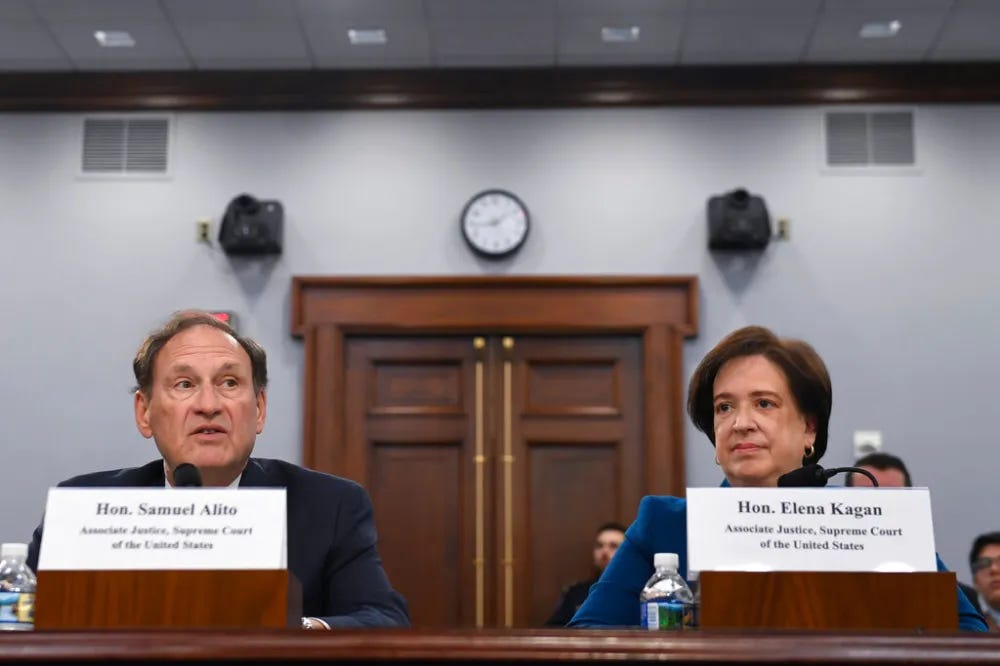
According to at least some reporting, we may see on Wednesday something we haven’t seen in 15 years—Supreme Court justices testifying at a Senate hearing. Specifically, Punchbowl News first reported on May 7 that unspecified justices were expected to appear at a May 20 Senate Appropriations Committee hearing to testify in support of the Supreme Court’s $228.4 million appropriations request for FY2027. No such hearing has yet been publicly noticed. My own guess is that such a hearing is going to happen, but that it’s been postponed (and so won’t happen this week).
Regardless, even the possibility of justices appearing before Congress provides a good excuse to reflect on a topic I’ve discussed before—how much more often justices used to appear before Congress; when that stopped; and why my own view is that more frequent appearances would be a relatively low-cost means of restoring some of the interbranch dialogue that used to be common—and the accountability that could indirectly come with it.
To make a long story short, just like Congress conducts (and should conduct) oversight of the executive branch, it’s also entirely appropriate, in my view, for Congress to conduct oversight of the judicial branch—including, at least in some circumstances, of the Supreme Court itself. And although Chief Justice Roberts has adamantly opposed such appearances “in light of separation of powers concerns and the importance of preserving judicial independence,” (1) the reality is that it used to be far more common for justices to appear before Congress; and (2) my own view is that a return to that historical pattern would be a salutary development.
More on that below. But first, the news.
On the Docket
The Merits Docket
On Thursday, the Court handed down two rulings in argued cases.
In Montgomery v. Caribe Transport II, LLC, Justice Barrett wrote for a unanimous Court in holding that the Federal Aviation Administration Authorization Act (the FAAAA) did not preempt a state-law negligent-hiring claim arising out of a serious highway crash. Even though the statute broadly preempts state laws related to the prices, routes, and services of the trucking industry, the Court held that this suit fell within the FAAAA’s “safety exception”—which provides that the federal preemption the statute creates “shall not restrict the safety regulatory authority of a State with respect to motor vehicles.” Justice Kavanaugh wrote a concurring opinion, which Justice Alito joined.
And in Jules v. Andre Balazs Properties, Justice Sotomayor wrote for a unanimous Court in holding that a federal court that previously stayed claims pending arbitration under Section 3 of the Federal Arbitration Act retains jurisdiction to confirm or vacate the resulting arbitral award—even if the post-arbitration motions would not independently satisfy federal jurisdictional requirements. That holding might seem obvious, but a circuit split had arisen after and in light of a 2022 Supreme Court decision that had concluded that federal courts lacked jurisdiction to entertain a standalone confirm-or-vacate action (versus a motion to confirm or vacate in an already pending action). Sotomayor once again is showing off her speed; this majority opinion came just 45 days after argument—giving her the first-, second-, and third-fastest majority opinions of the term.
(I covered both of those rulings Thursday afternoon in the first “Decision Day Summary” video—one of the new features that we launched on Thursday as a thank you for paid subscribers.)
Perhaps the most important thing the Court did on the merits docket last week came in the Alabama redistricting cases, in which, instead of granting Alabama’s applications to stay three district court injunctions (so Alabama could redistrict immediately), the Court granted certiorari on the merits (including granting certiorari “before judgment” in one of the cases), vacated those injunctions, and remanded for further proceedings in light of Callais. That order provoked an unusual (and sharp) dissent from Justice Sotomayor, joined by Justices Kagan and Jackson. As Sotomayor explained, one of those district court rulings had blocked Alabama’s 2023 map not just on VRA grounds, but also as an unconstitutional racial gerrymander in violation of the Fourteenth Amendment—a holding entirely unaffected by Callais. As she wrote, “That constitutional finding of intentional discrimination is independent of, and unaffected by, any of the legal issues discussed in Callais. Vacatur is thus inappropriate and will cause only confusion as Alabamians begin to vote in the elections scheduled for next week.” Given that vacatur is itself an exercise of the Supreme Court’s equitable authority, one might’ve thought that the Purcell principle should have augured against any intervention. Alas.
Of course, as Sotomayor stressed at the end of her dissent, the district court is free to simply re-adopt its findings of discriminatory intent and a Fourteenth Amendment violation on remand. But it stands to reason that, if that happens, the Eleventh Circuit (or, failing that, the Supreme Court) will stay any new injunction against Alabama’s redistricting efforts on the ground that it’s … too close to the election under Purcell. One might call such an outcome the very definition of chutzpah, but that ship has sailed. (Justice Thomas subsequently denied Alabama’s emergency applications as moot.)
The Emergency Docket
As expected, it was a busy week on the emergency docket, too.
Let’s start with the mifepristone case. On Monday afternoon, shortly before the (first) arbitrary deadline that Justice Alito had imposed on his own administrative stays, he extended the deadline for three more days—to 5 p.m. ET on Thursday. But 5 p.m. Thursday came and went without any further action, so the Fifth Circuit’s ruling went back into effect, at least briefly. At 5:26 p.m., the full Court ruled—and issued a stay of the Fifth Circuit’s ruling pending appeal over dissenting opinions from Justices Thomas and Alito.
The upshot is that mifepristone will remain generally available without an in-person doctor visit until one of two things happens: the Supreme Court conclusively resolves this case in Louisiana’s favor, or the FDA revokes its authorization(s). Once again, and frustratingly, the full Court said nary a word about why it was staying the Fifth Circuit’s ruling. That silence was not only amusingly highlighted by Justice Alito in his dissent (LOL), but by the Wall Street Journal’s editorial board—which claimed that it proves that critics of the emergency docket only care about the results. Alas, I’ve responded to this strikingly lazy and superficial claim before.
Speaking of the dissents, they are both extraordinary in their own respect. First, Justice Thomas went full Comstock Act, arguing that all dispensation of mifepristone through the mail is illegal—never mind that the Department of Justice took a different position as recently as 2022. Putting aside the (well-documented) weaknesses of the Comstock Act arguments, Justice Thomas is simply wrong to argue that parties “cannot, in any legally relevant sense, be irreparably harmed by a court order that makes it more difficult for them to commit crimes.” As the Trump cases have regularly illustrated, a party can be irreparably harmed (at least in view of a majority of the current Court—including Justice Thomas) by a court order that makes it more difficult for them to break the law. Justice Thomas also apparently saw no problem with the Fifth Circuit issuing nationwide relief under the APA—even though he joined a 2023 concurrence by Justice Gorsuch arguing that such universal vacaturs were likely not authorized by the APA. Needless to say, that inconsistency was … not addressed.
And then there’s Justice Alito’s dissent. Alito opened by claiming that “[w]hat is at stake is the perpetration of a scheme to undermine our decision in Dobbs.” Of course, Dobbs insisted that it was returning the question of abortion to the states, whereas the Fifth Circuit ruling would’ve required in-person doctor visits on a nationwide basis. In any event, though, the FDA first got rid of the in-person doctor-visit requirement in 2021—before Dobbs was decided. So the “scheme to undermine Dobbs” began … before Dobbs.
In any event, the crux of Alito’s dissent is based on the argument that the manufacturers won’t be irreparably harmed by the Fifth Circuit’s ruling—because, he claims, they can’t prove that the FDA would punish them if they continue to distribute mifepristone in a manner that’s inconsistent with the extant FDA regulations. Here, Alito is just reprising his 2023 mifepristone dissent. As I noted then,
First, the Court has never suggested that a party must show that it will be prosecuted to show that a law that clearly applies to it (and induces it to take actions to avoid violating it) causes harm. Second, even if this FDA would not enforce the Food, Drug, and Cosmetic Act against Danco in a world in which Judge Kacsmaryk’s order was in effect, that’s no guarantee that a future FDA wouldn’t. And if you’re Danco (or its investors, or its insurers, or its counterparties, or…), that specter is not remotely hypothetical.
In other words, Alito’s “lack of irreparable harm” argument is based on a hypothetical that is at odds with common sense (that a company wouldn’t take steps to comply with the law even if they had reason to suspect that the law might not be enforced). Meanwhile, like Justice Thomas, Justice Alito has nothing to say about the applicants’ likelihood of success on the merits—even though we’re constantly told that this is the most important aspect of the Court’s consideration of emergency applications (except, at least, when it isn’t). That omission is all the more problematic because, as Adam Unikowsky and Michael Dorf (among others) have both pointed out, Louisiana almost certainly doesn’t have standing.
And then there are the typos. I wouldn’t usually make hay out of such pedantry, but it’s more than a little ironic that Alito’s dissent, which was apparently rushed to comply with the entirely arbitrary deadline that Justice Alito had imposed on his own administrative stay, was also quite sloppy. The most Freudian of the slips was referring to the Alliance for Hippocratic Medicine case, in one citation, as Alliance for Hypocritic Medicine (indeed, it took two tries to correctly fix this one). But even the Supreme Court’s own “revisions” document, which somehow doesn’t include the first fix to the “Hypocritic Medicine” typo, tallies 18 changes in an eight-page opinion. Maybe Alito should have given himself (and the rest of us) some more time?
Just about 25 minutes after the full Court granted a stay in the mifepristone case late Thursday afternoon, it also granted emergency relief to Texas—to vacate a stay of execution the Fifth Circuit had entered in the case of death-row prisoner Edward Lee Busby. All three Democratic appointees dissented. As Justice Jackson explained in a short dissenting opinion that was joined by Justice Sotomayor,
Edward Busby’s expert concluded that Busby is intellectually disabled. Texas’s expert agreed. Recognizing the constitutional implications of that assessment, Texas joined Busby in asking the Texas courts to find Busby ineligible for execution. After the Texas courts refused, Texas changed its mind, opting to proceed with the execution it once tried to abandon.
Thus, “the Court grants emergency relief to ensure that Texas’s current inclination (that it must execute Busby tonight) wins out over its former one (that it could not execute Busby at all). In capital cases, we rarely intervene to preserve life. I cannot understand the Court’s rush to extinguish it, much less in the circumstances of this case.” Yet again, though, the death docket appears to move almost entirely in one direction.
Finally, Friday night, the Court summarily denied, over no public dissents, the emergency application that Virginia had filed in a long-shot bid to restore its new congressional map. The ruling generated a lot of headlines about the Court’s inconsistency and hypocrisy. My own view is that this outcome was both inevitable and correct. I’ve been plenty critical of how the justices have handled election-related cases, especially over the last three weeks. But the grounds on which Virginia was seeking relief included substantive arguments with which I vehemently disagree. Those arguments are not just unpersuasive, but they would also open the door to a heck of a lot more mischief going forward than they would cut off here. Except for those who think the law just doesn’t matter at all, that should’ve mattered here. One can think that the Court has been inconsistent and hypocritical in other election cases (see the above discussion of Alabama), and still think that Virginia’s application was a fool’s errand.
The Week Ahead
Given that the justices met in Conference last Thursday, we expect a regular Order List at 9:30 ET this morning. And the Court is also expected to hand down additional rulings in argued cases at 10:00 ET this Thursday, May 21. This is likely to be the pattern from now until well into June, when the Court may start adding additional decision days depending upon how much of a backlog it has to clear out. I’m not aware of any pending emergency applications likely to produce a full Court ruling this week. But it’s 2026, so anything is possible.
Miscellaneous
Finally, I wanted to flag a couple of media pieces that folks might find fun and/or interesting.
First, last week’s episode of “Last Week Tonight with John Oliver” was devoted almost entirely to a deep dive into the shadow docket (and yes, I make a cameo—apparently as John Oliver’s son, Nathaniel). I am obviously biased, but I found the discussion to be remarkably substantive and a fair recounting of some of the most significant critiques of the Court’s behavior.
Second, for those who would prefer a more back-and-forth conversation on the topic, I joined William and Mary law professor Jonathan Adler and host Julie Silverbrook on the latest episode of the National Constitution Center’s “We the People” podcast to discuss … the emergency docket. There’s a lot on which Adler and I disagree (not the least of which is the Knicks vs. the Sixers), but I think folks may find the exchanges illuminating.
The One First “Long Read”:
Crossing First Street
The possibility that justices may soon appear before the Senate Appropriations Committee (or one of its subcommittees) is being treated as something of a novelty—and, in the current environment, it is. But for most of the Supreme Court’s modern history, it was anything but. Justices regularly trekked across First Street to testify before Congress, on subjects ranging from the federal judiciary’s budget to the mechanics of the federal courts to broader questions of judicial administration. The two-justice ritual at the appropriations subcommittees, in particular, was for decades a fixed point on the congressional calendar—a low-drama exercise in interbranch housekeeping that nonetheless put sitting justices in the same room as the representatives and senators who fund and oversee the third branch.
As Jennifer Manning and Barry McMillion documented in a 2023 Congressional Research Service report, between 1960 and 2022, there were at least 93 committee or subcommittee hearings that included an appearance by at least one sitting Supreme Court justice. Indeed, at least one justice appeared before Congress every year from 1960 to 2011. And although the majority of those appearances have been specifically before the appropriations committees and tied to the Court’s annual budget request, the CRS Report flags two key caveats. First, “the questions posed to the Justices during appropriations hearings have not been limited solely to its request. For example, Justices have been asked questions related to why the Supreme Court itself has not adopted the Code of Judicial Conduct, how the judiciary handles workplace misconduct issues, and the confirmation process for federal judges.” And second, as Senator Leahy noted in 2011, there has been a distinct (if not as frequent) “tradition of Justices testifying before Congress on matters other than their appropriations requests, a tradition which included appearances by Chief Justice Taft and Chief Justice Hughes in the 1920s and 1930s, as well as by Justice Jackson in 1941.”
As the CRS Report demonstrates, the practice of justices appearing on substantive topics has deep pre-1960 roots. As I’ve explained before, Chief Justice (and former President) William Howard Taft was a frequent and enthusiastic congressional witness in the 1920s, lobbying personally for what became the Judiciary Act of 1925—known both at the time and since as the “Judges’ Bill,” because of Taft’s (and the Court’s) instrumental role in spearheading it. Justice Felix Frankfurter testified on judicial administration matters; Justices Tom Clark, Byron White, and Lewis Powell appeared before committees considering structural reforms to the federal courts. Chief Justice Warren Burger was a near-constant presence, pressing his court- (and Court-)management agenda before Senate and House committees alike.
Perhaps the most well-known modern episode came in March 2001, just a few months after the Court’s decision in Bush v. Gore, when Justices Anthony Kennedy and Clarence Thomas appeared before the House Appropriations Subcommittee on Commerce, Justice, State, and the Judiciary to discuss the Court’s budget. Representative José Serrano (D-N.Y.) used part of his time to press Justice Kennedy, in open session, to explain Bush v. Gore to a public that had real questions about how five justices had effectively settled a presidential election. Kennedy declined to relitigate the merits of the decision, but he reflected at some length about the difficult position the Court was in, the public trust the ruling had jeopardized, and the Court’s own conception of its role.
The exchange, which is archived on C-SPAN’s website, is worth noting for what it reveals about the norms of the era: a sitting justice appeared at a scheduled hearing, fielded pointed questions from a member of Congress about the Court’s most controversial recent ruling, and responded in a public forum. That kind of discussion would be difficult to replicate today. The routine of appearing before Congress did not just facilitate budget oversight; it also created a setting in which justices could be asked difficult questions and could demonstrate a willingness to engage with the political branches on terms beyond the Court’s own choosing.
That norm of regular engagement began to thin out in the 2010s. The last time sitting justices testified before a Senate committee was in 2011, when Justices Stephen Breyer and Antonin Scalia appeared to discuss the constitutional role of federal judges. Budget testimony on the House side limped along a bit longer, but not every year. And no justices have appeared before a House Committee since 2019, when Justices Samuel Alito and Elena Kagan appeared before a House appropriations subcommittee in support of the Court’s funding request. Ever since, the Court has been represented at these hearings only by its administrative officers.
The reasons for this shift were never formally announced. But the timing tracked the increasingly fraught politics around the Court. After all, proposals to require televised arguments, mounting criticism of the justices’ ethics, the 2016 confirmation standoff, a steady drumbeat of criticism over the Court’s rulings, and growing support for structural reform proposals have perhaps made an open hearing room seem less like a routine obligation and more like an unnecessary risk.
On a deeper level, the justices turning their back on congressional hearings dovetails with a broader move on the Court’s part away from any kind of institutional conversation with Congress. As I’ve noted before, the Chief Justice’s Year-End Report started as an annual invitation to a dialogue between Congress and the Court. But Chief Justice Roberts stopped using it that way quite visibly in 2009—reflecting this broader instinct not to invite what might be awkward conversations for the current Court.
That instinct is understandable, but the cost of that withdrawal has been considerable. The Court has fewer and fewer occasions on which any individual justice answers unscripted questions in public, under oath or not, about anything—and the institution as a whole has correspondingly fewer ways to demonstrate that it is accountable to the coordinate branches in even the most modest sense. Budget hearings may not be the place to relitigate Dobbs or to interrogate a justice about a particular recusal decision. But they are an opportunity for justices to explain how the judiciary spends public money, to make the case for resources the courts genuinely need (security, technology, judgeships), to react to some of the myriad threats federal judges from across Article III are currently facing, and to engage with members of Congress on matters of judicial administration where the branches have overlapping responsibilities. To me, at least, those are all conversations that the Court would benefit not only from having, but from having in the open.
A return to regular testimony would also help repair something subtler—and something more fundamental to the constitutional structure. The separation of powers does not mean that accountability is anathema to independence. Congress holds the power of the purse over the judiciary for a reason: it is one of the many mechanisms through which the elected branches can ensure that an unelected Court remains answerable, in at least some measure, to the public it serves.
When justices turn their backs on the legislature, they do not vindicate judicial independence; they erode the very norm of interbranch engagement that makes independence legitimate in the first place. The longer the justices stay away from the Hill, the more each appearance takes on outsized significance, inviting heightened scrutiny, and making the next one easier to decline. Restoring regularity would reduce the pressure on both sides: members would have less incentive to grandstand at a hearing they expect to see again next year, and justices would have less reason to treat any given appearance as an exceptional event requiring special justification. A Court that regularly accounts for itself before Congress would not, in my view, be a weakened Court; it would be one that does more to earn the structural deference our system asks the other branches to extend.
If it goes forward anytime soon, the hearing on which Punchbowl reported would be a welcome step. The better outcome would be if we could go back to such appearances by the justices not being newsworthy at all.
SCOTUS Trivia:
Sitting Justices Testifying at Confirmation Hearings
As noted above, justices have appeared at 93 different congressional hearings since 1960. Two of those were confirmation hearings—when sitting justices were nominated to the position of Chief Justice.
The first two times a sitting associate justice was nominated to be Chief Justice (Edward Douglass White in 1910 and Harlan Fiske Stone in 1941), they both declined to appear to testify in support of their nomination. But in 1968, when President Lyndon Baines Johnson nominated his close personal friend Abe Fortas to succeed Earl Warren as Chief Justice, Fortas made the ill-fated choice to appear in person. The four-day hearing not only put him at loggerheads with both Republicans and conservative Democrats over some of the Warren Court’s more controversial decisions (especially when it came to pornography), but it also brought out new details about just how close his personal connection was to Johnson, and how often he continued to informally consult with Johnson even as he was sitting on the Court. Fortas thus got tagged with both the full criticisms of the Warren Court and growing, bipartisan opposition to the (by-then) lame-duck President Johnson. After a remarkably poor showing on a procedural vote in October 1968, Fortas asked Johnson to withdraw his nomination—although he remained on the Court for another seven months before resigning.
The other example came in 1986, when then-Associate Justice William H. Rehnquist testified in support of his nomination to become Chief Justice. Rehnquist also faced sharp questioning—in his case, over allegations that he had personally challenged or harassed minority voters as a Republican “ballot security” official in Phoenix in the 1960s and had been less than candid about that activity during his 1971 confirmation hearing to be an associate justice. These were part of broader Democratic attacks—led by Senators Edward Kennedy and Howard Metzenbaum—that his record on race and individual rights placed him “outside the mainstream” of American constitutional law. Nevertheless, Rehnquist was ultimately confirmed, 65-33.
I hope that you’ve enjoyed this installment of “One First.” If you have feedback about today’s issue, or thoughts about future topics, please feel free to email me. And if you liked it, please help spread the word!
If you’re not already a paid subscriber and are interested in receiving regular bonus content (or, at the very least, in supporting the work that goes into this newsletter), please consider becoming one:
This week’s bonus issue will drop on Thursday. And we’ll be back with our regular content for everyone (no later than) next Monday. As ever, please stay safe out there—especially from Freudian typos.
Thank you, Steve, for including that video of the Bronx in the house so to speak. Bush v. Gore was such agony for the majority who voted Democratic and won the popular vote. It’s been increasingly awful since then.
The SCOTUS budget has doubled just in the last 15 years, and has grown many multiples in the last four decades. Yet, the number of written decisions issued has plummeted. They regularly issued hundreds of written decisions per year 40 years ago. Now they issue 50-80 per year. I realize this is a brutish metric on which to measure SCOTUS performance, but for god’s sake, don’t the people deserve to know why the Court decides things and explains itself so infrequently? It’s obviously not a function of resources.