

Welcome back to the weekly bonus content for “One First.” Although Monday’s regular newsletter will remain free for as long as I’m able to do this, I put much of the weekly “bonus” issue behind a paywall as an added incentive for those who are willing and able to support the work that goes into putting this newsletter together every week. I’m grateful to those of you who are already paid subscribers, and I hope that those of you who aren’t will consider a paid subscription—both to have full access to the bonus content and to more broadly support these efforts—if and when your circumstances permit:
As folks will recall, back on March 2, the Court simultaneously granted a pair of pretty important emergency applications—in Mirabelli v. Bonta and Malliotakis v. Williams. I wrote about both of them initially, and came back to Malliotakis on March 5. But there’s one more point that I’ve been meaning to make, especially about Mirabelli, and that seems worth writing down before these decisions get stale: The continuing efforts of some of the justices (and their defenders outside the Court) to claim to be responding to criticisms of the Court’s behavior in these cases without either (1) identifying the criticisms; or (2) meaningfully addressing the critiques.
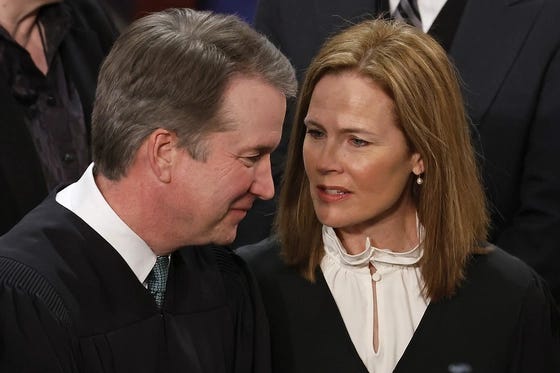
In Mirabelli especially, Justice Barrett’s concurrence, joined in full by the Chief Justice and Justice Kavanaugh, devotes an entire paragraph to explaining why the Court, in that one particular case, chose to write a majority opinion—an unambiguous response both to Justice Kagan’s dissent and to those who have been critical of the Court for not explaining itself. But as I explain in more detail below the fold, the defense is remarkably superficial—and neither correctly identifies nor engages with any of the more visible critiques of the Court’s unwillingness to write previously (or even in its contemporaneous ruling in Malliotakis).
One can say the same thing about the most concerted effort to defend the two March 2 rulings—my Georgetown colleague Stephanie Barclay’s March 6 SCOTUSblog post, titled “The Emergency Docket’s Critics Have it Backwards.” Other than the dissenters and a stray citation to a New York Times article, Barclay doesn’t identify the critics to whom she is supposedly responding, and her summary of their criticisms (and why she finds them unavailing) rests on some rather superficial—and, in some cases, flatly incorrect—claims about the Court’s (and the justices’) prior behavior.
We’re all better off when folks are engaging with these arguments rather than ignoring them altogether. But this isn’t meaningful engagement; it’s shadowboxing. If the Court and its defenders want to attempt to persuade those who aren’t already onboard that the justices’ behavior in these cases is all fine and dandy, a good place to start would be responding to the critics directly and persuasively—rather than caricaturing their arguments and knocking down strawmen.
For those who aren’t paid subscribers, we’ll be back (no later than) Monday with our continuing coverage of the Court. For those who are, please read on.
