

Welcome back to the weekly bonus content for “One First.” Although Monday’s regular newsletter will remain free for as long as I’m able to do this, I put much of the weekly “bonus” issue behind a paywall as an added incentive for those who are willing and able to support the work that goes into putting this newsletter together every week. I’m grateful to those of you who are already paid subscribers, and I hope that those of you who aren’t will consider a paid subscription—both to have full access to the bonus content and to more broadly support these efforts—if and when your circumstances permit:
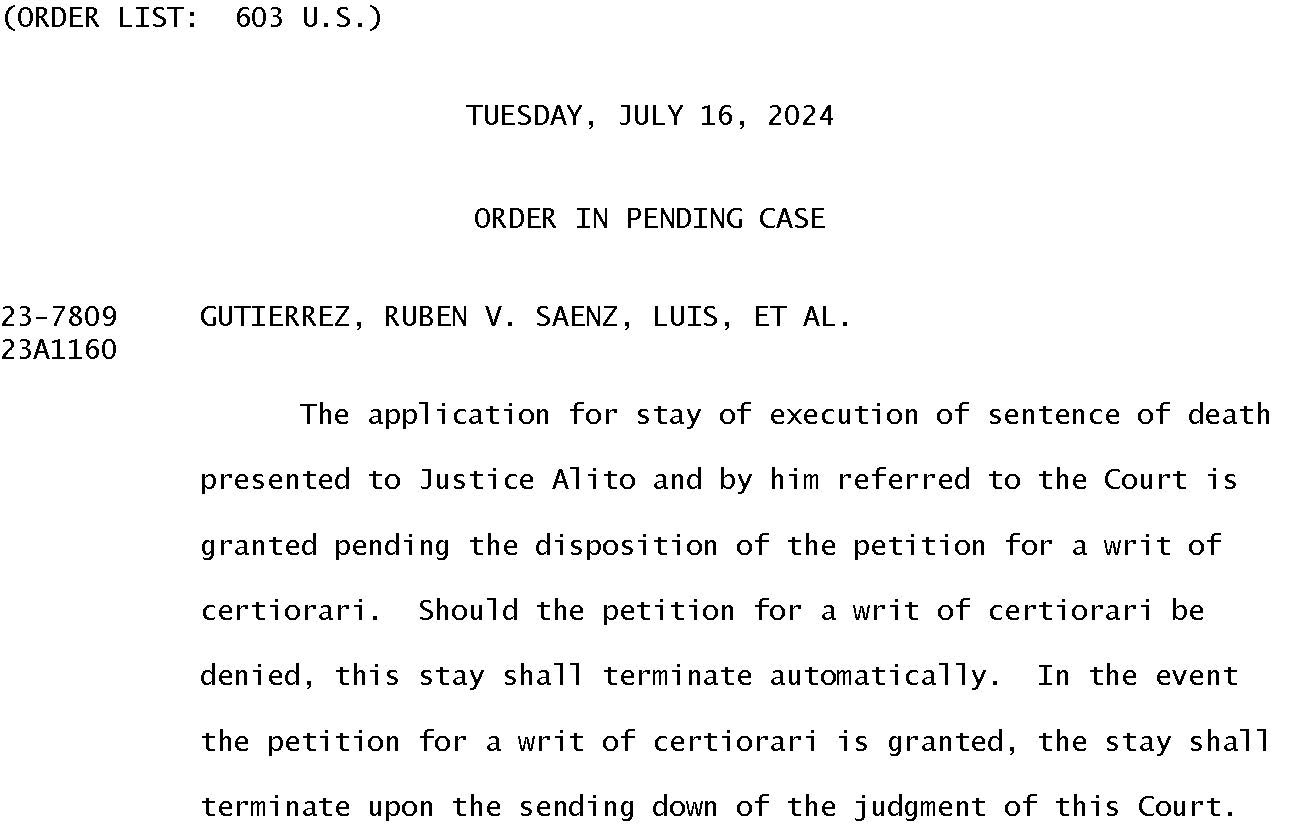
On July 16, 2024, the Supreme Court granted a stay of execution to Texas death-row inmate Ruben Gutierrez. That intervention wasn’t an especially noteworthy one—except that it remains, as of today, the last time that the justices granted emergency relief to block an execution. Emergency interventions in capital cases had been the bread-and-butter of the emergency docket from the 1970s all the way into the mid-2010s. But the Court’s change in personnel in 2018 and 2020 augured a dramatic shift in the Court’s death penalty jurisprudence writ large—and, with it, in the Court’s behavior on emergency applications in capital cases.
Indeed, the grant in Gutierrez was only the third time that the Court had blocked an execution since the beginning of the October 2020 Term—a period during which it has granted emergency relief to un-block executions ten different times. And since Gutierrez, the Court has denied at least 75 applications to stay executions from state prisoners—with only seven of those rulings drawing public dissents from even one justice, and only three drawing public dissents from three or more justices (one was 5-4).
In other words, however you slice the data, the bottom line is the same: even as the emergency docket has been busier than at any other point in the Court’s history, what Supreme Court clerks used to refer to as “the death docket” has all-but disappeared—at least as a source of interventions by the justices. Below the fold, I sketch out some thoughts as to why this has happened, and what its implications are both for death penalty cases and for how we think and talk about the emergency docket (and the Court) more generally.
For those who aren’t paid subscribers, we’ll be back (no later than) Monday with more of our regular coverage of the Court. For those who are, please read on.
