

Welcome back to “One First,” a (more-than) weekly newsletter that aims to make the U.S. Supreme Court and related legal topics more accessible to lawyers and non-lawyers alike. I’m grateful to all of you for your continued support—and I hope that you’ll consider sharing some of what we’re doing with your networks:
Every Monday morning, I’ll be offering an update on goings-on at the Court (“On the Docket”); a longer introduction to some feature of the Court’s history, current issues, or key players (“The One First ‘Long Read’”); and some Court-related trivia. If you’re not already a subscriber, please consider becoming one—and upgrading to a paid subscription if your circumstances permit:
Although the Court closed out last week with a headline-worthy grant of certiorari in one of the birthright citizenship cases (more on that in a moment), the biggest story of the week was, without question, Thursday night’s ruling in Abbott v. LULAC—in which a majority put back into effect the congressional district maps hastily drawn this summer by the Texas legislature. A three-judge district court had blocked those maps on the ground that they were the product of unconstitutional racial gerrymandering, but Thursday’s ruling stayed that decision for the duration of Texas’s appeal—including through the upcoming election cycle.
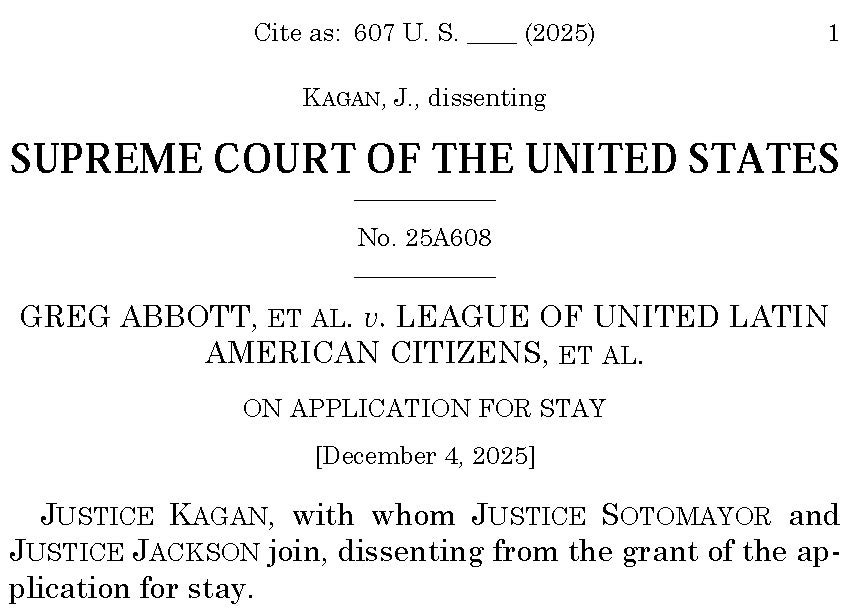
The result in the Texas case likely came as little surprise to almost anyone—and not just because Justice Alito had already granted an “administrative” stay of the lower-court ruling (which, as I suggested at the time, made no sense as anything other than a sign of things to come). But what the majority wrote in justifying the Court’s intervention is striking for at least three reasons, each of which Justice Kagan skewered in an especially biting 17-page dissent.
In the “Long Read,” I’ll walk through each of the three ways in which the ruling in LULAC appears to make new (and troubling) law. But the larger point is not just that Justice Kagan is especially persuasive on each of these three issues; it’s the exasperation with her colleagues that practically jumps off of each page. In that respect, Justice Kagan’s dissent is not just a series of arguments for why the justices in the majority are wrong; it’s yet another warning about the majority’s seeming willingness to do … whatever it wants, at least where rulings on emergency applications are concerned.
But first, the (other) news.
On the Docket
The Merits Docket
Because the Court hadn’t held a Conference the week of Thanksgiving, there was no regular Order List last Monday. Instead, the only formal activity on the merits docket were the oral arguments Monday, Tuesday, and Wednesday—and a brief set of orders that included four cert. grants on Friday.
At the risk of passing over the other three grants (all of which present relatively modest questions), obviously, the newsiest grant was in Trump v. Barbara, one of the two petitions the Department of Justice had filed seeking plenary review of lower-court rulings that had blocked President Trump’s effort to narrow birthright citizenship by executive order. What is especially striking about the grant in Barbara is that the Court did not grant the government’s companion application—in Trump v. Washington. We can only speculate as to why, but my best guess is because, even though the Solicitor General deliberately downplayed it, there’s a question about the plaintiff states’ standing in that case that just isn’t an issue in Barbara.
That particular tea leaf is significant because it reinforces something I’ve believed since the Court first ruled on the emergency applications relating to the birthright citizenship cases back in June—that a majority of the justices are likely to rule against the administration on the merits and invalidate Trump’s executive order. To me, there are three relevant data points that make this prediction about more than just my own wishful thinking:
First, if a majority were inclined to rule for the Trump administration, not granting cert. in the Washington case just doesn’t make sense. Not only might there have been a way to rule for the administration in that case without upholding the executive order, but there’d be no reason to avoid that possibility if they were going to side with Trump one way or the other. Avoiding the standing issue in Washington makes sense only if the justices wanted the clearest, cleanest possible path to affirm the lower courts on the merits. That’s not the behavior of a Court that’s trying to rule for Trump in any way possible.
Second, during the oral arguments on the emergency applications back in May, the justices were all-but clamoring to get this case back on the merits—so much so that Justices Gorsuch and Barrett basically forced Solicitor General Sauer to promise that he’d appeal when (not if) lower courts re-blocked the policy on the far side of the Court’s ruling that narrowed universal injunctions. (And to those who think the Court should just have denied certiorari, that misses the point—the Court wants to issue a ruling that repudiates this policy. Denying cert., which is what probably should have happened, wouldn’t have the same formal or institutional force.)
Third, the Department of Justice’s behavior itself is strongly suggestive that it doesn’t think it’s going to win this case, either. As I noted in an earlier post, after the Court’s remedy-specific intervention in June, the government was in no hurry to litigate the merits of these cases in the lower courts; it did not seek emergency relief when, even after the Supreme Court’s ruling in June, lower courts once again blocked the policy; and even the cert. petitions in both Washington and Barbara were largely going through the motions—refusing to make procedural arguments against the lower-court rulings that were, if not meritorious, at least available, like whether the plaintiffs in Washington had standing or whether the class certfication in Barbara was appropriate.
I get that plenty of folks have become awfully cynical about the current Supreme Court. Indeed, I’m usually one of them. But there’s an important difference between cynicism and nihilism. And for as much as the Court has bent over backwards to accomodate the Trump administration through emergency applications, there’s one pretty prominent example of it pushing back there, too. Here, not only do I think the Court might already have been inclined to do the right thing, but a ruling against Trump would arm the Court’s defenders with another example of how the Court isn’t just a rubberstamp (a point that won’t remotely be lost on Chief Justice Roberts).
Anyway, that’s my best guess. One way or the other, it looks like we’ll now find out by the end of June.
The Emergency Docket
Last week saw two significant interventions on emergency applications. The first, Wednesday’s ruling in the Texas redistricting case, is the focus of the “Long Read,” so I’ll save that for below.
The second came Friday afternoon—when Chief Justice Roberts issued a (very quick) administrative stay in the latest (32nd) emergency application from the Trump administration, a strange case captioned Margolin v. National Association of Immigration Judges. The underlying dispute in that case is a First Amendment challenge to a Biden-era restriction on public comments by immigration judges. But the real issue, and the reason why it has stakes that go far beyond immigration judges, is the jurisdictional fight the case has provoked—over whether those kinds of claims can be litigated directly in federal district courts, or whether they have to first go through the executive branch’s own Merit Systems Protection Board (MSPB), an agency the independence of which President Trump has worked hard, with an assist from the Supreme Court, to undermine.1
The Fourth Circuit had held that the current status of the MSPB justified allowing the district court to exercise jurisdiction—a ruling that had, in turn, provoked a spirited disagreement when the full court of appeals refused to rehear that decision en banc. Whether the Fourth Circuit is right or not potentially implicates nearly every claim brought by a current or former executive branch officer or employee arising out of or relating to their employment—and whether those claims must first be brought to the kneecapped MSPB (and, in many cases, appealed only to the Federal Circuit). More generally, it’s a referendum on how much courts must resort to formalism vs. account for reality when it comes to the functioning of the executive branch. So even though the substantive issue may not seem of national importance, the procedural issue is. In addition to temporarily pausing the Fourth Circuit’s ruling (which would otherwise have gone into effect on Wednesday), Chief Justice Roberts ordered the plaintiffs to respond by 4 p.m. Wednesday, so it’s possible we may get a ruling this week (my bet is not, given what else is happening).
The Week Ahead
Turning to this week, we expect a regular Order List at 9:30 ET, followed by the first of two days of major oral arguments. Today at 10, the Court hears argument in Trump v. Slaughter—the vehicle through which the justices are deciding whether to overrule Humphrey’s Executor and generally clear the way for the President to remove without cause virtually any executive branch officers, even when Congress has provided otherwise by statute.
I’ve written before about why the so-called “unitary executive theory” is radically overstated and inconsistent with any nuanced understanding of what the Founders believed when they set up the new federal government in 1789; suffice it to say, I’m not optimistic that a majority of the Court is going to agree. Instead, two of the biggest questions are (1) whether the Court will continue to find a way, however disingenuously, to carve out the Federal Reserve; and (2) what, if anything, the Court says about the second question it directed the parties to brief and argue in Slaughter—which goes to whether federal courts have the power to reinstate officers who have been wrongly removed. That issue is certainly moot if the Court concludes that Slaughter was lawfully fired. But it could have even bigger implications if the Court somehow concludes that her removal was unlawful, but that her (and every other wrongfully removed federal officer or employee’s) only remedy is back pay.
The Court is also set to hear a major case tomorrow—National Republican Senatorial Committee v. FEC, a case in which Republicans are asking the Court to strike down limits on the amount of money that political parties can spend in coordination with a candidate for office, and, if necessary, overrule a 2001 decision rejecting a similar challenge. Although it’s easy to default to the view that campaign finance restrictions are dead on arrival in the current Court, there is, as the Court-appointed amicus has pointed out, a pretty good argument that none of the parties challenging the regulation at issue still have standing as the case reached the Court. Maybe the Court will gravitate toward the lack of a standing as a way to avoid a ruling that’s otherwise likely to divide the justices right down their traditional, ideological lines. I thought the same thing before October’s argument in Chiles v. Salazar. Alas.
Beyond the oral arguments, we’re also still waiting for the Court to rule on the Trump administration’s (very-)long-pending emergency application in Trump v. Illinois, which, as of today, has been pending for 52 days. Even the last of the supplemental briefs that the Court had ordered in that case were filed three full weeks ago. So it stands to reason that a ruling in that case is due. As for whether that means today, tomorrow, or just sometime before 2026, ¯\_(ツ)_/¯.
The One First “Long Read”:
Justice Kagan’s (Mounting) Frustration
As long-time (or even first-time) readers of this newsletter have probably figured out, I use a lot of parentheticals in my popular writing, especially in writing that no one else edits. I’m not sure if I picked up this particular tic from Justice Kagan, or if it’s just a coincidence. But at least for me, it’s often a way to take a subtle (or not so subtle) shot at the subject of the sentence (see what I did there?); or to say something sarcastic in the midst of a more broadly serious point. It’s an outlet for asides that can tend to reflect exasperation.
One of the first things that jumped out to me about Justice Kagan’s dissent in LULAC was its abundant use of these kinds of parentheticals. To be sure, Justice Kagan has plenty to be exasperated about; as little as anyone was or ought to have been surprised by the fact that the majority intervened to put Texas’s new maps back into effect, the way it justified doing so was … maddening. But before turning to the three different flaws in the majority’s cryptic order, it’s worth taking a moment to pause on the stylistic point—this is a dissent that’s not just substantively unsparing; it’s also an opinion that manifests an unusual amount of publicly visible frustration on the part of one of the Court’s most careful (and strategic) writers.
Let’s start with what the majority actually wrote. Although the Court handed down a five-paragraph order, it was the third and fourth paragraphs that contained all of the majority’s “analysis”:
Based on our preliminary evaluation of this case, Texas satisfies the traditional criteria for interim relief. See Indiana State Police Pension Trust v. Chrysler LLC, 556 U. S. 960 (2009) (per curiam). Texas is likely to succeed on the merits of its claim that the District Court committed at least two serious errors. First, the District Court failed to honor the presumption of legislative good faith by construing ambiguous direct and circumstantial evidence against the legislature. Contra, Alexander v. South Carolina State Conference of the NAACP, 602 U. S. 1, 10 (2024). Second, the District Court failed to draw a dispositive or neardispositive adverse inference against respondents even though they did not produce a viable alternative map that met the State’s avowedly partisan goals. Contra, id., at 34–35.
Texas has also made a strong showing of irreparable harm and that the equities and public interest favor it. “This Court has repeatedly emphasized that lower federal courts should ordinarily not alter the election rules on the eve of an election.” Republican National Committee v. Democratic National Committee, 589 U. S. 423, 424 (2020) (per curiam). The District Court violated that rule here. The District Court improperly inserted itself into an active primary campaign, causing much confusion and upsetting the delicate federal-state balance in elections.
As Justice Kagan’s dissent points out, there are three different moves in these two paragraphs, and all three are … problematic.
Move #1: The Year Before an Election is Its “Eve”
Start with the timing. Although the majority dares not mention the “Purcell principle” expressly, the citation to RNC v. DNC in the second paragraph is, unambiguously (at least if you look), an invocation of Purcell—here’s the specific page of RNC v. DNC to which the LULAC majority cited. But in case you haven’t noticed, this is a case about the 2026 elections, and it’s still 2025. Here’s Justice Kagan (with my emphasis):
Texas is not on “the eve of an election,” as was true in the case the majority cites [RNC v. DNC]. The election there was five days after the injunction. Similarly, the election in Purcell was “just weeks” away. Here, Election Day is eleven months from now. Even the primary election (which Texas could change) is in March. The District Court carefully listed the various “election preparations” underway to switch to the 2025 map. On the other hand, the court noted how the 2021 map—which the injunction reinstated—was, in a real sense, the status quo. Officials, candidates, and voters are all familiar with it from the last two election cycles. Until late last summer, everyone expected that map to govern 2026 too. And indeed, it will be used in a special runoff election in the State’s largest county on January 31, 2026. So, the District Court properly concluded, “[a]n injunction in this case would not cause significant disruption.” Except to the extent all of us live in election season all the time, the 2026 congressional election is not well underway.
The move here, then, is to apply Purcell further in advance of an election than the Supreme Court ever has before—in a context in which it was not possible to challenge the (late-drawn) map any faster. As Justice Kagan concluded, “If Purcell prevents such a ruling, it gives every State the opportunity to hold an unlawful election. . . . That cannot be the law—except of course that today it is. According to the majority, Texas had a free pass to redistrict in August 2025 for the 2026 House elections. All that the plaintiffs can hope for is better luck in 2028.”
Indeed.
Move #2: District Courts, Schmistrict Courts
The dubious invocation of Purcell was the majority’s justification for intervening now. As for why intervention was generally appropriate, the majority relied upon what it identified as two “errors” by the district court—one about failing to give the Texas legislature a presumption of “good faith” by “construing ambiguous direct and circumstantial evidence against the legislature”; and one about failing to “draw a dispositive or neardispositive adverse inference against respondents even though they did not produce a viable alternative map that met the State’s avowedly partisan goals.”
As Justice Kagan’s dissent explains, both of these “errors” reflect a fairly radical (and unsstated) shift in the Supreme Court’s own conception of its role vis-a-vis district courts:
This Court owes, though today has not given, “significant deference” to the District Court’s marshaling and weighing of so much evidence. You would never guess it from the majority’s order, but under this Court’s precedents, a district court’s factfinding about electoral districting—“most notably, as to whether racial considerations predominated in drawing district lines”—is reversible “only for clear error.” Under that standard, “we may not reverse just because we would have decided the matter differently.” If a district court’s factual determination is “‘plausible’ in light of the full record—even if another is equally or more so”—that determination “must govern.” And in deciding what is thus “plausible,” we must “give singular deference to a trial court’s judgment about the credibility of witnesses.” The district court has conducted the hearing and knows the whole record. It is better positioned than this Court to decide what evidence to credit about the drawing of district lines.
After recapping the district court’s exhaustive findings in its 160-page majority opinion, Justice Kagan explained what should have happened: “I do not say that those findings were inescapable; a court coming out the opposite way could well have deserved this Court’s deference too. What they were—and this is the thing that matters on clear-error review—is plausible. It was ‘plausible’—perfectly plausible ‘in light of the full record’—that Texas drew its new map mainly on racial lines.” And as she explained, the district court didn’t fail to extend the presumption of good faith to the Texas legislature; it made specific factual findings about why the challengers had overcome it. (“Presumptions, after all, can be simultaneously “honor[ed]” and overcome. And so it was here, as the District Court assessed credibility and found facts—as, in the end, district courts must.”)
Thus, in addition to moving the Purcell window up even earlier, the majority’s order opens up a new substantive obstacle to challenges to racial gerrymandering—the possibility that the district court will make specific findings as to why the presumption of good faith was overcome, but, without concluding that the district court’s findings were clearly erroneous, the justices will just … disagree.
Move #3: The New, New Alternative Map Requirement
Finally, and perhaps of the most substantive significance, the Court seemed to ratchet up the requirement, first articulated in the Alexander case last year, that an adverse inference could be drawn against those challenging racial gerrymandering if they could not “produce a viable alternative map” that would meet the State’s partisan goals without the enacted map’s race-based features. In other words, Alexander had held that not having a non-racially gerrymandered map that would produce the same partisan advantage was circumstantial evidence that the state had acted for (non-justiciable) partisan reasons, as opposed to (unconstitutional) race-based reasons.
As Justice Kagan pointed out, though, that inference was about what a district court should do when confronted with only circumstantial evidence of racial discrimination—for cases in which plaintiffs had failed to adduce direct evidence of the same. Indeed, in a passage that began with a direct quote from Alexander (with my emphasis):
“The adverse inference may be dispositive in many, if not most, cases where the plaintiff lacks direct evidence.” The District Court quoted that language, and explained why it did not force a dispositive inference here. In short, because there was lots of direct evidence. Or as the District Court stated more fully: “Unlike the challengers in Alexander, who ‘provided no direct evidence of a racial gerrymander,’ the Plaintiff Groups here have produced substantial direct evidence indicating that race was the predominant driver in the 2025 redistricting process.” So a racial gerrymander could be found, under Alexander’s own terms, despite the lack of a map. That is because the map’s absence does not make the direct evidence of race-based decisionmaking go away
Thus, not only did the majority yet again trample on the district court’s detailed factual findings, but it did so in a way that could make it harder for all plaintiffs challenging racial gerrymanders going forward—for whom a failure to produce an alternative map is “near-dispositive” even if, as in this case, they have also provided compelling direct evidence that the state acted for impermissibly race-based reasons. It is, in essence, making it much harder to obtain relief from a racial gerrymander even when the legislature’s race-based intent is overt.
***
Justice Alito (who wrote the majority opinion in Alexander), joined by Justices Thomas and Gorsuch, wrote a short concurrence purporting to respond to (part of) Justice Kagan’s dissent, noting (with just a bit of irony) that “I will not delay the Court’s order by writing a detailed response to each of the dissent’s arguments.” His two arguments, in short, were that (1) “it is indisputable” that Texas drew its maps entirely to maximize partisan advantage; and (2) clear-error review isn’t required because the district court misapplied the Court’s precedents, especially Alexander.
The second argument is almost laughably silly. Even if the district court misapplied Alexander (and, as Justice Kagan’s dissent points out in detail, including by extensively quoting from Alexander, it didn’t), factual findings are still factual findings. If a single legal error allowed appellate courts to give no deference to any factual findings made by the district court in the same ruling, well, that would fundamentally restructure the relationship between trial and appellate courts writ large. Of course, that’s not what Alito said (or, I assume, what he really meant).
As for the first argument, this is, to be sure, what’s really happening in this case—a majority of the Court believes that Texas drew its new map principally to give Republicans five more seats in the House. Leaving aside that this is again ignoring the detailed factual findings the district court made about why, even if that was part of the impetus, Texas still acted in ways that were deliberately race-conscious, at a more fundamental level, it says the quiet part out loud—that partisan gerrymandering isn’t just something that is beyond the power of federal courts to rectify (which was the controversial 2019 holding of a 5-4 Court in Rucho); it’s something that is perfectly fine in a country committed to democratic representation, and, indeed, that it’s something the Supreme Court should affirmatively protect.
Part I of Justice Kagan’s dissent makes this exact point:
[A]lthough no one could challenge a partisan gerrymander in court—our decision in Rucho v. Common Cause, 588 U. S. 684 (2019), saw to that—voters could hold those supporting it to political account. (Again, this was in those innocent days—prior to Texas’s redistricting—when partisan gerrymanders seemed undemocratic or at least unsavory, rather than a mark of political conviction or loyalty.)
Thus, beyond the three specific ways in which the majority changed the rules in racial gerrymandering cases without adequate (or any) justification (and through the truncated process of the emergency docket), the broader problem with Thursday’s ruling in LULAC is the message it sends: extreme partisan gerrymandering, even on the eve of elections, is something the Court will not just decline to block; it’s something it will be invested in enabling. Even if that’s a natural consequence of the Court’s jurisprudence (and it isn’t), it sure isn’t one the justices should be celebrating.
SCOTUS Trivia: Rufus Peckham’s Confirmation
Unless you are a descendent of Justice Rufus Peckham (and perhaps even if you are), I suspect you don’t know that tomorrow marks the 130th anniversary of his confirmation to the Supreme Court. Peckham is perhaps best remembered for writing the majority opinion in Lochner v. New York, in which a 5-4 majority struck down New York’s maximum-hour and minimum-wage laws for bakers, thus ushering in the “Lochner era” of heightened scrutiny of state and federal economic regulation in the name of the “liberty of contract.” (Peckham also wrote the majority opinion in Ex parte Young, largely to ensure that progressive state attorneys general couldn’t use sovereign immunity as a way of evading Lochner’s constraints.)
Although my favorite Peckham claim to fame is that he’s the only person ever confirmed to the Supreme Court after the President’s nomination of his brother (Wheeler Hazard Peckham) was defeated, the relevant trivia is what happened on December 9, 1895: That was the last day on which a Senate controlled by Republicans voted to confirm a Democratic president’s nominee to the Supreme Court. (Justice Thomas is the most recent example in the other direction.) One can only wonder when (if?) we’ll next see a cross-party Supreme Court confirmation.
I hope that you’ve enjoyed this installment of “One First.” If you have feedback about today’s issue, or thoughts about future topics, please feel free to e-mail me. And if you liked it, please help spread the word!
If you’re not already a subscriber, I hope you’ll consider becoming one. If you are, I hope, circumstances permitting, that you’ll consider upgrading:
Either way, this week’s bonus issue for paid subscribers will drop on Thursday. And we’ll be back with our regular content no later than next Monday (and something tells me sooner). Have a great week, all!
Back in May, the Court in Trump v. Wilcox had granted a stay to freeze a district court injunction and clear the way for President Trump to fire members of the MSPB without cause. And just last Friday, a divided panel of the D.C. Circuit reversed the district court’s injunction in the MSPB case on the merits.
I agree with the observations of Professor Vladeck and the dissenting opinion of Justice Kagan. As a retired appellate lawyer, I’m particularly upset by the majority’s flagrant violation of basic standards of review in appellate cases. The majority should not be substituting its factual findings for the three-judge panel absent clear error. No such error was shown here. This is more than a shadow docket stay. In practical terms, the unsigned order amounts to a reversal without briefing and argument.
Professor Vladeck is edging toward a realistic view of the Court - which shoukd be on the far nihilist end of his cynicism vs nihilism spectrum. Thus court is simply corrupt, it was bought a long time ago. The country would,be far far better off with no court than this one. It deserves absolutely no reseprct.