

Welcome back to “One First,” a newsletter that aims to make the U.S. Supreme Court more accessible to lawyers and non-lawyers alike. I’m grateful to all of you for your continued support, and I hope that you’ll consider sharing some of what we’re doing with your networks.
Every Monday morning, I’ll be offering an update on goings-on at the Court (“On the Docket”); a longer introduction to some feature of the Court’s history, current issues, or key players (“The One First ‘Long Read’”); and some Court-related trivia. If you’re not already a subscriber, I hope you’ll consider becoming one—and upgrading to a paid subscription if your circumstances permit:
Thursday’s bonus post about Wednesday’s ruling in Callais—and how it should inform conversations about Court reform—provoked quite a bit of flak from both sides of the political spectrum. To folks on the left, I am a “conservative collaborator” because I believe that Court expansion, whatever its short-term benefits, would touch off a race to the bottom that would serve only to undermine the ability of all federal courts to play their intended constitutional role in the long term. To folks on the right, I am once again trying to “delegitimize the Court” and undermine its independence by suggesting that Congress “menace it” (and also, I don’t “understand checks on SCOTUS powers”).
Besides the view that I’m a naif, along with a rather frustrating willingness to criticize my (fairly substantial) body of work without reading it or taking it seriously, what these viewpoints have in common is an obliviousness to the history of how (and how often) Congress regulated, leveraged, sometimes “menaced,” and otherwise nudged the Court for most of American history. Those levers didn’t necessarily produce “good” results. But they did produce a Court that was regularly looking over its shoulder. From John Marshall’s “political masterstroke” in Marbury to the needle the Court threaded during Reconstruction to Justice Owen Roberts’s 1937 “switch in time” to Justice Fortas’s 1969 resignation, the justices were always operating not just in Congress’s shadow (including, until 1935, literally in the Capitol), but in response to it.
As regular readers know, my own view is that a big part of what’s wrong with the current Court is that it has become completely un-accountable—both because Congress has stopped pulling those levers and because the internal pressure on the Court to moderate created by justices like Stewart, Powell, O’Connor, and Kennedy is no longer there. It’s only in the absence of both forces that Justice Alito can say, as he did in 2023, that “no provision of the Constitution gives [Congress] the power to regulate the Supreme Court—period.” Alito’s statement was and is literally incorrect, but it captures what has increasingly become the zeitgeist, and underscores why my own view is that restoring a culture of accountability is the best way to split the difference between preserving the Court’s independence and making it more worthy of the diffuse, public support that gives that independence real-world force.
I don’t expect everyone to agree with me. But the point of today’s “Long Read” is to at least provide the historical background—so that folks can’t just respond to my position by saying that the Court never has been accountable to Congress, and/or that it never should be. The actual history, at the very least, is decidedly to the contrary.
Much more on all of that below. But first, the news.
On the Docket
The Merits Docket
Callais was one of two rulings in argued cases the Court handed down on Wednesday. The other was Justice Gorsuch’s opinion for a unanimous Court in the First Choice case—about when organizations will have standing to challenge subpoenas for information about their donors.
It’s also worth flagging the Court’s “summary reversal” on Monday in the Texas redistricting case—a quietly important (and, to my understanding, relatively novel) disposition, which I covered in its own separate post last Monday night. Last week’s regular Order List also included another grant of certiorari for next term—in a complex but important dispute over the constitutional authority of the Department of Labor to adjudicate through administrative (rather than judicial) proceedings fines against employers for violating the terms of employment for those working under H-2A visas.
The Emergency Docket
There were four full-Court rulings denying emergency applications last Thursday—three refusing to block Texas’s execution of James Broadnax, and one refusing to block Florida’s execution of James Hitchcock. There were no public dissents from the four orders.
We also got a pair of high-profile emergency applications on Saturday asking the justices to immediately pause the Fifth Circuit’s Friday night ruling in the mifepristone case—which I covered in much more detail in this post. Both Danco Laboratories and GenBioPro have asked Justice Alito (and, through him, the Court) for both an immediate “administrative” stay and a stay pending their appeal of that ruling.
The Week Ahead
We expect a regular Order List at 9:30 ET today, but nothing else formal from the Court.
That said, I expect we’ll see at least some movement on the mifepristone applications (perhaps administrative stays from Justice Alito—just like his first interventions in the mifepristone cases three years ago) as early as today, along with a call for Louisiana to respond to the applications.
Speaking of Louisiana, there’s also a heated dispute between the parties in Callais over whether the Court should issue the mandate immediately—or wait the regular period (or longer). Louisiana wants the mandate to issue immediately, presumably to help its case for using new maps for the 2026 midterm cycle. The challengers argue, with a fair amount of persuasiveness, that the Court should leave the status quo intact—especially given that many Louisianans have already voted in primaries under the old maps. (The last time we saw this kind of dispute over the timing of the issuance of the Court’s mandate was in the SB8 Texas abortion case in October 2021.) I’m not sure what Justice Alito will do (as the author of the majority opinion, it’s ostensibly up to him—although he’ll presumably need the support of a majority of his colleagues). But I expect we’ll find out sooner, rather than later.
Otherwise, the justices aren’t currently set to re-take the bench until Thursday, May 14. It’s possible the Court will add a day for handing down more rulings in argued cases before then, but I rather doubt it.
The One First “Long Read”:
Congress and/vs. the Court
As noted above, the goal of today’s “Long Read” is to persuade you of nothing other than the fact that there are lots of examples, throughout history, of Congress using various of its powers as a means of nudging, leveraging, and even threatening the Court (and individual justices). There’s plenty to say about each of these examples, and I’m sure folks will debate (as they have long debated) their efficacy. What seems undeniable, though, at least once we account for this rich history, are two key takeaways: First, Congress used to engage in these behaviors all of the time; and second, for a host of reasons (many of which pre-date Congress’s more recent polarization), it doesn’t do so anymore—which, as I suggested on Thursday, is how we’ve ended up not just with this Court, but with rulings like Callais.
Lever #1: The Court’s Calendar
It may seem strange to start with something as anodyne as the Court’s calendar, but when the Court sits is entirely up to Congress. (The “First Monday in October” is codified at 28 U.S.C. § 2.) And in 1802, Congress used this power to effectively point a gun at the Court’s head—moving the justices’ annual sitting from December to February, and doing so in April.
The effect (and, unquestionably, the goal) of the measure was to prevent the Court from sitting at all in 1802—where one of the cases the justices would’ve considered involved a challenge to the constitutionality of Congress’s elimination of the standalone circuit judgeships the lame-duck Federalists had created (and then filled) in 1801. By cancelling the Court’s 1802 sitting, the (now-Jeffersonian-controlled) Congress forced the justices to resume circuit-riding (about which more below) before they had a chance to re-take the full bench in person, and it also made plain how tenuous the Court’s position vis-a-vis the 1802 legislation was.
As I’ve noted in a prior post, the 1802 example is the most aggressive instance of Congress using the calendar as a cudgel, but Congress regularly tweaked the timing of the Court’s sessions throughout the nineteenth century, before settling on the First Monday of October in 1916. That power has receded from memory today, but it was certainly used to dramatic effect, and not just for the justices’ convenience, in the early years of the Republic.
Lever #2: The Court’s … Court
Likewise, Congress for a long time not only controlled where the Court sat, but used that control as a lever unto itself. Congress didn’t provide any permanent accommodations for the Court until 1810—and those accommodations were, more than a little deliberately, in the basement of the Capitol. The justices moved “upstairs” to the Old Senate Chamber in 1860 (when the “new” Senate Chamber was completed), but they continued to sit in the Capitol—very much by design—until 1935.
Opposition to funding and construction of the current Supreme Court Building (a home for which Chief Justice Taft had aggressively lobbied since running for President in 1908) was usually pitched on exactly these terms—that giving the Court its own physical plant would give it too much power and separation from the democratically elected branches of government. Justice Brandeis, who would never use his office in the new building, objected that what he called the “Marble Palace” would turn the justices into “‘the nine black beetles of the Temple of Karnak’ and would cause them to have an inflated vision of themselves.” As Paul Freund would later put it, Brandeis “opposed the new Supreme Court building on the ground that it might tend to cause the justices to lose whatever sense of humility they had theretofore possessed.”
Indeed.
Lever #3: Circuit-Riding
Humility was also one of the two central arguments Congress repeatedly relied upon to justify “circuit-riding,” through which it required the justices to spend much of their time out in the country, sitting as circuit judges at least once a year in each district within their particular geographic slice of the country.1
To be sure, having the justices spend much of their time out among the people was not just a punishment; it also reflected the idea that the justices were to be a kind of “republican schoolmaster,” as one scholar has put it—instructing the public not only on specific legal concepts but on their broader civic responsibilities. But a lot of it was about keeping the Court under Congress’s thumb. As then-Representative James Buchanan (yeah, that Buchanan) put it in an 1826 debate, “[i]f the Supreme Court should ever become a political tribunal, it will not be until the Judges shall be settled in Washington, far removed from the People, and within the immediate influence of the power and patronage of the Executive.”
Circuit-riding was thus a way of keeping the justices on a geographically long but metaphorically short leash. Nothing in the Constitution required Supreme Court justices’ jobs to be especially cushy; by forcing the justices to spend so much of their time on the road (at a time when travel and lodging were not exactly easy or comfortable), Congress preserved for itself a rather large separation-of-powers stick. It was only in the late 1800s, when the Court’s caseload had become too cumbersome to have the justices holding two different jobs, that Congress finally agreed to rein in (and ultimately eliminate) the practice.
Lever #4: The Court’s Docket
Congress’s biggest stick, or at least the one it relied upon the most, was its control of the Court’s docket. I’ve written about this in detail before, but Congress controlled every single feature of the Court’s caseload all the way until 1891. For its first century-plus, there was no “certiorari” jurisdiction; in cases in which the Court had jurisdiction, its review was mandatory. The justices eventually came up with a conceit to help get cases to the Court—but they had no way of keeping cases away.
Congress gradually relaxed that control—introducing certiorari as a limited experiment in 1891, then expanding it a bit in 1914 and 1916 before dramatically altering the Court’s docket in the 1925 “Judges’ Bill,” so named because the justices were intimately involved in writing and lobbying for it. But it wasn’t until 1988 that Congress all-but surrendered its docket control—giving the Court discretion over everything except appeals from three-judge district courts (which tends to account for an average of one merits case per term).
I won’t rehash here the long debates over (or earlier writings about) the merits and demerits of certiorari. The relevant point is that everyone understood each of these statutory reforms as transferring power from Congress to the Court—power that no one questioned Congress had the constitutional authority to both exercise directly and to delegate to the justices. Put another way, whatever the policy wisdom of certiorari, it’s another powerful example of how Congress used to use its control over the Court as a lever—and has stopped doing so. And the consequences have been … striking.
Lever #5: The Court’s Budget
A common pushback I get whenever I talk about Congress is that “this Congress will never pass any legislation about the Supreme Court.” To the contrary, Congress is guaranteed to pass at least one statute about the Court every year—its budget. Although Congress can’t diminish the justices’ salaries (more on that below), the Constitution says nothing at all about the rest of the Court’s accounts. And these days, the justices’ salaries tend to comprise only about 2% of the Court’s overall budget. That’s a lot of discretionary appropriations that Congress is choosing to provide.
I’ve written before about the different ways in which Congress historically used the budget as a lever. But perhaps the most meaningful recent example is a March 2001 House budget subcommittee hearing, where Rep. Jose Serrano (D-N.Y.) grilled Justice Kennedy about the Court’s ruling in Bush v. Gore (there’s video). The idea that the justices can and should be made to publicly defend some of their more controversial rulings in order to receive their annual fiscal allotment may seem entirely foreign in 2026; it wasn’t as recently as a quarter-century ago.
Lever #6: The Justices’ Salaries and Pensions
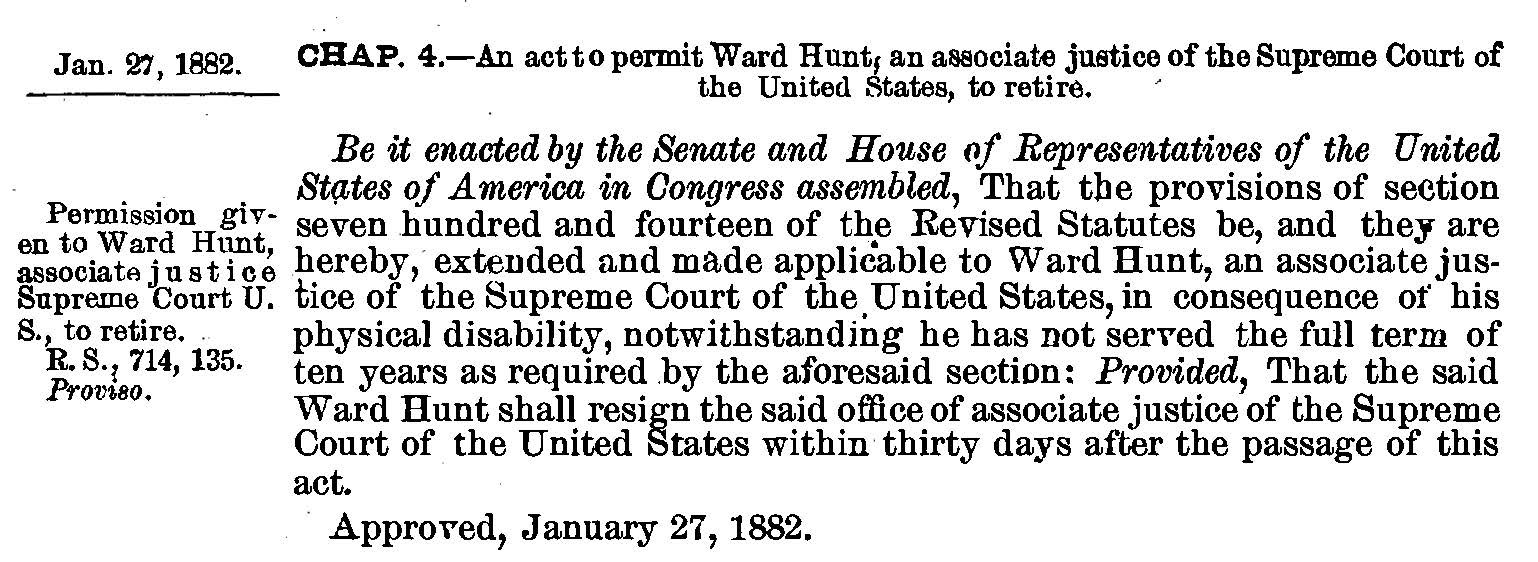
To similar effect, even though Congress can’t diminish the justices’ salaries, it regularly used them (and the justices’ pensions) as significant levers. A prior post goes through the details. On the salary front, in 1964, when Congress gave just about every federal officer and employee a long-overdue pay raise, the nine recipients who got the least were the justices—reflecting Congress’s … pique … with the Court’s trilogy of major redistricting rulings. And on pensions, until 1937, Congress would sometimes use justice-specific pension statutes (like the one pictured above) to nudge justices off the Court.
Congress largely surrendered the latter power in 1937, when it created a permanent retirement mechanism for justices. But, again, here’s an example of how Congress used its unquestioned powers to check the Court both directly and indirectly.
Lever #7: The Court’s Ethics
It is certainly true that Congress has never created some kind of formal ethics enforcement mechanism for the justices (even though it has enacted statutes imposing limits on the justices’ behavior). But it didn’t need to. I’ve told the story before of why Justice Abe Fortas resigned from the Supreme Court on May 14, 1969 (which remains the last day on which a majority of the justices had been appointed by Democratic presidents). But in a nutshell, in the midst of a relatively modest scandal over Fortas’s relationship with a sketchy financier (which is not to say Fortas had clean hands), Chief Justice Warren went to Fortas and told him he had to resign for the good of the Court—because, if he didn’t, Congress would come after the Court (including, Warren feared, Justice Douglas). It was the specter of congressional investigations (and potential impeachment proceedings) that forced Fortas’s hand. Suffice it to say, I don’t see a similar conversation happening today. That’s not just a reflection on the justices; it’s a reflection on Congress.
Lever #8: The Final Say on Statutes
Finally, perhaps the most significant substantive lever Congress has pulled is its unquestioned ability to overrule any Supreme Court decision short of one that is based upon an interpretation of the Constitution. In other words, Congress can reverse (and regularly has reversed) the Court’s statutory interpretations—a power that also unquestionably influenced how the Court approached those interpretations in the first place.
As I noted in last Thursday’s bonus post, Matthew Christiansen and Professor Bill Eskridge published an exhaustive study in 2014 that identified more than 100 statutes Congress passed between 1980 and 2000 at least parts of which overturned Supreme Court statutory interpretations with which it disagreed. That number has dwindled into the single-digits in recent years—and virtually no high-profile cases. (The most recent example I can think of is the Ledbetter case from 2007, which the 111th Congress overruled in its second statute in 2009.) A Congress that was still asserting its control over statutes would presumably have responded quickly, for instance, to Shelby County—and its demand for an updated “coverage formula” for the Voting Rights Act’s preclearance regime. But this Congress? Crickets.
I don’t mean to overstate this point; the volume of examples in the Christiansen/Eskridge study are a testament to the fact that even dynamic interbranch dialogue didn’t prevent the Court from getting a bunch of statutory interpretation questions “wrong.” But it’s worth asking what the “major questions doctrine,” or the overruling of Chevron, or any number of other moves the Court has made in the last decade would’ve looked like in a world in which the Court was genuinely convinced that Congress would more directly and immediately respond to its rulings.
Jurisdiction-Stripping and the Court’s Size
Of course, two of the proposals being pushed by the most aggressive Court-reformers—jurisdiction-stripping and Court expansion—could also be described as “levers” Congress has pulled at prior moments in the Court’s history. But I’m not persuaded that either of them are in the same category as the ones summarized above.
Taking jurisdiction-stripping first, Congress has never actually gotten away with completely stripping the Supreme Court’s ability to interpret a specific constitutional provision. As I’ve explained in detail in prior posts, there’s a lot Congress can do to structure and limit the Supreme Court’s jurisdiction, but it’s at the exact moment a jurisdiction-stripping statute becomes truly effective that, in my view, it crosses the constitutional line. And even for those who don’t agree, the only real example of jurisdiction-stripping succeeding was in the Reconstruction cases—where, lest we forget, the Court was ready to reach the merits in Ex parte Yerger before the Grant administration mooted the dispute by releasing Yerger from custody.
It’s also true, as I’ve suggested before, that Congress has used its control over the Court’s size as a lever—just never in the way that so many folks on the left are calling for today. The size of the Court changed seven times between 1789 and 1869—invariably for political (if not for partisan) reasons. But three of those changes (1807, 1837, and 1863) were simply to expand the Court to match the expanding number of circuits at a moment when the move was not perceived as an effort to shift the Court’s ideological center of gravity. Two of those changes were efforts to deny opportunities to presidents (Jefferson and Andrew Johnson) to fill seats; and two were to undo those last two.
Expanding the Court for the purpose of shifting its ideological control is a big part of what made FDR’s 1937 proposal so controversial—not just because it was unprecedented, but because of what it would mean if it succeeded, i.e., that, whenever any party had a trifecta in Congress and the White House, it could expand the Court to cement its ideological alignment with the current administration. The problem isn’t that this wouldn’t work in the short-term; it’s that it would necessarily set off a race to the bottom in the long term, one in which the Court loses any claim to being above the partisan politics of the moment. That’s a big part of why so many Democrats were opposed to FDR’s plan in 1937. We’ll never know if that opposition would have been sufficient if Justice Owen Roberts hadn’t switched his vote and/or if Justice Van Devanter hadn’t announced his retirement shortly thereafter. But I continue to think that opposition to enacting FDR’s proposal was normatively correct.
I realize that there are plenty of folks who think we’re already there with the current Court. But my goal is to see if it is possible to stay out of the abyss—not to plunge headlong into it. To be sure, the answer may be no. But it seems worth finding out first.
* * *
One last point: A common rejoinder to suggestions that Congress attempt to pull any of these levers again is that the Court could all of a sudden decide that they’re unconstitutional, notwithstanding the historical precedents marshaled above.
That is certainly a concern. But there are two final points that hopefully tie these threads together. First, the same thing could be said about Court expansion and jurisdiction-stripping (and, in the latter case, the Court might well be correct). Second, and in any event, if Congress starts pulling some of these levers and the Court tries to cut them off, it seems that the most likely outcome would be for Congress to become only more aggressive in seeking to rein in the Court—not less. The Court has the power to win one or two fights with Congress, but it can’t win a war—nor should it be able to.
Back to one of my favorite quotes (again, from Paul Freund): We should aspire to a world in which the justices “are not, [or] at any rate should not be, influenced by the weather of the day, but they are necessarily influenced by the climate of the age.” A lot of folks may think that can happen with the right justices. My own view is that, in the long term, that can happen only if we get to a point in which it doesn’t matter whether we have the “right” justices, because any justice is being regularly pushed to look over their shoulder—and across First Street.
SCOTUS Trivia: The Second-Longest-Serving Justice
For those who care about such things, it’s a big week for Justice Thomas’s march up the Court’s longevity rankings. Six weeks ago, Thomas passed John Marshall to become the Court’s fourth-longest-serving justice. Today, Thomas’s 12,612th day on the Court (34 years, 193 days), he passes Justice John Paul Stevens for sole possession of third place. And Thursday, he’ll move past Justice Stephen Field into second place—with only Justice William O. Douglas, whose tenure lasted 13,358 days, having served on the Court for longer.2
As I’ve noted before, Thomas is set to catch Justice Douglas in May 2028. For lots of reasons, it seems unlikely that he’ll retire before that happens.
I hope that you’ve enjoyed this installment of “One First.” If you have feedback about today’s issue, or thoughts about future topics, please feel free to e-mail me. And if you liked it, please help spread the word!
If you’re not already a paid subscriber and are interested in receiving regular bonus content (or, at the very least, in supporting the work that goes into this newsletter), please consider becoming one:
This week’s bonus issue for paid subscribers will drop on Thursday. And we’ll be back with our regular content for everyone (no later than) next Monday. As ever, please stay safe out there—especially from “conservative collaborators” trying to “menace” the Court.
Until 1911, each district court had its own circuit court, e.g., the Circuit Court for the Southern District of New York, within the broader “circuits” that we tend to think of today (the 1789 Judiciary Act, for instance, created three). The justices’ circuit-riding obligations required them to sit in each of those courts on an annual basis—which led them to literally “ride the circuit” when they were away from Washington.
If you want some real trivia, Thomas would be seventh different justice to hold the title of “longest-serving” justice. Douglas was obviously the sixth. In order, the previous five were: James Wilson (who held the title from the day he was sworn in until 1798); William Cushing (who held the title from then until 1819); Bushrod Washington (who held the title from then until 1832); John Marshall (who held the title from then until 1897); and then Stephen Field (who held the title until Douglas passed him in 1973).
I am a former judge. I do not disagree with your persuasive arguments that once we had a relatively effective system of "checks and balances" and that we desperately need that back to stem the current tide waters. I would like to ask if you will write a piece about how, if we can, get back there without falling again into the polarized, massively partisan congressional acceptance of radical judicial decisions.
I did not know that Congress set the date for the start of a new term of the court. Why October?
And is the justices' 3 month vacation also set by Congress? Now that there is a/c in DC, & that they don't physically "ride circuit" anymore, it seems that they should work year-round like the Circuit Courts of Appeal. And if anyone says that's too much of a burden on the justices given the advanced age of many, they can always retire. And if a longer term means less time for the freebie trips, so much the better. Oh, & if they work 12 months, they can hear more cases.