

Before “memes” had a name, NFL coach Dennis Green became one on October 16, 2006—when he launched into one of the most well-known post-game press conference tirades in modern professional sports. After having watched his Arizona Cardinals blow a 20-point halftime lead and lose to the Chicago Bears, 24-23, Green explained his frustration with his team by reference to the fact that the Cardinals had recently played (and defeated) the Bears, and were well aware of what they were (and weren’t) capable of:
The Bears are what we thought they were. They're what we thought they were. We played them in preseason—who the hell takes a third game of the preseason like it's bullshit? Bullshit! We played them in the third game—everybody played three quarters—the Bears are who we thought they were! That's why we took the damn field. Now if you want to crown them, then crown their ass! But they are who we thought they were! And we let 'em off the hook!
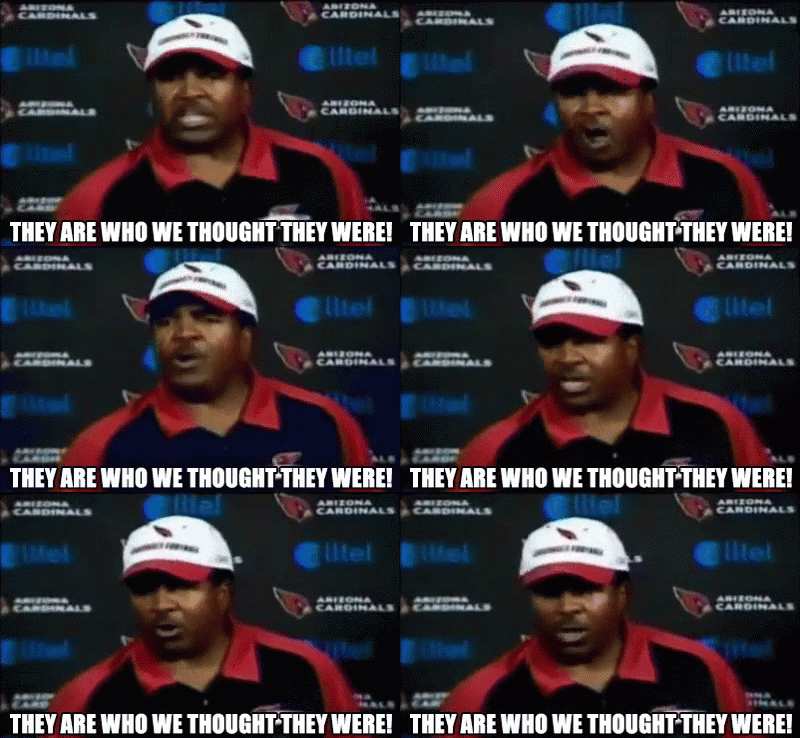
A 20-year-old rant by a football coach may seem like a strange place to start this week’s bonus post, but it perfectly encapsulates my reaction to yesterday’s (maddening) 6-3 ruling in Louisiana v. Callais, in which the Supreme Court took a hatchet to what’s left of the Voting Rights Act in an opinion by Justice Alito that can charitably be described as … motivated reasoning.
There are plenty of good and sophisticated analyses of Callais out there already; you might check out UCLA law professor Rick Hasen’s, for starters. Rather than re-hash Rick’s piece, I wanted to use today’s bonus post to make two different points that go beyond analysis of either the majority opinion or Justice Kagan’s dissent.
The first point, which hopefully explains the Dennis Green reference, is that I don’t know anyone who was genuinely surprised by this outcome—who didn’t think (1) that the Court would reach this result; (2) that it would disingenuously distinguish its ruling from <checks notes> three years ago in the Alabama case (and say nothing at all about its intervention in the Texas case from December); (3) that the Court would split right down ideological lines; or (4) that Justice Kagan, specifically, would write a stem-winder of a dissent. TL;DR: “they are who we thought they were”—which, among other things, really ought to be the final nail in the coffin for recent attempts to sell a narrative that the Court is not so bitterly divided along ideological (and partisan) lines. Once again, in the cases that matter the most (a real category that can meaningfully be distinguished from the rest of the Court’s docket), we tend to see the Court at its most predictable. And in my view, that’s both an indictment of efforts to whitewash the current Court and a reality that’s not healthy for the Court itself.
That brings me to the second point: Understandably, Callais has re-ignited calls (especially on the left) for Court reform—with expansion foremost among the specific proposals—the next time there’s a Democratic trifecta in Congress. And the defense of going right for the jugular is that the Supreme Court as currently composed would strike down anything else—so shifting the Court’s center of gravity is a necessary antecedent to any substantive policy goals Democrats might have, and not just to Court reform, itself.
As I elaborate upon below the fold, to me, this takes exactly the wrong lesson away from Callais. Like Shelby County v. Holder and Brnovich v. DNC before it, the Court’s three-step evisceration of the Voting Rights Act has been made possible not just by its personnel, but by the Court’s knowledge that there’s no universe in which Congress would meaningfully respond to its … contestable … intepretations of a statute Congress enacted, and then re-authorized, and then re-authorized again.
A world in which Congress is willing to hold the Court accountable is one in which it would not only override these kinds of patently ridiculous interpretations of statutes, but in which the specter of such legislative reaction might lead the Court away from such interpretations in the first place. And although the Court could still rest on (un-overrule-able) constitutional arguments to strike down Congress’s handiwork, that, too, assumes a Congress that wouldn’t simply respond by resorting to its array of other tools to push back against such an assertion of power by the justices.
Put another way, Callais itself and the reactions to it are both evidence, yet again, of what’s really wrong with the Court (the extent to which it has become completely unaccountable), and why the “right” way to fix it is to reform that, rather than hope that a Democratic president will appoint justices more committed than the justices in the Callais majority to the view that the Court is just one branch among three. Packing the Court may feel cathartic (and even accomplish partisan substantive goals) in the short term, but only at the further expense of the Court’s credibility and power in the medium- and long-term.
For those who aren’t paid subscribers, we’ll be back with our regular coverage of the Supreme Court (no later than) Monday. For those who are, please read on.
