

Back in December, I wrote about the Supreme Court’s five-paragraph order in the Texas redistricting case—in which the justices put back into effect Texas’s new congressional district map after a three-judge district court had concluded that it was likely an unconstitutional racial gerrymander. That ruling was, in theory, a temporary one—a “stay” of the three-judge district court’s preliminary injunction pending Texas’s appeal of that ruling to the Supreme Court.
Earlier today, as part of its regular Order List, the Supreme Court issued a truly unusual order in that appeal—summarily reversing the district court’s ruling “[f]or the reasons set forth” in the December order. In other words, in resolving the merits of Texas’s appeal of the preliminary injunction, the majority deemed it appropriate to simply incorporate December’s order by reference—even though that order included exactly two paragraphs of analysis, one of which was only about why Texas met the factors for a stay (which presumably is irrelevant to the question now before the Court).
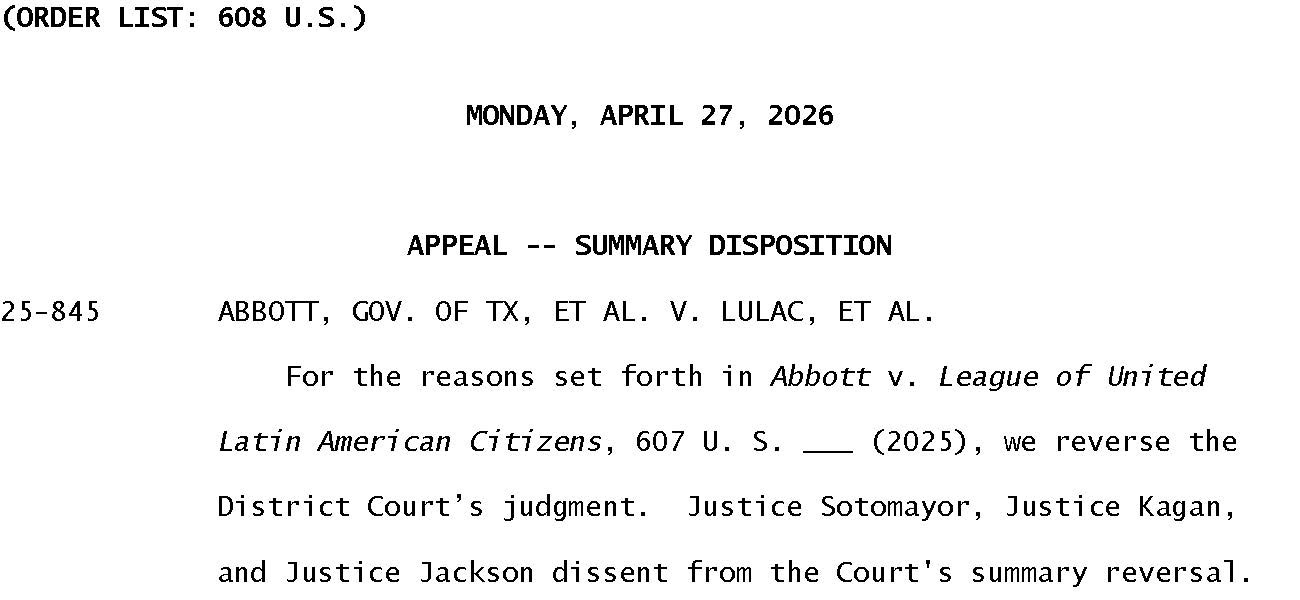
I wanted to put out a quick post to flag this development, because it strikes me that there are three different, but equally newsworthy, points to make about it.
First, procedurally, I can’t say I’ve ever seen this before—where the Court took a case in which it has “mandatory” appellate jurisdiction (meaning that, in theory, it has no discretion to refuse to hear an appeal), and summarily reversed the district court. Summary affirmances are (and historically have been) quite common in this context. And a separate body of rulings are (wrongly, in my view) often called “summary reversals”—where the Court resolves a cert. petition by deciding the whole case through an unsigned opinion, like the one we had just last week. But I can’t remember a prior case with this kind of (true) summary reversal—where the Court just reversed a three-judge district court on the merits without any detailed explanation. I don’t doubt that it happened in at least some cases back when the Court had much more mandatory jurisdiction, but if there’s a post-1988 example (and there may well be), I’m not aware of it.
Second, and the unusual procedure aside, there’s also the substance. I’ve explained before how, during COVID, we saw the first examples of the Court relying upon rulings on emergency applications in the context of summary “GVRs,” that is, in orders granting certiorari, vacating a lower-court ruling, and remanding for further proceedings in light of an intervening development (there, the emergency docket ruling). But I’m also not aware of a prior case where, on the merits, the Court simply relied upon a prior ruling on an emergency application as the entire substantive basis for the result.
To be clear, I don’t read Monday’s order as suggesting that the Court was bound by its December order. Rather, I read it as the Court seeing nothing to add to the December order—never mind the powerful (and, in my view, correct) arguments Justice Kagan offered in her dissent from December’s stay. In that respect, Monday’s order appears to be a novel extension of how the Supreme Court is using its rulings on the emergency docket as precedent—not for stare decisis purposes, but as the analytical foundation for its subsequent ruling on the merits. That strikes me as an entirely worrisome development when the foundation consists of two cryptic paragraphs that have been thoroughly debunked. (And in a case in which the three-judge district court moved heaven and earth to build a detailed evidentiary record in support of its preliminary injunction, a record at which the justices in the majority just waved their hands.)
And that brings me to the third point: There has been a remarkable amount of pearl-clutching over the past nine days with regard to criticisms of the Court’s behavior on the emergency docket—especially in the aftermath of the New York Times’ reporting on the leaked memos in the Clean Power Plan case. On Friday, former Tenth Circuit Judge Michael McConnell joined the fray with an op-ed in the Washington Post purporting to defend the “not-so-sinister ‘shadow docket.’”
Like many of the Court’s other defenders, Judge McConnell misdescribed the criticisms. And among other things, he claimed that “the shadow docket has proliferated” not because of anything the Court has done, but “because presidents have become increasingly aggressive in pushing new policies through executive order without going to Congress—or even after Congress rejected their proposals.” Of course, this misses the substantial evidence of the Court’s inconsistent treatment of presidents based upon their political affiliation (which was my central takeaway from the Clean Power Plan reporting). But it also ignores the rest of the emergency docket, where, as the Texas redistricting case reflects, the Court has been far more active in cases not involving the federal executive than it was a decade ago. Executive overreach, regardless of the president’s party, hardly explains that development.
In any event, the Court’s defenders, like McConnell, have stressed, over and over again, that the principal reason why critics of the Court’s emergency docket behavior are overreacting is because the rulings are temporary expedients—and don’t necessarily prejudge the merits. Indeed, Justice Kavanaugh has led the charge to re-brand the Court’s emergency applications output as the “interim” docket.
But as I wrote last September, anyone who actually looks at the full dataset would see that the “interim” label wildly understates the real-world effects of these rulings—which are increasingly permanent. Likewise, the Court’s newfound insistence that even unexplained orders have at least some precedential effects on lower courts also belies the notion that these orders are temporary expedients.
All of that was clear before today (indeed, it was clear by last August). What Monday’s order drives home is how little even the Supreme Court itself is treating its emergency interventions as “interim” rulings. If the Court is going to summarily reverse a three-judge district court on the merits “for the reasons set forth” in two cryptic paragraphs of analysis respecting a stay, then it’s only a matter of time before the Court starts relying upon similarly cursory analyses (or even simply the outcome) in other orders granting (or denying) emergency relief as controlling the merits of merits cases. And while that’s certainly something the Court has the raw power to do, if nothing else, it ought to drive home the tendentiousness—if not the mendaciousness—of the “interim docket” label once and for all.
We’ll be back Thursday (if not sooner) with our continuing coverage of the Supreme Court. If you’re not already a subscriber, I hope you’ll consider becoming one. And if you are, I hope you’ll consider upgrading to a paid subscription if you’re willing and able to support the work that goes into keeping tabs on the current Supreme Court:
Stay safe out there.
Despicable abuse of power. Thank you for explaining this.
The Texas case demonstrates the partisan nature of these decisions. As the District Court demonstrated, Texas followed the instructions of the DoJ Civil Rights Division and consciously created several majority Hispanic districts. Roberts & Co seem not to be bothered by the record. Is it too simple to say Republicans always win? Supreme Court or Judicial Politburo?