

By now, you’ve probably seen the headlines—that the Supreme Court on Monday night denied the Trump administration’s application for a stay in U.S. Postal Service v. California, thereby leaving intact district court injunctions that will effectively prevent the federal government from implementing a new USPS rule respecting mail-in ballots in time for this November’s elections.
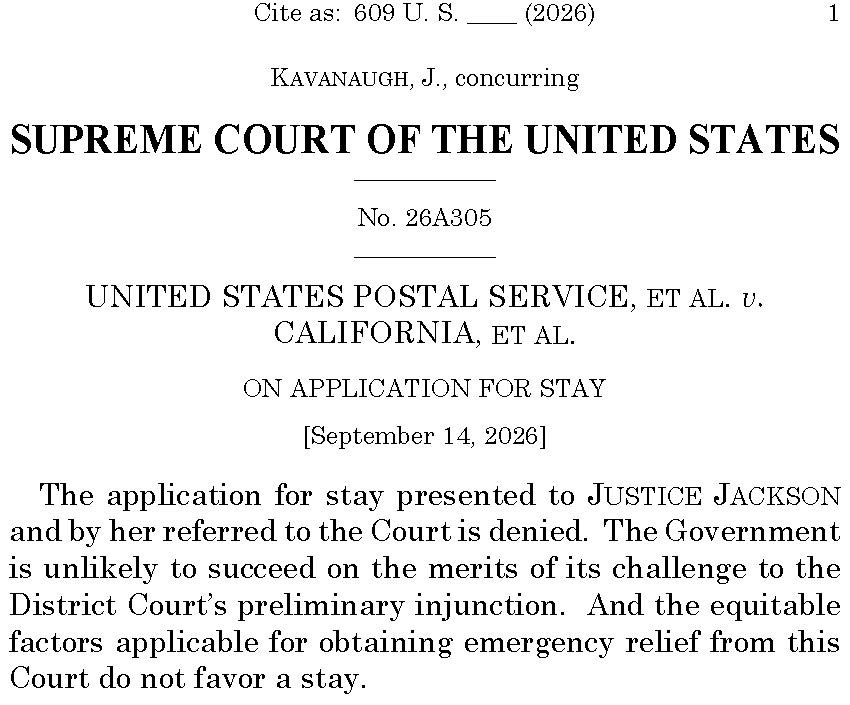
Without question, this is a very big decision (and a big loss for President Trump). It’s also not an especially surprising ruling, even for this Court. As my Georgetown colleague Marty Lederman documented in multiple blog posts, and as a really excellent amicus brief by Professors Rick Hasen, Ned Foley, Pam Karlan, and Doug Laycock demonstrated in detail, the government had (and made) both an exceptionally weak case on the merits and an even weaker case on the “equities” of emergency relief—even relative to other emergency applications that, in my view, should also have been denied. And although the Court wrote only three sentences (sigh), two of those sentences signaled the majority’s agreement on both of those points: “The Government is unlikely to succeed on the merits of its challenge to the District Court’s preliminary injunction. And the equitable factors applicable for obtaining emergency relief from this Court do not favor a stay.” Just to say it out loud, those are two independently fatal obstacles to relief.
But despite the (unfortunate) brevity of the Court’s order, I wanted to write a quick post about the decision because I think we still learned at least three important lessons from the nine pages the justices handed down last night—one about the majority; one about Justice Kavanaugh (who wrote a one-paragraph concurrence); and one about Justices Thomas and Alito (who filed an eight-page dissent penned by Alito).
What We Learned from the Majority
A lot of media outlets reported the ruling as 7-2. As ever, I think that’s a mistake—not because it’s necessarily wrong, but because it isn’t necessarily right. It seems to me that we only know three things for a fact: First, Justices Thomas and Alito were publicly in dissent. Second, Justice Kavanaugh was publicly in the majority. And third, at least five other justices were also in the majority (because of the daylight between the majority’s cryptic sentence on the merits and what Justice Kavanaugh wrote in his concurrence, about which more shortly). Math being math, that leaves the possibility that a third justice voted for the stay internally, but chose not to make their views public—that it was 6-3, not 7-2. We won’t know (for a long time) if this happened, and it’s almost certainly a distinction without a meaningful difference in the interim. But as with so many things about the Court’s emergency docket, it’s important to distinguish between what we know and what we think.
To me, the more significant math point here is that there’s no way it was 5-4. And so despite Justice Kavanaugh’s (surprising) support for the USPS’s authority here, my own read of the cryptic order is that five other justices publicly signaled that they do not believe the government will ultimately succeed in challenging Judge Talwani’s injunction. If that was all the Court had written, it would be possible to interpret that as a point about the equities—that five justices believed the government would never be able to displace preliminary relief in this case (which, again, would make sense given the imbalance of the equities here, and would not necessarily be expressing a view on the validity of the USPS rule).
But given that the Court added a separate sentence about the equities, it sure seems to me that a majority of the Court wanted to signal something bigger—that the government isn’t going to win this case, because it’s unlikely five justices will ultimately vote to sustain the USPS rule even “on the merits.” If so, that’s a really important message not just to the Trump administration, but to lower courts. Unlike the Missouri redistricting dispute from last week, this case surely will go forward. And for better or worse (and my own view is the former), five justices other than Justice Kavanaugh have now put a pretty heavy thumb on the scale against the government on the merits.
What We Learned from Justice Kavanaugh’s Concurrence
Justice Kavanaugh, once again to his credit (I’ve been consistent about this), wrote separately to explain his position. Taking out his citations, here’s what he said:
In my view, based on the briefing the Court has received at this interim stage, there is at least a fair prospect that the final rule falls within the Postal Service’s statutory authority. But applying the rule in the 2026 elections would be arbitrary and capricious in violation of the Administrative Procedure Act because state and local election officials do not have sufficient time to reasonably implement the rule before the elections. For that reason, I concur in the denial of the application for stay.
Again, there’s a lot going on in three short sentences. The first sentence sure reads like a response to the majority—that, unlike his five (or six) colleagues who also voted to deny the stay, he thinks the USPS may win on the ultimate merits of the validity of the rule. If this is a response to the majority, then I think it only reinforces the reading that the majority was suggesting exactly the opposite. For what it’s worth, I think he’s completely wrong on the merits. But the fact that he felt impelled to make that point is at least decent evidence that the majority thinks so, too.
The second sentence is what I find most striking. I would’ve thought that the fact that “state and local election officials do not have sufficient time to reasonably implement the rule before the elections” is an argument about the equities—that, even if the government is likely to ultimately prevail, the harms and chaos from rushing the rule into effect are reason enough to keep the rule paused through November. But Justice Kavanaugh frames it as a procedural APA violation instead. That matters in at least two respects.
First, Kavanaugh may be avoiding the equities because otherwise he’d have to explain why Purcell doesn’t push in exactly the opposite direction—since he has so often deployed that “principle” to keep federal courts from doing exactly what Judge Talwani did here, i.e., blocking an eleventh-hour legislative/executive change to voting rules. Second, and Purcell aside, this approach seems to open the door to other challenges to late-breaking federal changes to election procedures on procedural APA grounds—where the argument is that the change is procedurally unlawful because it is so late in the game. At least off the cuff, that seems like an interesting way to convert the malleability of equities balancing in election cases into more objective procedural harms, at least when the federal government is the defendant. But smarter folks than me will need to think about how that can and would work in practice.
What We Learned from Justice Alito’s Dissent
And then there’s the dissent.
I have been quite critical before of many of Justice Alito’s separate opinions on the emergency docket. He has a tendency to take liberties with the facts (or procedural posture); to make brazen claims without substantiation; and to insinuate unclean hands on the part of lower courts, litigants, and/or his colleagues in the majority without doing the work of proving it. Well, all of those tendencies were on display in these eight pages, along with a rather stunning disregard for the interests of eligible voters in having their lawfully cast votes counted. Indeed, to the concern that the rule would disenfranchise millions of voters, Alito’s only response was that “I take that problem very seriously, but it is not enough to convince me to deny the application.”
Why not? Alito offered two reasons, and they’re both remarkably tendentious.
First, Alito wrote that “the States disagree about the nature of these effects. Twelve States supported the rule below and asserted that compliance at this time is practicable.” As Professor Derek Muller explains in a lengthy post over at Election Law Blog, this is (1) a remarkable tense-change to muddy what twelve red states actually argued below; and (2) a non-sequitur given that the ability to comply with the rule is radically different from whether that compliance will lead to massive disenfranchisement of eligible voters.
Second, and worse, Alito wrote that “the plaintiff States and the courts bear a substantial share of the blame for the rule’s timing.” As the Brits would say, this is utter bollocks. Alito tried to spin the plaintiffs’ litigation behavior and the district court’s rulings as preventing the government from moving forward in putting out the USPS rule, but that’s just not a fair summary of the record. As Rick Hasen pointed out last night, “the district court allowed USPS to keep working on its rule and its (still nonexistent) portal for voluntary use by states.” Indeed, the fact that the USPS issued the rule the Supreme Court refused to unblock last night while the executive order was still enjoined should be all of the proof anyone needs that Alito is wrong to insinuate otherwise, to say nothing of the government’s inability to get the critical electronic portal online before voters started … voting. (For all of the ugly shots folks on the right have taken at Judge Talwani, the denial of a stay is a pretty significant vindication of her rulings in these cases.)
Alito also blamed his colleagues, noting that “this Court spent from late July to the end of August drafting nearly 40 pages of opinions, including two dissents, despite the Government’s public notice that it would not publish a final rule while subject to the injunctions, and its representation that it had a strong interest in issuing its rule in early- to mid-August to allow time to implement it.” As Alito concluded (read this sentence carefully), “The plaintiff States cannot claim the timing of the rule tilts the equities in their favor when they, and courts hearing their claims, are responsible for so much of the delay.”
Of course, it is ludicrous to blame plaintiffs for delays Alito attributes to courts. It’s even more ludicrous to do so when the Supreme Court’s own prior ruling in this case (which Alito almost certainly joined) asserted that the earlier injunctions had to be stayed because the plaintiffs’ suits were filed too early. And it’s tendentious to the extreme to claim that the point that putatively “tilts the equities in [plaintiffs’] favor” is the timing of the USPS rule, not the massive disenfranchisement that neither the government nor Alito ever publicly disputed would occur were it to go into effect. It may not surprise anyone that this is where Alito and Thomas are. But it’s striking to see it captured in writing so plainly and unmistakably.
***
In the end, it’s heartening that only two justices were willing to say these things out loud. And it’s even more heartening that a majority of the Court was unwilling to abide President Trump’s transparent effort to make it harder for a large number of lawfully registered voters to actually cast their ballots in the 2026 general election. But it continues to be deeply sobering that it came to all of this in the first place.
Happy Tuesday, all.