

Welcome back to “One First,” a newsletter that aims to make the U.S. Supreme Court more accessible to lawyers and non-lawyers alike. I’m grateful to all of you for your continued support, and I hope that you’ll consider sharing some of what we’re doing with your networks.
If you’re not already a subscriber, please consider becoming one—and upgrading to a paid subscription if and when your circumstances permit:
Last Thursday’s grant of a stay in the Missouri redistricting case (see Thursday’s bonus post for more background) used boilerplate language to freeze the district court’s temporary restraining order—and to effectively restore the Missouri Supreme Court’s unanimous September 3 ruling (which had ordered the state to use its 2022 congressional map for the upcoming general election). That didn’t stop a lot of folks online from being confused about what the U.S. Supreme Court had done, what it means for the 2026 general election, or whether the ruling ended the Missouri litigation.
I thought I’d use today’s post to walk folks through exactly what a stay … stays. It turns out that, depending upon the context, the Supreme Court uses at least four different sets of boilerplate when staying a lower-court ruling pending appeal. But despite variations in their text, they all basically mean the same thing: the ruling at issue is frozen (i.e., it cannot be enforced) until and unless the U.S. Supreme Court acts conclusively on the full appeal—no matter what happens in the lower courts in the interim.
In Missouri, for instance, that means that the district court’s TRO will remain frozen while the challengers continue to appeal it (although, as I’ll explain below, that appeal will almost certainly be mooted later this week). But no matter what happens in that appeal, the status quo is for the TRO to remain frozen indefinitely—and certainly through the November elections. The critical difference here is between the formal effects of the Supreme Court’s ruling on the underlying litigation and its practical effects on the real world.
More on all of that below. But first, the (other) news.
On the Docket
Another busy September week for the justices kicked off on Tuesday, when Justice Kavanaugh, acting by himself, denied Missouri’s request for emergency relief directly from that underlying Missouri Supreme Court decision. You won’t find that ruling anywhere obvious on the Supreme Court’s webpage because single-justice denials of relief don’t show up on the “Orders of the Court” page (or any other compendium of the Court’s rulings); it’ll appear only on the docket page for that particular case, which you can’t find without either the docket number or the case caption. (It’s almost like some of these rulings are hard to find—almost … shadowy.)
The full Court on Tuesday denied an emergency application from the parents of a child seeking to enroll in a New York public school—who sought an order that their child be enrolled without the vaccinations required by New York state law, due to religious objections (that New York doesn’t recognize) to those requirements. The lower courts rejected the parents’ claim that New York’s vaccination requirements thereby violate the Free Exercise Clause, and the full Court—over publicly noted (but unexplained) dissents from Justices Alito and Gorsuch—denied an injunction pending appeal.
On Wednesday, the Court agreed to expedite the briefing in the (dumb) attempt by Iowa and Montana to invoke the Court’s “original” jurisdiction in order to shut down the lawsuit by a dozen states seeking to block the Paramount Skydance-Warner Bros. Discovery merger. My own view is that this doesn’t change the odds of the Court actually agreeing to take up this case (by granting leave to file an original bill of complaint). But, if nothing else, we’ll now find out sooner.
Thursday morning brought the full Court’s order granting a stay of the district court’s TRO in the Missouri redistricting case—over no public dissents (which I found slightly—and pleasantly—surprising). Just like every other time the Court hands down a result that isn’t conservative- or Trump-coded, the usual suspects used it as a clumsy excuse to attack the Court’s critics (e.g., “So is the shadow docket good this week?”). But two things can be true at once: The Court absolutely reached the right result, but it once again did itself no favors by providing no explanation for its intervention (breaking the streak of four straight opinions of the Court respecting grants of emergency relief). I’m not sure how many times I need to say it before people believe I mean it, but it’s always a problem when the Court doesn’t explain these rulings, even (if not especially) in the rare but non-zero instances in which I think that there are good explanations for them. And although time was of the essence here in ways that haven’t been true previously, I still think the Court could/should have said at least something about why it was granting a stay—or, at least, promised a forthcoming opinion to that effect. Alas.
Later on Thursday, the Court denied a stay of execution, over no public dissents, to Florida death-row inmate Daniel Conahan.
Turning to this week, there’s nothing formal on the justices’ calendar. But the Court could rule at any time on the Trump administration’s application in the mail-in ballots case. My own view is that the briefing has made it even more abundantly clear why that application should be denied—and that some pretty ugly things could result if it’s granted. Marty Lederman has (another) excellent post about the Solicitor General’s reply brief—a brief that is really quite striking both in what it says and in what it doesn’t say. It’s possible that it’s taking this long because the Court has already voted to deny, and it’s just taking time to produce opinions respecting such an order (indeed, one would think the Court would’ve moved considerably faster if it was granting a stay). But I’ve been wrong before.
There’s also the Trump administration’s other pending emergency application—seeking to restore the government’s new effort to link the Systematic Alien Verification for Entitlements (SAVE) program to Social Security data (an effort a divided D.C. Circuit panel refused to un-block on September 4). To maximize everyone’s confusion, the SAVE case is captioned Department of Homeland Security v. League of Women Voters (although the lead mail-in ballots case is U.S. Postal Service v. California, the consolidated case is Trump v. League of Women Voters). Anyway, the plaintiffs’ response in the SAVE case is due tomorrow (September 15) by 4 p.m. ET, so it’s possible we’ll get a ruling in that case this week, as well.
And I’d be remiss in not flagging two other non-Trump-related emergency applications also pending before the Court. The first is in the Jeffery Lee Alabama death-penalty case—the same one where the Court denied Alabama’s request to vacate a stay of execution earlier this summer. After the district court held that Alabama’s current nitrogen hypoxia protocol is unconstitutional, Alabama is now attempting to execute Lee by lethal injection, and Lee is asking the justices to pause his execution while the Court decides whether Alabama is allowed to make such a late switch in procedure. Lee’s execution is currently scheduled for sometime between 6 a.m. (CT) Thursday and 6 a.m. (CT) Friday, so we’ll likely get something on that this week.
There’s also an application out of California arising from a messy interstate dispute over surrogacy, custody, and abortion (that Kelsey Reichmann helpfully summarized over at Courthouse News). In essence, the surrogate who lost a California state court dispute over custodial rights is now asking the justices to invalidate that order so she can intervene in medical care for the critically ill newborn (whom she brought to term over the couple’s objections after a 20-week scan detected a life-threatening congenital heart condition). It’s an incredible mess, but also the kind of mess that (1) is almost always governed by state, rather than federal, law; and (2) the justices ought to be invested in not getting into on the emergency docket. Justice Kagan has called for a response to the application by this Friday at 4 p.m. (ET), so we likely won’t hear anything until next week.
I know I’m a broken record on this, but it’s striking how, for the second year in a row, the emergency docket has really swallowed the Court’s “summer.”
On a personal note, I’ll be in Richmond, Virginia on Wednesday (September 16) for oral argument before the Fourth Circuit in Bork v. Brisco, the latest case challenging whether it’s constitutional to court-martial retired servicemembers for offenses they commit after retiring. For the three of you who might be interested, the audio will be live-streamed, starting at 9:30 ET, at this page (we’re in the “Gold” Courtroom). And before you ask, the Fourth Circuit doesn’t announce panel assignments until the morning of the argument.
The One First “Long Read”:
What Does a Stay … Stay?
One of the most common mistakes I make in my writing, including in this newsletter, is assuming too much familiarity with legal concepts and too much facility with technical language. That manifested on Thursday, when I received a lot of comments on Bluesky from folks who were confused about the Supreme Court’s stay in the Missouri redistricting case—including (1) whether it meant the case is “over”; (2) why the Supreme Court’s order even mentions the Eighth Circuit; and (3) what, if anything, could happen to undo the stay’s effects.
When Karen and I launched the newsletter back in November 2022, one of our goals was to make the Court more accessible. So here’s my effort to use Thursday’s order to break down, in perhaps too much detail, what the boilerplate language in a stay actually means.
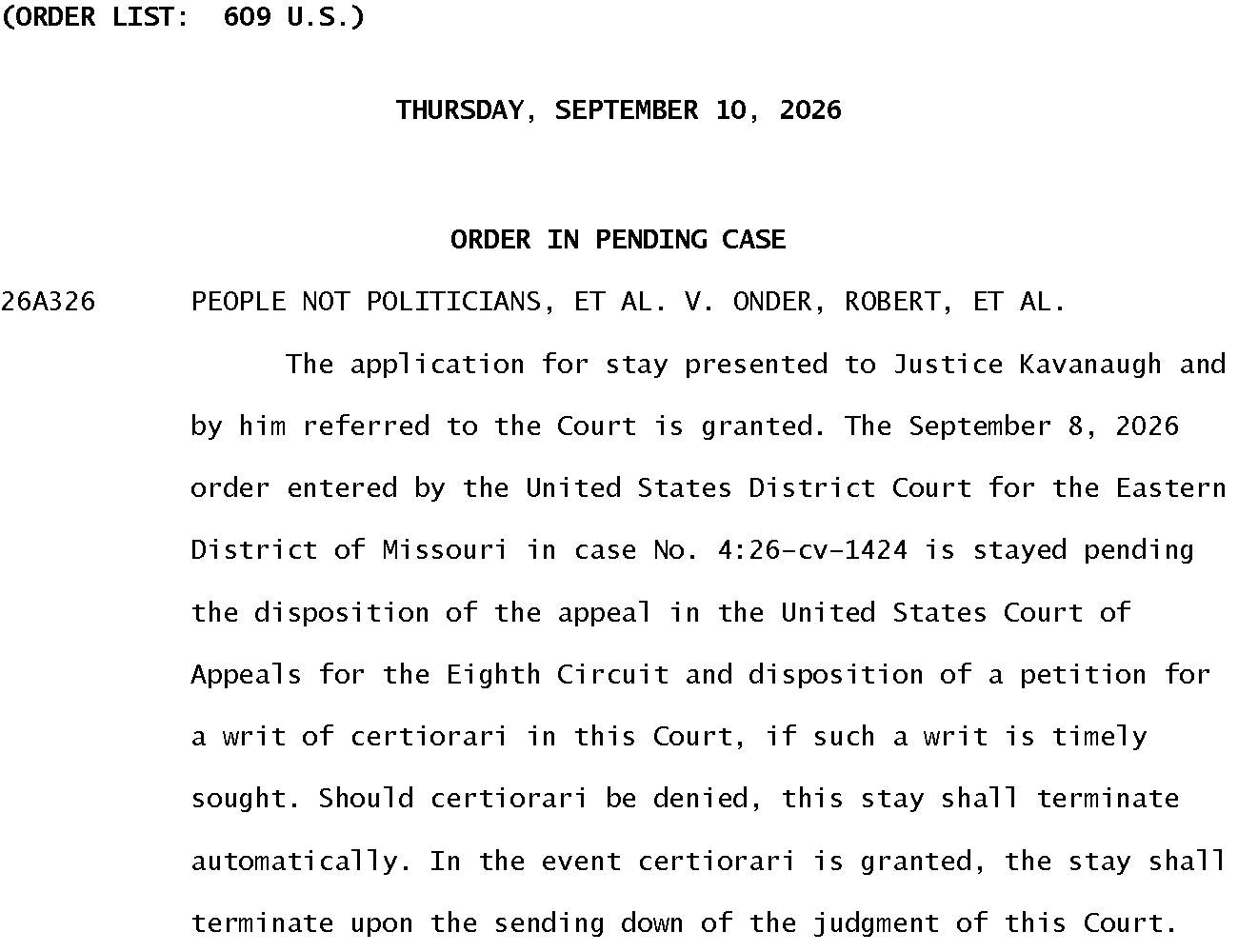
The First Sentence: The Grant
The first sentence is the easiest; it describes (1) to whom the application was referred (Justice Kavanaugh, who’s the Circuit Justice for the Eighth Circuit, which includes Missouri); (2) that he referred it to the full Court (almost always a predicate for full Court action); and (3) what the full Court did (it “granted” the application). There was a time when circuit justices could and would grant relief by themselves. Today, though, the only relief circuit justices grant on their own is temporary relief, like an “administrative” stay. For well over a decade, a “full” stay pending appeal has always come from the full Court. That’s why, even though Kavanaugh acted alone in denying Missouri’s request for a stay on Tuesday, it was the full Court that acted on Thursday, even without any public dissents.
The Second Sentence: The Relief
The second sentence is the longest, but that’s because it’s doing two different things. First, it describes exactly which lower-court order is being stayed (something that can really matter when there are multiple lower-court rulings ostensibly at issue). Second, it describes for how long the stay will be in effect. This second clause is really important, because it’s the reason why we can be confident that Thursday’s ruling settled things for the 2026 election cycle. Here’s the text again: the district court order is stayed “pending the disposition of the appeal in the United States Court of Appeals for the Eighth Circuit and disposition of a petition for a writ of certiorari in this Court, if such a writ is timely sought.” What this language is capturing is that the stay will remain in effect until something happens in the Supreme Court (the “and” is doing a lot of work).
So even if the Eighth Circuit, in the challengers’ appeal, were to affirm the district court’s TRO, that wouldn’t affect the stay. Rather, the stay remains in place “pending . . . disposition of a petition for a writ of certiorari in this Court.” That means the district court order is frozen until the Supreme Court grants or denies plenary review after the Eighth Circuit rules on the appeal, no matter what the Eighth Circuit does. Only the Supreme Court, in other words, can formally undo its own stay. (Of course, the Eighth Circuit could vacate or reverse the TRO, but if that happens, then the challengers wouldn’t need further review from the Supreme Court; the stay would eventually expire as moot—once such an appellate ruling became final, there’d be nothing left to stay.)
Now to the timing: The Eighth Circuit, for … reasons, has issued an expedited briefing schedule in the challengers’ appeal (even though the TRO should expire of its own force later this week). But even if the Eighth Circuit decides the appeal and affirms the district court’s TRO (again, very unlikely, in my view), the stay remains in effect while the challengers seek certiorari in the Supreme Court—something they’d have 90 days from the Eighth Circuit’s ruling to even ask for (and that’s without seeking up to 60 days’ worth of legally available extensions). In other words, there’s no universe in which this case would come back to the Court on the merits before the election.
That’s why I could say with confidence on Thursday that the Court’s ruling is effectively final; it doesn’t conclusively resolve the lawsuit, but it formally bars enforcement of the district court’s TRO indefinitely—which, practically, includes the duration of the current election cycle. And the whole point of the Missouri Supreme Court’s ruling, which is back in full effect, is to leave to Missouri voters whether the new map (“HB 1”) will go into effect thereafter.
So the case isn’t “over,” but the effort to use HB 1 in the 2026 general election is (as Missouri Secretary of State Denny Hoskins begrudgingly conceded later on Thursday).
The Third and Fourth Sentences: The Variations
The last two sentences are there just to deal with variations on what could happen next. If the Court were to deny plenary review, that ruling automatically terminates the stay. This makes sense if you think through the two scenarios: if the challengers were seeking certiorari, that would mean they’d lost in the Eighth Circuit, so denying certiorari means the Court is effectively agreeing with Missouri at that point. And if the state were seeking certiorari, that would mean the challengers won in the Eighth Circuit, so there’s nothing left to stay if certiorari is denied.
And if the Court were to grant plenary review, then the stay will remain in effect until and unless either (1) the Court dissolves it; or (2) the Court fully decides the case, at which point whatever the Court has decided will take precedence—either because it makes the stay permanent or because it undermines the basis for the stay. The very last clause (“the sending down of the judgment”) just makes clear that the stay expires not when the ruling comes down, but 32 days later, when the Court issues its judgment after the time for seeking rehearing has expired. (As in Callais, that period can be shortened, but only by affirmative order of the Court.)
Other Formulations
I mentioned that the text in the Missouri order is “boilerplate.” In fact, there are at least four different types of boilerplate—depending upon (1) whether it’s a discretionary (certiorari) or mandatory appeal; and (2) in certiorari appeals, how far the litigation has progressed in the lower courts. The Missouri case is a good example of the broadest stay—where no part of the appeal has yet been heard in the court of appeals. There’s different language for when the court of appeals has already ruled on the merits, and also when it has not just ruled on the merits, but when its own mandate is being stayed. There’s also different language when the “stay” is directed not toward a lower-court ruling, but toward some kind of executive action (e.g., a stay of execution, or a stay of an administrative regulation).
But the goal of this post isn’t to be exhaustive about the linguistic differences across every permutation; it’s to use the Missouri case to illustrate the linguistic mechanics—and why, in whatever formulation a stay comes down, its effect is to basically freeze things until the Supreme Court, and only the Supreme Court, acts next, even if lower courts will continue to move the litigation forward in the interim. And when you add in the time it takes for cases to work their way back to the Court, that means that stays, whether we like their effects or not, usually remain in effect for fairly substantial periods of time—time during which they produce significant effects, good and/or bad.
That doesn’t mean the shadow docket is “good this week” or “bad this week”; it means we should be clear-eyed about the significant effects these orders typically produce, why those effects are often much more than “interim” (including in the Missouri redistricting case), and why that ought to put pressure on the Court to explain its interventions—whether we “like” them or not.
SCOTUS Trivia: The Seniority Tiebreaker
This week is the 55th anniversary of the beginning of one of the most tumultuous six-day periods in the modern Court’s history—when Justices Hugo Black and John Marshall Harlan II retired six days apart, on September 17 and September 23, 1971, respectively. Both were gravely ill; Black had a stroke on September 19 and died on September 25; Harlan succumbed to spinal cancer three months later.
I’ve written before about my appreciation for the second Justice Harlan—even, if not especially, when I’ve disagreed with him. Black is a heavier lift, although no one can doubt the impact he had on the Court during his 34 years on the bench (he retired as the third-longest-serving justice, behind only Field and Marshall, and is still sixth today). But whatever else might be said about the two justices, the impact of their simultaneous departures was unquestionably seismic. Black was succeeded by Lewis Powell and Harlan by William H. Rehnquist—two appointments that would help turn the Court sharply to the right, perhaps far more so than President Nixon’s first two appointees (Chief Justice Burger and Justice Blackmun).
And all of that is the (unnecessarily long) build-up to today’s trivia—the “tiebreaker” for seniority when two associate justices are sworn in on the same day, as Powell and Rehnquist were on January 7, 1972. (There’s no seniority issue when a Chief Justice and associate justice are sworn in on the same day, like Rehnquist and Antonin Scalia on September 26, 1986, since the Chief Justice is always senior.)
It turns out that Congress specifically addressed this scenario in section 1 of the Judiciary Act of 1789, providing that “the associate justices shall have precedence according to the date of their commissions, or when the commissions of two or more of them bear date on the same day, according to their respective ages.” In other words, different birth dates are the tiebreaker.
January 7, 1972 was the third time in the Court’s history that multiple associate justices were sworn in on the same day, after February 2, 1790 and January 3, 1911. But unlike the first two (when the relevant justices’ commissions had been issued—deliberately—on different dates), Powell’s and Rehnquist’s commissions bore the same date. So theirs was the first (and, to this day, only) time the birthday tiebreaker was brought to bear. Because Powell was the older of the two—born September 19, 1907, to Rehnquist's October 1, 1924—he became the senior justice as well, which Chief Justice Burger memorialized by swearing him in first.
As for what happens if there are ever two associate justices with the same date of birth who are sworn in on the same day, ¯\_(ツ)_/¯.
I hope that you’ve enjoyed this installment of “One First.” If you have feedback about today’s issue, or thoughts about future topics, please feel free to email me. And if you liked it, please help spread the word!
If you’re not already a paid subscriber and are interested in receiving regular bonus content (or, at the very least, in supporting the work that goes into this newsletter), please consider becoming one:
This week’s bonus issue will drop on Thursday. As ever, I hope you are all staying safe out there, especially from legal boilerplate.
Regarding Supreme Justice seniority, our laws clearly have defects. ¯\_(ツ)_/¯.
Indeed, our current president keeps finding them, and if he doesn't find one, he uses a bulldozer. Same result. ¯\_(ツ)_/¯.
Insomniac here: is this a new development in the mail-in ballots slugfest? It's easy to get lost in the reads...uh, I mean weeds.
https://substack.com/@chrisgeidner/note/c-336666733?r=e1sbw