

Welcome back to “One First,” a newsletter that aims to make the U.S. Supreme Court more accessible to lawyers and non-lawyers alike. I’m grateful to all of you for your continued support, and I hope that you’ll consider sharing some of what we’re doing with your networks.
If you’re not already a subscriber, please consider becoming one—and upgrading to a paid subscription if and when your circumstances permit:
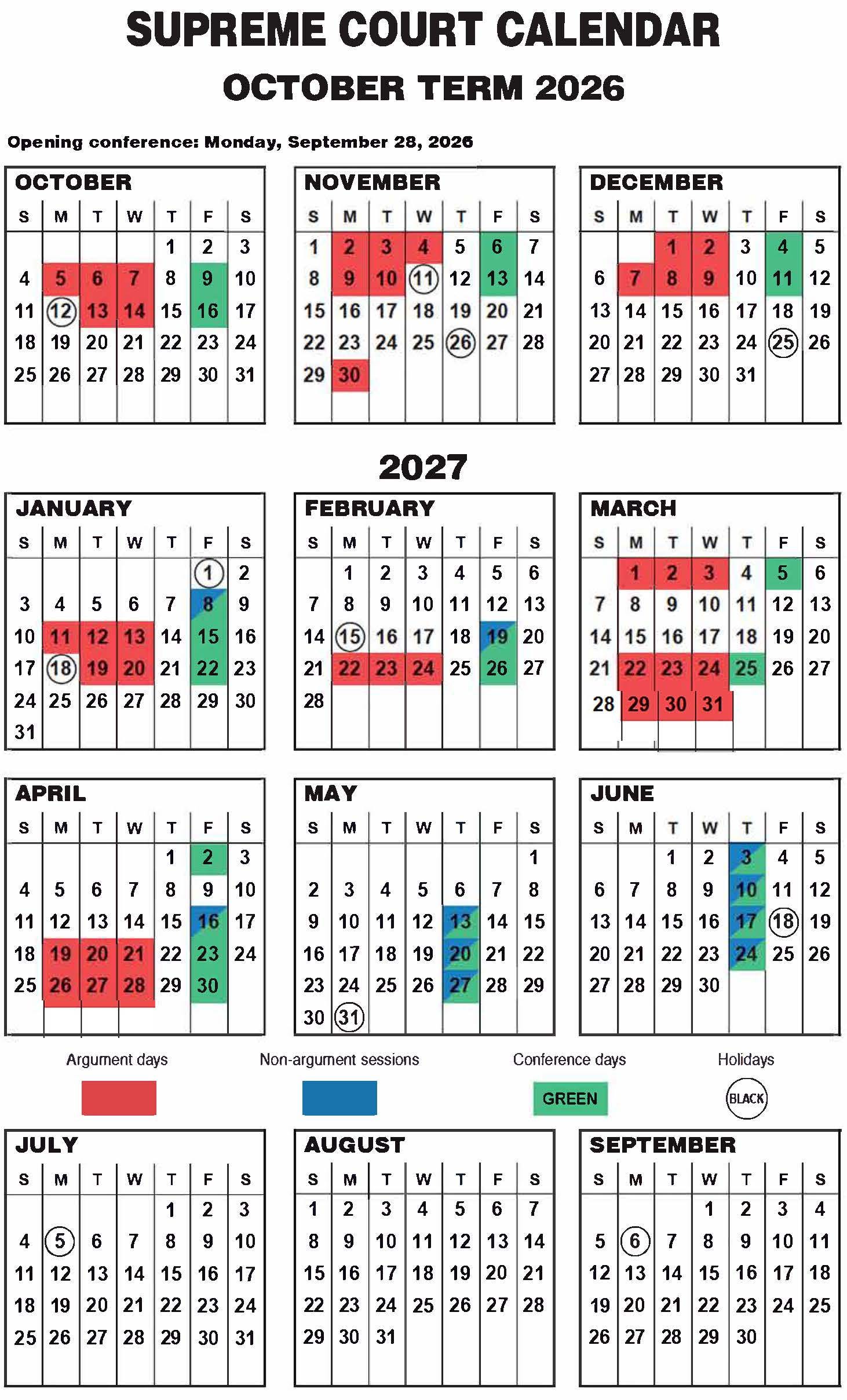
Today is the First Monday in October, which brings with it the official start of the Supreme Court’s October 2026 Term—and the official close of the October 2025 Term. I’ve written before about how just about nobody (the Court included) keeps accurate term-to-term statistics, mostly because they stop counting the previous term’s data at some relatively arbitrary point over the summer. But just as I did for the October 2024 Term 52 weeks ago today, I wanted to dedicate a post to some truly final data about the October 2025 Term—now that it really is “over.”
Last year’s post explained that the Court set two fairly revealing records on its emergency docket during OT2024—with 140 full Court rulings on applications and 31 grants of emergency relief. OT2025 came very close on the former front, with 133 full Court rulings. The number of grants “dropped” to 21, but that’s still a remarkable number compared to what was par for the course as recently as five years ago (when the averages were closer to 70 full Court rulings and 8-10 grants). And as has been true during every recent term, the divisions on the emergency docket were, once again, homogeneously ideological.
More on all of this below. But first, the news.
On the Docket
The Merits Docket
At 9:30 on Thursday morning, the Court announced three new cert. grants out of the Long Conference—a surprisingly low number. The biggest of the three, by far, is in Rhoney v. Barbosa da Cunha—one of the many pending cases about the Trump administration’s controversial and chaos-inducing claim that it can treat every noncitizen who was never lawfully admitted as an “arriving alien” (even if they’ve resided in the United States for decades) and therefore deny them bond hearings when they are arrested pending removal proceedings.
Curiously, the Court did not follow the government’s advice about which case to use to decide that question—and so took up just the statutory question (whether the administration’s novel interpretation is correct), and not the constitutional question (whether denying bond hearings violates due process). My own view is that this move on the Court’s part can be read in two very different directions. On one hand, a Court that knows it’s ruling against the government on the statute doesn’t need to spend any time on the due process question. On the other, this also allows the Court to resolve the statutory question in the government’s favor without having to immediately decide the massive constitutional question that would follow. One thing is clear, though: Barbosa da Cunha immediately moves to the front of the line as the most important case (currently) on the docket for OT2026—with oral argument likely to occur in January or February.
The Court also added another high-profile Trump immigration case to its merits docket on Tuesday—when, as part of its grant of a stay in the D.V.D. third-country removals case (about which more below), it also added that case to the merits docket, with oral argument now set for December 9. So in just two days, we went from no major Trump cases on the merits docket in OT2026 to two—and a bunch more are necessarily coming.
I also want to flag yet another aggressive new attempt by red state attorneys general to invoke the Court’s “original” jurisdiction, this time in a suit by Louisiana, Arkansas, and Alabama against New York, Massachusetts, and California—challenging those states’ telehealth shield laws insofar as they protect doctors in those states from liability arising from abortions that physically take place in the plaintiff states. Without getting into the tricky interstate federalism questions raised by state telehealth shield laws, the relevant point for present purposes is one I’ve made over and over before: the Court—yes, even this Court—has shown precisely zero interest in allowing its original jurisdiction to be usurped for these kinds of cases, no matter how ideologically charged or politically important the substantive questions may be.
Instead, the line the Court has drawn for fifty years now is one in which the justices exercise their discretion to take these state-v.-state cases if—but only if—the underlying claims are incapable of being litigated in the lower courts. And that’s not true here. We’ll surely get the usual Thomas/Alito dissent from a denial of leave to file (on their consistent view that the Court lacks discretion to not hear these cases), but it takes five votes to grant leave to file, and there’s no evidence that there are likely to be any more than two here.
The Emergency Docket
The Court closed out the October 2025 Term with yet another very busy week on the emergency docket. By my count, there were six full Court rulings on emergency applications—including two grants.
The first grant was in D.V.D., the third-country removals case about which I wrote in Thursday’s bonus issue. As I noted there, what’s especially galling about Tuesday’s stay is that it had no explanation—despite the justices’ apparent newfound commitment to provide opinions of the Court when intervening on the emergency docket. The return to unexplained interventions continued Wednesday night, when the Court granted Tennessee’s request to un-block the execution of Christa Pike (which had been paused by the Sixth Circuit)—over a written dissent from Justice Sotomayor (joined in full by Justices Kagan and Jackson). I suspect you know what happened next: Tennessee botched the execution, and Pike is currently in a Tennessee hospital in critical condition. Don’t get me wrong: The botch may well have happened even if there’d been more time between the justices’ intervention and the procedure. But it’s hard to completely discount the possibility that the litigation chaos … didn’t help.
Three of the other four full Court rulings were denials of stays of execution—including an earlier ruling in the Pike case and two denials to Florida death-row prisoner Curtis Beasley. By my count, the full Court issued a total of 46 rulings during OT2025 respecting stays of execution. 43 of those 46 denied prisoners’ requests for stays of execution (only two of which provoked public dissents); two granted states’ requests to vacate lower-court stays of execution (both of which provoked public dissents from the three Democratic appointees); and one denied a state request to vacate a stay (over public dissents from Justices Thomas, Alito, and Gorsuch). In other words, the Court sided with the prisoner in exactly one of those 46 rulings (2.2%, if you prefer your data that way).
Finally, the Court also denied the application for an injunction pending appeal in Americans for Prosperity Foundation v. Albence, a challenge to the constitutionality of Delaware’s Elections Disclosure Act, which requires organizations spending over $500 on electioneering communications close to an election to publicly disclose donors who contributed more than $100 during the election cycle (the lower courts had rejected the challenge). Given how Delaware-specific the case is, I’m not surprised that the full Court stayed out of it. But the fact that eight days passed between the completion of briefing and the boilerplate denial may suggest that, even though there were no public dissents, there was at least some internal debate. Either way, that Thursday order was the last formal decision from the Court during the October 2025 Term.
The Week Ahead
At 9:30 today, we expect one of the longest Order Lists of the term—a list that will be full of denials of certiorari from the Long Conference, and perhaps some summary rulings and opinions respecting those denials, too. Then, at 10:00, the justices will take the bench for the first time since June—and Chief Justice Roberts will formally open the October 2026 Term.
The first argument of the term is a biggie: In Suncor Energy (U.S.A.) Inc. v. County Commissioners of Boulder County, the Court will consider whether local and state governments can sue major fossil fuel companies under state tort law for the local costs of climate change, or whether those claims are impliedly preempted or otherwise displaced by … less-than-explicit federal law. One interesting note here is Justice Alito’s very belated decision to recuse—as the Court informed the parties in a letter filed last Monday afternoon. The Court will also hear argument in three other cases this week—part of an October calendar with only six arguments, total.
And because the emergency docket never stops spinning, it also stands to reason that there will be action on that side of the ledger this week, too. The most significant pending application is the Trump administration’s 41st request for emergency relief (matching the total from the entirety of Trump’s first term) in Trump v. Kingdom—in which Judge Lamberth (D.D.C.) had blocked the Trump administration’s policy restricting gender-affirming care for incarcerated transgender individuals, and a divided D.C. Circuit panel had denied a stay pending appeal. Chief Justice Roberts ordered a response to the application by this Thursday at 4 p.m. ET, so it’s possible we’ll get a ruling by the end of the week—although next week may be more realistic.
Miscellaneous
And in the miscellaneous category, I’d be remiss in not flagging two media stories and a book launch. To the former, there’s Jodi Kantor’s New York Times story from Thursday about Chief Justice Roberts’s increasing inability to escape from public criticism even on the remote Maine island where he spends much of his summer. Not surprisingly, folks’ reactions to Kantor’s reporting have largely tracked their broader feelings about the Court. But it strikes me that it shouldn’t be controversial that the justices are public figures, and that the public should be allowed to hold them accountable in public. Where the line is between public and private is, of course, much messier. But the more the justices are going out on hagiographic public speaking tours, the harder it is, in my view, to claim that they must nevertheless be protected against public criticism—even if many of them have leaned into the public celebrity role more than the Chief Justice has.
Speaking of hagiography, tomorrow is the publication date for Justice Alito’s book, So Ordered: An Originalist’s View of the Constitution, the Court, and Our Country, which has also prompted a series of public and media appearances for the 76-year-old justice. The book (which is really more a compendium of speeches than a monograph) includes a detailed discussion of the emergency docket (both from Alito’s September 2021 Notre Dame speech and a “postscript”), in which I figure … prominently. I’m going to write about at least that part of the book in a separate post—perhaps for tomorrow. So stay tuned.
In the other direction, folks might also find interesting Jay Willis’s piece for Slate (cross-posted at Balls and Strikes) about the evolution of SCOTUSblog. Without getting into the merits of Jay’s arguments, let me just say that I think it’s always important for all of us to do our best to distinguish between true journalism and what, for lack of a better word, may be described as “commentary” on current events. I make no bones about the fact that this newsletter provides commentary on the Court, not journalism about it (even when I’m covering things no one else is). For outlets like SCOTUSblog that provide both, it seems especially important to help readers identify which is which—a distinction that can easily turn on more than just who the author is.
The One First “Long Read”:
Math-ing the OT2025 Emergency Docket
Today’s “long read” will actually be pretty short, because I previewed most of the big takeaways above. Just to remind folks, most Supreme Court datasets reset for the next term when the justices rise for their summer recess—an anachronism that dates back to the pre-1980 universe, in which the Court formally “adjourned” at that point, bringing the current term to a formal close. Since 1980, the Court’s term has been “continuous” (as memorialized in Rule 3 since 1990), meaning any attempt to count everything that happens during a specific term ought to run through the Sunday before the first Monday in October—i.e., yesterday.
Part of why this is more than just pedantry is because of how much busier the Court’s summers have become. Last summer (2025), for instance, there were 11 different grants of emergency relief (in a slew of really important cases), many of which provoked some pretty significant dissents. This summer, there were “only” eight grants, but five of those came with formal opinions of the Court. For a Court that handed down only 56 rulings in merits cases, these are—or at least ought to be—significant contributions to any attempt to assess and characterize the Court’s overall workload.
And adding emergency docket data more generally also helps to provide more context for the Court’s overall behavior: Of the 31 non-unanimous decisions in merits cases, for instance, 13 divided the justices into their usual 6-3 camps. Meanwhile, of the 133 full Court rulings on the emergency docket, 29 provoked at least one public dissent. Within those 29 cases, the most common lineup was also the usual 6-3 split (14 times). Two were 5-4 (Cook and the ballroom case); two were 6-3 the other way (with Thomas, Alito, and Gorsuch in dissent); four had two Republican appointees in dissent; one had two Democratic appointees in dissent; and six had solo dissents (Thomas, Kavanaugh, and Jackson x4).1 As this data suggests, in none of those 29 cases did a justice from the Thomas/Alito/Gorsuch bloc join one of the Democratic appointees in dissent. Once again, the divisions on the emergency docket are uniformly ideological—and only reinforce arguments that the Court is defined by its political divisions.
One last point that should be obvious, but that I’ll say anyway: For as much as the uptick in the Court’s emergency docket began a decade ago, it’s really the last three terms when it’s reached these current proportions—where the emergency docket is producing as many significant, non-unanimous rulings as the merits docket. In other words, there really has been a second wave to the modern emergency docket—one that began before President Trump returned to office last January. When I first started writing about the emergency docket in 2017, a prominent conservative lawyer responded to many of my tweets with a “who cares” GIF. If nothing else, I think we can say “we all care,” and any attempt to assess the business of today’s Supreme Court that doesn’t fully account for the emergency docket is necessarily incomplete.
SCOTUS Trivia: The First Monday … Since 1917
Since I assume that folks have not committed my prior posts to memory, I thought I’d use today’s trivia to re-up a point I’ve written about before—the history of the “First Monday in October.” The full write-up is here, but the short version is that the Supreme Court’s term has begun on October’s first Monday only since 1917—thanks to a 1916 statute.
Over the course of its history, the Court’s terms have begun on the following dates:
1790—1801: The First Mondays in February and August (there were two terms per year)
1802: [No Term]
1803—26: The First Monday in February
1827—44: The Second Monday in January
1844—73: The First Monday in December
1873—1916: The Second Monday in October
The above also gives away the answer to a really obscure trivia question—the last time the Court had two full terms begin in the same year (kind of the same vibe as the “years of the three kings”). The answer is 1844, when the Court held both a January Term and a December Term—because Congress moved the beginning of the term up in June, i.e., in between the two.
Those were the days…
I hope that you’ve enjoyed this installment of “One First.” If you have feedback about today’s issue, or thoughts about future topics, please feel free to e-mail me. And if you liked it, please help spread the word!
If you’re not already a paid subscriber and are interested in receiving regular bonus content (or, at the very least, in supporting the work that goes into this newsletter), please consider becoming one:
This week’s bonus issue for paid subscribers will drop on Thursday. And we’ll be back with our regular content for everyone (no later than) next Monday.
Happy First Monday to all who celebrate.
The author of the "Shadow Docket" has a section on the "Emergency Docket."
This underlines that there is one large 'shadow" and a smaller "emergency."
I think the death penalty statistics are exactly what Congress intended when it passed AEDPA. The last second stay was always an unjustified part of death penalty litigation-- these were cases that already went through state direct appeal, state habeas, and federal habeas, but capital defense lawyers tend to have a "there's no such thing as a frivolous argument" ethic and filed cert petitions and successive habeas petitions and stay applications that had no chance of ultimate success, because they are trying to delay the execution.
A major part of AEDPA was channeling everything into first federal habeas, which means the vast majority of last second stay applications have been prohibited by Congress. Pike had a semi-clever workaround but whatever you think of that argument, most last minute stay applications don't have it and are somewhere between sure losers and legally frivolous.
So it shouldn't surprise anyone that nobody's getting last minute stays. Capital defense lawyers eventually are going to need to adjust to the new reality and get everything worth raising into the first federal habeas petition. Because under AEDPA, almost nothing can be raised later.