

I have sometimes been asked to name the one contemporary emergency docket case that bothers me the most. My answer, even before Tuesday afternoon, has always been the litigation in D.V.D. v. Department of Homeland Security—the “third-country removals” case. (A “third-country removal” is when the government removes a deportable noncitizen to a country other than the countries that federal law identifies as appropriate candidates—a list that usually starts with their country of nationality or their last country of residence.)
There have certainly been rulings on the emergency docket that I believe to be more clearly and obviously wrong on the merits. And there have been rulings on the emergency docket that have produced even more harmful effects domestically and/or to the separation of powers. But there’s something profoundly ugly about the D.V.D. case that, unfortunately, was on display again on Tuesday.
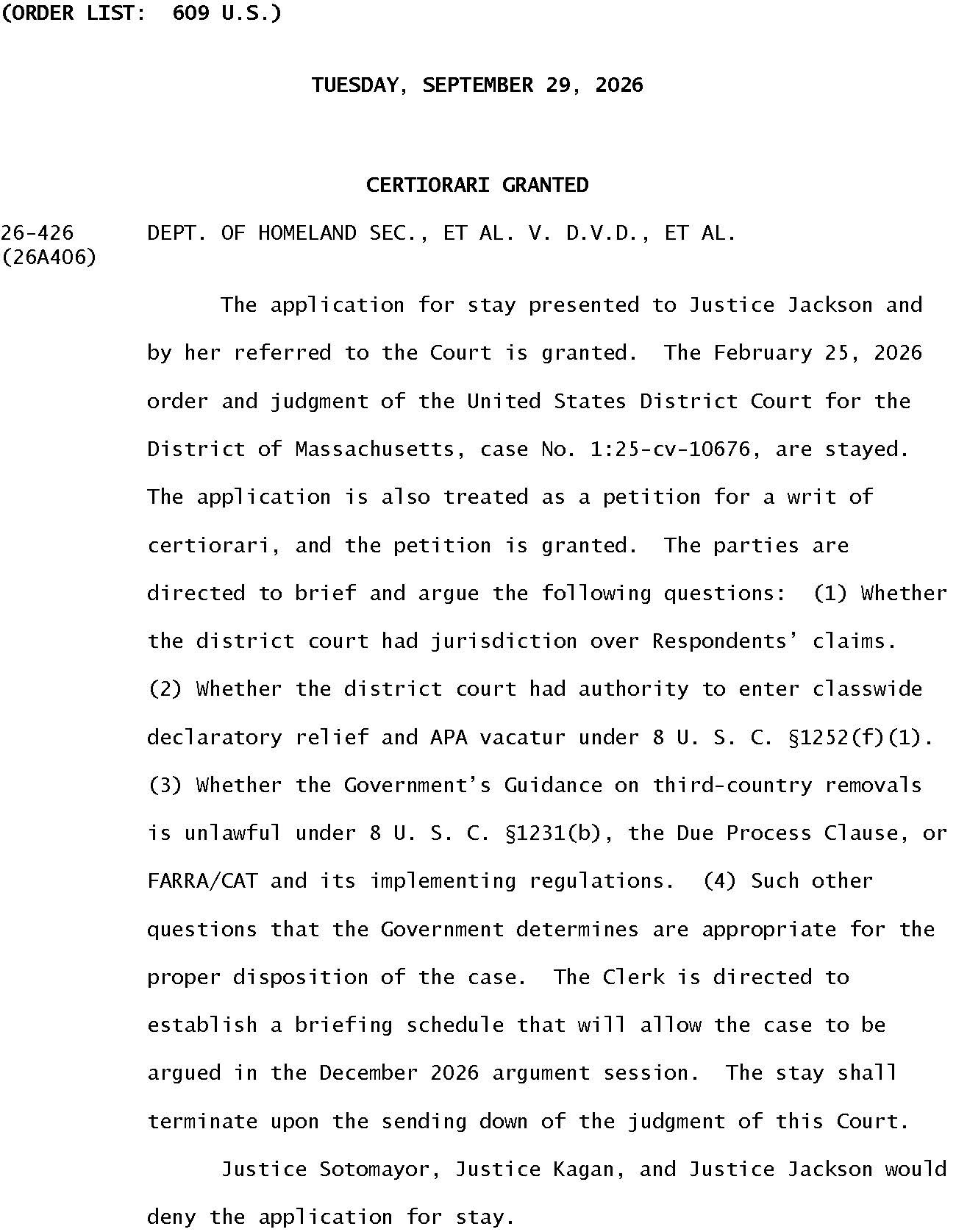
Specifically, in another wholly unexplained grant of emergency relief (so much for what had appeared to be a new norm of writing), the Court cleared the way for the Trump administration to resume the removals of noncitizens to third countries without what two lower courts concluded was the legally required opportunity to challenge whether they’d face torture or other unlawful conditions if removed to that country. And although the same order also granted certiorari and expedited consideration of the “merits,” it’s hard to view that as any kind of silver lining. Rather, if the Supreme Court is going to allow the Trump administration to deport people to third countries where they might be tortured, and without robust pre-removal review of how likely that is, it shouldn’t be controversial to believe that the justices should’ve explained why they were doing so before condemning countless immigrants to such a fate.
As I explain below the fold, the lack of any explanation is just one of four things that’s really bothering me about what the Court did on Tuesday. The second, related problem is how the Court has once again completely mucked up the balance of the equities in a Trump-related emergency application—something that’s even harder to understand given the simultaneous grant of plenary review. The third problem is the bizarre way the Court granted certiorari—including by inviting the Solicitor General to just … make up … questions the Court should decide (some of the justices may have one question in mind, in particular).
Finally, there’s the ridiculous way this decision has been portrayed on social media by right-wing lawyers who should know better. Third-country removals can raise, and have raised, some difficult legal questions. But comparing what the district court and First Circuit did in this case to what the district court and Eighth Circuit did in the Missouri redistricting case is comparing apples to tractors—all while completely whitewashing the very real harm that third-country removals can and do cause to a lot of very real people.
For those who aren’t paid subscribers, we’ll be back with our regular coverage of the Supreme Court (no later than) Monday. For those who are, please read on.
