

Welcome back to “One First,” a newsletter that aims to make the U.S. Supreme Court more accessible to lawyers and non-lawyers alike. I’m grateful to all of you for your continued support, and I hope that you’ll consider sharing some of what we’re doing with your networks.
If you’re not already a subscriber, please consider becoming one—and upgrading to a paid subscription if and when your circumstances permit:
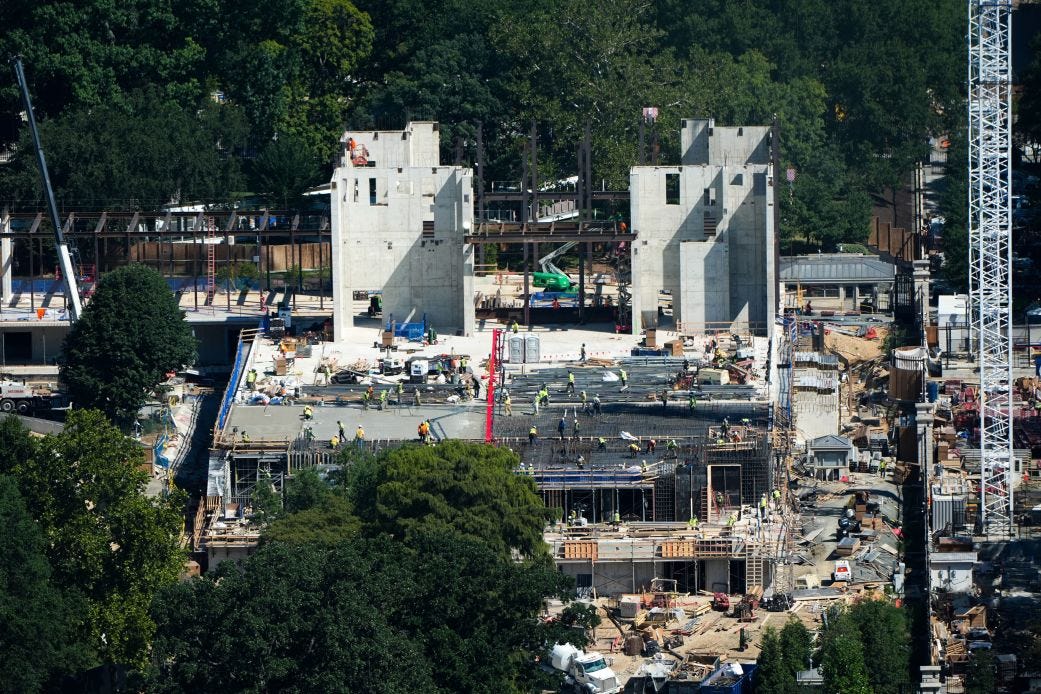
Late Friday afternoon, Chief Justice Roberts issued a one-sentence administrative stay keeping Judge Richard Leon’s injunction against above-ground construction of the new White House ballroom on hold “pending further order” of the Chief Justice or the Court. (In English, Roberts allowed ballroom construction to continue.) There was no reasoning, no vote count, and no dissent—because, as I’ve explained before, these kinds of “administrative” stays are issued by a single justice (the “circuit justice” responsible for the lower courts from which the case came) to buy time for the full Court to act.
The problem with Roberts’s administrative stay isn’t that it was unexplained; it’s that no defensible explanation for it exists. Other than a March 2024 concurrence by Justice Barrett (which was about administrative stays issued by courts of appeals), the justices have never publicly identified any criteria for an “administrative” stay, as opposed to a stay pending appeal. But irreparable harm has to be at least part of the equation. And there’s just no universe in which a party is “irreparably” harmed by a temporary pause in construction; indeed, it wouldn’t be a construction project without unplanned, temporary pauses.
For quirky procedural reasons, it’s possible that Roberts’s Friday afternoon intervention isn’t necessarily a harbinger of how the full Court is going to rule (I’m skeptical, alas). But whether it is or not, the real takeaway from the ballroom case, at least at this juncture, is that it’s long past time for the justices to publicly articulate criteria for when they should (and shouldn’t) issue “administrative” stays—and, even more importantly, to follow them.
More on all of that below. But first, the (other) news.
On the Docket
As expected, the Court released the second of three scheduled summer Order Lists at 9:30 ET last Monday. The only real news on this one was the entirely expected denial of the petition for rehearing in Trump v. Carroll, with the Court showing no interest in reconsidering its refusal to take up President Trump’s appeal of one of the two monetary judgments E. Jean Carroll has obtained against him.
The only other action from the full Court last week was Tuesday’s denial, over no public dissents, of a stay of execution to Florida death-row prisoner William F. Silvia. And the only other ruling of note was Friday’s administrative stay from Chief Justice Roberts in the ballroom case, about which more shortly.
Besides a full Court ruling in the ballroom case, we’re also still waiting for the Court’s disposition of the two emergency applications (one from the Trump administration) in the Trump v. California mail-in ballots case. Those applications have become rather more complicated by two subsequent developments. First, there’s now a separate injunction by Judge Talwani against the USPS provisions of the executive order in the separate League of Women Voters case (which would keep the most important parts of the executive order on hold even if the Court granted stays in Trump v. California). Second, late Friday, the U.S. Postal Service finally submitted its final rule purporting to implement the executive order (which is scheduled to be published this Wednesday), although the rule itself notes that “the Postal Service will not take actions to implement the rule specifically for the 2026 election unless and until the government obtains relief from those injunctions.”
One of the Trump administration’s central arguments in support of a stay in Trump v. California was that any relief against the USPS would be premature—because there wasn’t yet a final rule. Friday’s development pours pretty cold water on that position, and raises the odds that the Court simply ducks its way out of these cases for now (or that any relief it grants is limited to the DHS provisions, with the injunction against the more important USPS provisions remaining intact). It’s all a mess—one, it should be said, that’s entirely of the Trump administration’s making.1
The One First “Long Read”: The Irreparable Harm of Not Building an Unlawful Ballroom
Background
The dispute that reached the Supreme Court last week as National Park Service v. National Trust for Historic Preservation goes back to the announcement in July 2025 that the East Wing would come down to make way for a 90,000-square-foot ballroom, to be paid for with something like $400 million in (supposedly) private donations. Demolition came last fall, construction began in October, and the National Trust for Historic Preservation filed suit in December.
Judge Leon—a George W. Bush appointee, a fact worth mentioning only because of how readily the White House now describes anyone who rules against it as a Democrat—issued a preliminary injunction against construction on March 31. His holding was narrow and statutory. Congress has appropriated money to maintain the White House; it has appropriated nothing for a ballroom. The workaround—private donations routed through the Park Service and then, by way of the Economy Act, to the Office of the Executive Residence—was in Leon’s phrase a “Rube Goldberg contraption,” and it did not supply the missing authority. Two weeks later, Leon modified his injunction to clarify that it applied only to above-ground construction of the ballroom. His April 16 order carved out all underground work, bunkers and shelters included, along with any above-ground work “strictly necessary to ensure the safety and security of the White House and its grounds.” In other words, Leon structured the injunction to allow construction directly related to the bunker and any related national security needs, but to block the ballroom itself.
The government immediately appealed Leon’s April 16 ruling and sought a stay pending appeal. The next day, the D.C. Circuit issued an “administrative” stay, allowing construction to continue while it considered whether to stay the injunction pending an appeal it also expedited. Then, on August 7, instead of ruling on the stay, a divided D.C. Circuit panel affirmed Judge Leon’s preliminary injunction on the merits.
Writing jointly across 100 pages, Judges Millett and Garcia concluded that Congress has “full constitutional control over federal property” and that the government could point to no “express or implied authorization” for what it was building. National security, they added, is “not an automatic get-out-of-law-free card,” especially given that Leon’s injunction specifically exempted below-ground construction and above-ground construction strictly necessary for national security purposes. Having affirmed on the merits, the panel denied the pending stay motion as moot. That last detail is worth pausing on, because the government has since described itself as having been turned down for a stay by two separate courts. What actually happened is that it lost its preliminary injunction appeal on the merits—which ought to be a bigger deal (and carry more weight) in the Supreme Court.
Judge Rao dissented in the D.C. Circuit, in an opinion that formed much of the basis for the Solicitor General’s subsequent application to the Supreme Court. Her principal objection is to the plaintiffs’ standing. The Trust, she wrote, cannot sue in its own right because this litigation is not germane to its statutory purposes, and the germaneness theory the majority relied upon had, in her view, been forfeited by the parties anyway—an argument pitched squarely at a Court that has lately shown a keen interest in party presentation. She also would have rejected the Trust’s reliance on the putative injuries to Alison Hoagland, the architectural historian whose enjoyment of the White House the lower courts found impaired by the construction. As for the injunction itself, Rao called it “a blatant abuse of discretion”: “The district court seized supervision of construction at the White House, and my colleagues affirm this judicial overreach.” Alas, I don’t think the standing portion of Judge Rao’s dissent is crazy (although that’s partly because of how malleable standing doctrine has become). The merits, on the other hand…
What drove the timing from there was how Judges Millett and Garcia structured the mandate: They stayed their ruling for 14 days to allow the Trump administration to seek Supreme Court review. That clock was set to expire at the end of the day last Friday, which is why, when the Trump administration filed for a stay on August 13, it also requested at least an “administrative” stay by last Friday to preserve the “status quo” (one in which construction was continuing).
In its application before the Supreme Court, the government offered two arguments for why allowing Leon’s injunction to go into effect would cause irreparable harm. One was national security: Solicitor General Sauer described the project as “an integrated military complex” that is “vitally required by national security.” The other was momentum: a “250-person crew working 20 hours a day, 7 days a week,” on a project “65% complete in its entirety, and moving quickly toward total completion.”
The Trust’s response, filed last Tuesday, made the obvious rejoinder to the first theory of irreparable harm. Nothing in Leon’s order “prevents them from continuing work on the bunker, securing the East Wing site, or ensuring the safety of the President, his family, and staff.” The security carve-out is transparent on the face of the (modified) injunction. What the injunction stops is just the ballroom. As for the government’s second irreparable harm argument, the Trust said the quiet part out loud: the government has been trying to “outrun judicial review,” building as fast as it can so that it can then tell the justices the project is “beyond the point of no return.” Those “efforts to foil judicial review and arrogate Congress’s exclusive powers,” the brief argued, “should not be rewarded with a stay that allows [the government] to complete a ballroom [it] lack[s] any authority to commence in the first place.”
Friday’s Order and Its Implications
An administrative stay is supposed to be a housekeeping device—to freeze things so that the Court has time to rule on the application in front of it. Roberts’s order says nothing about the merits and doesn’t purport to, and it stands to reason that he’s already referred the application to the full Court, the full Court has already voted on it, and the delay involves the preparation of opinions supporting or dissenting from whatever that disposition is. It is therefore entirely possible that Friday’s order is simply buying time for the Court by “preserving” what had been the status quo since April 17, i.e., that ballroom construction could continue.
There are two problems, though. The first is that there’d be no need to preserve that status quo if the Court had already voted, behind the scenes, to deny the stay. Indeed, especially given the arguments the Trust has made about trying to “outrun judicial review,” even a brief extension of the status quo would be problematic if the end result was foreordained—and adverse to further construction.
Compounding the first problem is the second—the lack of any published standards to guide when a circuit justice should (and shouldn’t) issue an “administrative” stay, a tool that has become much more common in recent years (Roberts’s Friday order is at least the eighth of the October 2025 Term; as recently as the October 2020 Term there were two). You will not find, anywhere in the Supreme Court’s Rules or in any published opinions, a definition of an administrative stay, a standard for granting one, a cap on how long one may last, or a rule about who gets to decide. Did the Chief Justice balance the equities? Did he form a view about the government’s likelihood of success? Did he conclude that the government faced some interim harm? Or did he simply decide that the justices needed more time, and that freezing the injunction was the tidiest way to buy it? The order tells us nothing, and that’s a problem unto itself.
The only real discussion of administrative stays anywhere in the Court’s recent emergency-docket work is Justice Barrett’s concurrence, joined by Justice Kavanaugh, in United States v. Texas—the March 2024 order that let Texas’s SB4 go into effect while the Fifth Circuit sat on the stay motion. Barrett conceded that “there is no jurisprudence of administrative stays, much less a one-size-fits-all test,” thought the gap was tolerable (“Play in the joints seems appropriate for a measure that functions as a flexible, short-term tool”), and I argued at the time that she had reached the right conclusion for the wrong reason. Two more years have not changed my mind.
But Barrett also conceded three things that should cut directly against Friday’s order. First, these stays are “not value neutral”; they reflect “a first-blush judgment about the relative consequences of staying the lower court judgment versus allowing it go to [sic] into effect.” Second, they must be short: “An administrative stay should last no longer than necessary to make an intelligent decision on the motion for a stay pending appeal.” Third, “[t]he time may come, in this case or another, when this Court is forced to conclude that an administrative stay has effectively become a stay pending appeal and review it accordingly.”
On Barrett’s own account, Friday’s order was not value neutral—it embodies a judgment that halting the ballroom by mistake would be worse than letting any further construction go forward by mistake. Given that the injunction exempts anything relating to national security and/or the safety of the President, his family, and White House staff, I just cannot construct the reasoning that gets anyone there on these facts. It’s also worth flagging that the status quo legally is that there’s a preliminary injunction against the construction that the D.C. Circuit affirmed. Barrett acknowledged that “there is no settled way of defining ‘the status quo,’” but on every candidate she floated—before the challenged conduct, before the lawsuit, before the courts got involved—the answer is not a 250-person crew working around the clock on a structure already 65% finished. Staying Leon’s injunction protects the government’s timetable here, not the Court’s ability to deliberate. And the order is not time limited: Roberts set no deadline, so construction proceeds until the Court says otherwise.
In the SB4 case, the justices were reviewing a court of appeals’ administrative stay, and Barrett’s answer thus also included a paean to institutional restraint, i.e., that the Court should let the Fifth Circuit “be the first mover” on the formal stay factors. Here there is no first mover left. The D.C. Circuit affirmed the injunction and mooted the stay motion. The only stay analysis outstanding is the Supreme Court’s own, on an application it has now had before it for 11 days.
If anything, the fact that the government’s strongest argument on the merits is about standing, and not the legality of the construction, only makes this worse. After all, this is the same Court that held in Biden v. Nebraska—in an opinion by the same Chief Justice—that Missouri could challenge student-loan forgiveness on the strength of an attributed injury to MOHELA, a separately incorporated entity that hadn’t sued and could have sued on its own (a holding I described, quite deliberately, as “lawless” for how it defied settled constraints on standing).
Hoagland’s injury here, in contrast, is conventional standing fare, much closer to the ordinary run of environmental and historic-preservation cases than anything in Nebraska. A Court that swallowed that theory in 2023 is poorly positioned to call this one too thin—and if it does, then the D.C. Circuit’s holding that Congress controls construction on the White House grounds becomes unenforceable by anyone.
To bring things full circle, if the government’s best merits argument is that nobody can sue, and the stay lets construction race to completion while the justices deliberate that issue, then the stay isn’t protecting the Court’s ability to decide the merits; it’s effectively dissolving it. That’s why we’re long overdue for the Court to articulate criteria for administrative stays—to make it easier to have at least some faith that these kinds of interventions, which can have dramatic effects on the litigation in which they’re undertaken, are pursuant to neutral principles, and not just case-specific (or president-specific) whims of individual justices.
And whatever those criteria turn out to be, it’s hard to imagine how they could have been satisfied here—no matter what the full Court does next, or when.
SCOTUS Trivia: The Last August Argument
Speaking of emergency litigation before the Supreme Court in August, this Friday marks 68 years since the last time the Supreme Court heard an oral argument in the eighth month of the year. On August 28, 1958, the justices convened in a rare Special Term—the caption in the U.S. Reports reads “August Special Term, 1958”—to take up the Little Rock school board’s request to postpone desegregation for two and a half years. (“Special Terms” are a pre-1990 relic for when the Court needed to convene after it had adjourned the previous term but before the new one had begun. The Court’s 1990 move to a “continuous” term has mooted the need for them.)
The posture was, of course, an emergency one: the board had won a suspension from Judge Lemley, the Eighth Circuit had reversed on August 18 but stayed its mandate, and school was set to open on September 15. The Court heard argument on August 28 on the motion to vacate that stay, with Solicitor General Rankin appearing by invitation as amicus and urging the justices to vacate it forthwith.
Having concluded that the motion could not be resolved without reaching the merits, the Court set an expedited schedule for plenary review, and set argument on the merits for noon on September 11. It affirmed in a per curiam order filed the next day (September 12), with the full opinion—signed individually by all nine justices—following on September 29, at which point Chief Justice Warren adjourned the “Special Term.”
Every other month on the calendar has had at least one Supreme Court argument since 1958. August is the lone holdout—although, the way the emergency docket is going, it may not be for too much longer.
I hope that you’ve enjoyed this installment of “One First.” If you have feedback about today’s issue, or thoughts about future topics, please feel free to email me. And if you liked it, please help spread the word!
If you’re not already a paid subscriber and are interested in receiving regular bonus content (or, at the very least, in supporting the work that goes into this newsletter), please consider becoming one:
This week’s bonus issue will drop on Thursday. As ever, I hope you are all staying safe out there, especially from standardless administrative stays.
In the League of Women Voters case, Judge Talwani is moving very quickly to potentially block publication of the USPS Final Rule, with the government’s briefs respecting a potential TRO due by 8:00 a.m. tomorrow. So it’s possible that the League of Women Voters case, and not Trump v. California, ends up as the vehicle through which the merits of the USPS provisions reach the Court.
SCOTUS justices always were expected to be governed by strict rules. Public servants governed by rules is essential to the rule of law. As Alexander Hamilton in Federalist No. 78 (to explain why Americans should support ratification of the Constitution) emphasized, "To avoid an arbitrary discretion in the courts, it is indispensable that they should be bound down by strict rules and precedents."
Judges are not allowed (by our Constitution) to "substitute their own pleasure to the constitutional intentions of the legislature" (or the will of the People expressed in our Constitution). Judicial independence means that "judges [actually] do their duty as faithful guardians of the Constitution." The "necessary independence" of judges means their "inflexible and uniform adherence to the rights of the Constitution, and of individuals, which we perceive to be indispensable in the courts of justice."
"This independence of the judges is equally requisite to guard the Constitution and the rights of individuals from the effects of those ill humors, which the arts of designing men, or the influence of particular conjunctures, sometimes disseminate among the people themselves, and which . . . have a tendency [ ] to occasion dangerous innovations in the government, and serious oppressions of the minor party in the community."
When are people going to stop ignoring the patently obvious and just state that this SC is packed full of crooked hacks. They will say or do anything, and they will rule in whatever way they have to to keep Trump in power.