

Welcome back to “One First,” a newsletter that aims to make the U.S. Supreme Court more accessible to lawyers and non-lawyers alike. I’m grateful to all of you for your continued support, and I hope that you’ll consider sharing some of what we’re doing with your networks.
If you’re not already a subscriber, please consider becoming one—and upgrading to a paid subscription if and when your circumstances permit:
On Thursday, the en banc Fifth Circuit finally ruled on the long-pending Alien Enemies Act case that had reached the Supreme Court in April 2025 as A.A.R.P. v. Trump, but that has since been captioned W.M.M. v. Trump. To make a long story a bit shorter, the full court of appeals held that the important questions the case raised about the President’s authority under that 1798 statute had been mooted by the fact that the government had successfully removed the three named plaintiffs under other, more “ordinary” immigration authorities. Some right-wing commentators hailed the ruling as a “win” for the Trump administration, and in the narrowest sense, that’s not completely inaccurate. Given that it was the petitioners who appealed, the fact that their appeal was dismissed and the reason why it was dismissed (because these individuals were removed from the United States) certainly means that they didn’t “win.”
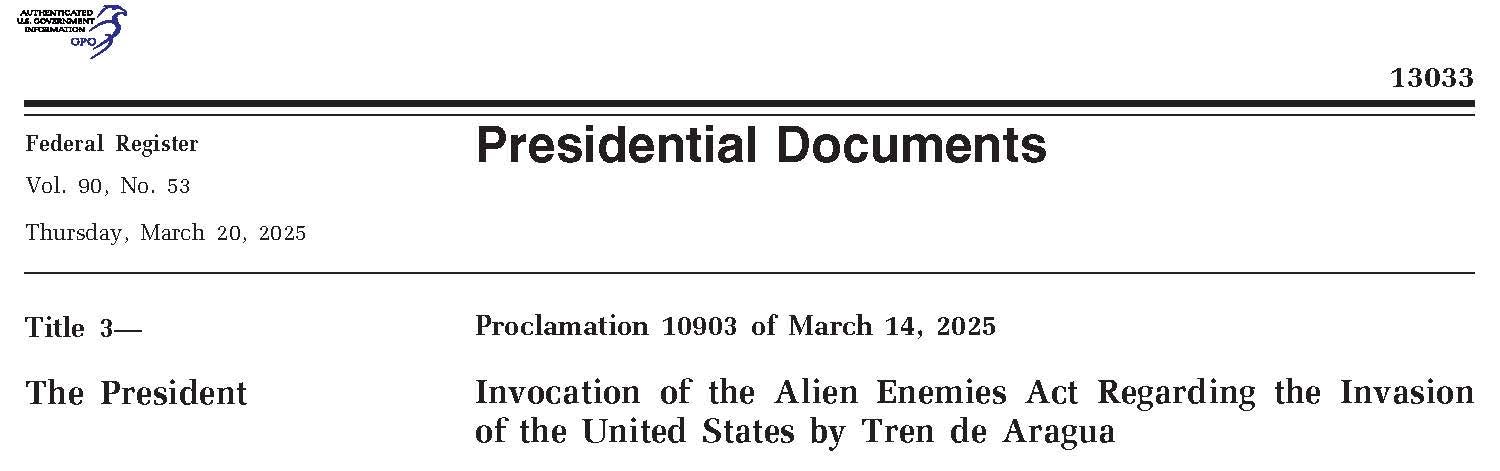
But I want to use today’s post to argue, to the contrary, that the denouement in W.M.M. quietly but emphatically drives home how badly the Trump Administration lost the Alien Enemies Act litigation writ large—as reflected in its clearly deliberate decision to moot these cases rather than defend the validity of President Trump’s March 14 proclamation invoking the act against members of Tren de Aragua (a Venezuelan gang).
Clever lawyering on the government’s part may have allowed it to avoid a precedential holding that the March 14 proclamation is invalid—which, as I’ll explain below, is a problem unto itself. But the reality is that, ever since the famous planes that didn’t turn around on March 15, 2025, every public indication is that no one has been removed from the United States under the AEA. And as problematic as I believe (and have argued) so much of the Supreme Court’s behavior on the emergency docket over the past 18 months has been, I also have to admit, as I explain below, that the justices were key players in the failure of the Trump administration’s misbegotten AEA enterprise. Folks can spin last week’s Fifth Circuit ruling however they want; the real bottom line is that this is how the AEA litigation seems destined to end—with a procedural whimper, not a substantive bang.
More on all of that below. But first, the news.
On the Docket
There was a single ruling by the full Court last week—Thursday’s denial of a stay of execution to Tennessee death row prisoner Anthony Hines, over no public dissents. Justice Kagan also issued a very brief administrative stay in the latest iteration of the long-running litigation between Apple and Epic Games—one that she dissolved herself in denying Apple’s application in chambers on Thursday.
This week will necessarily be busier—if for no other reason than because we expect the second of the Court’s three “regular” summer Order Lists at 9:30 ET this morning. We may also get a ruling on the two pending emergency applications respecting President Trump’s effort to interfere with mail-in ballots via executive order. And as expected, the administration also filed an emergency application last week (#36 if you’re scoring at home—or even if you’re by yourself) in the White House ballroom case. Besides the substantive significance of that case, the application includes 10 brand-new factual declarations by various government witnesses (beyond the declarations submitted in the lower courts)—raising the recurring (and problematic) issue of the factual “record” that’s before the justices on their emergency docket. (Chief Justice Roberts ordered a response by noon ET tomorrow, so this one may move quickly.)
In less significant news, the Court has also released the argument calendar for its November 2026 sitting—a whopping seven cases over five days. I wrote in April about how the Court could decide the same total number of cases each term without an April argument sitting by filling more of the slots earlier in the term; here’s a good example of those slots sitting open.
The One First “Long Read”:
The AEA Litigation … Ends?
I wrote a lot last spring about President Trump’s invocation of the Alien Enemies Act on March 14, 2025 as part of an apparent attempt to engage in mass, summary removals of at least some non-citizens the administration simply deemed to be members of Tren de Aragua—a Venezuelan drug gang that the government claimed had deep connections to the Maduro regime. Without rehashing all of the details, it may be useful to provide a brief procedural recap—to underscore the Supreme Court’s role in at least indirectly thwarting the administration’s (apparent) plan to utilize the AEA as a way of depriving a large number of non-citizens of the ordinary administrative and judicial process before they could be removed.
Round 1: J.G.G.
The litigation started, of course, in the D.C. federal district court in the case captioned J.G.G. v. Trump. On Saturday, March 15 (the same day that the President’s AEA proclamation was actually made public—by which point efforts were already well underway to remove hundreds of non-citizens from the country pursuant to that proclamation), Chief Judge Boasberg issued a pair of TROs—the first one blocking the removal of the named plaintiffs; and the second blocking the removal of any member of a nationwide class of individuals otherwise subject to the proclamation.
It’s worth pausing for a moment to flag the substantive point: the proclamation is based on the view that the United States is subject to a “predatory incursion” by Venezuela because of drug trafficking by gangs like TdA. Leaving aside the dubiousness of the factual predicate (one that the Trump administration’s own intelligence agencies rejected), the whole theory turns the AEA on its head—since that statute was meant to deal with nationals of countries with which the United States is in an actual war, like German, Italian, and Japanese nationals during World War II. Whatever else one might say about drug trafficking, or about the Maduro arrest operation, we were not then, and are not now, at war with Venezuela.
Anyway, the government defied (yes, Judges Katsas, Rao, and Walker—defied) those TROs by refusing to turn around planes that were already in the air, and it also appealed the TROs and sought emergency relief from them first in the D.C. Circuit and, when that failed, in the Supreme Court.
On April 7, 2025, the Supreme Court stayed Boasberg’s TROs by a 5-4 vote, with Justice Barrett joining the three Democratic appointees in dissent. The actual legal basis for the stay was the majority’s (deeply contestable) assertion that challenges to AEA removals had to be brought as habeas petitions, rather than, as in J.G.G., in a single, nationwide action under the Administrative Procedure Act. And because habeas petitions typically have to be brought in the districts in which the petitioners are actually detained, that meant these cases would have to be re-filed in Texas. As I detailed at the time, however doctrinally inconsistent (and wrong) that conclusion may have been, it had the intended and direct effect of channeling AEA claims into district-by-district habeas petitions.
But perhaps because of the stridency of the dissenting opinions in J.G.G., both the unsigned majority opinion and Justice Kavanaugh’s concurrence went out of their way to preemptively reject the Trump administration’s more extravagant claim—not that these cases had to be brought as habeas petitions, but that the petitioners were entitled to vanishingly little process in challenging their potential removals under the AEA.
Instead, the majority opinion in J.G.G. specifically emphasized that “AEA detainees must receive notice after the date of this order that they are subject to removal under the Act. The notice must be afforded within a reasonable time and in such a manner as will allow them to actually seek habeas relief in the proper venue before such removal occurs.” And Justice Kavanaugh buttressed that point in his concurrence, explaining that “all nine Members of the Court agree that judicial review is available.” In other words, even as the Court (wrongly, in my view) channeled AEA claims into a series of distinct, multi-district habeas petitions, it emphasized that such habeas review would be—and would need to be—meaningful. If anything, the way the Court handled the emergency application in the Abrego Garcia case just days later provided further evidence that the justices were contemplating a vigorous role for judicial review even for those who had already been removed from the United States—and not just a rubber stamp.
Round 2: A.A.R.P.
Less than two weeks after J.G.G., the strength of the Court’s commitment to that kind of meaningful review was tested in the A.A.R.P. case. That case was the lead district-wide habeas class action brought on behalf of AEA detainees in the Northern District of Texas—the only district court to hear such a case that did not immediately enjoin or otherwise block AEA removals pending the notice and hearing that the Supreme Court had required. When it appeared that the government was going to remove a group of detainees from the Northern District without abiding by J.G.G., the Supreme Court issued its only grant of emergency relief to date against the second Trump administration—handing down a short but unusually emphatic order shortly before 1:00 a.m. ET on Saturday, April 19 that directly barred the removal of any member of the putative class (that is, any AEA detainee in the Northern District of Texas) while that litigation proceeded. The order came over only two public dissents (from Justices Thomas and Alito), and was backstopped with a more complete opinion on May 16.
As I suggested at the time, the Court’s machinations in A.A.R.P., like its ruling in J.G.G., had two sides. On one hand, here was the Court moving quickly and aggressively to preserve its own mandate in J.G.G., and to communicate, as clearly as it could, that it meant what it had said on April 7 about notice and an opportunity to be heard. On the other hand, rather than pretermitting all of this messy, chaotic, and high-stakes litigation by addressing the substantive merits of President Trump’s March 14 proclamation, or saying anything about the government’s misbehavior in J.G.G., the Court’s moves had been entirely procedural—ensuring a meaningful role for the courts (and the Court) at some future point in answering that question.
Round 3: W.M.M.
With A.A.R.P. quashing any thought of trying to remove folks under the AEA anyway, the Trump administration pivoted to litigating those questions—and to doing so only in the Fifth Circuit (since, under J.G.G., those questions could only be addressed where AEA detainees were being held). This led to the three-judge Fifth Circuit panel’s decision in W.M.M. (what had been the A.A.R.P. case) on September 2, 2025. Over a … lengthy … dissent from Judge Oldham, the court of appeals, in an opinion by Judge Southwick, held that the proclamation was in fact unlawful—principally because Tren de Aragua’s activities did not constitute an “invasion” or “predatory incursion” absent at least some military action.
At that point, rather than take the case to the Supreme Court, the Trump administration decided, instead, to seek en banc review in the Fifth Circuit. That move was another in a series of efforts by the Solicitor General’s office to avoid Supreme Court review on the merits of the President’s AEA proclamation—or, at the very least, to delay it. It’s one thing to delay such review when you’re winning. But recall that the status quo here was a de facto nationwide block on AEA removals. In that posture, not trying to get before the Supreme Court faster was a pretty clear tell. Indeed, it certainly appeared that the government had decided that it wasn’t likely to prevail on the merits if and when the case returned to the Supreme Court—and so the best-case scenario was to (1) vacate the adverse, precedential Fifth Circuit panel ruling; and (2) buy time to pursue other avenues for removing the named plaintiffs in W.M.M. Otherwise, there was no reason to seek further review in the Fifth Circuit rather than immediately petitioning for certiorari in the Supreme Court.
Unsurprisingly, the Fifth Circuit was perfectly happy to oblige—granting rehearing and vacating the panel opinion on September 30, 2025. As last Thursday’s unsigned ruling by the en banc court of appeals explained, “after oral argument before the en banc court, we learned that the government has removed all three named petitioners under the Immigration and Nationality Act—that is, not the AEA.” The result was to moot these petitioners’ appeals. And although the ACLU had asked the Fifth Circuit to substitute other detainees (who are still in U.S. custody) to allow the case to proceed, the court of appeals denied that request in a separate order (albeit without prejudice to the district court allowing the same).
To be sure, the dismissal was accompanied by a pair of thinly-veiled Supreme Court auditions qua concurring opinions from Judges Oldham and Ho trying to salvage the government’s position on the merits (with Oldham reupping his panel dissent and Ho going off on “invasions”). But the fact that those (deeply problematic) analyses came as separate concurrences proves the point: the majority of the en banc court went the procedural route and dismissed the petitioners’ appeals as “moot” rather than giving any credence to the substance of the government’s position.
So now what? I’d be very surprised if the three specific petitioners in W.M.M. try to pursue this litigation any further. Of course, the ACLU may well seek to have other plaintiffs substituted in the district court to continue the challenge, but if the government is bent on mooting those cases, too, it will likely be able to do so. There is also, of course, the ongoing litigation in the D.C. district court over the government’s defiance of Chief Judge Boasberg’s TROs in the J.G.G. case. But on the merits, that case, too, has long-since been mooted. And so far as I know, there are no other live, pending cases in which the government is appealing an adverse AEA ruling by a district court. For now, at least, this appears to be the end of the line for President Trump’s March 14 proclamation—and for whatever plans the Trump administration had for using the AEA as part of its immigration policy. (And for the conspiracy theorists among you who might worry that this was all just a ploy to get out from under the Supreme Court’s A.A.R.P. rulings, specifically, but not to give up on AEA litigation at least for now, let me just say that I don’t think the justices would be especially … impressed by such a maneuver.)
The upshot of all of this, of course, is that there is no adverse, precedential ruling holding that the proclamation was unlawful—and so there’s nothing to stop this administration (or a future one) from trying to rely on this proclamation, or the theory behind it, in future cases. In that respect, the AEA litigation has become the poster child for what Professor Andrew Coan has called “the appellate void”—when the government can effectively frustrate appellate review of rulings blocking a policy simply by not appealing them. Without universal injunctions (mostly foreclosed by the Supreme Court in CASA), nationwide APA relief (expressly foreclosed in the AEA context by J.G.G.), or nationwide class actions (implicitly foreclosed in the AEA context by J.G.G.), the government can litigate in a number of district courts, and then not be bound in any other cases when it loses those. As I suggest in my forthcoming Harvard Law Review Foreword, the Supreme Court bears direct responsibility for exacerbating this phenomenon over the last 18 months, and the AEA litigation is the textbook illustration of how it has done so.
And yet, for as unsatisfying as the AEA litigation has been substantively, it’s worth coming back to the practical bottom line: procedurally, it has been wildly successful from the perspective of the countless non-citizens who might otherwise have been subject to AEA removals. Yes, some of those folks, like the petitioners in W.M.M., have been removed anyway, but only under authorities that were already established. It’s not a “win” for the Trump administration to use its existing powers; if anything, that proves only that the extraordinary claim of new authority may never have been necessary—to say nothing of whether it’s legal.
Instead, the bottom line is that not a single person has been removed from the country under the AEA since March 15 of last year. The first three weeks of that can be traced directly to Chief Judge Boasberg’s TROs. But credit for the remainder has to be given to the Supreme Court, including the three justices in the majority in both J.G.G. and A.A.R.P. (the Chief Justice, Justice Gorsuch, and Justice Kavanaugh)—who went out of their way to (1) insist on notice and a meaningful opportunity to be heard in J.G.G.; and (2) back that up in A.A.R.P. Those were clearly meaningful moves in retrospect, even if their formal effect was to put off (potentially, indefinitely) conclusive judicial review of a patently lawless executive action.
The Court’s more ardent defenders have already held up the AEA litigation as one of the most meaningful examples of this Supreme Court standing up to Trump. I’ve always thought that claim was both slippery (compared to what?) and badly overstated given what the Court didn’t do in either J.G.G. or A.A.R.P. (i.e., reach the merits). But even if that claim is overstated, the trajectory of the AEA litigation since April 2025, potentially culminating in last Thursday’s en banc Fifth Circuit ruling in W.M.M., increasingly demonstrates that it isn’t wrong.
SCOTUS Trivia: A Correction on Last Week’s Trivia
I wrote last week about President Washington’s August 1795 recess appointment of John Rutledge as the second Chief Justice—and how Rutledge doomed his confirmation chances by giving a fiery speech in opposition to the Jay Treaty. But I got something importantly wrong—writing (in a brain fog, apparently) that Rutledge had been the first recess appointment to the Supreme Court.
In fact, that “honor” goes to Justice Thomas Johnson, the first justice to be appointed to the Court after the “original six” (take that, NHL!).1 As my friend (and incomparable Supreme Court historian) Maeva Marcus pointed out, Johnson received a recess appointment in August 1791 (although he didn’t take the oath until September 19), before being formally confirmed by the Senate on October 31. Indeed, Johnson’s recess appointment may be the answer to another puzzle—why the Supreme Court itself has apparently changed its mind about who the shortest-serving justice was, with the Court’s website now (correctly) identifying James F. Byrnes after it had, for a time, identified Johnson.
But this also gives me a chance to share my favorite Thomas Johnson trivia—the letter he sent to President Washington when he resigned from the Court so shortly after joining it. Like many of his contemporaries, Johnson hated circuit riding—and he wasn’t afraid to let Washington know about it, writing, among other things, that “I cannot resolve to spend six Months in the Year of the few I may have left from my Family, on Roads at Taverns chiefly and often in Situations where the most moderate Desires are disappointed: My Time of Life Temper and other Circumstances forbid it.”
Those were the days.
I hope that you’ve enjoyed this installment of “One First.” If you have feedback about today’s issue, or thoughts about future topics, please feel free to email me. And if you liked it, please help spread the word!
If you’re not already a paid subscriber and are interested in receiving regular bonus content (or, at the very least, in supporting the work that goes into this newsletter), please consider becoming one:
This week’s bonus issue will drop on Thursday. As ever, I hope you are all staying safe out there, especially from unlawful executive proclamations.
I’m counting Justice Iredell as one of the original six—even though Robert Harrison was nominated (and confirmed) to hold that seat before him, and on the same day as the other five justices initially appointed to the Court. Harrison declined the appointment, and thus never assumed office on the Court.
"There is also, of course, the ongoing litigation in the D.C. district court over the government’s defiance of Chief Judge Boasberg’s TROs in the J.G.G. case. But on the merits, that case, too, has long-since been mooted."
Yes. Actually punishing these people is the sort of thing that leads people to dream of an afterlife.
Thirty-six emergencies! This ultra conservative majority “humors” - indeed gives near total immunity to - a cranky manchild whose behavior is ignored but whose loud, whiny demands are immediate.