

Welcome back to “One First,” a newsletter that aims to make the U.S. Supreme Court more accessible to lawyers and non-lawyers alike. I’m grateful to all of you for your continued support, and I hope that you’ll consider sharing some of what we’re doing with your networks.
Every Monday morning, I’ll be offering an update on goings-on at the Court (“On the Docket”); a longer introduction to some feature of the Court’s history, current issues, or key players (“The One First ‘Long Read’”); and some Court-related trivia. If you’re not already a subscriber, I hope you’ll consider becoming one—and upgrading to a paid subscription if your circumstances permit:
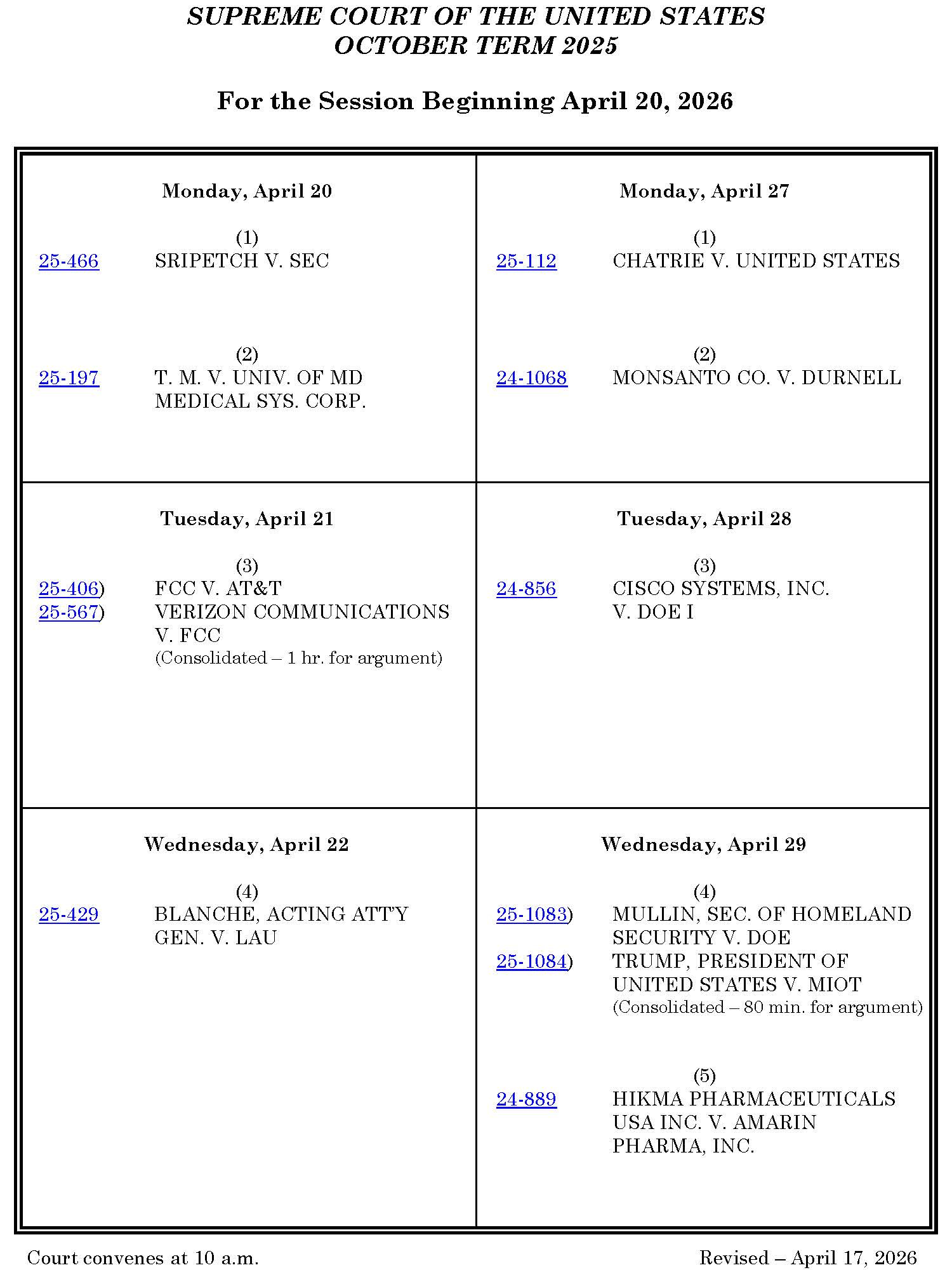
At the risk of writing a post that isn’t about the emergency docket and/or the Clean Power Plan cases, I wanted to use this week’s “Long Read” to take up a topic that’s long been a bugaboo within the Supreme Court’s press corps—the very existence of the April argument calendar. Specifically, the concern is that the justices unnecessarily back-load their argument calendar with cases that, under even the best of circumstances, just can’t be given the same amount of time and attention that they’d receive if they were argued earlier in the term. (The reason is because of the all-but inviolable, if entirely arbitrary, norm that the Court hands down all of its decisions in argued cases before July 4, and usually by the end of June.) One of the Court’s most visible (and direct) advocates, Lisa Blatt, even said the quiet part out loud during one of last week’s oral arguments, suggesting to the justices that she had assumed that a particularly broad holding was not a possibility because of when the case was being argued—“Not in an April case. Not happening.”
Historically, there have really been only two good arguments for keeping the April calendar, and both have arguably been overtaken by recent events. The first is that the Court would run out of argument slots without it. But as the total number of oral arguments has continued to stay below 60 each term since OT2019, that claim is increasingly incorrect as a matter of basic math. This term, the Court’s first six argument calendars (five or six days per month during each month from October-March) had a total of 17 “open” slots (that is, days on which the Court heard only one argument, not two). The entire April calendar has nine arguments.
The second is that some of these cases are both late-breaking and need to be resolved during the current term, so having them bumped back to October isn’t really viable. But even if that’s a regular phenomenon (only the TPS cases arguably meet that standard from this argument session), it’s not an argument for keeping the entire April calendar. The Court could simply add an unscheduled argument date for cases that need one—just as it did last year for the emergency applications in the birthright citizenship cases, which were argued not in April, but on May 15.
At the very least, it seems worth once again asking whether the April calendar causes more problems than it solves.
More on that below. But first, the news.
On the Docket
The Merits Docket
The Court handed down two decisions in argued cases on Wednesday:
In Enbridge Energy, LP v. Nessel, Justice Sotomayor wrote for a unanimous Court in holding that the 30-day time limit for defendants who want to remove certain lawsuits filed against them from state court to federal court isn’t subject to “equitable tolling.” Thus, even if defendants had a good reason for their delay in removing a case, the time limit still applies because of the text and structure of the relevant provision of the removal statute.
In Hencely v. Fluor Corp., Justice Thomas wrote for a 6-3 majority in reviving a state tort suit against a military contractor arising out of a suicide bombing in Afghanistan carried out by one of the contractor’s employees. Specifically, Justice Thomas reiterated that the federal common law immunity defense to such suits that the Supreme Court recognized in Boyle v. United Technologies Corp. doesn’t apply when the contractor is being sued for conduct other than what its government contract required. Justice Alito wrote a dissenting opinion that was joined by Chief Justice Roberts and Justice Kavanaugh. I have two quick thoughts about this ruling (that I hope to expand upon in future issues), both of which are in the footnote at the end of this sentence.1
The Court also issued yet another summary reversal on Monday—its sixth(!) of the term. The unsigned six-page opinion in District of Columbia v. R.W. reversed the D.C. Court of Appeals (the highest state-like court in D.C.) on the question of whether a specific law enforcement officer in a specific case had “reasonable suspicion” to “seize” a suspect by parking his car in such a way to prevent the suspect’s departure from the scene. The Court didn’t hold that the D.C. Court of Appeals applied the wrong test; it held only that the lower court didn’t give sufficient weight under the correct doctrinal test to one specific fact. Justices Sotomayor and Jackson dissented from the Court’s summary disposition—with Jackson writing separately to wonder (correctly in my view) why the Court devoted any of its resources to, in her words, “word-smith a lower court.” Indeed. The Court regularly insists, as Justice Scalia put it in 2015, that “we are not, and for well over a century have not been, a court of error correction.” Except when it is—which has a remarkable tendency to be in favor of only the government in criminal, civil rights, or prisoner cases.
Speaking of summary reversals, the Court issued a quietly significant “GVR” (granting certiorari, vacating a lower-court ruling, and remanding) in Smith v. Scott—a qualified immunity case with pretty ugly facts. Over public dissents from the three Democratic appointees (dissents from GVRs are quite rare), the Court sent the case back to the Ninth Circuit for further consideration in light of its March 23 summary reversal in Zorn v. Linton, which was the subject of the “Long Read” on March 30.
Besides these summary rulings, Monday’s Order List also included two significant grants of certiorari—adding cases to the docket for next term. The first, St. Mary Catholic Parish v. Roy, is a case about whether Colorado violated the Free Exercise Clause by excluding from its “universal preschool” program schools that refuses to admit LGBTQ children and children with LGBTQ parents, even if the school’s refusal is religiously motivated. Although the Court did not grant cert. on the “big” question the petition presented (whether to overrule Employment Division v. Smith), it’s a pretty significant case on its own—and yet another (to my mind, troubling) offshoot of the Court’s recent evisceration of the Establishment Clause. The justices also agreed to take up a very-long-lingering question about whether the “commentary” to the Sentencing Guidelines to which federal courts refer in federal criminal cases reflects authoritative interpretations of ambiguous language therein (as the Court held in 1993), or whether that view has been overtaken by subsequent events, including the Court’s 2005 holding that the Guidelines were unconstitutional insofar as they were mandatory.
The Emergency Docket
There was only one full Court ruling of note on an emergency application—Tuesday’s denial, over no public dissents, of a stay of execution to Florida death-row prisoner Chadwick Willacy.
The Week Ahead
The week ahead promises to be a busy one. We expect a full Order List at 9:30 this morning, followed by the last (scheduled) week of oral arguments during the October 2025 Term. And the Court has also noted that it plans to hand down one or more rulings in argued cases Wednesday morning at 10 ET..
Miscellaneous
Finally, I wanted to briefly flag a fascinating analysis by NBC News (specifically, Lawrence Hurley, Katherine Doyle and Gary Grumbach) on “why Trump’s winning streak at the Supreme Court came to an abrupt end.” The basic gist of the piece is that (1) the pace of emergency applications from the Trump administration has slowed dramatically; and (2) after an unprecedented run of success last yeaer, Trump is starting to lose big cases at the Court.
I may come back to this piece in a future installment, but wanted to note two quick points for now: First, in my view, these two takeaways are directly related. One of the exasperating things about the administration’s success on the emergency docket has been that many of the “wins” have been in cases in which I think it’s likely to lose on the merits (hence my frustration with how the Court’s internal memos gave such little weight to the harm to the government in the Clean Power Plan cases—because of the seeming inconsistency in how the harms are factoring in depending upon who the president is). The fact that that’s happening may be proof of that concern, and not just a coincidence.
Second, the slow-down in the pace of emergency applications, in my view, reflects two related but distinct developments: For starters, we’re not seeing nearly the same volume of novel (and litigation-inducing) executive action this spring that we saw last spring. And in any event, partly because of the Supreme Court’s behavior over the past 15 months, we’re also seeing at least some lower courts (and litigants) moving a bit differently in the cases that are challenging those actions. In other words, the lull may be at least in part because the administration has gotten a lot of what it wanted from—not because it’s been thwarted by—the Supreme Court.
The One First “Long Read”:
April Showers Bring Rushed June Decisions
Justice Sotomayor’s unanimous opinion for the Court last Wednesday in Enbridge Energy came down just 57 days after oral argument—the second-fastest of the term (topped only by Sotomayor’s unanimous opinion for the Court in the New Jersey Transit sovereign immunity cases, which took only seven weeks from argument to hand-down). I mention these data points not to reiterate Sotomayor’s undisputed place as the Court’s fastest writer these days, but to flag how unusual it is for the Court, given its druthers, to hand down (even unanimous) decisions less than two months after oral argument. Indeed, the third-fastest ruling thus far this term, in Coney Island Auto Parts, took 11 weeks (which, for a case argued today, would bring us to July 13).
Indeed, it seems objectively undeniable that cases argued in April generally get short shrift from a process perspective. That creates all kinds of problematic pressures on the Court—to hustle; to fudge things; and so on, pressures that can sometimes lead to mistakes, both publicly visible and otherwise. After all, at the same time as the justices are hustling to decide cases argued in April, they’re also continuing to fight over cases argued earlier in the term. And although that’s hardly a new phenomenon (folks have been complaining about the April calendar for years), the relevant thing that has changed is the shrinkage of the Court’s overall calendar—which has opened up space to redistribute the same number of oral arguments across six six-day sessions, rather than seven. Put another way, what’s new isn’t that the Court backloads its calendar; it’s that the backloading has become even less necessary than it used to be.
There will, of course, always be cases granted in late December or early January that have the combination of importance and urgency that would militate against pushing them over to the following term (for an October argument instead of an April argument). But with all due respect to the litigants and lawyers in the other eight cases being argued during this term’s April session, it seems to me the only case(s) warranting that treatment this year are the TPS cases—which, it should be noted, the Court granted late already. It’s not immediately clear to me why the other cases couldn’t have been shuffled among the February and March calendars where possible, or pushed to October, without any significant consequences.
And were the Court to fully get rid of its April session, that would also change parties’ (and the Court’s) timing incentivies vis-a-vis the cert. calendar—since they could recalibrate when they file, whether they seek extensions, and whether they seek expedition based on a calendar in which the cut-off for new cases for the same term moves from mid-January to mid-December. Put another way, any genuine unfairness from the switch would likely arise only during the first term without the April calendar; if history is any guide, everyone will adjust their behavior to accomodate the new calendar pretty quickly.
It’s hardly the biggest issue facing the Court right now. But it seems to me that, as it becomes increasingly clear that < 60 argued cases is the new normal, and not just a COVID-caused aberration, there’s room to revisit the structure of the Court’s calendar in a way that should be a good thing for (almost) everybody—to spread out more of the Court’s decisions; to give the justices more time to decide each of the weighty cases before them; and to (maybe) take a little bit of pressure off the intensity that tends to be the last six weeks of each annual term. I harbor no illusion that the Court will decide cases argued earlier in the term faster without an April session. But it would be nice if the justices handed down their biggest decisions of the year when they’re ready, and not just because the calendar is about to turn to July.
SCOTUS Trivia: The Longest Time to Decision?
There are, of course, cases the Supreme Court decides within days of the oral argument—including the TikTok case from last term (seven days); or, perhaps more infamously, Bush v. Gore (~33 hours). At the other extreme, there are numerous examples of cases that were argued one term and held over to be decided the next (or, in the old days, perhaps even later). But within the same term, the record for the longest time from oral argument to decision is something Adam Feldman looked into back in 2019—when the Court took 261 days from oral argument to its ruling in Gundy v. United States.
As Feldman reported, at least going back to 1960, the record (as of June 2019) belonged to a pair of cases from the October 1993 Term—Johnson v. De Grandy and Holder v. Hall. Both of those cases were argued on the First Monday of OT1993—October 4, 1993. And they were decided on the last day before the justices’ summer recess—Thursday, June 30, 1994, or 269 days later. Although it’s possible I missed one, some very quick checking on my part found no obvious candidates since June 2019 (even during OT2019, when the Court didn’t finish until July 9, 2020).
Just to drive the point home, 269 days from this Wednesday’s final scheduled arguments of the term would be January 20, 2027.
I hope that you’ve enjoyed this installment of “One First.” If you have feedback about today’s issue, or thoughts about future topics, please feel free to e-mail me. And if you liked it, please help spread the word!
If you’re not already a paid subscriber and are interested in receiving regular bonus content (or, at the very least, in supporting the work that goes into this newsletter), please consider becoming one:
This week’s bonus issue for paid subscribers will drop on Thursday. And we’ll be back with our regular content for everyone (no later than) next Monday. As ever, please stay safe out there—especially from rushed Supreme Court decisions.
First, on the merits, I’ve written (and litigated) a lot about Boyle—and am glad to see the Court reaffirm its narrowness. Whatever the persuasiveness of Justice Scalia’s majority opinion (which he himself came to regret), it doesn’t make much sense to expand it beyond its facts. Second, on the lineup, those who are invested in defending the Court are, of course, pointing to it as proof that the Court doesn’t always divide ideologically. I think that claim is both superficial (of course it doesn’t) and wrong as applied to this case. At its core, Boyle is about the ability of federal courts to displace state law without any support from Congress—something that is usually a bête noire for conservatives. The split in Hencely, in my view, says more about the dissenters’ lack of consistency with respect to their hostility to judicial lawmaking when it comes to military-adjacent cases than it says about the Court not being “ideological.” And in that respect, I’m not especially surprised to find Justices Alito or Kavanaugh there (or Thomas, Gorsuch, and Barrett on the other side), but I’m a bit surprised by the Chief Justice’s vote.
The Court’s calendar is a holdover from a less litigious era where courts took the summer off. It’s time to recognize those days are over and not coming back. The Court should be a full time job and in session every day of the week, every month of the year (just like ordinary lawyers and other workers). Too hard for the oldsters? Retire!
Or the court could simply stop shutting down for three months every summer, space out its oral arguments over the entire year (e.g., eight sessions, one every six to seven weeks), and get rid of the arbitrary "term" distinction that causes the end-of-year compression in the first place.