

Fourteen weeks before the midterms, the Trump administration has asked the Supreme Court to let the federal government take over a piece of how 23 states and the District of Columbia run their elections. That’s at least one superficial summary of the emergency application the Department of Justice filed on Monday in Trump v. California (the 35th emergency application of the second Trump administration), and it’s how much of the coverage has framed the dispute. Unfortunately, that wildly overstates what the justices were actually asked to do—both in Monday’s application and in a related application filed by a dozen red states on Wednesday. The reality is messier—and, for now, far less apocalyptic.
The underlying question in these cases is indeed a massively important one: whether President Trump had the power, as he purported to exercise back in March, to order the U.S. Postal Service to refuse to deliver mail-in ballots to anyone not on a federal citizenship list built and maintained by the Department of Homeland Security and the Social Security Administration (a list that will fail to account for countless citizens who are legally registered to vote in states that allow mail-in voting—including those who live in states that have refused to cooperate with administration demands for their voter rolls).
At least for now, though, the dispute in front of the Supreme Court involves who can challenge Trump’s order and when—not whether the order is legally valid on its face. Thus, even if the Supreme Court grants either or both of the applications filed this week, all it will be doing is putting off resolution of the merits (and, depending upon what the government does, perhaps only for a matter of weeks).
For reasons I explain below the fold, my own view is that such a move would still be problematic in its own right. Either the Trump administration is going to take meaningful steps to implement this executive order before the election (at which point, the standing and ripeness issues necessarily go away) or it isn’t (in which case, it’s impossible to see how the federal government is suffering the kind of irreparable harm that is supposed to be necessary to obtain emergency relief from the Supreme Court). The key point for present purposes is that, whatever headlines it may generate, even a full grant of relief in Trump v. California would almost certainly leave the federal government’s authority to interfere with mail-in voting unresolved—not settled in Trump’s favor.
For those who aren’t paid subscribers, we’ll be back with our regular coverage of the Supreme Court on Monday. For those who are, please read on.
Background
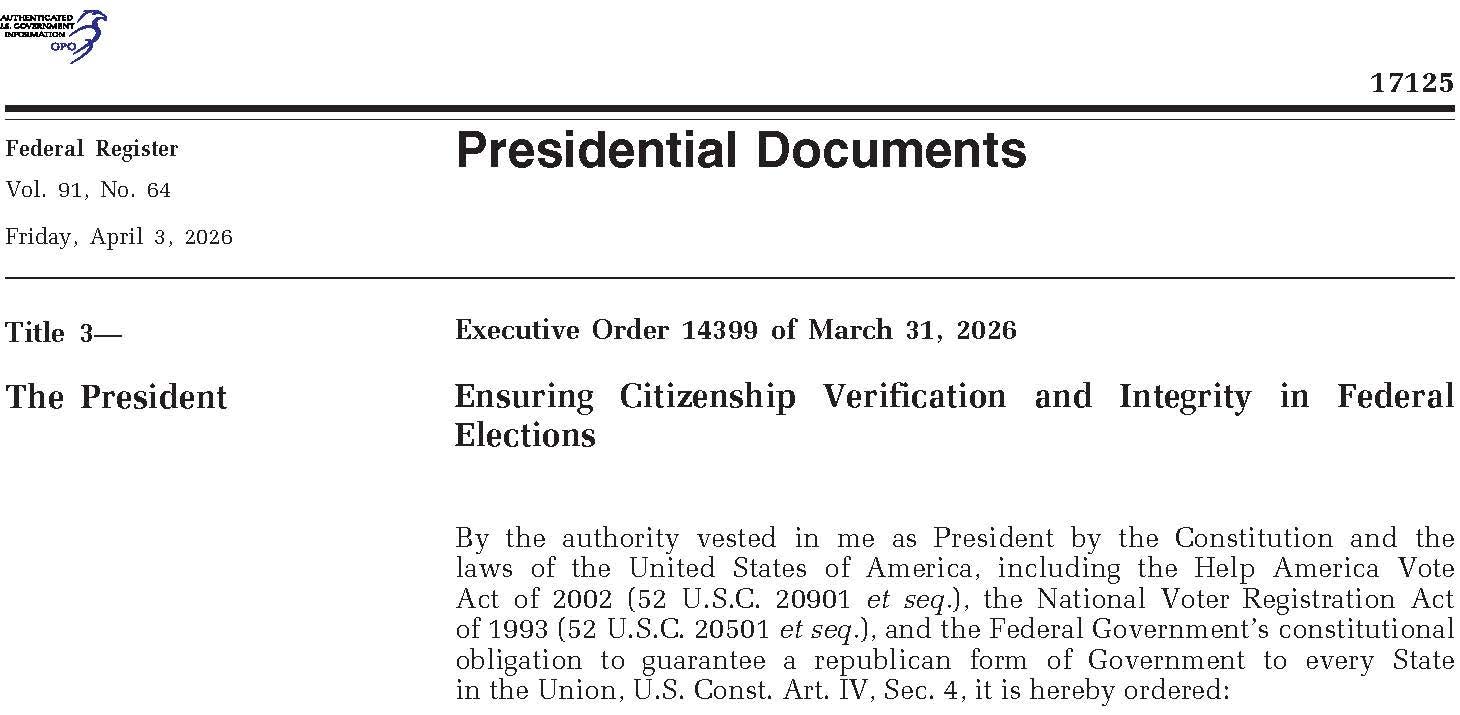
On March 31, President Trump signed Executive Order 14,399, “Ensuring Citizenship Verification and Integrity in Federal Elections.” It is the second of his election orders. The first, from March 2025, sought documentary proof of citizenship for federal voter registration and a ban on counting late-arriving ballots (it has largely been struck down or enjoined).
The new order has two operative parts. Section 2 directs U.S. Citizenship and Immigration Services and the Commissioner of Social Security to compile “state citizenship lists”—state-by-state rosters of people the federal government has identified as citizens who will be 18 or older by Election Day. Section 3 tells the U.S. Postal Service (USPS) to build a system under which it accepts and delivers mail ballots only for voters who appear on state-submitted lists keyed to those federal lists, and only in envelopes bearing new barcodes and logos that USPS would specify.
Together, Sections 2 and 3 purport to hand USPS a veto over which ballots move through the mail. Postmaster General David Steiner has not been coy about this. He told senators that USPS would not deliver mail ballots for states that declined to hand over their absentee voter lists to the federal government—a threat that matters precisely because the states’ refusals all but guarantee that the federal list will be massively incomplete (and not just full of individual errors). Asked whether USPS actually has the authority to do any of this, Steiner said he’d “have to defer back to the courts.”
California v. Trump
So far, the courts to reach the merits have been uniform in their skepticism of the order’s legality. Five suits were filed against the order, and the one that has reached the Supreme Court first came from 23 states and D.C., led by California, Massachusetts, Nevada, and Washington, and filed in Boston (in the U.S. District Court for the District of Massachusetts). In that case (captioned California v. Trump), Judge Indira Talwani granted summary judgment to the states back on June 25.
Two things about Judge Talwani’s ruling have been underplayed. First, Talwani didn’t rest on any single doctrinal hook. She held that Sections 2 and 3 are ultra vires and that they violate the separation of powers—that they are, in her words, “legally void.” As she summarized the ruling in a later order, the “Constitution lodges power over congressional elections in state legislatures primarily and in Congress ultimately. The President plays no role in the regulation of elections.” But the statutory holding is at least as important, and probably harder for the government to dislodge: “No law enacted by Congress delegates authority to control mail-in voting to USPS,” and Congress hasn’t authorized the Postal Service “to sort the mail, let alone to refuse to transmit mail ballots for certain voters.” As in the birthright citizenship litigation, whatever the federal government’s power to take these steps, there’s a far easier argument that the executive branch can’t take them by itself.
Second, Judge Talwani’s June ruling also found that the order’s compressed timeline left “no allowance for Congress’ mandated procedure regarding USPS rulemaking.” An order that can only be carried out by violating the statutes that govern the agency carrying it out ought to be in serious trouble regardless of what one thinks about Article II.
The remedy Judge Talwani imposed was also relatively modest. She enjoined the federal defendants—not the President personally—from implementing Sections 2 and 3 as to the plaintiff jurisdictions, and only for the November 3 election and any elections before it (so this is not a “universal” injunction). Nothing stops the administration from implementing the order in the non-plaintiff states, and nothing about her decision bears in any way on the rules for the 2028 cycle.
Talwani had also, days earlier, refused to dismiss a parallel challenge from the League of Women Voters and other voting-rights groups, finding that “disenfranchisement as to the upcoming election is plausibly likely and imminent.” And on the timing question the government now presses at the Supreme Court, she’d explained her reasoning in an interim order: “[I]n light of the EO’s specific deadlines over the next three months, and the reality that elections will be occurring throughout this period . . . postponing judicial review is impracticable and may inflict significant hardship on Plaintiffs.”
The federal defendants and 12 intervening Republican-led states appealed to the First Circuit and moved for a stay pending appeal. In their stay application, they argued solely that the plaintiffs lacked standing and that their claims weren’t ripe. Tellingly, they did not ask the First Circuit to hold that the order is lawful.
On Saturday, July 25, the First Circuit denied the stay. Most media accounts reported the decision as a divided one, with brand-new Trump-appointed Judge Joshua Dunlap in dissent. But that doesn’t quite capture the nuance. Critically, Judge Dunlap agreed with Judges Gustavo Gelpí and Julie Rikelman with respect to Section 3 of the executive order (the USPS-specific provisions)—i.e., that it should remain paused for the duration of the litigation. As he wrote,
[A]lthough final regulations must normally exist before standing can arise, the specificity of the EO’s stated timelines and the inescapable legal requirements and impending deadlines that States currently face in facilitating mail-in and absentee balloting for immediately upcoming elections together establish sufficient concrete injury from the EO in this unusual case. Unlike Section 2(a), therefore, the Government and Intervenor States have failed to show a substantial likelihood of success as to their argument that Plaintiff States will not suffer actual or imminent harm sufficient to establish standing to challenge Section 3.
And “Because the Government and Intervenor States mount no substantive defense of Section 3, they have no other basis to demonstrate likelihood of success as to the injunction barring implementation of that provision.” Dunlap dissented only as to Section 2, because “Section 2(a) . . . merely orders the provision of information to States; it does not order States, including Plaintiffs, to take any action based on the State Citizenship List.”
To be sure, the majority had a response with regard to Section 2—focusing on a question the government never answered: whether it would prosecute a state official who mailed a ballot to someone missing from the DHS list. “State and local officials are no exception to the commonsense rule that ‘[p]eople do not lightly disregard public officers’ thinly veiled threats to institute criminal proceedings against them if they do not come around.’” And it concluded that letting the order operate for September and November “would sow confusion and threaten disenfranchisement of many eligible voters.”
But whoever has the better argument with respect to Section 2, the key is that the panel was unanimous as to Section 3—and voted to leave it blocked. We’ll come back to the significance of that in a moment.
The D.C. Cases
Complicating matters, both descriptively and analytically, is the eight-page ruling the D.C. Circuit handed down on Tuesday in a different case challenging the executive order—holding, in DSCC v. Trump, that “this case likely is unripe for review in its present posture.” Both Supreme Court applications suggest that there’s a tension between the DSCC and California rulings, but on closer inspection, that isn’t true.
At the heart of the D.C. Circuit’s ruling was the conclusion that the DSCC’s injuries “flow not from Executive Order 14,399 itself, but entirely from predicted future actions contemplated by that Order” (a separate panel had reached the same conclusion on July 17 in the NAACP’s parallel case). The panel thereby affirmed Judge Nichols, who had denied relief earlier this summer on standing grounds. But rather than focusing on standing, the court of appeals rested on the lack of “ripeness”: a party committee suing for its members is suing based upon injuries that depend on someone else’s subsequent choices, so there was nothing yet for a court to review.
In the process, the D.C. Circuit specifically distinguished the facts of the California litigation:
[T]hese Plaintiffs are not directly regulated by the Order, which functions as a directive to federal agencies. Nor are they the States charged with administering elections and adapting their procedures to the requirements contemplated by the Order. Nor do they assert injuries as electoral candidates whose individual campaigns currently are being adversely affected by the ordered instability and uncertainty of the field on which they are competing. Plaintiffs argue instead that their organizations will be harmed by expending resources to counter not the Executive Order, but the ensuing agency actions that Order contemplates. So the record does not establish that the Order “itself” is inflicting “concrete harm” on these Plaintiffs before the agencies act.
The First Circuit, in a case brought by sovereign states rather than an association, found both standing and ripeness satisfied, because the order imposes immediate requirements on California and its co-plaintiffs—including with respect to the lists they must compile, how they must distribute their mail-in ballots, and which officials will be exposed to potential federal investigation the moment the final rule is issued, and not after some future act by a third party. In my view, both of these decisions are correct. But that hasn’t stopped both the federal government and the intervening red states in California from holding them out as in tension with each other—and as thus providing their own basis for relief. As is hopefully clear, that just isn’t accurate; the D.C. Circuit’s DSCC ruling may not have cited the California case, specifically, but the sentence highlighted above expressly distinguished its fact pattern. In that respect, the rulings reinforce each other; they don’t create a split.
The Two Emergency Applications
In its application for a stay in the Supreme Court, filed on Monday, the Trump administration sought both a stay of Judge Talwani’s judgment pending its appeal in the First Circuit and an immediate administrative stay while the justices consider it. The argument is the same one the First Circuit rejected, i.e., that it’s too early. As the application argues, courts “cannot enjoin implementation of Executive Orders that leave open material issues that still need to be resolved by agencies, unless and until those agencies actually take concrete actions that injure the plaintiffs.” The injunction is “especially indefensible because the agencies are still deliberating over how (if at all) to implement the Order, yet the district court preemptively decided that whatever the agencies may choose to do will necessarily be unlawful.” And the equities, as Solicitor General Sauer argues, run only one way: without a stay, “there will not be sufficient time to obtain appellate relief before the November election,” because implementation has to begin “as soon as early to mid-August.”
And yesterday, the 12 states that intervened in California v. Trump to defend the executive order filed their own stay request. (Alabama, Florida, Indiana, Kansas, Louisiana, Missouri, Montana, Nebraska, Oklahoma, South Carolina, South Dakota, and Texas are the applicants, with Missouri Solicitor General Louis Capozzi as counsel of record.) These states want what the federal government wants: a stay of Judge Talwani’s injunction pending the First Circuit appeal, plus an immediate administrative stay. Armed with Tuesday’s D.C. Circuit ruling (which came after the Justice Department’s filing), the states argue quite aggressively that there’s a real tension between the First Circuit’s denial of a stay and the D.C. Circuit’s affirmance of the dismissal in DSCC. Again, there isn’t, but you have to dig fairly deep to see why.
Three Takeaways
All of this leads to three points that should clarify both the stakes of these applications and, as important, what they’re not about.
First, and starting with the latter, neither application asks the Supreme Court to bless Sections 2 and 3 on the merits, and both rest on the same procedural move, telling the Court that no one has a present, concrete injury yet. The government prevailed on this argument against the DSCC and NAACP plaintiffs because they were associations, whose harms run through what some future voter or USPS employee might do; it should fail against the California plaintiffs, who are being told right now, as sovereigns, to take certain concrete and cost-inducing steps. (Again, the First Circuit was unanimous that Section 3 is harming the plaintiff states now.) But even if the Court fails to draw this distinction and grants the applications in full, all that would do is put off, perhaps for only a few weeks, a challenge to the government’s actions. After all, as noted above, one of two things has to be true: Either the government is going to take meaningful steps to implement Section 3 of the executive order or it isn’t. In other words, it’s not clear how the government can even make the procedural case for emergency relief without simultaneously undermining its arguments that the plaintiffs haven’t yet been (or won’t imminently be) injured.
Second, although I’m sympathetic to the First Circuit majority in California, there’s also a lot to commend Judge Dunlap’s approach—which would grant the stay only in part (with respect to Section 2), and deny it in part (with respect to Section 3). Because Section 2 doesn’t directly require the states to do anything, one could reasonably argue that it doesn’t harm the states (or, at least, that it doesn’t harm them irreparably) even if Judge Talwani is right that it’s ultra vires. If that’s the ruling we get from the Supreme Court, my own view is that it would be a significant defeat for the Trump administration—even though the headlines will likely portray it as a partial victory. Here’s a case where the two different pieces are just not of remotely equal importance.
Third, the timing here may also be instructive. In addition to seeking a stay pending appeal, the Trump administration’s application sought an immediate administrative stay—something neither Justice Jackson (who’s the Circuit Justice for the First Circuit, and thus the recipient of the applications) nor the full Court has granted. Justice Jackson has called for a response to both applications (no surprise there), but the plaintiffs’ brief (covering both applications) is not due until 4 p.m. next Monday (August 3). The Court, in other words, is not moving heaven and earth to decide these applications—which suggests that it may not be especially taken with the Justice Department’s own claimed harms, or at least their urgency. Either way, I wouldn’t expect a ruling before the latter part of next week—and perhaps even later if there are any separate writings by the justices. And again, the critical thing to watch for is not whether the Court grants any relief, but whether it grants the applications in full. Whether Section 3 goes into effect is much more important here than whether Section 2 does.
***
I don’t mean to downplay the significance of this litigation, or of the emergency applications in Trump v. California. These cases are a big deal; the executive order is a bigger deal; and Section 3 would be deeply problematic were it to be operative in the 2026 midterm election cycle (or, frankly, ever). But even the best-case scenario for the Trump administration here is a narrow procedural victory in the Supreme Court that puts off Section 3’s reckoning only for a matter of weeks. That’s more relief than the government deserves at this juncture, but it would be far less consequential than it will seem (and than the media will likely report it to be).
This analysis and explication of the issues is very interesting. I am confused, though, as to why the intervenor states have standing to request a stay. I don't see any circumstance in which they suffer harm. What is their stake in this litigation other than that they don't like what another state is trying to do?
You seem to retain some shreds of faith in the intellectual honesty of the Supreme Court majority. I find this touching. I'd ascribe it to naivete, if you weren't the smart and knowledgeable person that you are. Spiritual innocence? Optimism? Whatever - bless you for continuing to see some possibility of light in the darkness. For my part, I would not find it surprising to read a majority opinion by "Justice" Alito extending the unitary executive theory to authorize the president to order the USPS to do any damn thing he wants.