

Welcome back to “One First,” a newsletter that aims to make the U.S. Supreme Court more accessible to lawyers and non-lawyers alike. I’m grateful to all of you for your continued support, and I hope that you’ll consider sharing some of what we’re doing with your networks.
Every Monday morning, I’ll be offering an update on goings-on at the Court (“On the Docket”); a longer introduction to some feature of the Court’s history, current issues, or key players (“The One First ‘Long Read’”); and some Court-related trivia. If you’re not already a subscriber, please consider becoming one—and upgrading to a paid subscription, for which we just launched new bonus features, if your circumstances permit:
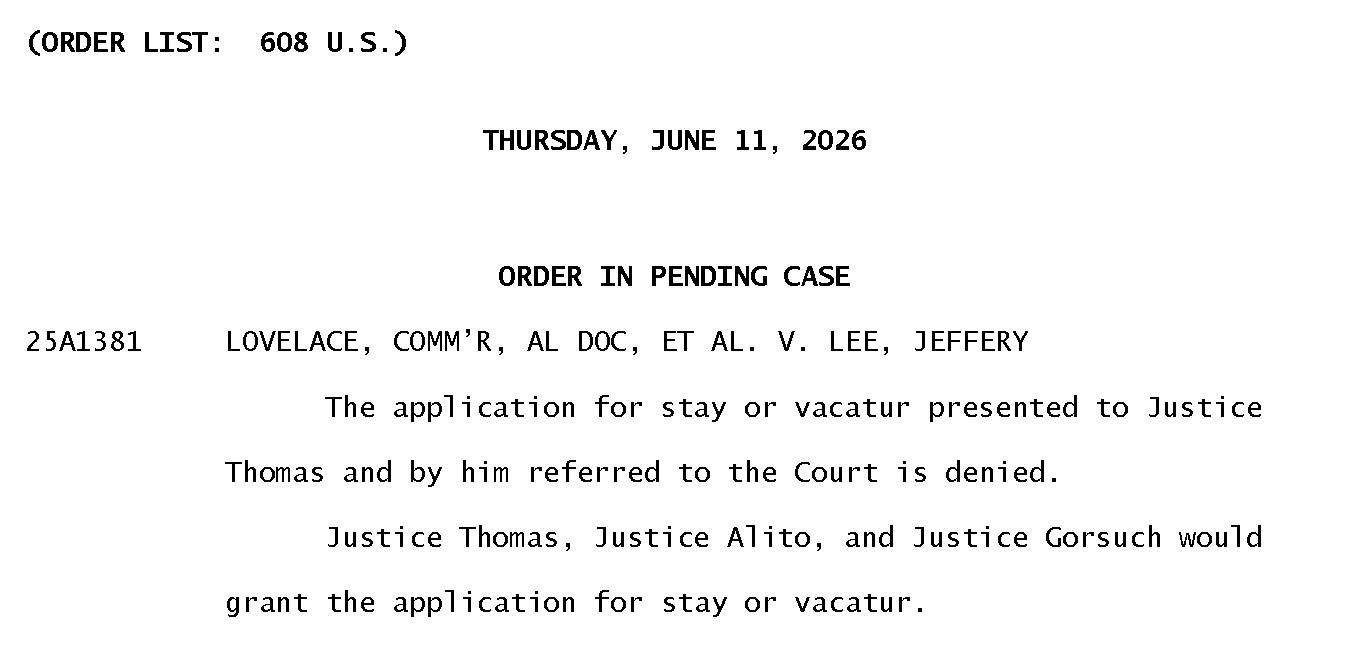
The Supreme Court did something on Thursday that it hadn’t done in more than five years: it denied a “state-on-top” emergency application in a capital case (where a state asks the Court to un-block an execution that a lower court had put on hold). Indeed, according to data compiled by the Death Penalty Information Center, since Justice Kavanaugh joined the Court in October 2018, the Court had granted 21 of 23 such requests prior to Thursday—including as recently as May 14, when the Court granted Texas’s request to unblock an execution in Guerrero v. Busby, over public dissents from Justices Sotomayor, Kagan, and Jackson.
This time around, Justices Thomas, Alito, and Gorsuch were the public dissenters. But, like the majority in Lovelace v. Lee, they didn’t explain their votes, either. All of that raises the question of why, if the Court has been all-but-reflexively granting these requests when brought by states, it denied this one? As I explain below, I think there are two different explanations for the outcome in Lee—one of which would have interesting substantive ramifications with regard to future method-of-execution challenges; and one of which would have interesting procedural ramifications with regard to the source of the Court’s authority to grant emergency relief in general. But because the majority didn’t write (which, as I’ve said about 1000 times before, is a problem even—if not especially—when someone like me might like the result), we can’t know which of these was doing the work. (I should note that I’m even more biased than usual, as, together with Andrew Tutt and Stanton Jones from Trial Lawyers for Justice, I filed an amicus brief in opposition to the application.)
More on this topic below. But first, the (other) news.
On the Docket
The Merits Docket
The justices handed down three more rulings in argued cases last Thursday—although, again, none of the three were in the “big” cases we’re still waiting for:
In Keathley v. Buddy Ayers Construction, Inc., Justice Jackson wrote for a unanimous Court in holding that the Fifth Circuit had adopted too narrow an understanding of “judicial estoppel” in bankruptcy cases (a doctrine that generally—albeit not always—prevents a party from asserting a position in litigation that’s directly contrary to a position they took in prior litigation). As Jackson explained, to determine whether an omission of a claim in the bankruptcy context was inadvertent or mistaken for purposes of judicial estoppel, courts should look to the totality of the circumstances surrounding the omission, and not just whether the debtor had knowledge of the underlying facts or a potential motive to conceal the claim. Justices Thomas (joined by Gorsuch) and Sotomayor wrote separate concurring opinions, including Thomas’s (alarming) suggestion that the Court should reconsider the entire doctrine of judicial estoppel—an argument I hope to address in a future issue (perhaps as soon as this Thursday’s bonus issue).
The most significant ruling of the trio was in FS Credit Opportunities Corp. v. Saba Capital Master Fund, Ltd., in which Justice Barrett wrote for (the usual) 6-3 majority in holding that the Investment Company Act (ICA) does not impliedly empower private parties to sue for rescission of contracts that allegedly violate the Act. As Federal Courts students learn, ever since the Court’s 5-4 2001 ruling in Alexander v. Sandoval, the Court’s conservative judges have taken a remarkably narrow view of the circumstances in which a statute can be implicitly read to allow for private enforcement—even statutes written before Sandoval, and even when the absence of a private cause of action would leave the statute largely unenforceable. In one sense, FS Credit Opportunities is just another example of that phenomenon. But it’s even richer for the pretty substantial debate between Justice Barrett’s majority opinion and Justice Jackson’s dissent over the sources courts can and should consider when interpreting ambiguous statutory language; indeed, for those curious about the debate over the virtues and vices of textualism, this is a pretty accessible and fascinating example.
Finally in Abouammo v. United States, Justice Kagan wrote for a unanimous Court in holding that federal prosecutions for falsifying official records under 18 U.S.C. § 1519 must be brought in the district where the falsification occurred; they cannot be filed in a different district where the investigation was located—because no “conduct constituting the offense” happened there. Although no one will likely be especially interested in this specific result, it could have consequences for efforts by prosecutors in other false-statement cases to manipulate venue.
Last Monday’s regular Order List also brought with it a quietly important move on the merits docket in American Gas Ass’n v. Dep’t of Energy. In that case, the D.C. Circuit had rejected a challenge to Biden-era energy efficiency standards for consumer furnaces and commercial water heaters. But rather than repeal the rules, the Trump administration simply abandoned the government’s defense—noting in its brief in the Supreme Court that, “Following the change in Administration, the government agrees with [petitioners’] contention,” and recommending that the Court “GVR” (grant certiorari, vacate the D.C. Circuit’s decision, and remand for reconsideration in light of the government’s changed position). And that’s exactly what the Court did.
To be sure, this is hardly the first time that the Justice Department has pulled this move (refusing, after an intervening change in administration, to defend a judgment that its predecessors won below). But (1) the Court often makes hay out of such shameless changes in position; here, it just meekly complied; and (2) this is a good illustration of a broader point I’ve made before—that there’s a class of “GVR” orders that are a heck of a lot more substantive than just sending a case back in light of an intervening Supreme Court decision.
The Emergency Docket
Other than the Alabama case (about which more in a moment), it was a relatively quiet week on the emergency docket.
The Week Ahead
We expect another regular Order List (out of last Thursday’s Conference) this morning at 9:30 ET. As of now, the Court’s only other scheduled business is its public, non-argument session on Thursday—in which it is expected to hand down one or more rulings in argued cases. By my count, we’re down to 19 merits cases (plus the Lisa Cook emergency application), at least half of which are pretty “big” cases. It’s possible the Court holds all of those for the last week-plus of the term, but the odds are also increasingly on the side of something significant coming down this week. And because Friday is a federal holiday, Thursday appears to be the only opinion day we’ll get before next week.
The One First “Long Read”:
Making Sense of Lovelace v. Lee
The Supreme Court’s jurisprudence respecting a death-row prisoner’s challenge to his method of execution rests on a doctrinal scaffold the Court has built almost entirely in (and to) the prisoner’s disfavor. It begins with the 2008 ruling in Baze v. Rees, in which a plurality led by Chief Justice Roberts upheld Kentucky’s three-drug lethal-injection protocol and announced that a method is “cruel and unusual” only where it presents a “substantial” or “objectively intolerable” risk of serious harm. Crucially, the plurality held that a State’s refusal to adopt an alternative procedure offends the Eighth Amendment only where that alternative is “feasible, readily implemented, and in fact significantly reduces a substantial risk of severe pain.”
Seven years later, in Glossip v. Gross, a 5–4 majority in an opinion authored by Justice Alito hardened that gloss into a freestanding pleading burden—holding that a prisoner must “identify a known and available alternative method of execution that entails a lesser risk of pain,” which the Court characterized as “a requirement of all Eighth Amendment method-of-execution claims.”
The Court completed the doctrinal structure in its April 2019 ruling in Bucklew v. Precythe, in which Justice Gorsuch, writing for another 5–4 majority (now with Justice Kavanaugh instead of Justice Kennedy), held that Baze and Glossip “govern all Eighth Amendment challenges, whether facial or as-applied,” and rejected an as-applied claim premised on a prisoner’s rare medical condition. Notably, Bucklew itself involved a prisoner who proposed nitrogen hypoxia as his alternative; the Court found he had failed to present a triable question on its viability, faulting his reliance on “reports from other states indicating the need for additional study.” The through-line of all of these cases is a comparative, alternative-driven framework that, as Justice Gorsuch put it, does not “guarantee a prisoner a painless death.”
No majority opinion has yet resolved the constitutionality of a state’s use of nitrogen hypoxia, specifically. But in a series of rulings on the emergency docket, the justices have already divided bitterly over that particular method, especially as deployed by Alabama. For instance, in January 2024, the three Democratic appointees all dissented from the Court’s refusal to block the Nation’s first execution by that procedure in Smith v. Hamm—with Justice Sotomayor’s dissent describing the protocol as “untested” and warning that Alabama had selected Smith as its “guinea pig” to “test a method of execution never attempted before,” and against a prisoner whose execution by lethal injection Alabama had already botched. Justice Kagan wrote separately, joined by Justice Jackson, faulting Alabama for failing to disclose adequate information about its new protocol and stating she would have stayed the execution to allow the Court to address that issue.
As that record has accumulated, the Democratic appointees have only gotten louder in their dissents. Last October, for instance, Justices Kagan and Jackson joined Justice Sotomayor’s eye-opening opinion in Boyd v. Hamm describing exactly what someone experiences when they are executed through nitrogen hypoxia. As she explained, “firsthand accounts from those executions reveal that nitrogen hypoxia is not at all what it was promised to be,” invoking the Eighth Amendment’s “dignity” principle and arguing that the method “risks extending the period of terror up to 140-fold.” And although Sotomayor argued (correctly, in my view), that, “it is deeply troubling to weigh the associated pain posed by the two different methods [of execution] against each other,” she conceded that “this ‘comparative exercise’ is demanded by the Court’s recent precedents,” and argued that “So long as the [alternative-method] requirement persists, however, courts must engage in this macabre weighing.”
That’s where Lee v. Lovelace comes in. Jeffery Lee is an Alabama prisoner who was convicted for his role in a 1998 double-murder (and an attempted murder). The jury voted 7-5 to sentence him to life imprisonment without parole, but the trial judge overrode that sentence and imposed the death penalty—under a procedure Alabama abandoned in 2017.
Lee brought a lawsuit challenging Alabama’s proposal to execute him by nitrogen hypoxia. After a full bench trial, U.S. District Judge Emily Marks initially ruled on May 28 that, while death by nitrogen hypoxia involves some suffering, Lee had failed to show the protocol was unconstitutional. But the Eleventh Circuit reversed, endorsing Judge Marks’s factual findings but concluding as a matter of law that Alabama’s protocol presents a "substantial risk of serious harm" and that the up-to-three-minute timeframe for losing consciousness is "intolerable." Under the Court’s precedents, it remanded for the district court to consider Lee’s proposed firing-squad alternative. On remand, Judge Marks found the firing squad to be a feasible alternative that significantly reduces those risks—and permanently enjoined Alabama from executing Lee by nitrogen hypoxia. This represented the first ruling of its kind—a conclusive, merits decision that a particular method of execution was unconstitutional even under the Supreme Court’s current jurisprudence.
After both Judge Marks and a divided Eleventh Circuit panel refused Alabama’s request for emergency relief from Judge Marks’s ruling, Alabama sought the same from the Supreme Court. And Thursday night, the Court denied Alabama’s request—over public dissents from Justices Thomas, Alito, and Gorsuch. Neither the majority nor the dissenters wrote anything, so we’re left to figure out why, given how well states have fared when seeking emergency relief in death penalty cases, this case was different. As I noted above, I see two possibilities.
The first potential explanation involves the substance of Lee’s case—and Judge Marks’s (and the Eleventh Circuit’s) fidelity to the Baze/Glossip/Bucklew line of cases. To give credit where it’s due, Lee’s lawyers—including a team of folks from Arnold & Porter led by Paige Sharpe and a cohort of public defenders—litigated his claims brilliantly, using the justices’ own doctrinal moves as the basis for Lee’s legal challenges to nitrogen hypoxia, and building a remarkable record in the district court of both the effects of nitrogen hypoxia and the availability of alternatives. For the Court to grant emergency relief to Alabama when a litigant had somehow surmounted all of the doctrinal traps the justices had themselves erected in such cases would give at least the appearance that the doctrine was simply cover for the Court’s hostility to method-of-execution challenges, and not just the Court’s good-faith application of its own view of the relevant Eighth Amendment principles.
The second potential explanation involves the unique procedural context in which Alabama’s request arose (the point on which my amicus brief focused). Most emergency applications to reach the Court seek relief from a preliminary ruling by a lower-court—to allow the party on the wrong side of that ruling to get out from underneath it while the appeal works its way to the justices. Here, Alabama was seeking relief from a permanent injunction—the equitable judgment a district court enters at the end of litigation, not the beginning.
More than that, had Alabama succeeded, the relief it was seeking (allowing it to execute Lee) would necessarily have deprived the Supreme Court of jurisdiction over its plenary appeal—since it would have necessarily mooted the case. That’s true in other death penalty contexts, of course, but my own research (with help from one of my superstar Georgetown Law research assistants, Abby Liman) uncovered no prior example of the Supreme Court granting emergency relief against a permanent injunction in a capital case—and Alabama’s reply brief (which responded to our amicus brief) didn’t identify any. As we argued, it’s one thing to grant emergency relief against a preliminary, probabilistic stay of execution entered by a district judge; it’s something else altogether to do so when that judge has permanently barred a particular method of execution at the end of trial-court litigation (and it’s not, in any sense of the term, “interim”).
Ultimately, we can’t know which of these two arguments persuaded at least two of the Chief Justice and Justices Kavanaugh and Barrett to join the Democratic appointees in voting to deny Alabama’s application. And that’s too bad, because they have pretty different consequences, going forward. The former (substantive) route would suggest that there is meaningful room for death-row prisoners to litigate methods of execution under the Baze/Glossip/Bucklew framework, and that more resources can and should be devoted to those kinds of cases.
The latter (procedural) route is, in some respects, an even bigger deal, for it suggests that there’s room to argue to the justices whose votes matter the most that, as Professor Will Baude argues in a new article, the Court really needs to peg emergency relief in all cases to whether such relief is meaningfully “in aid of [its] jurisdiction[]” under the All Writs Act. Such a reorientation of the emergency docket could have consequences far beyond method-of-execution challenges, which is yet another reason why Thursday’s (surprising) outcome in Lee could potentially be so important, and why the lack of any explanation for that outcome is, yet again, a pretty big problem.
SCOTUS Trivia: Flag Day
Yesterday was, of course, Flag Day. It was also the 83rd anniversary of one of my favorite (and, in my view, one of the most moving) opinions the Supreme Court has ever handed down—Justice Jackson’s majority opinion in West Virginia State Board of Education v. Barnette. I’ve written before about Barnette’s entire backstory (including the misspelling of the plaintiff’s family name). But I like to come back to this ruling every year, and especially these days, for what Jackson said about the First Amendment and orthodoxy.
Now more than ever, we ignore Jackson at our peril:
As governmental pressure toward unity becomes greater, so strife becomes more bitter as to whose unity it shall be. Probably no deeper division of our people could proceed from any provocation than from finding it necessary to choose what doctrine and whose program public educational officials shall compel youth to unite in embracing. Ultimate futility of such attempts to compel coherence is the lesson of every such effort from the Roman drive to stamp out Christianity as a disturber of its pagan unity, the Inquisition, as a means to religious and dynastic unity, the Siberian exiles as a means to Russian unity, down to the fast failing efforts of our present totalitarian enemies. Those who begin coercive elimination of dissent soon find themselves exterminating dissenters. Compulsory unification of opinion achieves only the unanimity of the graveyard.
It seems trite but necessary to say that the First Amendment to our Constitution was designed to avoid these ends by avoiding these beginnings. There is no mysticism in the American concept of the State or of the nature or origin of its authority. We set up government by consent of the governed, and the Bill of Rights denies those in power any legal opportunity to coerce that consent. Authority here is to be controlled by public opinion, not public opinion by authority.
The case is made difficult not because the principles of its decision are obscure but because the flag involved is our own. Nevertheless, we apply the limitations of the Constitution with no fear that freedom to be intellectually and spiritually diverse or even contrary will disintegrate the social organization. To believe that patriotism will not flourish if patriotic ceremonies are voluntary and spontaneous instead of a compulsory routine is to make an unflattering estimate of the appeal of our institutions to free minds. We can have intellectual individualism and the rich cultural diversities that we owe to exceptional minds only at the price of occasional eccentricity and abnormal attitudes. When they are so harmless to others or to the State as those we deal with here, the price is not too great. But freedom to differ is not limited to things that do not matter much. That would be a mere shadow of freedom. The test of its substance is the right to differ as to things that touch the heart of the existing order.
If there is any fixed star in our constitutional constellation, it is that no official, high or petty, can prescribe what shall be orthodox in politics, nationalism, religion, or other matters of opinion or force citizens to confess by word or act their faith therein. If there are any circumstances which permit an exception, they do not now occur to us.
Amen.
I hope that you’ve enjoyed this installment of “One First.” If you have feedback about today’s issue, or thoughts about future topics, please feel free to email me. And if you liked it, please help spread the word!
If you’re not already a paid subscriber and are interested in receiving regular bonus content (or, at the very least, in supporting the work that goes into this newsletter), please consider becoming one:
This week’s bonus issue will drop on Thursday. And we’ll be back with our regular content for everyone (no later than) next Monday. As ever, please stay safe out there.
The Secretary of Defense could certainly benefit from a reading of the Barnette case. Thanks for a reading that actually is appropriate for Flag Day.
Thanks for an excellent explication of the 8th Amendment issues — especially how the Reactionary Justices have set up “doctrinal traps.” Why are these Justices making it more difficult for ordinary people to prevail in asserting their constitutional rights? It’s getting to the point where corporations have more rights than people … and “property rights” are protected more than human rights.