

If you’ve been reading One First for any length of time, you know that the last few weeks of June are when the Supreme Court does most of the work that ends up in the history books. This year is no exception. As of this writing, 23 of the 58 cases argued during the “October 2025 Term” remain undecided (including all but two of this term’s “big” ones), and we expect, as usual, that the Court will clear this backlog by the end of June—or, at the very latest, early July. That means we’re now in the part of the calendar in which the justices hand down the rulings they’ve been sitting on for the longest—often saving the hardest and/or most divisive cases for last. And that sprint starts tomorrow (Thursday, June 11), when we expect the Court to hand down decisions in argued cases from the bench starting at 10:00 a.m. ET.
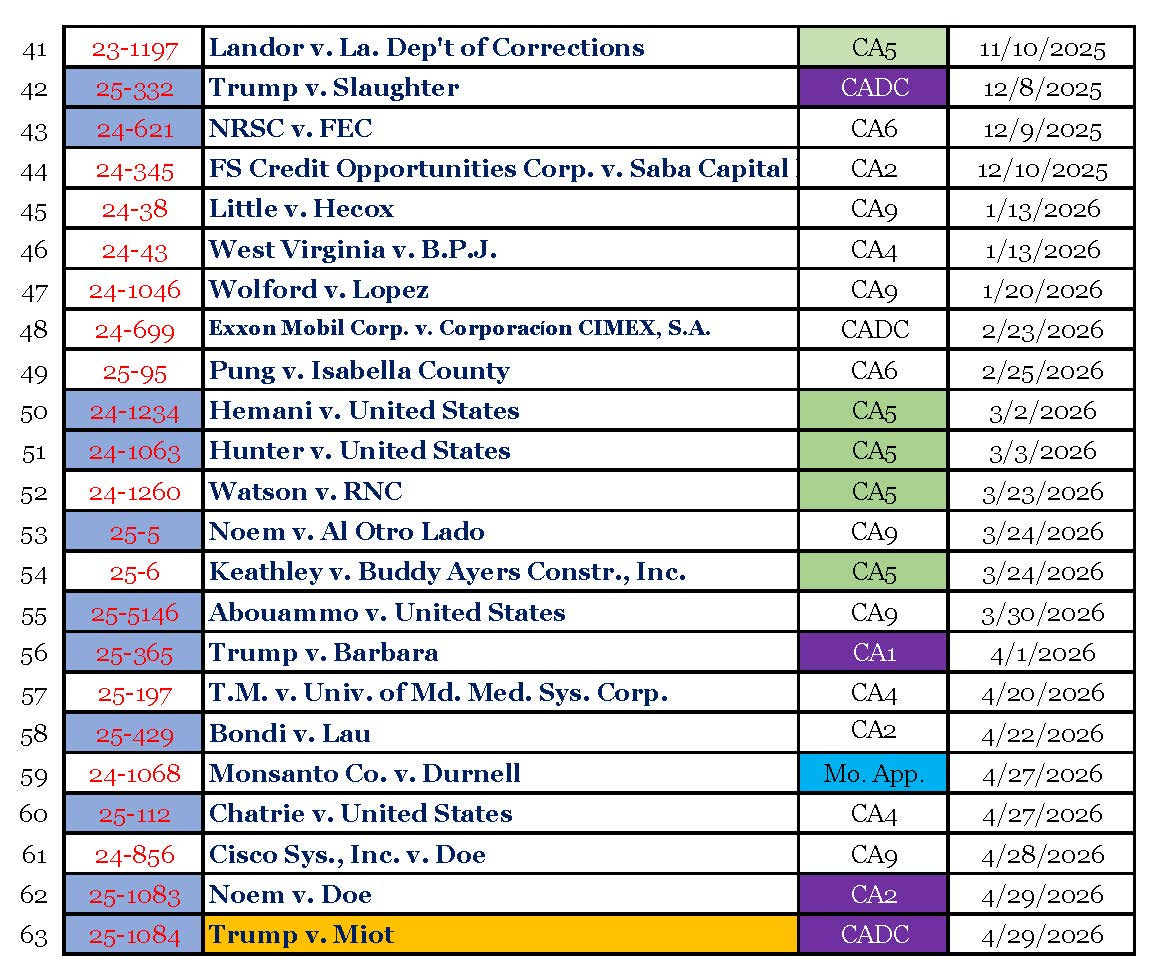
I wanted to put out this extra post to do three things: To take inventory of what’s still pending; to explain when (and how) to expect the rest of these decisions; and to step back to identify the themes that have already defined this term—and that are very likely to shape the opinions still to come. To get us started, here’s my list of what’s left, sorted by when each case was argued (note that this list of “merits” cases doesn’t include the emergency application in Trump v. Cook, argued on January 21, which I’ll address below). There’s a key that explains the color-coding in the footnote at the end of this sentence.1
Two Big Ones Already on the Board
Before turning to what’s left, it’s worth remembering what the Court has already done, because it frames everything else. The two highest-profile decisions issued so far cut in opposite directions for the administration. In Learning Resources v. Trump, decided 6–3 on February 20, the Court held that President Trump exceeded his authority when he invoked the International Emergency Economic Powers Act to impose sweeping tariffs on nearly every U.S. trading partner—a significant defeat on one of his signature policies. Trump’s reaction was telling: he publicly called the six justices in the majority an “embarrassment,” singling out his own appointees, Justices Gorsuch and Barrett.
The other marquee ruling, Louisiana v. Callais, went the other way for the voting-rights community. By a 6–3 vote along ideological lines, the Court struck down Louisiana’s congressional map as an unconstitutional racial gerrymander (because it held that the map it was responding to did not violate Section 2 of the Voting Rights Act), with the liberal justices accusing the majority of gutting what remains of Section 2. The practical effect has already rippled outward, with Republicans in several Southern states moving to redraw maps to diminish or eliminate majority-Black districts, assisted by a trio of shadow docket moves by the Supreme Court (issuing the judgment in Callais immediately; issuing a GVR—“grant, vacate, and remand”—in the Alabama case; and then staying the injunction the Alabama court had subsequently reimposed).
Keep both of those in mind. One is a loss for Trump; one is a loss for civil-rights plaintiffs. At this early juncture, this term resists a simple “winners and losers” narrative—and that complexity is itself part of the story.
The Cases Still Pending
Here’s the inventory of the argued-but-undecided cases that, in my view, are especially important, with the core question presented in each:
Birthright citizenship—Trump v. Barbara. The blockbuster of the term. At issue is whether Trump’s day-one executive order denying citizenship to children born in the U.S. to parents who are here without authorization or on temporary visas can be squared with the Fourteenth Amendment’s Citizenship Clause or the statutes Congress has enacted to implement it. After the April 1 argument—which Trump attended in person, a presidential first—at least five and perhaps as many as seven justices appeared likely to rule against the order. But the later this drags out, the sharper we might expect any separate opinions to be.
Independent agencies—Trump v. Slaughter. Whether the for-cause removal protections shielding FTC commissioners violate the separation of powers, and whether the Court should overrule Humphrey’s Executor, its unanimous 1935 precedent permitting such protections. The smart money says the conservative supermajority sides with Trump, which would mean (most) independent agencies are no longer meaningfully independent. The harder questions will be about which agencies (like the Federal Reserve) are excepted from that rule, and how far down the executive branch hierarchy (including the civil service) it goes.
The Federal Reserve—Trump v. Cook. A close cousin of Slaughter, this emergency application asks whether the President can remove a Fed governor “for cause” based on allegations—here, of pre-appointment mortgage fraud—that Lisa Cook vigorously denies and that the record … doesn’t seem to support. At the January 21 argument, the justices seemed sympathetic to Cook, and several conservatives hinted that the Fed may enjoy more protection than other agencies—a needle the Court will have to thread both here and in Slaughter. It wouldn’t surprise me at all if these two rulings came down on the same day.
Transgender high school athletes—Little v. Hecox and West Virginia v. B.P.J. Whether state laws barring transgender girls and women from female sports teams violate the Equal Protection Clause (and, in the West Virginia case, Title IX). After the January arguments, the Court appeared poised to uphold the bans, perhaps in a single opinion (which would reduce the expected total by one). There’s also a chance that it divides these cases and dumps the Idaho case (Little) on mootness grounds.
Mail-in ballots—Watson v. Republican National Committee. Whether federal law, by defining Election Day as the first Tuesday after the first Monday in November, requires that all ballots be received by Election Day—which would invalidate Mississippi’s grace period for ballots postmarked by Election Day but arriving within five business days. A majority during the oral argument seemed ready to side with the challengers—a ruling that could reach similar laws in more than a dozen states, potentially also affecting grace periods for overseas and military voters. But this one may also go the other way—albeit narrowly.
Campaign finance—NRSC v. FEC. Whether limits on coordinated party expenditures violate the First Amendment, which would require overruling the Court’s 2001 decision in Colorado Republican. Several justices were sympathetic to the challengers at argument, and the trendline of how this Court approaches First Amendment challenges to campaign finance restrictions is … one-sided.
Temporary Protected Status—Mullin v. Doe and Trump v. Miot. Whether the administration can strip “Temporary Protected Status” protections from Haitian and Syrian nationals based upon … dubious … factual claims about the conditions in the two countries, and whether such decisions are even reviewable by the courts. The April 29 argument left the outcome genuinely uncertain. One possibility, if the Court reaches the merits (and agrees with the lower courts that there’s some room for judicial review here), is a mixed verdict—with the Court upholding the revocation for Syria but rejecting it for Haiti, perhaps in two opinions instead of one. My own bet is that this case is the most likely to go to the very last day—and that it will be messy and close.
Asylum at the border—the Al Otro Lado litigation. Whether the government’s “metering” policy of turning back asylum seekers before they reach U.S. soil violates a federal law allowing those who “arriv[e] in the United States” to apply. A majority appeared sympathetic to the administration at the oral argument, but there’s a potential mootness off-ramp that I wouldn’t sleep on.
Guns—Wolford v. Lopez and United States v. Hemani. In Wolford, whether Hawaii’s requirement that gun owners obtain advance permission to carry on private property open to the public violates the Second Amendment; a solid majority seemed skeptical of the law. In Hemani, whether a federal ban on gun possession by users of illegal drugs survives—a law less likely to fall. Both of these cases are more likely to be applications of the Court’s rulings in Bruen and Rahimi, rather than significant shifts in the doctrine.
Religious liberty—Landor v. Louisiana. Whether a Rastafarian prisoner whose dreadlocks were forcibly shaved can sue prison officials for money damages under a federal antidiscrimination statute (RLUIPA). Unusually for a religion case, the justices appeared to divide along ideological lines, with conservatives skeptical that the statute permits damages.
Digital privacy—Chatrie v. United States. Whether a “geofence” warrant—which compels a service provider like Google to identify every user inside a virtual perimeter at the time of a crime—amounts to an unconstitutional search of the many innocent people swept in. This is perhaps the biggest Fourth Amendment case the Court has had in years, and one that is likely to divide the justices in … less-predictable ways.
* * *
To be sure, this isn’t all of the remaining cases. And some of the ones I haven’t mentioned (like Cisco v. Doe or the Monsanto case) could end up being significant, too. But these are the ones that strike me as likely to be “newsy” regardless of how they come out.
When to Expect the Rest
The mechanics here matter, so let me be concrete. The Court issues opinions on scheduled “opinion days,” and as the term winds down, those days come more frequently. The next batch of decisions is expected tomorrow—Thursday, June 11. As of now, the Court has only two public sessions scheduled for after tomorrow—next Thursday, June 18; and Thursday, June 25. I expect both of those to hold, but they won’t be enough to get through what’s left. Rather, I expect the justices to add opinion days throughout June, clearing the docket in waves and almost certainly saving some of the most contentious and divisive cases for the final week or two. We may not often get more than a few days’ notice of a newly added decision day, although we will be told which day will be the “last” day—which is followed by the often-overlooked “Cleanup Conference,” from which some quietly important procedural rulings can also emerge.
My advice for the next three weeks is simple—watch Thursdays and Fridays especially, and don’t be surprised if the Court adds a Monday or two as the pile shrinks.
The Themes Worth Watching
This is, once again, a presidential-power term. Three of the marquee pending cases—birthright citizenship, the FTC removal case, and the Fed case—are direct tests of how much the Constitution lets this President do unilaterally. And the TPS cases are important tests of the ability of courts to review what certainly appear to be deeply arbitrary executive actions. The throughline is the scope of Article II, and the decisions handed down over the next three weeks could have, as the New York Times has put it, “generational consequences” for the balance between the President and the other branches.
The merits docket can’t be read in isolation from the shadow docket. Regular readers know this is my hobbyhorse, and for good reason. While the Court was hearing these arguments, it was simultaneously handing the administration a remarkable run of emergency-docket wins—siding with the government in so many of the major cases, and with Republican-coded litigants in a number of other disputes to which the United States was not a party. That backdrop matters because several pending merits cases—Slaughter, Cook, the TPS cases—first reached the Court via the emergency docket, where the justices may already have tipped their hand. Watch whether the merits opinions ratify those interim signals—and also watch for folks making broad claims about the term that wholly ignore or unduly discount the justices’ machinations on the orders side of the ledger.
The 6–3 line is real, but it isn’t everything. The tariffs loss is the clearest reminder that this majority will, on occasion, rule against the President—and that he’ll lash out when it does. Expect a genuinely mixed scorecard: a likely loss for Trump on birthright citizenship and the Fed, paired with likely wins on independent-agency removal, asylum metering, and possibly TPS. The term may ultimately be remembered less for a single direction than for the Court’s selectivity about when it checks the executive.
The dissents are doing heavy lifting. Justices Jackson, Sotomayor, and Kagan have spent the term writing pointed, sometimes scorching dissents, especially respecting grants of emergency applications. As the divisive merits cases land, expect that trio to speak loudly, and to be writing as much for the future as for the present.
The Court’s relationship with lower courts. My own (idiosyncratic) take on the term is that perhaps the biggest theme cutting across most of these cases is how the justices have reconfigured their relationship with lower courts—in many cases, by either aggrandizing the lower courts’ power; constraining/undermining the lower courts; or both. (I have a draft law review article underway that should be ready for posting by mid-July.) That institutional shift may not lead to an obvious string of right- or left-coded outcomes, but it’s there all the same, and will be really important to keep an eye on as the Court clears its decks over the next three weeks.
Needless to say, I’ll be watching the opinion days closely (and providing the new “Decision Day Summary” videos for our paid subscribers. However you experience the Supreme Court’s output over the next three weeks, I hope you’ll find this newsletter to be a useful resource. If you’re not already a subscriber, I hope you’ll consider becoming one—and upgrading to a paid subscription if your circumstances permit:
As always, more soon.
The second column is the docket #. Those with light gray highlighting are cases in which the federal government is a party. The third column is the case name. The one in orange highlighting reflects a case that was consolidated with the case above it for oral argument. The fourth column is the originating court; blue highlight = state court; purple = a grant of certiorari “before judgment”; green = the Fifth Circuit. The fifth column (LOL) is the argument date.
So helpful, Steve, as always. Thank you for all the work you put in for us non-lawyers.
A big thank you for this time consuming survey