

The latest installment in our series on “lazy Supreme Court tropes” takes us to the ongoing attempt to push back against claims that the justices tend to divide ideologically in most of their biggest rulings. That effort is currently focused on attacking what it means for a ruling to be “big” in the first place. Among other things, some have asserted that decisions aren’t labeled as “big” until after they are handed down—which, they claim, produces the circular result that only those cases in which the Court does divide ideologically are given that label. And to my surprise (and chagrin), Justice Barrett joined the fray earlier this week—echoing a version of this talking point in remarks at the George W. Bush Presidential Center in Dallas:
You have this phenomenon where at the beginning of the term. You know, the media will say, here are the cases to watch, and you know they'll list a couple big cases and then if one of those big cases turns out to be unanimous or turns out to be 7-2 or to have a scramble all of a sudden it falls out of the narrative and it wasn’t really one of the big cases. Because then the narrative will be like, well, but all the big cases came out by party of appointing president, right? So it’s, it’s really a numbers game, and I think you have to read very critically about the Court. I think it gets maybe more clicks or more people worked up if the Court is portrayed that way, but it’s just not consistent with the data.
There is, as you might imagine, tons of evidence to the contrary—in both directions. The case about whether President Trump could be disqualified from the ballot in Colorado was, of course, “big” even though the ultimate vote count was 9-0. Ditto the TikTok case from last term. Likewise, the tariffs case from earlier this term was obviously a “big” one, even if the Court split in a slightly unusual way (with Justices Gorsuch and Kavanaugh trading places within one of the two otherwise-conventional 6-3 splits).
On the flip side, other than the petitioner, his counsel, and a handful of federal prisoners, I suspect no one will count the Court’s ruling from January of this year in Bowe v. United States among the “big” rulings of the current term—even though the Court split 5-4 with Chief Justice Roberts and Justice Kavanaugh joining the Democratic appointees in the majority. Likewise, I doubt you remember Williams v. Reed, Hewitt v. United States, or Monsalvo Velazquez v. Bondi from last term—all three of which were also 5-4 splits with the Chief Justice and one of the other Republican appointees joining the three Democratic appointees in the majority.
And I’ll just say, from the perspective of how the CNN team of which I’m a part covers the Court, how much material we prepare in advance of the Court’s rulings in cases is guided by our own internal assessment of the case’s bigness—which, quite obviously, is a call we have to make long in advance of the ruling itself or, obviously, the ultimate vote count. My sense is that just about everyone who regularly (and comprehensively) covers the Court operates the same way—which ought to be proof enough of how shallow the after-the-fact circular-labeling argument really is.
But the (easily debunked) superficiality of the claim notwithstanding, there is a more interesting, nuanced conversation to be had about how, methodologically, we should both identify and count the Court’s “biggest” rulings—and why such a malleable and necessarily subjective categorization is still a relevant one in assessing the Court’s work. Specifically, it seems to me there are at least four points worth making, and I’ll try to unpack each of them below the fold:
The idea that the justices divide ideologically in most of the “big” rulings on the merits docket is backed up by both common sense and data;
Whether a case is “big” or not reflects a combination of political, legal, social, and cultural factors that will necessarily vary in both degree and proportion across different cases, that tend to be assessed in advance, and that different people will assess differently;
In a minority of cases, the outcome (but not the vote count) will dictate whether a case is “big” or not (including some cases in which it’s the Court’s ideology that leads it to turn what could’ve been a small case into a big one); and
It is a (recurring) category error to ignore the role the emergency docket plays both in any broader assessment of the depth of the Court’s divisions and in whether or not a particular case, on the merits, is a “big” one.
I hold no special claim to defining which cases do and don’t count as “big” ones (I give them yellow highlighting in my trusty Excel spreadsheet; SCOTUSblog—perhaps surprisingly—continues to list them in its traditional red font). But even if there are disagreements at the margins, I think (1) there does tend to be at least a loose consensus among the Court’s press corps and Court watchers as to which cases from any given term are the “big” ones; (2) that consensus forms well before the Court hands down its rulings in those cases; (3) those cases are a meaningfully relevant subset of the Court’s overall output; and (4) the most common divisions in those cases do reflect justices sorting along and across the ideological spectrum.
TL;DR: The justices don’t divide ideologically in all of the big cases, and they do divide ideologically in some small ones, but the broader claim still holds—and efforts to suggest otherwise are invariably refusing to take any/all of these points (or the full data set) seriously.
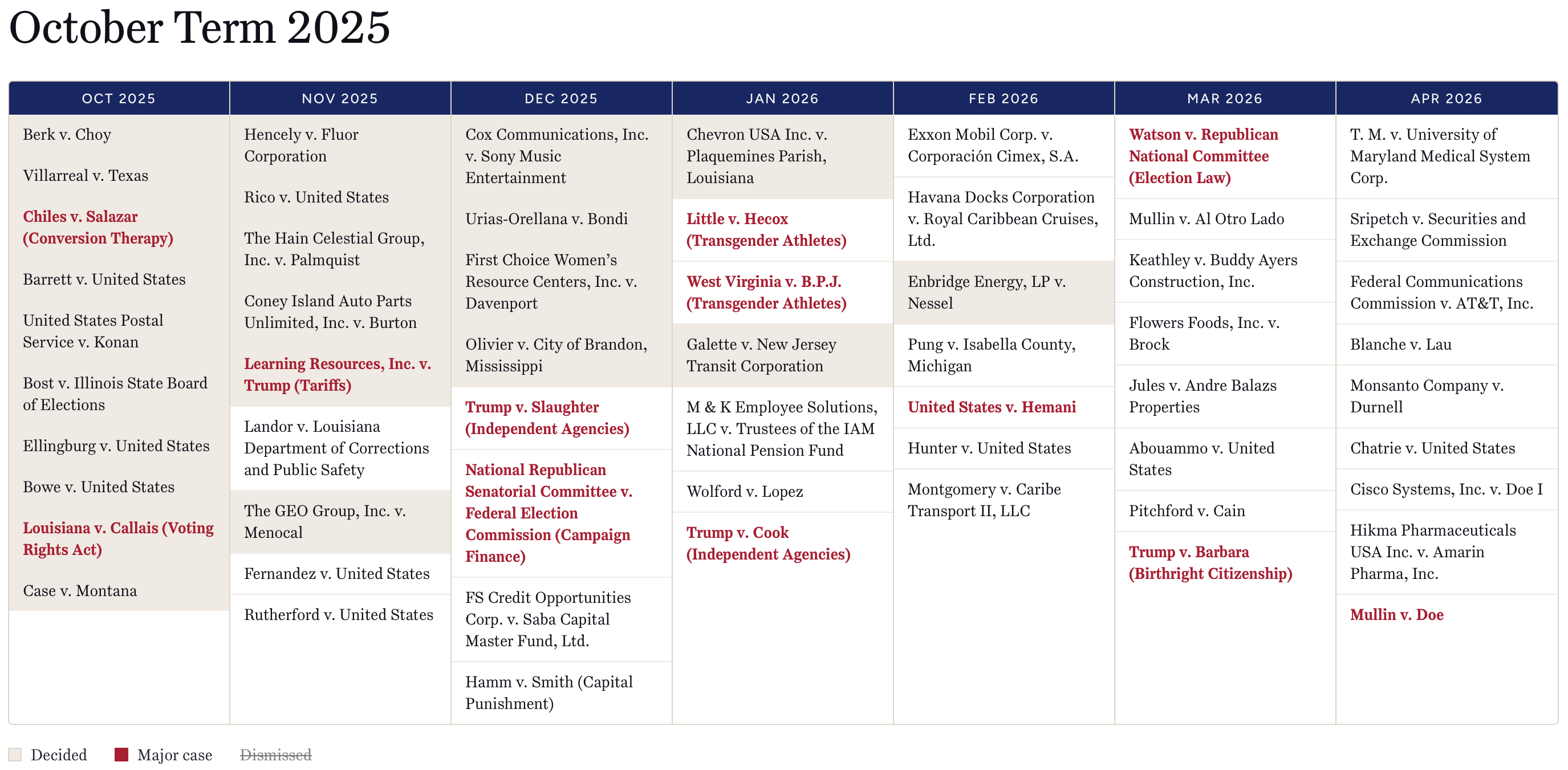
For those who aren’t paid subscribers, we’ll be back (no later than) Monday with our continuing coverage of the Supreme Court. For those who are, please read on.
