

Three years ago next month, I published my first book, The Shadow Docket. The book offers what I hope is a fairly comprehensive history of the evolution of the Supreme Court’s power (and willingness) to resolve cases through unsigned and un- or thinly explained orders. Some of those rulings come in the form of grants or denials of emergency relief (what most people think of when they think of that title). But many come through grants or denials of certiorari; summary rulings at the certiorari stage; and so on. As the book shows, some of the Court’s current practices in these respects can be traced to the early parts of the twentieth century; some of them can be traced to the early 1980s; and some of them can be traced to moves the justices cemented in the mid-2010s.
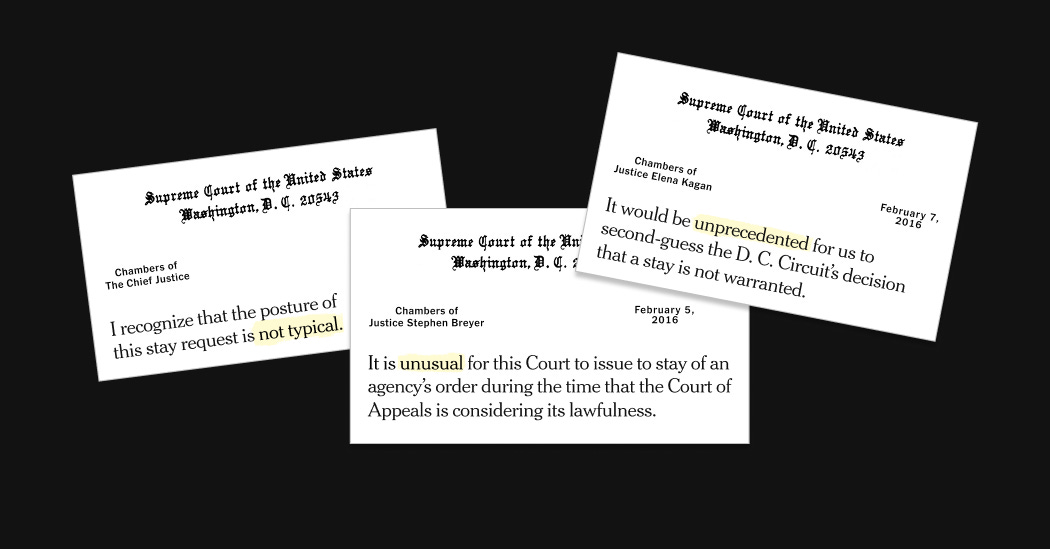
Against that backdrop, I’ve been rather … exasperated … by the avalanche of (mostly right-wing) commentary this week purporting to push back against Saturday’s New York Times scoop (and some of my own work) about the Court’s unsigned, unexplained, February 2016 ruling in the Clean Power Plan cases. This commentary has gravitated toward some combination of four different claims: That what happened in February 2016 wasn’t actually new (nor was it the birth of the “modern emergency docket”); that the memos actually bespeak a decision that was deeply principled (and “carefully” deliberated), like the rest of the Court’s behavior on the emergency docket; that the real story is the fact of the leak, not its substance; and, most bizarrely (is “unhinged-ly” a word?), that Adam Liptak should somehow face disciplinary sanctions from the New York bar for his role in the reporting. Sure, Jan.
Frankly, I’m a little tired of the ideological framing and valence of this discourse. I’m also tired of the barrage of dissembling, misdirection, and assumptions of bad faith on the critics’ part that figures so prominently in so many of the responses to critiques of the Court’s emergency docket behavior, of which this week’s tranche are just the latest examples. I harbor no illusion that I have always perfectly adhered to neutral principles, or that my principles are the same as yours. But I’ve always tried to explain, defend, and support my arguments with evidence—which is more than I can say for a troubling number of my interlocutors.
To that end, and in the interest of trying to close the loop, I wanted to take one final shot at responding to the two substantive claims being advanced by the Times’ (and my) critics—that there was nothing meaningfully new or novel about the Clean Power Plan ruling; and that the way Chief Justice Roberts’s internal memos handled the equities was principled and defensible. The former claim is objectively false—as the putative counterexamples themselves help to illustrate. And the latter claim requires a remarkable obliviousness, if not willful blindness, to how the Court (including Roberts) has handled the equities in emergency relief involving the federal government both before and since February 2016.
As is so often the case with commentary about the emergency docket, the Court’s defenders make arguments that sound outwardly reasonable, but that depend entirely on cherry-picking their examples and ignoring the counterexamples. And at the end of the day, the single most newsworthy thing about the Clean Power Plan ruling is not what happened in February 2016, but what happens when you compare the behind-the-scenes analysis to the Court’s behavior over the last 15 months—which none of these commentaries have seriously done. For as long as I’ve written about the emergency docket, I’ve flagged the Court’s tendency to act inconsistently in ways that are more favorable to Republican litigants (and presidents) and more unfavorable to Democrats. Because the Court writes so little in these cases, it’s hard to prove that inconsistency. But that’s a big part of what the Clean Power Plan memos actually do.
It’s easy for folks who clerked on the Court and/or who spend much of their time writing about it to tell themselves that it isn’t news that the Court makes hugely impactful decisions with scant briefing, even less deliberation, and no public explanation. But (1) it certainly seems to have been news to others (especially those who haven’t paid as close attention); and (2) regardless, the Court’s apparent inconsistency across administrations is problematic no matter when it started, who’s engaging in it, or how we learned about it.
I would’ve thought all of that would be uncontroversial, even in 2026. Alas.
For those who aren’t paid subscribers, we’ll be back (no later than) Monday with our continuing coverage of the Court. For those who are, please read on. And either way, my thanks and gratitude to Grace Kiple and Ava Singh for timely and terrific research assistance.
