

Welcome back to “One First,” a newsletter that aims to make the U.S. Supreme Court more accessible to lawyers and non-lawyers alike. I’m grateful to all of you for your continued support, and I hope that you’ll consider sharing some of what we’re doing with your networks.
Every Monday morning, I’ll be offering an update on goings-on at the Court (“On the Docket”); a longer introduction to some feature of the Court’s history, current issues, or key players (“The One First ‘Long Read’”); and some Court-related trivia. If you’re not already a subscriber, I hope you’ll consider becoming one—and upgrading to a paid subscription if your circumstances permit:
Even though the Supreme Court made plenty of news last week (which I wrote about both Monday night and in Thursday’s bonus issue, and may yet come back to later this week), I wanted to use today’s “Long Read” to provide some more context for a broader conversation that’s afoot respecting the United States’ ongoing military operations—indeed, its war—against Iran. One strain of commentary has, quite rightly, flagged the myriad ways in which the Trump administration’s behavior constitutes a flagrant breach of the U.N. Charter (which, as a treaty ratified by the Senate, is just as much a part of the “supreme law of the land” as any other statute or treaty); and is also a textbook violation of the separation of powers insofar as it is authorized neither by a statute nor by the President’s inherent constitutional authorities under Article II. A separate strain has suggested that these legal constraints are irrelevant because they are not judicially enforceable—that is, because it’s virtually impossible for anyone to walk into court and use these legal arguments to stop the U.S. operations. Still a third strain has tried to explain why the law matters even when it can’t be enforced in court—rightly (in my view, anyway) reasserting the principle that law should constrain government whether or not courts can punish the government for breaking it.
What I wanted to add to these points is a bit of context for why it would be so difficult for these legal constraints to be judicially enforced. And that context is the Supreme Court’s (not-so-well-known) role in Vietnam. The short version, which I expand upon a bit below, is that there were dozens of efforts to try to get the Supreme Court to rule on the legality of the war in Vietnam itself, and on countless subsidiary questions—especially separation-of-powers questions about the President’s power to use force in contexts increasingly far removed from what Congress had authorized in the August 1964 Gulf of Tonkin Resolution.
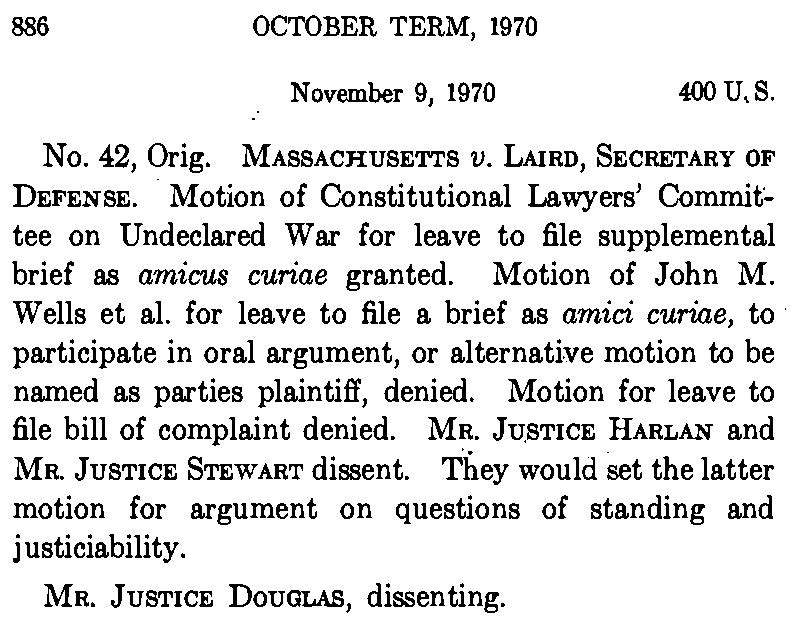
And although the Court decided plenty of cases related to the war in Vietnam, when it came to the legality of the war itself, the Court ducked the matter altogether—by repeatedly refusing to even take up appeals (or, in one extraordinary case, an original action) asking the Court to settle the separation-of-powers questions. Thus, as the federal courts of appeals (especially the Second and D.C. Circuits) eventually held that most of these disputes were not justiciable (whether because the plaintiffs lacked standing or because their claims presented “political questions”), the Supreme Court just … sat on its hands. Four different justices (led by Justice William O. Douglas) would dissent at one point or another from many of these procedural denials. But there were never four votes to take up a single one of those cases (or five to take up the original action). Vietnam came and went without any definitive judicial pronouncement as to its legality—or even the legality of things like President Nixon’s 1973 bombing of Cambodia.
The Court’s (unmistakbly willful) refusal to intervene has been interpreted, ever since, as an endorsement of the (in my view, flawed) conclusion that these kinds of disputes are best left to the other branches to resolve. As much as that judicial hesitation might make sense in a world with a moderately functioning Congress, we’re seeing, right in front of our eyes, the real—and steadily increasing—costs of such judicial abdication when Congress has abandoned any semblance of institutional responsibility.
More on all of this below. But first, the news.
On the Docket
The Merits Docket
The Court handed down two unanimous rulings in argued cases on Wednesday:
In Urias-Orellana v. Bondi, Justice Jackson sided with the government in a dispute over the specific standard that courts of appeals should apply to review claims of whether a given set of undisputed facts rises to the level of persecution for purposes of asylum claims. Specifically, the Court held that the question for the court of appeals is whether “substantial evidence” supports the agency’s determination respecting whether or not an asylum applicant was persecuted by the country from which they’re seeking asylum.
And in Galette v. New Jersey Transit Corporation, Justice Sotomayor held that New Jersey Transit is not an “arm of the state” for purposes of the Eleventh Amendment—and, thus, cannot avail itself of New Jersey’s sovereign immunity in suits for damages. I’ve suggested before that Justice Sotomayor has inherited Justice Ginsburg’s mantle as the Court’s fastest writer, and this certainly seems to bear that out; the decision was handed down just seven weeks after argument (the second-fastest ruling so far this term took 11 weeks).
Earlier in the week, the three Democratic appointees all dissented from the denial of certiorari in Johnson v. High Desert State Prison—a dispute over “whether federal law prohibits the poorest prisoners from splitting the $350 fee required to file a federal lawsuit when it allows everyone else to do so.” The (divided) Ninth Circuit panel ruling had held that the answer was “yes,” a holding that, as Justice Sotomayor’s dissent (joined in full by Justice Jackson) explained, was worthy of the Court’s review even if it was correct—but all the more so because it probably wasn’t.
Otherwise, the Court wrapped up the “February” argument calendar on Wednesday, and we don’t expect the justices to take the bench again until Friday, March 20.
The Emergency Docket
The biggest news out of the Court last week were the (bizarrely) simultaneous grants of emergency relief on Monday night in Mirabelli v. Bonta and Malliotakis v. Williams. I’ve already explained at some length why the ruling in Mirabelli was both premature and problematic in its application of the traditional standards for equitable relief; and why the ruling in Malliotakis appeared to rest on a mischaracterization of the record by Justice Alito that allowed him to claim that the Court had jurisdiction when … it didn’t. Later this week, I may have a bit more to say on the attempts to defend those rulings from folks more sympathetic to the Court than I am, but … there’s a lot going on.
The Court also denied emergency relief on Tuesday (over no public dissents) to Florida death-row inmate Billy Kearse. Kearse was executed later Tuesday night.
The Week Ahead
Other than a regular Order List at 9:30 ET this morning, there’s nothing on the Court’s formal calendar for the upcoming week. Briefing is complete on the Trump administration’s (33rd) emergency application seeking to revoke temporary protected status for Syrian nationals in the United States, so it’s possible a ruling on that could come this week. On Friday, a group of more than 175 former state and federal judges filed a remarkable amicus brief in support of the respondents (the plaintiffs challenging the revocation of TPS)—focusing on why the Supreme Court’s rulings on emergency applications, including its prior rulings respecting TPS for Venzuela, shouldn’t have precedential effects in other cases. It’s striking that it’s come to this, but, it’s come to this.
One other development of potential relevance to the Syria TPS case is Friday night’s denial, by a divided D.C. Circuit panel, of the Trump administration’s request to freeze a district-court ruling blocking its rescission of TPS for Haiti—and the panel majority’s (to me, deeply persuasive) explanation of why the justices’ earlier interventions in other TPS cases didn’t compel a stay here. The Haiti case may well factor into how the justices handle the Syria case—and whether they might take these cases up on the merits, rather than continuing to tackle such massively important immigration moves by the executive branch through the truncated process of emergency applications.1
The One First “Long Read”:
The Vietnam Court and the “Passive Virtues”
Toward the end of his majority opinion for the Court in Boumediene v. Bush (the 2008 Guantánamo habeas case), Justice Kennedy offered a curious reflection on judicial review of the government’s war powers.2 In his words, “[b]ecause our Nation’s past military conflicts have been of limited duration, it has been possible to leave the outer boundaries of war powers undefined. If, as some fear, terrorism continues to pose dangerous threats to us for years to come, the Court might not have this luxury.”
As a historical claim, Justice Kennedy’s rhetorical flourish was deeply flawed. Up until Vietnam, federal courts routinely reviewed a wide range of questions arising from military operations during wartime, including, among others: the legality of particular maritime captures during the “Quasi-War” with France; the validity of the naval blockade imposed by President Lincoln during the Civil War; the constitutionality of military commissions convened by President Roosevelt to try Nazi saboteurs during World War II; and, perhaps most famously, the propriety of President Truman’s seizure of steel mills during the Korean War. Indeed, as I’ve explained before, the most significant military power that Congress delegated to the President in the early years of the Republic—the power to use the military during domestic emergencies—was, in the most controversial cases, expressly conditioned on judicial review (and pre-authorization). These assertions of power were not just justiciable; judicial review was a prerequisite.
Instead, Justice Kennedy was presumably alluding to the array of decisions that began during the Vietnam War, in which federal courts relied upon a host of justiciability rules—especially Article III standing and the political question doctrine—to avoid settling inter-branch disputes over the constitutionality of particular uses of military force. (And disputes there were; although President Johnson relied heavily upon the Gulf of Tonkin Resolution to justify the dramatic ramping up of combat operations in Southeast Asia, U.S. activities quickly took on a scale and scope that far exceeded what Congress could ever have been said to have authorized in August 1964.)
As those questions percolated through the federal courts, between 1965 and 1974, the Supreme Court used every way imaginable to avoid deciding on the merits any fundamental questions about the legality or scope of the Vietnam War, even as public and academic debate on those questions intensified. As one academic commentator has written in a comprehensive survey of those rulings,
Avoiding decisions on the merits of justiciable Vietnam issues presented by litigants with requisite standing through cryptic silence would be an ignoble abdication of the Court’s constitutional responsibilities, whether or not a judgment on the merits would have sustained or invalidated the Government’s prosecution of the war. The Court had frequently declared its power and duty to adjudicate federal questions on the merits, but it withheld judgment on the Vietnam cases. The Court was willing to approve the war by silence but would neither confirm nor condemn that result by opinion for or against the Government. Although concealed by the privilege of discretionary review, the Court’s apparent failure of courage was inexcusable.
The lower federal courts followed suit in similarly Delphic decisions. In dozens of suits, federal judges relied on two different procedural barriers to justify not reaching the merits of a wide range of litigants’ challenges to the constitutionality of the war; the draft; and a host of other Vietnam-era measures. In one class of cases, these courts held that the plaintiffs lacked “standing”; they could not prove that the allegedly unlawful government action they sought to challenge injured or would injure them specifically. In another class of cases, courts relied on the “political question” doctrine, holding that the Constitution committed disputes over the scope of whatever authorization Congress had (or had not) provided for military force in Southeast Asia to the political branches, not to the courts.
To be sure, the Supreme Court during the same period heard various disputes related to the war, several of which are now part of our constitutional canon and historical consciousness. For example, in New York Times Co. v. United States (the Pentagon Papers case), the Court famously rejected the government’s effort to enjoin the New York Times and the Washington Post from printing the Pentagon Papers. In Cohen v. California, the Court threw out the conviction of an anti-war protestor who was prosecuted for wearing a “Fuck the Draft” jacket. In United States v. O’Brien, the Court upheld a federal law that made it a crime to burn a draft card. And in Clay v. United States, the Court threw out the conviction of Muhammad Ali for refusing to report for induction, holding the government failed to demonstrate that Ali’s application for conscientious objector status was properly denied.
Every time, however, that a litigant asked the Supreme Court to take up an appeal contesting the substance of U.S. military or paramilitary activities in Southeast Asia, or the means by which soldiers were conscripted to participate in those operations, the Court ducked and declined to review lower court decisions—virtually all of which had concluded that such disputes were not justiciable. For a time, the Supreme Court’s repeated avoidance provoked dissents from as many as three of the nine Justices, William O. Douglas foremost among them. Those dissents, however, had no visible effect on the Court’s majority, which only appeared to harden against intervention as the war dragged on. (This was also a period of remarkable turnover on the Court; between 1969 and 1972, four of the Court’s nine seats received new occupants—each of whom was appointed by President Nixon.)
The result was to radically ratchet up the bar litigants had to clear for persuading federal courts that they could review separation-of-powers questions arising out of exercises of military force—and not just individual rights questions—even as the war became ever more detached from even the thinnest reed of statutory support.
Nor did things change in the first years—or decades—after Vietnam. An especially illustrative case in point is Campbell v. Clinton, where three D.C. Circuit judges relied on a combination of Article III standing and the political question doctrine to avoid reaching the merits of a claim that nineteen members of Congress brought challenging the constitutionality of U.S. airstrikes over Kosovo. As Campbell illustrates, from the end of the Vietnam War onwards, courts faced with lawsuits challenging overseas military operations on separation of powers grounds have consistently relied on the same two doctrines—standing and the political question doctrine—to avoid reaching, let alone resolving, such thorny constitutional questions. The result has been not to sustain the President’s ability to use military force in circumstances in which neither a statute nor the Constitution authorizes it, but rather to leave the President’s power in such a case to be resolved only through the practicalities of the political process—not the formalities of litigation.
In one sense, the Court’s refusal to intervene in Vietnam powerfully reflected an idea that Professor Alex Bickel had first advanced in his 1961 Harvard Law Review Foreword, titled “The Passive Virtues.” Bickel’s thesis was that the Court could (and, in the long term, would) gain more power by not reflexively intervening in various high-profile disputes and/or handing down sweeping decisions, on the theory that the Court’s credibility would be burnished by the sense that the justices were carefully picking their battles and were participating in—rather than hijacking—a broader dialogue with the other branches of government about what the law ought to be.
Bickel was writing at least in part to defend the Court’s use of various procedural devices, including cert. denials, to sidestep hot-button issues. In his view, the Court had only so much capital to spend. And in a context in which Congress and the President were continuing to fight a series of smaller battles over how much war power Congress had truly delegated with respect to the goings-on in Southeast Asia, maybe the less the Supreme Court said, the better.
To be sure, Bickel’s thesis has been controversial since the day he wrote it. (The late Stanford professor Gerry Gunther once described Bickel’s essay as an “emphasis on principle as the highest Court duty, but only in a limited sphere of Court actions; the 100% insistence on principle, 20% of the time.”)
But a larger problem has emerged with Bickel’s thesis—one that’s powerfully mapped out in a brand-new paper that’s forthcoming in the Georgetown Law Journal (woot!), in which my friend and University of Michigan law professor Leah Litman writes about the “passive vices.” Litman’s thesis is that the Supreme Court’s behavior on emergency applications arising from the second Trump administration calls Bickel’s entire account into serious question—because of the extent to which, in our current political moment (especially the disappearance of an institutionally minded Congress), the Court’s passivity is necessarily (if not inevitably) enabling more lawlessness by the executive branch.
It’s well beyond the ambit of Litman’s paper, but it seems to me that the same can be said about the Court’s Vietnam-era passivity: In a context in which Congress had already ceded so much of its constitutional authority to the President, the Court’s refusal to clarify when the President had crossed the line (and, indeed, whether there was even a line for the President to cross) necessarily enabled more unilateral presidential warmaking. Of course, that warmaking could have been (and can be) halted at virtually any moment by a sufficiently motivated Congress. And, failing that, it can be halted come November (or, next January, anyway) by a sufficiently motivated electorate. But given the rich history of the Supreme Court inserting itself into the middle of some awfully significant questions about the legality of presidential actions undertaken ostensibly during “wartime” (and its willingness to insert itself into plenty of other highly “political” disputes), the Court’s turn toward passivity in the Vietnam cases looks, with each passing day, like far more of a vice for the separation of powers than a virtue.
SCOTUS Trivia: A Canonical Anniversary
Today marks the 62nd anniversary of the Supreme Court’s 1964 decision in New York Times Co. v. Sullivan—in which an effectively unanimous Court held that the First Amendment “prohibits a public official from recovering damages for a defamatory falsehood relating to his official conduct unless he proves that the statement was made with ‘actual malice’—that is, with knowledge that it was false or with reckless disregard of whether it was false or not.”
I’ll save for another day the richness of the background to Sullivan and the contemporaneous significance of the Court siding with the Times at such a critical juncture in the Civil Rights Era. But I largely agree with the Times’s own retrospective on the decision in an editorial marking the 50th anniversary back in 2014:
The ruling was revolutionary because the court for the first time rejected virtually any attempt to squelch criticism of public officials—even if false—as antithetical to “the central meaning of the First Amendment.” Today, our understanding of freedom of the press comes in large part from the Sullivan case. Its core observations and principles remain unchallenged, even as the Internet has turned everyone into a worldwide publisher—capable of calling public officials instantly to account for their actions and also of ruining reputations with the click of a mouse.
Justice Thomas has regularly called for the Court to revisit (if not overrule) Sullivan, and has picked up, at least at some moments, the support of Justice Gorsuch. But for as much mischief as Sullivan allows, consider me one of those who thinks we’d be a lot worse off without it than we are with it.
I hope that you’ve enjoyed this installment of “One First.” If you have feedback about today’s issue, or thoughts about future topics, please feel free to e-mail me. And if you liked it, please help spread the word!
If you’re not already a paid subscriber and are interested in receiving regular bonus content (or, at the very least, in supporting the work that goes into this newsletter), please consider becoming one:
This week’s bonus issue for paid subscribers will drop on Thursday. And we’ll be back with our regular content for everyone no later than next Monday (but it’s 2026, so you never know). As ever, please stay safe out there.
There’s a reflective footnote by Judge Walker at the end of his dissent in the Haiti TPS case with which I largely agree—about how grants or denials of emergency relief don’t necessarily signal anything about the efforts or integrity of the judges involved on either the giving or receiving ends. That said, Walker also parrots a claim by Justice Kavanaugh that I’ve addressed before—that what’s happening on the emergency docket at the Supreme Court these days isn’t new. As I wrote when Kavanaugh first made this argument in April 2024, that’s just poppycock. There may be defenses of the Supreme Court’s behavior on emergency applications over the past decade, but the claim that it’s nothing new under the sun just isn’t one.
Today’s “Long Read” is adapted from a bonus post from last June—so it may seem a bit repetitive to folks who’ve already read that one.
As a retired emergency medicine physician I'd like to offer a different perspective. I didn't spend my workdays searching for interesting patients to whom I could offer medical care. The emergency department reality is we have to manage everybody who comes to our door. I'll admit that sometimes I wondered why I "got chosen" to care for somebody so ill but couldn't waste time dwelling on that if I was to do the best I could for that person. Excusing myself from a difficult issue was abandoning the patient and that was never a possibility. Thus, when I hear of people who have risen to important levels of society and are tasked to manage hard problems, like our Supreme Court Justices or Congresspeople, sidestepping an issue because it is too hard or might cause a loss of power, or whatever, I feel abandoned by them. We the People need to hold them to a higher standard.
Kagan also wrote a paper criticizing Sullivan!
Judge Walker is probably the most interesting judge on DC Cir. I think he'd be a decent nominee for SCOTUS, though it's politically unlikely.