

Welcome back to the weekly bonus content for “One First.” Although Monday’s regular newsletter (and extra issues) will remain free for as long as I’m able to do this, I put much of the weekly “bonus” issue behind a paywall as an added incentive for those who are willing and able to support the work that goes into putting this newsletter together every week. I’m grateful to those of you who are already paid subscribers, and I hope that those of you who aren’t will consider a paid subscription if and when your circumstances permit:
Back in August, I wrote a post titled “Legal Pedagogy and the Dual State,” in which I reflected a bit on the unique challenges of teaching law students (and, especially, first-semester 1Ls) in the midst of mounting concern that the United States has its own emerging version of what Professor Ernst Fraenkel called “the Dual State”—the “Normenstaat” (the “normative state,” i.e., “an administrative body endowed with elaborate powers for safeguarding the legal order as expressed in statutes, decisions of the courts, and activities of the administrative agencies,” with the goal of maintaining the existing economic order) and the “Maßnahmenstaat” (the “prerogative state,” i.e., “that governmental system which exercises unlimited arbitrariness and violence unchecked by any legal guarantees,” with the goal of advancing the governing party’s ideological agenda).
Since then, I’ve wanted to return to the relationship between my job and Fraenkel’s thesis—this time in the context of legal scholarship, and, specifically, the intersections between the work of legal academics and legal theories being advanced by the government. (For what I hope are obvious reasons, Fraenkel’s thesis is less directly relevant to how legal scholarship intersects with the behavior of private actors; this is a problem most relevant to those of us writing and working in public law.) It should go without saying that every legal academic hopes that their work will produce a meaningful impact, however that may be measured in their specific field(s). But given that my work is very public-facing to begin with (including in this newsletter), and given that some of my work is also reflected in litigation in which I’m involved (where the results can have direct real-world impacts), I spend more time than I’d care to admit reflecting upon what my goals are—and whether there are circumstances in which a particular line of work, or line of cases, or set of arguments might produce harmful results even if I think they’re correct.
In this respect, one of the essays that I come back to a lot is a book chapter written in 2019 and published in 2022 by my friend and University of Minnesota law professor Oren Gross, titled “Hitler’s Willing Law Professors” (a not-so-subtle callback to Daniel Jonah Goldhagen’s best-selling 1996 book, Hitler’s Willing Executioners). In a nutshell, the thesis of Gross’s chapter is that “the story of the moral decline of German universities and professors in general, and of German law professors in particular, was one in which professional myopia, personal opportunism, moral weakness, antisemitism, and legal jurisprudential claims had been inexorably intermingled.”
Unfortunately, there’s no easily accessible version of the essay online (if it helps you find it, it’s part of a book titled The Betrayal of the Humanities: The University During the Third Reich). But below the fold, I’ll walk through Gross’s arguments, how they have influenced my own thinking, and why I think it’s incumbent upon just about everyone doing public law scholarship these days to think about the relationship of their work to our own state—one way or the other. The point is most definitely not that our current moment can or should be analogized to anything about Nazi Germany. Rather, it’s that there are broader lessons that I, at least, have tried to take away from some of the shortcomings of legal academics in that very different time and place—lessons that some readers may find useful. As ever, though, your mileage may vary.
For those who aren’t paid subscribers, we’ll be back (no later than) Monday with our regular coverage of the Supreme Court. For those who are, please read on.
Gross’s book chapter covers a lot of ground, and it would take more space than I have (and, I suspect, more patience than you have) to summarize it all here. But after documenting the purge of Jewish intellectuals from German law faculties in the 1930s, Gross turns to the role of those who were left. In his words, “once the ranks of university professors had been filled with supporters of the Nazi Party, German academia turned with much zeal and enthusiasm to the project of justifying and legitimating the actions of the regime.” Across the 41-page chapter, Gross marshals countless examples in support of his bottom line—that “While legal scholars did not, by and large, participate directly in the crimes perpetrated by the Nazis, they facilitated those by conferring a veneer of legality and legitimacy to the actions of the regime.”
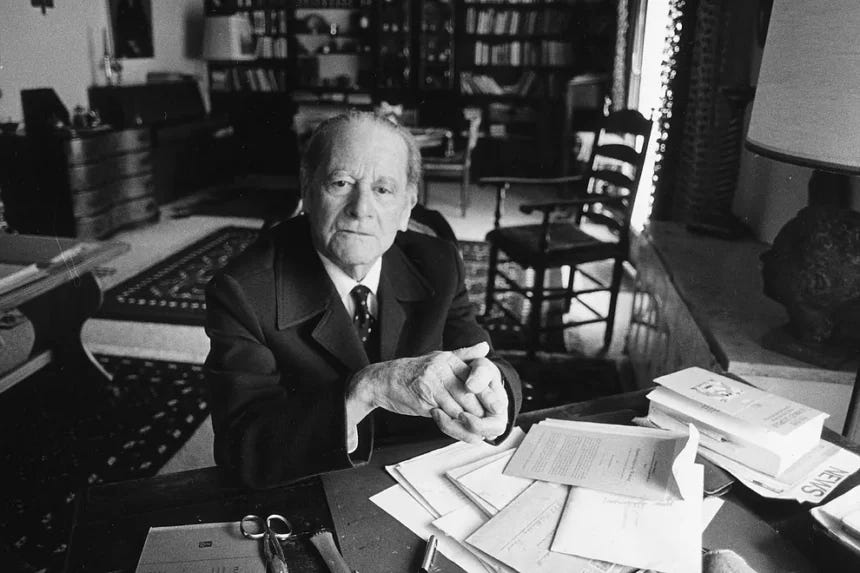
No academic featured more prominently in this enterprise than Carl Schmitt (who’s the subject of the 1978 photograph, above). As Gross writes,
No single member of the Mandarin legal elite had a more pernicious impact on the collapse of Weimar and the rise of the Nazi state than Carl Schmitt. None made greater contributions to the weakening and eventual dismantling of the Weimar Republic and its constitution. None rose as fully in support of the racial policies of the Nazi regime, while also theorizing about, legalizing, and legitimizing the phenomenon of the Führer. Dubbed the “crown jurist of the Third Reich,” Schmitt, the first and most prominent constitutional theorist and political thinker to join the cause of National Socialism and lend his active support to the Nazis, “developed for Hitler the legal-philosophical outlines for the constitution of the Third Reich and wrote that the pivot was Hitler’s status as both head of state and party Ieader.”
In my August post, I wrote a bit about Schmitt’s theory of the “exception,” and how that theory became the dominant leitmotif of Nazi-era approaches to legality. It was also essential to the formation of the “dual state,” insofar as the “exception” was what justified resort to, and what defined the scope of, the prerogative state vis-à-vis the normative state.
But what Gross’s chapter really brings out is how much the Nazi regime, especially in its early years in power (i.e., 1933—1937), depended upon the work of Schmitt, his colleagues, and his pupils to prop up legal justifications for everything from the dictatorial power asserted by Hitler to the validity of the Nuremberg race laws. This was even more significant in the critical first 18 months of the regime—until the August 1934 death of Reich President Paul von Hindenburg, perhaps the only person who could still have thwarted Hitler (even though he had also been responsible for the final step of Hitler’s rise to power, having appointed him Chancellor in January 1933).
Quoting Gross, “Hitler’s rise to power allowed Schmitt to see his ideas put into action. His general musings about political and legal theory now turned into concrete actions in support of the National Socialist cause by formulating the case for the Führer state and for purifying the ranks of the legal profession of ‘alien’ elements—first and foremost Jews—and ensuring its ethnic, racial, cultural, spiritual, and ideological homogeneity.” Schmitt even published an essay shortly after the Night of the Long Knives1 defending the legality of the bloody purge of the SA and Hitler’s other remaining political opponents.
It’s not that Schmitt didn’t have a theory; as Gross notes in detail (and as others have written at even greater length), there was at least a degree of analytical coherence to the intellectual principles that Schmitt espoused in his writing. But Schmitt’s work provided cover—not only to the Nazi regime, which received the veneer of legitimacy from the legal arguments he advanced, but to his colleagues and pupils to join him in the enterprise of propping up Hitler’s government by providing the legal architecture for both ends of the dual state. As Gross notes, these academics’ “professional myopia was soon bolstered by rank personal opportunism. . . . [T]he Nazis’ seizure of power in 1933 brought with it opportunities for advancement in academia. With almost a third of those teaching at law faculties removed from their positions, mostly on racial grounds, the vacant positions were filled, in short order, by untenured faculty demonstrating nationalistic orientation.” And “as academic promotion was inexorably tied to support for the National Socialist cause, the newly promoted professors were at great pains to demonstrate their allegiance.”
Critically, as Gross highlights, the support for the regime came not just from the opportunists; it also came from the silence of the others who stood idly by: “For all of the moral depravity of the many who willingly flocked to the Nazis’ camp and cause, many legal scholars, judges, lawyers and law students simply remained silent in a self-imposed state of “voluntary coordination” with the Nazi machine.” And concluding on a personal note to drive home the stakes, Gross emphasized how, “For ten out of twelve people in my paternal grandfather’s immediate family in Poland (four of them young children), the Final Solution exercised by the murderous Nazi machine was no political exercise or theoretical debate.”
***
As I’ve noted in some prior issues of this newsletter, I spent a lot of time, especially in college, thinking about the role of law in (and after) the Nazi regime. I had hoped that this would remain an academic exercise, but from the very beginning of my legal career, there were reasons to be worried about the rise of “the exception” in our own legal system—as first reflected, at least from my personal experience, in some of the United States’ responses to the September 11 attacks. I think it’s safe to say the exception has become an ever-larger part of our contemporary legal culture—whether or not you share my view that one can find numerous warning signs of the emergence of a version of Fraenkel’s “dual state” in our current moment.
That led me, from the very beginning of my academic career (which I trace to roughly the middle of my time in law school—when I first started publishing legal scholarship) to try to think holistically about what, in the best-case scenario, I was trying to accomplish. Indeed, I vividly remember, at the final “officer proof” for a case comment I was publishing in the Yale Law Journal as a 3L, my editor asking me “how do you think history will remember this piece”? At the time, my response was to suggest I’d be excited if history remembered it at all (spoiler alert: it didn’t). But now that I and my work are, for better or for worse, far more visible, it’s a question I take a lot more seriously. To that end, I try to ask myself three questions about every project I undertake—from scholarly essays to real-world lawsuits and everything in-between.
First, what am I hoping to accomplish? It is inevitable that, especially for junior scholars, one of the goals of any scholarly work is to get their name out there—which may lead to thinking about the goals of any particular work at least in part by reference to increasing/maximizing one’s visibility. As my growing number of gray hairs (regularly pointed out to me by my daughters) can attest, I am past that point in my career. Instead, these days, I try to think about whether a specific project will not just enhance my own understanding of the relevant topic, but will meaningfully move the ball in (1) changing how the relevant audience thinks about a set of legal questions; (2) generally raising the audience’s awareness and understanding of issues they might not previously have been aware of or understood; and/or (3) helping to produce or push for a result that is (or would be), in my view, a net positive for the individuals / communities / institutions that are or would be directly affected. There are different ways to try to implement these goals depending upon the specific medium and format, but my internal litmus test for whether a project is “worth it” invariably involves some (at least informal) consideration of these variables. (One very recent case-in-point would be the New York Times op-ed that NYU law professor Barry Friedman and I published on Monday.)
Second, to what extent is the upshot of my scholarly work dependent upon who’s in charge? This one’s a bit trickier, but it’s a sanity check that I try to impose upon my work is to make sure it’ll stand the test of political time, and to insulate it against charges of opportunism, partisan hackery, or both. As a recent case-in-point, a theory of federal accountability that applies only to presidents of one party isn’t a theory worth a scholarly defense. More generally, I think one of the most visible examples of this phenomenon in my work is my repeated defense of the institution that is our federal judiciary, even if so much of its contemporary output, especially at the top, gives me so much agita. The key here, in my view, is to view scholarly work not as a prop for political actors to wield when it suits them, but as an effort to build a longer-term vision of how our system ought to work regardless of whether it has a specific partisan political valence in the short term. It’s inevitable that scholarly work can still be co-opted to support short-term political goals, but to paraphrase one of my favorite lines (from the Scottish writer Andrew Lang), unlike how a drunk uses a lamppost, I want my work to illuminate, and not just to support.
Third, and perhaps most vexingly, I think it’s incumbent upon those of us with a platform to balance the risk that our scholarly work may cause genuine harm to individuals / communities / institutions against the risk Gross’s essay highlights—of the professors who said nothing while the rule of law disintegrated around them. In some—perhaps many—cases, that won’t be a zero-sum game. But there are pieces I haven’t written and cases I’ve declined to work on where I was genuinely concerned that my intervention might do more harm than good—to the subject-matter; to the clients; or, every once in awhile, to people out in the world. On the flip side, there are plenty of times I’ve spoken out on scholarly issues at least in part because I thought it was important to speak out (among other examples, this category includes virtually every time I’ve agreed to testify at a congressional hearing).
I harbor no illusion that these are the “right” (or only) considerations that should go into how law professors approach their scholarly projects, either in general or at this particularly fraught moment for the rule of law in the United States. My goal here isn’t to provide advice to or criticism of anybody else. All I can say is that they’re the considerations on which I spend time. And whatever considerations my friends and colleagues across the legal academy use to guide their own work, I just hope that at least some of them will take the time to track down and read Professor Gross’s chapter—and, whether or not they do, to reflect upon the increasing professional, personal, moral, and ethical responsibilities we incur as our work becomes more publicly visible, and how those responsibilities dovetail with the unfortunate but increasingly undeniable reality that we have a government seeking to rationalize profoundly alarming (if not lawless) behavior.
We’ll be back Monday (if not sooner) with our regular coverage of the Supreme Court. Until then, have a great weekend, all—and, as ever, stay safe out there.
For more on the Night of the Long Knives, see this post from the U.S. Holocaust Memorial Museum.
Interested readers might want to check with their local public library to see if “The Betrayal of the Humanities: The University during the Third Reich” is part of the library’s online HOOPLA collection. Many public libraries offer HOOPLA, an online collection of ebooks, audiobooks, and videos. It was available in my public library.
Wow! Thank you for this very personal analysis of your way of looking at your (and other legal academics’) responsibilities when confronted with a lawless (and I would even use the word evil) government. We should also look at the responsibilities of others – business leaders, bankers, academics in other fields , federal employees , elected officials, religious leaders etc. – and their response and actions when confronted (and subject to significant personal risks if they become visible as opponents) with the cruelty and insanity of the federal government. To the extent it is possible or reasonable to pass judgment on those who are actively or even passively complicit with a cruel and lawless government the question of how much risk or loss any individual will face by not supporting or actively opposing it comes into play. Congresspersons do nothing or publicly support the lawless so they will (they hope) be more likely to be reelected. Business leaders make choices based on the impact on their (often already immense) wealth. Supreme Court Justices because….? Many people take decisions from silence to active opposition depending on how they judge the risks they face as a function of their status and condition (citizen, immigrant status, ethnicity, consequences if deported etc.). and/or the threats of harm they have been subjected to. I cannot predict how "heroic" or otherwise I would be if confronted directly with masked, armed, and apparently unhinged thugs on "official" business.
I refer you to an article (The Impact of Nazi Law) I recently came across serendipitously from the Wisconsin Law Review of July 1945 written by my paternal grandfather Friedrich Roetter ( I assume you have access to this journal - https://archive.org/stream/sim_wisconsin-law-review_1945-07_1945_4/sim_wisconsin-law-review_1945-07_1945_4_djvu.txt - if not I can send a pdf. He had been a successful lawyer in Germany until 1935, but was arrested and then released by the Gestapo – he was on the defense team of the Communist leader Ernst Thaelmann – after which wisely he, his wife and three sons fled to England. He makes the point that the Nazis operated with a system of law (mob rule elevated into law), and there were many helpers from all sectors of German society and the economy. Today's American "lawessness"is also receiving support from many quarters within the US polity. ICE agents certainly seem to fit the description of mobs acting “lawfully”, given the claim that they enjoy immunity for any action they take while anyone who shows the slightest sign of disagreement with them will be prosecuted as a “domestic terrorist.” In an Orwellian reversal, the terrorized becomes the terrorist.