

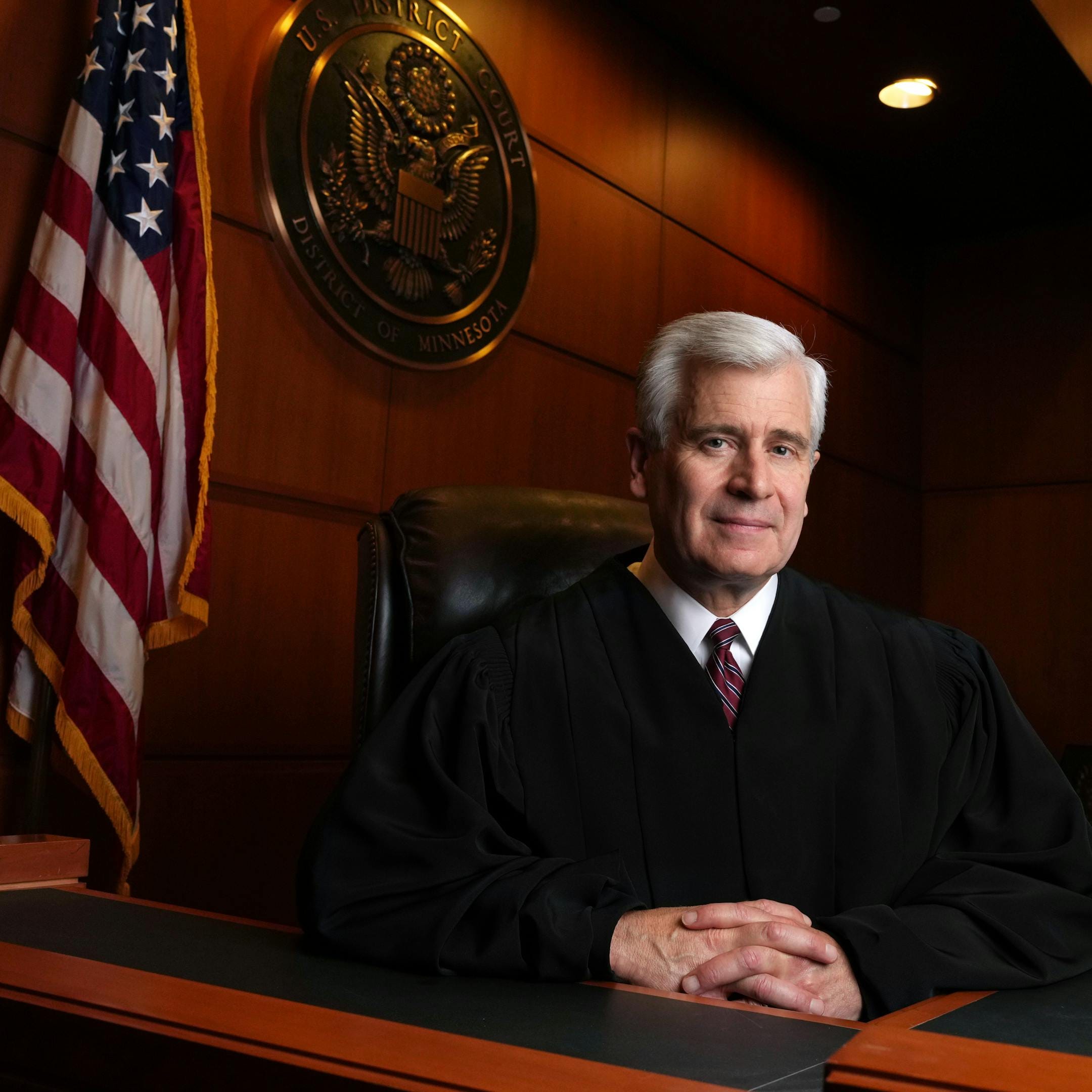
The chief judge of the U.S. District Court for the District of Minnesota is the Honorable Patrick J. Schiltz—a George W. Bush appointee who followed up clerkships for D.C. Circuit Judge (and then Justice) Antonin Scalia with a distinguished career on the faculty at Notre Dame Law School and then as Dean of the University of St. Thomas School of Law in Minneapolis. (Schiltz is also the author of one of my favorite law review articles of all time: “On Being a Happy, Healthy, and Ethical Member of an Unhappy, Unhealthy, and Unethical Profession.")
I mention all of this because, although it ought not to matter, Chief Judge Schiltz is a highly regarded jurist who could not be accused of having an axe to grind against the current administration. And that’s all the more reason why everyone, but especially his colleagues across the federal judiciary, ought to take seriously a pair of letters he filed on Friday in response to an extraordinary (in multiple senses of the word) attempt by the Department of Justice to end-run long-settled understandings of basic criminal procedure in order to bring federal criminal charges against individuals who protested inside a St. Paul church last Sunday.
The Schiltz letters are striking not only because of who wrote them, but because of the deeply unprofessional behavior they describe. One hopes, if nothing else, that these letters will give Judge Schiltz’s fellow judges (and especially appellate judges—including Schiltz’s colleagues on the Eighth Circuit) a moment of pause before acquiescing in any similar attempts by the Trump administration to strong-arm district courts.
Let’s start with the background. Last Sunday, a group of demonstrators entered the Cities Church in St. Paul during Sunday services as they protested one of its pastors, David Easterwood—who is also the head of the St. Paul ICE Field Office. (Don Lemon, now an independent journalist, followed the demonstrators with a producer, and live-streamed the goings-on via YouTube.)
Without regard to whether local or state officials could or would pursue charges against the protesters, the Department of Justice loudly announced that it would launch an investigation—including tweets and TV appearances by the Assistant Attorney General in charge of the “Civil Rights” Division calling the protesters “domestic terrorists” (never mind D.C. Rule of Professional Conduct 3.8(f)) and threatening charges for violating 18 U.S.C. § 241. Here’s Chief Judge Schiltz on what happened next:
On the evening of Tuesday, January 20, the United States presented an application for eight arrest warrants to Magistrate Judge Douglas Micko in connection with the disruption of a religious service at Cities Church on Sunday, January 18. Judge Micko was the magistrate judge who was on duty at the time. Judge Micko found there was probable cause to issue warrants with respect to three of the suspects but not with respect to the other five [SIV: including Lemon and his videographer]. Minutes after Judge Micko signed three arrest warrants, the U.S. Attorney notified me that his office wanted a district judge to review Judge Micko's decision-either by hearing an appeal of that decision or by considering the application de novo.
As Schiltz points out, that request is utterly extraordinary. Usually, when a magistrate judge refuses to sign an arrest warrant, the government either (1) drops the case; (2) reapplies for a warrant when it has more evidence; or (3) presents its evidence to a grand jury in the hopes of obtaining an indictment. In Schiltz’s words,
I have surveyed all of our judges—some of whom have been judges in our District for over 40 years—and no one can remember the government asking a district judge to review a magistrate judge's denial of an arrest warrant. I have also surveyed the chief judges of all of the districts in the Eighth Circuit. I have heard back from almost all of them, and all of those responding have said that, to their knowledge, no district judge has ever reviewed the decision of a magistrate judge to deny an arrest warrant.
Critically, Schiltz did not turn the government down. Instead, he told the U.S. Attorney that he wanted to consult with the rest of the court, and that he also wanted to see a brief about whether he had the authority to second-guess a magistrate judge’s refusal to sign an arrest warrant. But, as he explained,
we had to postpone our bench meeting at the request of the United States Marshal because of security concerns created by the presence of both the Vice President of the United States and the Attorney General of the United States in Minneapolis yesterday and by the initial appearances of two of the leaders of the invasion of Cities Church (who had been arrested pursuant to arrest warrants signed by Judge Micko) in St. Paul. We are scheduled to meet over lunch on Tuesday, January 27. I have informed the U.S. Attorney that I will make a decision about the warrant application immediately after that meeting.
In other words, the government’s attempt to bring a novel “appeal” of the magistrate judge’s refusal to sign an arrest warrant hasn’t been rejected by Chief Judge Schiltz; he’s just not ruling on it until Tuesday.1
Apparently, that wasn’t a satisfactory result for the Department of Justice. Unbeknownst to Schiltz (or, apparently, anyone else), the government filed a sealed, emergency petition for a writ of mandamus in the Eighth Circuit, claiming that the case, in Schiltz’s words, presented a “national-security emergency” because, if it couldn’t immediately arrest the other five individuals (including Lemon and his producer), “‘copycats’ will invade churches and synagogues this weekend and disrupt religious services.”2 (Note that, at least on the synagogue side, this didn’t happen.) Schiltz explained why this was all hokum (and why, if it really was such an emergency, the government could’ve gone to the grand jury for indictments); I couldn’t agree more.
But here’s where it gets truly bizarre: Schiltz found out about the emergency appeal only because, at 11:34 a.m. (CT) on Friday, he received an order from the Eighth Circuit directing him to respond, by 2:00 p.m. (CT), to a petition he didn’t know about, with which he had not been served, and to which he did not have access. Thus, the first letter was Schiltz’s effort to literally guess what the mandamus petition was about and explain why it should be denied. (Clearly, Schiltz guessed correctly.)
Then, there’s the second letter. Apparently, on behalf of the panel to whom the government’s petition was assigned, Susan Bindler, Clerk of the Eighth Circuit, responded to Schiltz’s first letter not by forwarding him the government’s briefing, but by asking a series of specific questions—and giving Schiltz an hour to respond. I don’t believe Bindler’s letter is public, so we have to guess a bit as to what the questions were. But Schiltz’s answers are, again, telling:
(1) I do not doubt that I have the legal authority to consider the application and decide for myself whether to issue the five warrants. As I have described, however, I do have doubt about whether and how I should exercise that authority. I have now heard from all of the Chief Judges of the Eighth Circuit—and many of them have checked with their colleagues and staff—and no one is aware of a single instance in the long history of the Eighth Circuit in which a district judge did what the government asks me to do: review a magistrate’s decision to deny an arrest warrant.
(2) I have not “refused” to make a decision about whether to issue the warrants. I have told the government that I will make a decision on Tuesday, after I meet with my colleagues.
(3) The government lumps all eight protestors together and says things that are true of some but not all of them. Two of the five protestors were not protestors at all; instead, they were a journalist and his producer. There is no evidence that those two engaged in any criminal behavior or conspired to do so.
(4) The government’s arguments about the urgency of its request makes no sense. As the government says, “dozens” of protestors invaded Cities Church on Sunday. The leaders of that group have been arrested, and everyone knows that they have been arrested. The government says that there are plans to disrupt Cities Church again on Sunday. Of course, the best way to protect Cities Church is to protect Cities Church; we have thousands of law-enforcement officers in town, and presumably a few of them could be stationed outside of Cities Church on Sunday. The government does not explain why the arrests of five more people—one of whom is a journalist and the other his producer—would make Cities Church any safer, especially because that would still leave “dozens” of those who invaded the church on Sunday free to do it again.
Schiltz closed by asking the Eighth Circuit to unseal the government’s petition for mandamus and his letters in response.
This saga came to a (temporary) close late Friday, when the Eighth Circuit summarily denied the government’s request. But rather shockingly, given Chief Judge Schiltz’s submissions, one member of the panel (Judge Grasz) concurred only in the judgment and wrote separately to suggest that DOJ might actually be onto something. In his words, “the Complaint and Affidavit clearly establish probable cause for all five arrest warrants, and while there is no discretion to refuse to issue an arrest warrant once probable cause for its issuance has been shown, the government has failed to establish that it has no other adequate means of obtaining the requested relief.” (Grasz did not explain how it was “clearly establish[ed]” that the government had probable cause to arrest Lemon and his producer.)
In other words, rather than chastising the Department of Justice for its sneaky and shady behavior, the Eighth Circuit summarily rejected its request—with Judge Grasz suggesting that it was just premature. The court of appeals did grant Schiltz’s request to unseal the government’s petition and his letters, but the government’s reply, at least as of this writing, remains sealed.
I realize there’s a lot of procedure here, but just to underscore the highlights:
The government was unable to persuade a magistrate judge to sign off on arrest warrants for five of the folks who entered the church last Sunday without permission (including Lemon and his producer);
Rather than come back with more evidence or go to a grand jury, the government tried to “appeal” the magistrate’s refusal to the district court—something for which there’s no precedent, at least in the Eighth Circuit;
The district judge hearing the “appeal” decided to take a few days to consult his colleagues and hear from the government before ruling;
The government wouldn’t have it, and, claiming that its inability to arrest these other officers constituted a “national-security emergency,” ran to the Eighth Circuit with a sealed emergency filing seeking immediate arrest warrants;
The district judge responded to a blind request from the Eighth Circuit by filling in those parts of the background that the government’s filing had … omitted;
The Eighth Circuit turned the government away, but (1) without pausing to say a word about its conduct; and (2) with one of the judges on the panel seemingly endorsing it; and
As Chief Judge Schiltz put it, “The five people whom the government seeks to arrest are accused of entering a church, and the worst behavior alleged about any of them is yelling horrible things at the members of the church. None committed any acts of violence. The leaders of the group have been arrested, and their arrests have received widespread publicity. There is absolutely no emergency.”
Suffice it to say, this is not how our legal system is supposed to work—especially with respect to the government’s ability to arrest those suspected of breaking the law. Indeed, it seems to me that this episode reveals three separate points, all of which ought to be taken closely to heed by Chief Judge Schiltz’s colleagues across the federal judiciary:
First, the Department of Justice’s priorities are, as so many of us have suspected, simply about generating the right kind of headlines as quickly as possible. Whatever one thinks of last weekend’s Cities Church protest, a federal case it ain’t—let alone one that justifies unprecedented procedural moves; the claim of a “national-security emergency”; and a sealed emergency petition to the Eighth Circuit. That’s only that much more the case for Lemon and his producer. As Schiltz put it, “There is no evidence that those two engaged in any criminal behavior or conspired to do so.”
Second, the Department is perfectly willing to bend every procedural rule to achieve those headlines. Even if you’re more convinced than I am that this is a federal case, these suspects aren’t going anywhere. The government has every right to go to the grand jury or to bring additional evidence back to the magistrate judge if it really thinks it can. But filing a sealed, emergency mandamus petition to ask the Eighth Circuit to order a district judge to do something no district judge in that court had ever done before (or to do it itself) in a case with no palpable exigency or national security implications is something no prior Department of Justice would’ve done. Indeed, the fact that the government won’t present these charges to the grand jury may be telling in its own respect—that this isn’t about the law.
Third, although it shouldn’t have to be, it is, sadly, incumbent upon the judges to be the ones who push back—and to make public hay out of the Department’s misbehavior. Were it not for Chief Judge Schiltz’s actions here, we might not know about any of this backstory—or, even worse, the Eighth Circuit might have simply acceded to the government’s entirely one-sided account of what happened and granted unprecedented relief. It shouldn’t matter that the judge making the noise in this case is someone with Chief Judge Schiltz’s resume and reputation. But, if nothing else, that ought to only reinforce the point even more forcefully. Judges, especially these days, have a special obligation to make sure the government is turning square corners; to not just take the government at its word that it is; and to blow the whistle when it isn’t.
I’m grateful for Chief Judge Schiltz on this snowy Sunday morning. But I hate that we needed him to speak out in the first place.
If you’re not already a “One First” subscriber, I hope you’ll consider signing on:
Regardless, we’ll be back tomorrow with our regular coverage of the Supreme Court and related topics. Stay safe out there, whether you’re hankering down to ride out “Fern” or living in the Twin Cities.
Schiltz’s second letter added other reasons why it has been difficult for judges in his court to conduct regular business: “I am also dealing with a number of emergencies, including a lockdown at the Minneapolis courthouse because of protest activity, the defiance of several court orders by ICE, and the illegal detention of many detainees by ICE (including, yesterday, a two-year old).”
It’s not clear from Schiltz’s first letter when/where the government made the arguments about a national security emergency and “copycats”; given that he hadn’t seen the mandamus petition when he wrote the letter, my assumption is that it was in written or oral representations to him, not the Eighth Circuit.
Steve, thank you for laying out so clearly the facts as well as the judicial reasoning that helps protect what seems right now to be our strongest institution. Judge Schlitz is doing the job the Founders planned for the courts to do.
There's another sad dimension to this. It used to be that when DOJ came into court, you could depend on its lawyers to be capable and honest. The occasional private lawyer might be less than straightforward, sure. But an AUSA? Never. And now that "presumption of regularity" is gone. The presumption instead will operate in reverse: judges will assume until shown otherwise that an AUSA is shading the truth (if not lying outright), is citing cases that don't actually say what the government claims they say, is inventing evidence, is ignoring the rules, is playing dirty. And this is OUR Justice Department, people. DOJ represents US. The Trump administration has taken OUR law firm, the crown jewel of American government law offices, and in the space of only a year has ruined it.