

Welcome back to “One First,” a newsletter that aims to make the U.S. Supreme Court more accessible to lawyers and non-lawyers alike. I’m grateful to all of you for your continued support, and I hope that you’ll consider sharing some of what we’re doing with your networks.
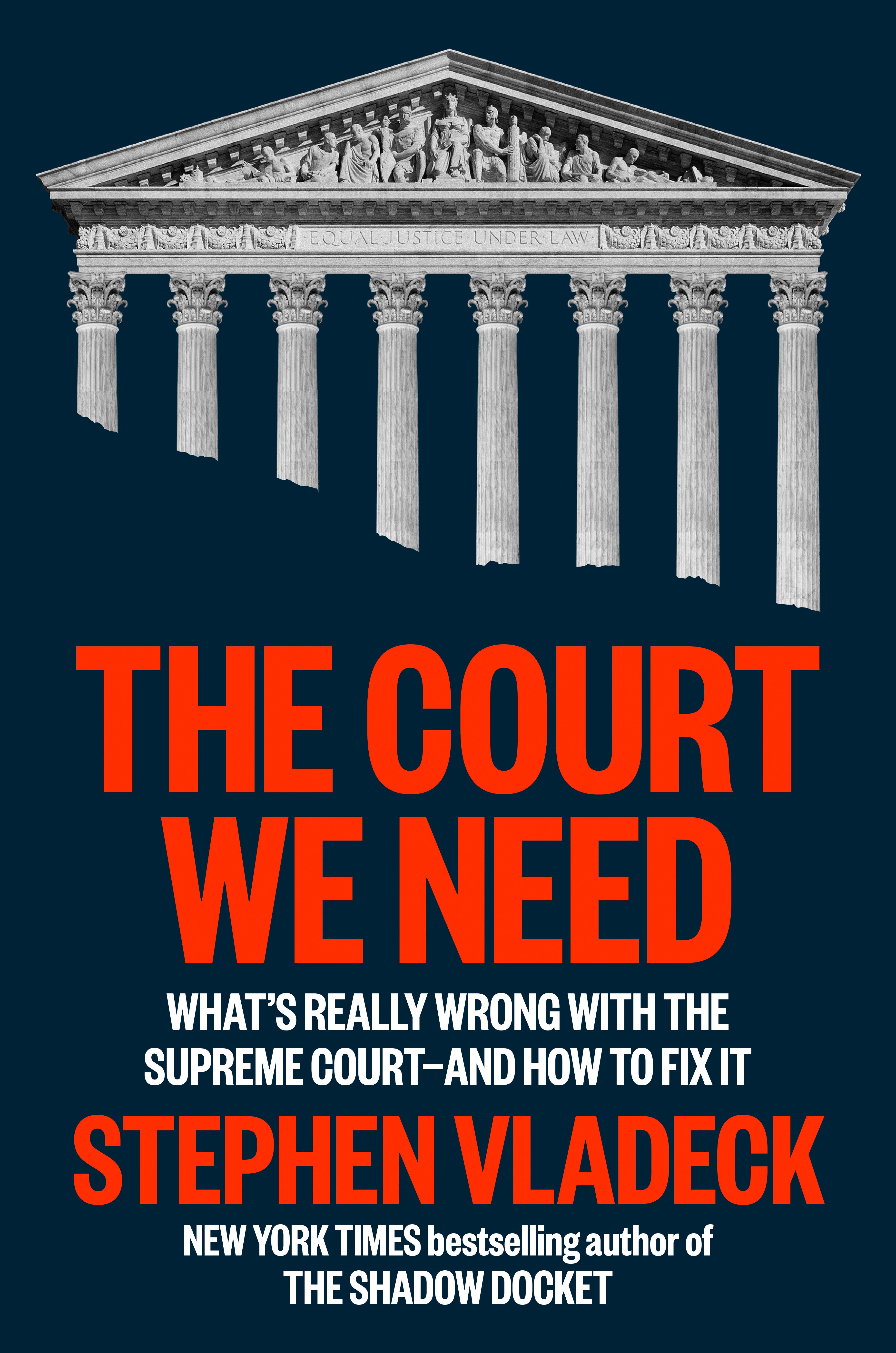
The Supreme Court made lots of news last week, and we’ll cover all of it below in the “On the Docket” section. But I’m also thrilled to use today’s “Long Read” to introduce my new book about the Court, The Court We Need: What’s Really Wrong With the Supreme Court—and How to Fix It. The book is due out from Viking Books (an imprint of Penguin Random House) on Tuesday, May 4, 2027, but it’s available for pre-orders now.
In a nutshell, the book argues that the real problem with today’s Court is that it has become unaccountable to any other institution of government—free to do just about whatever it wants, whenever it wants. And that’s new. For most of the Court’s history, the justices were active participants in a robust, ongoing conversation with Congress, the executive branch, and the people—and their power grew out of that dialogue, not in spite of it.
After tracing how the Court we had (Part I) became the Court we have (Part II), the book makes the affirmative case for the Court we need (Part III). That case is deeply skeptical of proposals to weaken the Court (recent events have powerfully underscored the need for an independent judiciary). Instead, it’s focused on replenishing what Justice Kennedy called the Supreme Court’s “reservoir” of trust, which the current justices have drawn down to dangerous levels. To that end, the book closes with some specific reform proposals alongside a broader call to everyone, regardless of how they feel about the current Court, to understand the importance of having a Court that enjoys broad, diffuse public support—to make it easier for that Court to push back against tyrannies of the majority.
More on all of that below. But first, the busy week of news.
On the Docket
The Merits Docket
Today is the Long Conference—where the justices will meet to consider the hundreds of cert. petitions and other non-time-sensitive matters that stacked up over the summer. We expect a partial Order List later this week, at least for those cases the Court is adding to its merits docket for the October 2026 Term. The full Order List out of the Long Conference (one of the longest of the year, mostly comprising denials of certiorari) will come down next Monday, October 5—the first day of the October 2026 Term—at 9:30 a.m. ET.
The Emergency Docket
The full Court1 handed down three rulings on emergency applications last week:
Ramey v. Texas: On Wednesday, over no public dissents, the Court denied a stay of execution to Texas death-row prisoner Ker’Sean Ramey.
Department of Homeland Security v. League of Women Voters: On Friday morning, over a dissent from Justice Jackson on behalf of all three Democratic appointees, the Court granted the Trump administration’s application for a stay in the SAVE case. The issue there was a Trump administration proposal to link the SAVE database to Social Security records so states could use it not just for employment verification, but to screen voter rolls for any noncitizens registered to vote. Judge Sooknanan had blocked it on the ground that Congress had never authorized the merger of these databases (or the override of our privacy interest in our Social Security information), and a divided panel of the D.C. Circuit had agreed. But in an unsigned, seven-page majority opinion, the Supreme Court concluded that the new rule is authorized by a 1996 immigration law permitting DHS to obtain and disclose citizenship information to states, and that the balance of equities justifies a stay. Justice Jackson’s dissent flagged the problems with both the majority’s merits analysis and its balancing of the equities. But both the majority and the dissent agreed that the immediate effects of the ruling should be fairly modest since we’re already inside the 90-day safe harbor created by the National Voter Registration Act within which states can’t make any systemic changes to their voter rolls (which sure makes you wonder about how the federal government is “irreparably harmed” by the injunction). Ultimately, this is an issue for 2028 more than 2026.
People Not Politicians v. Onder: Then, a little after 6 p.m. ET on Friday, the Court (as expected) granted a stay in the Missouri redistricting case—once more turning away an effort by Missouri Republicans to put into effect a new congressional map that the Missouri Supreme Court had blocked. The Court wrote another majority opinion (more about this in a moment), and the unsigned opinion closed with understandable frustration with the district court and the Eighth Circuit: “The District Court and Court of Appeals should not enjoin or otherwise prohibit the use of the 2022 map in the 2026 congressional election in Missouri,” the opinion concluded. “And the District Court and Court of Appeals should not order or otherwise require Missouri to use the 2025 map in the 2026 congressional election in Missouri.” As I suggested last week, two things can be true: the lower courts in the Missouri case absolutely deserved such an unusual slap-down, but there’s also a lesson for the justices about what lower courts can try to justify when the Supreme Court doesn’t explain its emergency docket interventions.
Taking a step back, both rulings on Friday really do appear to reflect a new commitment on the Court’s part to file “opinions of the Court” to accompany at least grants of emergency relief. Consider the dataset of grants of emergency relief in cases in which the Court did not hear oral argument (so, everything except CASA and Cook). During the October 2024 Term, there were 28 examples of such rulings, and exactly three came with “per curiam” opinions of the Court (including none of the last 18). During OT2025, in contrast, there have been 19 examples of such rulings, and we’re now up to eight majority opinions. Even more strikingly, all eight of those have come since May 14—a period during which the Court has granted emergency relief a total of nine times. Only the full Court’s first grant of emergency relief in the Missouri redistricting case on September 10, which came in a fast-moving case, didn’t have a majority opinion to accompany it.
It seems to me that this is happening enough now to be more than a coincidence. And insofar as the Court really is committed to filing opinions of the Court in (almost) every case in which it grants emergency relief, that strikes me as an unequivocally positive development, and one for which the justices should be commended. Just as significant, in my view, is how it appears to provide yet another example of the Court being responsive to at least certain types of criticisms (about which more below).
The Week Ahead
Speaking of the emergency docket, the justices have yet another major application to deal with this week—the latest in the third-country removals case, the one unhelpfully captioned “DHS v. D.V.D.” The third-country removal litigation involves whether noncitizens are entitled to notice and an opportunity to challenge their removal to a country other than the one designated in their removal proceedings on the ground that they’d face torture or other forms of unlawful treatment there. Although the justices had initially stayed Judge Murphy’s preliminary injunction blocking the policy (after the government had overtly violated it), Judge Murphy concluded after full proceedings that DHS’s new rule had to be vacated, and the First Circuit affirmed his final judgment in substantial part on September 18. I’m hoping to write more about this remarkable (and horrifying) case later this week, but I wanted to mention here one truly extraordinary feature of the Solicitor General’s application, first flagged by Chris Geidner: In addition to a stay of Judge Murphy’s ruling pending appeal, the application asks for an “immediate administrative stay.” But then it gets weird:
In light of the ongoing disruption caused by the First Circuit as well as the prior stays granted by the full Court, if the Circuit Justice enters a briefing schedule without also entering an immediate administrative stay, the government respectfully requests that its request for the immediate administrative stay be referred to the full Court. Cf. Rollins v. Rhode Island State Council of Churches, 146 S. Ct. 402 (2025) (No. 25A539); A.A.R.P. v. Trump, 145 S. Ct. 1034 (2025) (No. 24A1007).
In other words, Solicitor General Sauer invited the Court to override Justice Jackson—and cited in support the two recent cases in which (we think) the full Court overrode a circuit justice. I see at least two problems here. The first is that, as I’ve explained before, the Court’s internal processes clearly already provide for circumstances in which the circuit justice’s preferences are contrary to those of a majority of the Court—something that, if anyone outside the Court understands, it’s the Solicitor General. A litigant without inside information as to how the Court works might ask for such unusual relief, but the SG knows—or, at least, should know—better.
Second, going after Justice Jackson, in particular, seems especially ugly given the context. Despite misinformed claims of right-wing commentators to the contrary, there’s no evidence that Jackson has abused her authority as circuit justice to slow-walk or otherwise frustrate the government’s procedural rights in any of these cases. The Rollins example cited in the new application only proves the point: in that order in the SNAP litigation last November, Jackson publicly dissented from the full Court’s extension of an administrative stay (benefiting the government) that she had initially entered.
Here, at least, this gambit seems to have failed. Justice Jackson did in fact set a briefing schedule (the plaintiffs’ response is due by 4 p.m. this afternoon), and no administrative stay issued from her or the full Court. But asking the rest of the Court to preempt a circuit justice is still a brazen escalation by the Solicitor General, and one that hopefully bothers even those justices who are more sympathetic to the government in these cases than Jackson has been.
Miscellaneous
Speaking of Justice Jackson and the emergency docket, the Court’s juniormost member gave the 31st Annual Joseph L. Rauh Jr. Lecture at the University of the District of Columbia on Thursday night, in which she was once again quite publicly critical of the Court’s behavior on emergency applications. “There is a serious concern that the Supreme Court’s modern stay practices are having a disruptive and potentially corrosive effect,” she told faculty and students at UDC’s David A. Clarke School of Law. And although she acknowledged that her colleagues are writing more, these opinions were “still not the full kind of explanation” that comes with rulings on the merits docket. “If we’re not careful,” she argued, “the emergency docket can and will become an end-run around the standard review process.” Going off media reports, Jackson’s remarks sound quite similar to the James A. Thomas Lecture she delivered at Yale Law School earlier this year. Still, it’s striking that one of the Court’s current members continues to criticize her colleagues in public even as at least some of the Court’s behavior has apparently started to shift.
And speaking of criticizing the Court’s use of the emergency docket, I was also struck by reports of what Eighth Circuit Judge David Stras had to say at William & Mary’s annual Supreme Court preview event. According to Bloomberg Law, Stras (who was one of the judges on the panel in the Missouri redistricting case) observed that “They release these short orders that are sometimes really unclear to the circuit courts," and that “It would have been better to have a little bit more, in terms of tell us what to do. . . . What’s off limits and what can we look at?” Again, I don’t think the Court’s September 10 intervention in the Missouri case was remotely ambiguous, but it’s striking that even a highly visible conservative appellate judge is now saying out loud what so many of the Court’s right-of-center defenders have previously refused to acknowledge.
And then there are the rather striking (if hard to fully parse) comments by Justice Gorsuch on Friday at the Tenth Circuit Judicial Conference. Gorsuch’s topic was also emergencies, but he was focused more on … executive power. Gorsuch bemoaned “[t]he rise of the emergency. The perpetual emergency. Everything is an emergency.” According to media reports, Gorsuch complained that “[w]e’ve moved so much up to the federal level that needs to be done by states. And now through delegations of authority, through emergency legislation of all stripes, we’ve moved it over to the executive branch. And I just don’t think that's a recipe for a healthy democracy over the long term.” To be sure, Gorsuch has sounded this particular trumpet before. But aside from his very visible vote in the tariffs case, Gorsuch has largely sided with the Trump administration with regard to virtually every (divided) case to reach the Supreme Court since last January—raising at least the appearance that, as fair as his overall critique may be, his actions to actually implement it have been inconsistent.
The One First “Long Read”: The Court We Need
The Book
The Court We Need isn’t the book I planned to write after The Shadow Docket. That book, instead, was going to be all about the Election of 1864—the wildest and most important presidential election that no one knows much about. (I wrote a bonus post about the topic a little over a year ago.) But then, two things happened. First, people actually read this newsletter. Karen and I had launched it back in November 2022 largely as a response to the breakdown of Twitter, where I had provided a lot of legal explainers in the past. Moving to Substack allowed me to put together those explainers in long-form folks could receive in their inboxes, and not just as threaded tweets folks had to find for themselves. It also coincided with the release of my first book—The Shadow Docket, which was set to be published in May 2023. But not only did interest in the newsletter continue past the publication date of the book; interest in the Court continued to grow, and it spiked once President Trump returned to office in January 2025. That interest continues to provoke genuine questions about the Court that I wanted to try and help answer
Second, my superstar agent, Alia Hanna Habib (from The Gernert Company), persuaded me that I had more to say about the Court beyond the shadow docket. So much contemporary discourse about the Supreme Court paints the institution (and the justices) in black and white, with little regard for what is unique and uniquely problematic about the Court of today. But the book’s central claim is that what sets the current Court apart from every one of its predecessors is a majority of the justices’ apparently unshakable belief in the institution’s absolute and inviolable independence, reflected, among other places, in Justice Alito’s 2023 assertion that “no provision in the Constitution gives [Congress] the authority to regulate the Supreme Court—period.” It’s not a coincidence that the Court has come to this view at the same time as Congress over time abandoned every lever it had used to keep the Court loosely in line for the first two centuries of the Republic. Those levers are the heart of Part I—the Court we had.
There’s no one flash point where everything changed to produce the subject of Part II—the Court we have. Instead, at roughly the same time, Congress gradually gave the Court more and more control over every facet of its work, and the middle of the Court—the irregular bloc of justices who had tended to moderate the more extreme impulses of their colleagues—hollowed out. Those developments may have coincided with 11 consecutive appointments to the Court by Republican presidents (from 1969–1993), but they were not caused by those appointees. Instead, most of what folks criticize when they criticize today’s Court and justices is, as the book concludes, a symptom of the disease—rather than the disease itself.
Part III turns to what, in my view, are the reasons for, and the way to get to, the Court we need. As regular readers of this newsletter already know, although I have little patience for the argument that everything is fine at the Court, I’m similarly skeptical of the two reforms that tend to dominate the conversation among the Court’s critics. Expanding the Court would be seen unequivocally for what it is—partisan political power being used for partisan political purposes, which does precisely nothing for the diffuse public support that is the actual source of the Court’s power. It might provide short-term wins for progressives, but it will only touch off a race to the bottom in which the Court will enjoy ever-less support from the public. Some may see that as a feature; to me, it’s a pretty serious bug.
Likewise, although term limits are, in my view, constitutionally permissible, they amount to a recipe for more predictability in when Supreme Court vacancies arise . . . and very little else. (I’m also not sure they could be implemented by statute except prospectively—which would mean they wouldn’t be a viable reform until we had an entirely new Court.)
What I’m after instead is what Justice Kennedy described to a skeptical congressman in 2001, three months after Bush v. Gore: the “deposit, a reservoir, a storehouse of trust” that the Court draws down every time it hands out a divisive ruling. Kennedy was right about the softness of the Court’s power, but the even more important point is that he had to publicly defend the institution in the first place.
The ultimate goal of the book is to persuade anyone who reads it that we should all be invested in rebuilding those channels of accountability. The justices should have to look over their shoulders before they interpret statutes in ways Congress couldn’t have intended, before they adopt novel constitutional interpretations wildly out of touch with the American people, before they overrule precedents for no reason other than their disagreement with them, and before they behave in ways that raise serious ethical questions. And if they do start looking over their shoulders again, they might—as so many of their predecessors did—act in ways that are meant to promote accountability (like, for instance, starting to write opinions of the Court when they grant emergency relief).
Where You Come In…
As noted above, the book is due out on May 4, 2027 (I’m already working on my Star Wars jokes). And I’ll have lots more to share about the book between now and then. But I’m posting about it today because it’s now officially out in the world for pre-orders. The Viking landing page has links to all of the bookstores already offering it for sale, and pre-orders, as it turns out, are really important to help new books succeed. Every copy that’s ordered before publication day counts toward first-week sales, and that number is what determines (1) whether a book lands on the bestseller lists; (2) how much attention it gets from booksellers; and (3) whether the people who decide what gets reviewed and covered in other outlets will consider including The Court We Need. So if you’re planning to buy the book at all, buying it now does considerably more good than buying it late because of the signal it sends; it’s the single most useful thing you can do for a book you’d like other people to read.
I’m still planning to continue providing the same coverage of the Supreme Court here at One First—the majority of which has been, and always will be, free (even to Yankees fans). But the book is far more than just an edited compendium of One First posts; there’s a lot of original historical research and anecdotes in there, along with a far more comprehensive assessment of the current Court’s shortcomings. And telling a coherent story across a single 110,000-word book written for a (very) general audience is a meaningfully different enterprise from 500 Substack posts published across four years.
And so I hope you’ll consider clicking on that pre-order button—if not for you, then at least for someone who disagrees with you (or me) about the Court. And even if that’s not possible, please consider other ways to express support for the book—whether by requesting it from your local library when it comes out; sharing details about the book and the pre-order campaign with your circles; and, if you’re in a position in which it would make sense, consider inviting me to come talk about it with your group sometime next spring or summer.
The Village
Finally, although there will be a far more comprehensive acknowledgments section in the book itself (don’t worry, mom), I want to say a special word of thanks to a few especially critical people here. As I suggested above, this book would literally not exist without my agent Alia, who talked me into writing it and is so good at her job that she even has a wonderful book of her own for those considering non-fiction writing/publishing. Thanks also to my superlative editor at Viking, Allison Lorentzen, who has been this project’s biggest cheerleader ever since our first (Zoom) meeting in March 2025. As ever, I’m grateful to my army of Georgetown Law research assistants—Ricky Coyne, Grace Kiple, Abby Liman, Alyssa Negvesky, Ava Singh, and Mackenzie Webb—who not only put up with my ridiculous requests, but always make my work better. And just about nothing I do would be possible without the support of my wife and best friend, Karen—who, unlike The Shadow Docket, has promised to actually read this book.
But most importantly, I’m grateful to you—the 100,000+ subscribers to this newsletter. When I finished The Shadow Docket, I really wasn’t in a hurry to write another book about the Supreme Court. But your support for, your interest in, and your engagement with my weekly work on the Court as an institution has been the engine behind the labor that went into getting The Court We Need from an idea Alia had to a completed book on its way to the real world. There’s a lot of you in there, too.
I’ll have much more to share about the book, including some excerpts; some (hopefully fun) opportunities to engage with it; and a schedule of public events and media appearances as we get (much) closer to May. For now, let me just say that I’m really excited to get to share all of this with you, and I hope you’ll want to read the book when it’s out in the world in a little over seven months.
SCOTUS Trivia: “Supreme Court Trivia”
This one is a little meta, but I couldn’t resist. For my birthday this past Saturday (my last prime number birthday until I turn 53), my older sister, Liz, sent me the below “Supreme Court Trivia” game—which, candidly, I’d never seen before:


My daughters kept asking me multiple-choice questions from the cards until I got one wrong. That took 27 cards—when I flubbed the number of days President Clinton took to nominate Ruth Bader Ginsburg to the Court when Justice White retired in 1993. (Honestly, I’m okay that I didn’t know that one.)
Your mileage may vary, but it was a remarkably thoughtful gift from my older sister—and something anyone who actually reads this particular section of my newsletter on a weekly basis will likely enjoy.
And unlike The Court We Need, this one’s ready to ship now.
I hope that you’ve enjoyed this installment of “One First.” If you have feedback about today’s issue, or thoughts about future topics, please feel free to email me. And if you liked it, please help spread the word!
If you’re not already a paid subscriber and are interested in receiving regular bonus content (or, at the very least, in supporting the work that goes into this newsletter), please consider becoming one:
This week’s bonus issue will drop on Thursday. As ever, I hope you are all staying safe out there, especially if your baseball team ended up in last place for the first time since 2003.
Acting by herself, Justice Kagan denied the application for emergency relief in the California surrogacy case that I’d written about a few weeks ago.
I am listening to Shadow Docket now and I was wondering how you'd analyze the change. It seems like the Court is trying to write more on the Shadow Docket but continues to create that confusion for the lower courts, litigants and the public even when they are writing. A striking observation is how contradictory so many of their rationales and observations are — internally, and individually even — about why they are changing procedures. Trump 2 has illustrated that this Court is reaping what it has sowed, and then complaining about it.
For some time I have thought that technology and science (including medicine) has passed SCOTUS by. The world is increasingly complex, making well-informed, objective decisions all the more difficult. There may be some with preformed biases. Thoughts?