

Welcome back to “One First,” a newsletter that aims to make the U.S. Supreme Court more accessible to lawyers and non-lawyers alike. I’m grateful to all of you for your continued support, and I hope that you’ll consider sharing some of what we’re doing with your networks.
Every Monday morning, including holidays like today, I’ll be offering an update on goings-on at the Court (“On the Docket”); a longer introduction to some feature of the Court’s history, current issues, or key players (“The One First ‘Long Read’”); and some Court-related trivia. If you’re not already a subscriber, please consider becoming one—and upgrading to a paid subscription, for which we just launched new bonus features, if your circumstances permit:
Two of the highest-profile individual immigration cases of the second Trump administration—those of Mahmoud Khalil and Kilmar Abrego Garcia—produced major news on Friday. In Khalil, a 6-5 majority of the en banc Third Circuit refused to rehear a three-judge panel decision that had held that Khalil had to bring his First Amendment challenge to his arrest and potential removal from the country before executive branch immigration “judges” in the first instance, and could not raise that challenge through a habeas petition filed in federal district court. And in Abrego Garcia, a Tennessee federal district judge dismissed the criminal case the Trump administration had hastily filed against Abrego Garcia shortly after bringing him back from El Salvador last summer—holding that there was overwhelming evidence that the prosecution was (unlawfully) vindictive.
My own view, as I explain in more detail below, is that the Third Circuit is wrong—largely for the reasons articulated by Judge Krause in her dissent from the denial of rehearing en banc, and those provided by Judge Freeman in her dissent from the original panel ruling. But the majority’s view here is, alas, not preposterous—thanks to both (1) a jurisdiction-stripping statute Congress passed in 1996; and (2) the Supreme Court’s (in my view, problematic) 2020 ruling in DHS v. Thuraissigiam. And so these two developments, between them, underscore what courts both can and can’t do when it comes to curbing this administration’s transparent abuses of what was already a labyrinthine system for judicial review in immigration cases.
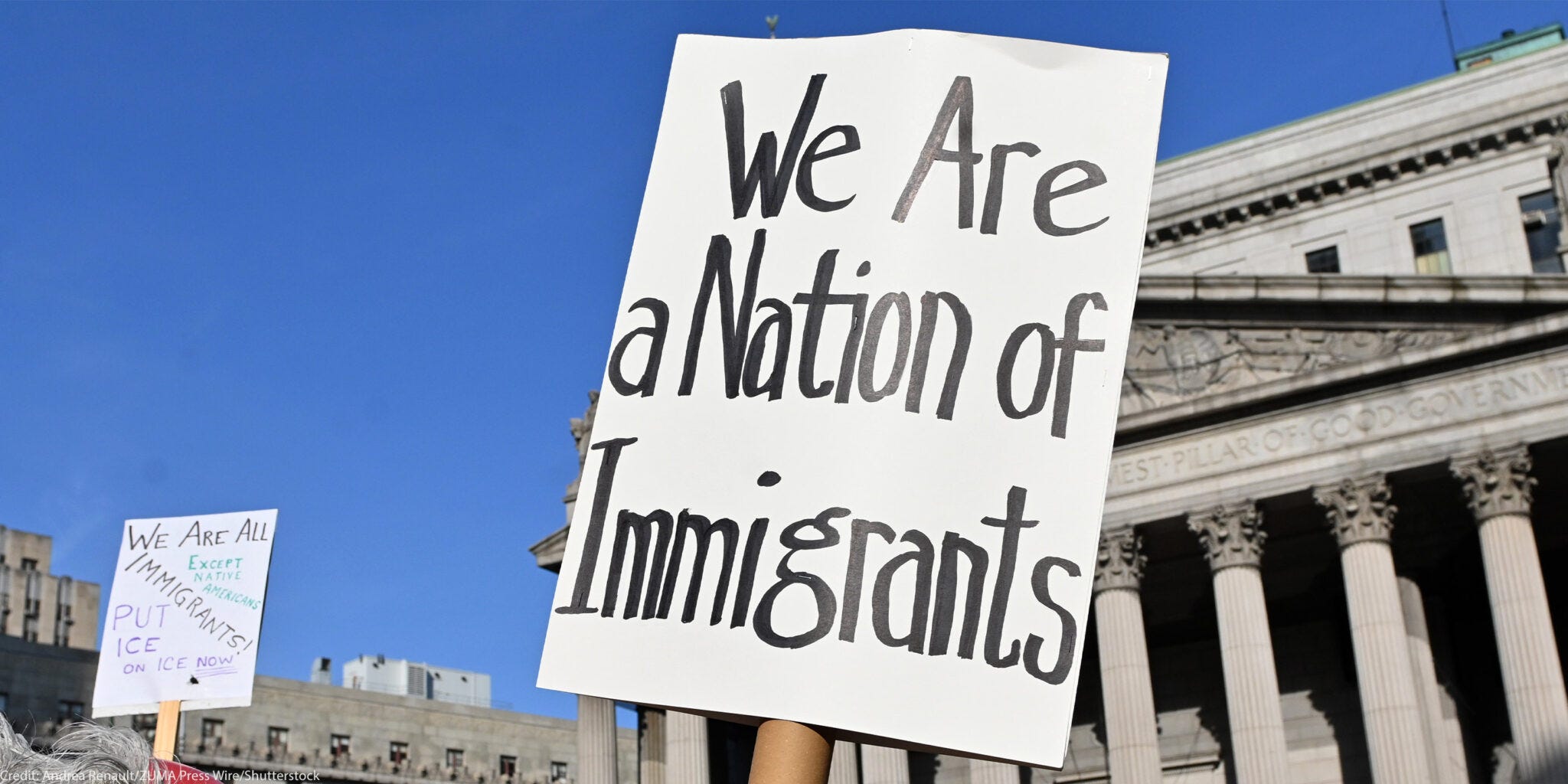
More on all of that below. But first, the (Supreme Court) news.
On the Docket
The Merits Docket
The Court handed down three rulings in argued cases last Thursday.
M & K Employee Solutions, LLC v. Trustees of the IAM National Pension Fund: In a unanimous opinion by Justice Jackson, the Court resolved a circuit split and held that multiemployer pension plans may calculate employers’ withdrawal liability using actuarial assumptions adopted after the statutory “measurement date”—the last day of the plan year preceding the employer’s withdrawal—so long as those assumptions reflect data and conditions that existed on or before that date. (Four employers that withdrew from the IAM National Pension Fund in 2018 challenged the fund’s use of a 6.5% discount rate adopted in January 2018 rather than the prior 7.5% rate in effect at the December 31, 2017 measurement date—a change that increased total unfunded vested benefits from roughly $448 million to over $3 billion and dramatically raised each employer’s share.) The Court held that ERISA's "as of" language fixes factual inputs on the measurement date but does not impose a deadline for selecting actuarial assumptions, which are analytical tools rather than hard data, and it noted that employers retain the safeguard of challenging unreasonable assumptions in arbitration.
Havana Docks Corporation v. Royal Caribbean Cruises, Ltd.: In an 8-1 decision written by Justice Thomas, the Court held that four major cruise lines—Royal Caribbean, Norwegian, Carnival, and MSC—may be held liable under Title III of the Helms-Burton Act for using docks at the Port of Havana that Cuba’s government confiscated from the Havana Docks Corporation in 1960, even though Havana Docks’ time-limited concession to operate the docks would have expired in 2004. The majority reasoned that “property which was confiscated” under the statute encompasses the physical docks—not merely the plaintiff’s intangible interest—rendering confiscated property permanently “tainted” such that anyone who uses it can be liable. Justice Sotomayor concurred but warned that the ruling could expose an unlimited number of dock users to repeated multi-million-dollar judgments far exceeding Havana Docks' certified $9 million loss, and she flagged a statutory exception for lawful travel to Cuba that may shield the cruise lines on remand; Justice Kagan dissented alone (for, as near as I can tell, the first time in her entire tenure on the Court), arguing the docks always belonged to Cuba and that the majority effectively converted time-limited property interests into perpetual ones.
Hamm v. Smith: In one of what I would call the term’s “big” cases, the Court punted—“dismissing as improvidently granted” the writ of certiorari and leaving in place the Eleventh Circuit’s ruling that Alabama death-row inmate Joseph Clifton Smith is intellectually disabled and therefore cannot be executed under Atkins v. Virginia. Smith, convicted of a 1997 murder, received five IQ scores ranging from 72 to 78—all above the 70-point cutoff Alabama uses. But the standard error of measurement on his lowest score placed his true IQ potentially as low as 69, and a federal district court found him intellectually disabled after a holistic review of IQ scores, expert testimony, and adaptive-functioning deficits. By process of eliminating, we know that the vote was 5-4: Justice Sotomayor, joined by Justice Jackson, concurred that the case was a poor vehicle because the parties agreed no single formula exists for weighing multiple IQ scores and the issue had not been squarely litigated below; Justice Thomas dissented alone—calling for overruling Atkins in its entirety (because it’s apparently okay to execute those who are intellectually disabled); and Justice Alito, joined fully by Justice Thomas and in part by Chief Justice Roberts and Justice Gorsuch, dissented to argue the Court should have provided guidance on methods such as composite scores for evaluating cumulative IQ data. The really interesting part here, in my view, is that Justices Kavanaugh and Barrett (who clearly voted for the DIG) didn’t write separately to explain why.
The other interesting development on the merits docket came in last Monday’s regular Order List—in which the Court issued a pair of “GVRs” (granting certiorari, vacating the decision below, and remanding for further proceedings) in cases about whether section 2 of the Voting Rights Act can be privately enforced despite not providing an express “cause of action.” The Court GVR’d “in light of” its ruling in Louisiana v. Callais. As Justice Jackson pointed out in a short dissent, nothing in Callais (which was about the scope of section 2) remotely bears upon who can enforce that statute. Alas.
The Court also added one case to its merits docket for the October 2026 Term—agreeing to review an Eleventh Circuit ruling that had held that employees of educational institutions receiving federal funding can’t use Title IX to bring sex-discrimination claims against their employers (and must instead use Title VII).
The Emergency Docket
Speaking of the death penalty, there were seven full Court rulings on emergency applications last week. Six denied stays of execution to two different death-row prisoners: Richard Knight in Florida, and Tony Carruthers in Tennessee. Knight was executed on Thursday. Tennessee botched Carruthers’ execution—leading Governor Bill Lee to grant a one-year reprieve. There were no public dissents from any of the six orders.
The seventh order also came over no public dissents—denying emergency relief to two candidates for the Georgia Supreme Court who sought to block the state’s Judicial Qualifications Commission from putting out a public statement that they had violated the state's Code of Judicial Conduct when they endorsed each other and promised to restore abortion rights if elected.
The Week Ahead
The Court is closed today for Memorial Day. We expect a regular Order List at 9:30 ET tomorrow (Tuesday), and more decisions in argued cases Thursday at 10 ET. I’m not currently aware of any pending emergency applications likely to provoke full Court rulings this week, but that can always change quickly.
The One First “Long Read”:
The Next Steps in Khalil and Abrego Garcia
Last Friday, federal courts on opposite ends of the Eastern Seaboard issued consequential rulings in two of the most closely watched immigration cases of the Trump administration’s second term. In Philadelphia, the U.S. Court of Appeals for the Third Circuit, sitting en banc, voted 6–5 to deny rehearing of a panel decision that stripped a federal district judge of jurisdiction over Mahmoud Khalil’s constitutional challenge to his detention and removal. In Nashville, U.S. District Judge Waverly Crenshaw dismissed the human-smuggling indictment against Kilmar Armando Abrego Garcia, finding that the Department of Justice had pursued a “vindictive prosecution” in retaliation for Abrego Garcia’s successful challenge to his wrongful deportation to El Salvador.
Both men have become emblematic of the administration’s aggressive use of immigration authority—Khalil as the face of the crackdown on pro-Palestinian campus activism, and Abrego Garcia as the symbol of mass removals to El Salvador’s Terrorism Confinement Center (CECOT) based upon invented facts and in defiance of a prior order specifically barring his removal to El Salvador.
Friday’s rulings cut in opposite directions: Khalil lost a critical procedural battle that brings him closer to a second detention and possible deportation to a country like Algeria or Syria, while Abrego Garcia secured a sharp judicial rebuke of the Justice Department’s conduct that frees him of federal criminal exposure, even as his removal proceedings continue. Read together, the decisions illustrate the increasingly central role of Article III courts in policing the boundary between executive immigration authority and individual constitutional rights, even if that boundary isn’t always where you (or I) think it ought to be.
Khalil
Mahmoud Khalil, 31, is a lawful permanent resident, a recent Columbia University graduate, and a former lead negotiator between Columbia and student protesters during the spring 2024 pro-Palestinian encampments. He was arrested by Immigration and Customs Enforcement officers at his Columbia housing in March 2025. His case became the first high-profile detention in what became a broader campaign against foreign students and scholars engaged in (constitutionally protected) pro-Palestinian advocacy. The government invoked a seldom-used Cold War–era provision of the Immigration and Nationality Act allowing the Secretary of State to deem a noncitizen removable on the ground that the person’s presence or activities would have “serious adverse foreign policy consequences” for the United States. Officials accused Khalil of leading activities “aligned to Hamas,” though they have produced no supporting evidence and have not charged him with any crime. The government later added a charge that Khalil had misrepresented information on his green-card application—a charge his lawyers say was retaliatory.
After roughly three months of detention in a Louisiana ICE facility, U.S. District Judge Michael Farbiarz of the District of New Jersey ruled in June 2025 that the foreign-policy ground for removal was likely unconstitutional and ordered Khalil released. The Trump administration appealed, arguing that constitutional challenges to removability must be channeled through the immigration “court” system—an arm of the Justice Department over which the Trump administration has exerted far more direct, political control than its predecessors—before reaching an Article III court. In January 2026, a divided Third Circuit panel agreed, 2-1, vacating Judge Farbiarz’s orders on jurisdictional grounds and concluding that Khalil’s federal-court suit was premature. The Board of Immigration Appeals separately upheld Khalil’s order of removal in April 2026, designating Algeria or Syria as countries of removal.
On Friday, the full Third Circuit voted 6-5 to deny rehearing en banc of the January panel decision. The vote split along ideological lines and leaves intact the panel’s holding that 8 U.S.C. § 1252’s channeling provisions require Khalil to litigate his First Amendment and due process claims within the immigration adjudicatory system—and ultimately a federal court of appeals on petition for review—rather than through a habeas or civil action in district court. (Judge Emil Bove, a recent Trump appointee who had previously been involved in Justice Department investigations of student protesters, did not participate in the en banc vote; he separately denied as moot a motion by Khalil’s counsel that he recuse himself.)
Judge Cheryl Ann Krause, writing in dissent, accused the majority of “abdicating [its] duty to meaningfully review Khalil’s constitutional claims” and warned that the judiciary “cannot fulfill [its] role as a check on the other branches of government … if we write ourselves out of relevance and leave the Executive Branch to check itself.” Three dissenters jointly wrote that the majority “ignores canons,” “strains precedent,” and “imperils the civil liberties of [Khalil] and similarly situated noncitizens.”
I’ll confess to being deeply sympathetic to Judge Krause’s dissent, especially because of the formal and practical constraints on judicial review within the immigration system. As things currently stand, neither an immigration “judge” nor the Board of Immigration Appeals has the same authority to resolve constitutional challenges to removal grounds as federal district courts do, and that’s without even taking into account the lengths to which the current administration has gone to deprive that entire system of even a modicum of independence. I also think there’s quite a lot to commend the argument Judge Krause made in her dissent that, insofar as the relevant “channeling” statutes require such futile judicial review first, they violate the Constitution’s Suspension Clause. The problem there is the Supreme Court’s 2020 ruling in DHS v. Thuraissigiam, which held that the Suspension Clause does not generally ensure judicial review of challenges to removal orders. In a world in which Thuraissigiam is right, the Suspension Clause argument is not as open-and-shut as I wish it were.
Practically, the ruling means that as of this Friday—when the Third Circuit’s mandate is scheduled to issue—the district court’s release order will be dissolved, and the government will be free to re-arrest Khalil and begin removal proceedings. Khalil’s attorneys have asked the Third Circuit to stay its mandate pending a petition for certiorari to the Supreme Court, which they expect to file by late summer. The decision also has systemic significance: by foreclosing pre-removal federal-court review of constitutional challenges to detention and charging decisions, it effectively channels speech-based and retaliation claims by detained noncitizens into the Attorney General–supervised immigration “court” system, at least within the Third Circuit. Khalil has separately appealed his removal order to the Fifth Circuit, where he was detained, and is pursuing a motion before the BIA to reopen on the ground that the administration improperly fast-tracked and tried to predetermine his immigration proceedings.
Abrego Garcia
Kilmar Abrego Garcia, 30, is a Salvadoran national who entered the United States illegally as a teenager, married a U.S. citizen, and has lived and worked in Maryland for years under ICE supervision. In 2019, an immigration judge granted him withholding of removal to El Salvador, finding that he faced a clear probability of persecution by a gang that had threatened his family. On March 15, 2025, the Trump administration nonetheless placed him on one of three planeloads of alleged gang members removed to El Salvador’s CECOT mega-prison, in what an ICE official subsequently conceded was an “administrative error.” Rather than own up to its mistake, though, the administration doubled down, and then tripled down, manufacturing evidence that Abrego Garcia was affiliated with MS-13 (even though that wasn’t the basis for his original removal order, and, even had it been true, wouldn’t have overcome the withholding of removal with respect to El Salvador).
U.S. District Judge Paula Xinis of the District of Maryland ordered the government to “facilitate and effectuate” his return. In April 2025, the Supreme Court unanimously affirmed the obligation to facilitate his release while questioning the scope of “effectuate” and counseling deference to the executive on foreign affairs. After months of resistance, the administration brought him back in June 2025 to face a two-count human-smuggling indictment in the Middle District of Tennessee arising out of a November 2022 traffic stop in which he had been pulled over for speeding with nine passengers and released with a warning. Abrego Garcia pleaded not guilty, and the case proceeded in tandem with continued civil litigation before Judge Xinis over the government’s serial attempts to deport him to third countries including Uganda, Eswatini, Ghana, and Liberia. In August 2025, Abrego Garcia’s defense team moved to dismiss on grounds of vindictive and selective prosecution.
In a 32-page opinion issued Friday, Judge Crenshaw—a Nashville-based Obama appointee—granted the motion to dismiss, finding that although the record contained “insufficient evidence of actual vindictiveness,” the government had failed to rebut the presumption of vindictiveness that the court had previously found Abrego Garcia had established. Under decisions like Blackledge v. Perry, once a defendant raises a realistic likelihood of vindictive prosecution, the burden shifts to the government to offer objective, non-retaliatory reasons for its charging decision.
Judge Crenshaw concluded that “absent Abrego’s successful lawsuit challenging his removal to El Salvador, the Government would not have brought this prosecution.” He emphasized the timeline: federal authorities had closed the Homeland Security Investigations file on the 2022 traffic stop and reopened it only after Judge Xinis ordered the government to facilitate Abrego Garcia’s return. “What the Government labels as ‘new evidence’ was not new as a matter of law,” he wrote. The court found that public statements by then–Deputy Attorney General (now Acting Attorney General) Todd Blanche tied the renewed investigation directly to Abrego Garcia’s habeas victory, and that Associate Deputy Attorney General Aakash Singh’s “sustained oversight” of the matter—including treating it as a “top priority”—“directly tie[d] Main Justice” to the indictment. Judge Crenshaw expressly rejected the contrary testimony of then–Acting U.S. Attorney Robert McGuire that he alone had decided to charge, observing that the court “cannot ignore the chain of command that McGuire reported to: Singh, Blanche, and then [Pam] Bondi.”
The practical consequences are immediate and significant. Abrego Garcia is freed of federal criminal exposure in Tennessee, although the Department of Justice has stated it will appeal to the Sixth Circuit, calling the order “wrong and dangerous” and the judge an “activist” (LOL). The Department of Homeland Security separately emphasized that Abrego Garcia’s final order of removal remains in force and that “this Salvadorian is not going to remain in our country.” Doctrinally, the opinion is one of the most detailed recent applications of the vindictive-prosecution doctrine to a politically charged immigration matter, and it provides a roadmap—anchored in objective timeline evidence and senior-official communications—for defendants alleging prosecutorial retaliation.
***
Friday’s decisions, though pointing in different directions, reflect a common set of questions now before the federal courts: how much process is constitutionally due to noncitizens swept up in high-profile enforcement actions; how far the Executive may go in selecting targets based on protected expression or successful litigation; and what role Article III judges retain when Congress has channeled review through Justice Department–controlled tribunals. The Third Circuit’s en banc denial in Khalil narrows the federal forum for pre-removal constitutional claims and tees up a likely cert. petition that could reach the Supreme Court by later this summer. Judge Crenshaw’s dismissal in Abrego Garcia, by contrast, demonstrates the continuing vitality of judicial review of charging decisions, even where the executive invokes national-security and foreign-policy interests. It’s a mixed bag to be sure, but a powerful reminder of both the critical role federal courts are playing in these cases, and the limits they face even where the government’s misbehavior appears to be undeniable.
SCOTUS Trivia:
The Last Confirmed Nominee Who Didn’t Serve
Over the weekend, I briefly re-encountered the Netflix miniseries “Death by Lightning,” a four-episode arc about the Election of 1880 and the collision course it created for President James Garfield and Garfield’s would-be assassin, Charles Guiteau. The series itself is … okay (I’m a much bigger fan of the book from which it is ostensibly derived, Candice Millard’s Destiny of the Republic). But the acting is truly wonderful, including Nick Offerman as (a hilarious) Chester A. Arthur and Shea Whigham as (a dead-ringer for) Roscoe Conkling.
Conkling is the answer to one of my favorite Supreme Court trivia questions, as he is the last person to be nominated to the Court and confirmed by the Senate who did not actually serve. Instead, Conkling turned down a seat on the Court in 1882, at least largely due to continuing enmity toward Arthur (who had nominated him) over their rather sharp break on the topic of civil service reform.
I hope that you’ve enjoyed this installment of “One First.” If you have feedback about today’s issue, or thoughts about future topics, please feel free to email me. And if you liked it, please help spread the word!
If you’re not already a paid subscriber and are interested in receiving regular bonus content (or, at the very least, in supporting the work that goes into this newsletter), please consider becoming one:
This week’s bonus issue will drop on Thursday. And we’ll be back with our regular content for everyone (no later than) next Monday. As ever, please stay safe out there.
Thank you for your update on these two very troubling cases.
If your time permits, please write about the origin of immigration courts which, if I am correct, were created by statute and were placed under DOJ in the executive branch. How can individuals such as Khalil and Abrego be assured of fair treatment when challenging executive branch action? I think lawyers and judges (generally speaking) are saving our country right now, but placing "courts" in the executive branch (DOJ and agencies) violates the separation of powers, doesn't it? As these two cases illustrate, this arrangement jeopardizes the principle of fair and impartial treatment.
Great commentary, as always, but I do have a few nits to pick.
Granted that this administration is stripping immigration courts of the independence Congress intended, a very significant development, I would nonetheless ask you to reconsider your choice to use quotation marks for those courts and their judges.
Also, Tennessee is in the Mississippi watershed and is not part of the eastern seaboard, and certainly not the middle district.