

Someone once described my work as being especially good at highlighting inconsistencies in the Supreme Court’s jurisprudence. In context, it wasn’t meant to be a compliment; the speaker was, near as I can tell, trying to suggest that identifying such inconsistencies is like spotting typos—not unimportant, but also not undermining the broader substance of the work. Like Ralph Waldo Emerson once said, “a foolish consistency is the hobgoblin of little minds.”
But when it comes to the Supreme Court, my own view is that there’s a direct relationship between consistency and legitimacy—that the Court’s willingness to be consistent in how it applies legal principles across different cases is the strongest evidence the justices can provide that they are doing law, rather than politics. This is a central reason why one of my sharpest critiques of the Court’s behavior on the emergency docket is how, by not providing detailed explanations to accompany its rulings, it’s doing nothing to rationalize what otherwise appears to be inconsistent behavior based upon the partisan and/or ideological valence of the dispute.
Against that backdrop, today has provided two different flashpoints for the charge of inconsistency—and Justice Samuel Alito figures prominently in both of them.
Flashpoint #1: Justice Alito and Mifepristone, Round II
This morning, Justice Alito issued two “administrative stays” of the Fifth Circuit’s Friday night ruling that purported to suspend the ability of doctors across the country to prescribe mifepristone without an in-person visit. But although the Court’s sanewashers were quick to point to Alito’s interventions as proof of the Court’s neutrality,1 that elides two different problems with how he did it:
First, Justice Alito waited almost 48 hours to act—a period during which there was quite a lot of chaos across the country among doctors, pharmacists, and patients over whether and to what extent they were bound by Friday’s Fifth Circuit decision. 48 hours may not seem like a long time, but for comparison, in November, Alito issued an administrative stay in the Texas redistricting case just 68 minutes after Texas’s application for emergency relief was docketed by the Supreme Court (both of which happened after hours on a Friday night).
Second, and speaking of the Texas case, Alito’s administrative stays in the mifepristone case had something that his administrative stay in the Texas case didn’t—a deadline (next Monday at 5 p.m. ET). This follows a much broader pattern—in which Alito issues indefinite administrative stays in cases in which he appears to be sympathetic to the applicants, but imposes deadlines on the stays in cases in which he doesn’t. Before Monday, the last nine administrative stays in which Alito imposed deadlines were all cases in which at least one of the applicants had been the Biden administration. In contrast, Alito imposed no deadline in the Texas redistricting case; a potentially significant non-delegation case from 2024; and several other cases with … less … of an ideological valence.
To be sure, Alito isn’t the only justice to ever put a deadline on an administrative stay; Justices Gorsuch and Jackson have also each done it exactly once. And although the deadlines tend to create unnecessary tension and stress for both the parties and the Supreme Court’s press corps (who worry about what will happen if the deadline comes and goes with no action—which appeared to happen in the Texas SB4 immigration case in March 2024), they’re not especially significant beyond that. But it certainly seems like a petty way to treat parties differently based upon what you think of their claims.
Flashpoint #2: Justice Alito and the Judgment in Callais
The other flashpoint came Monday evening—when the Court agreed to put its ruling last week in Louisiana v. Callais into immediate effect, rather than waiting the ordinary 32-day period prescribed by its rules.
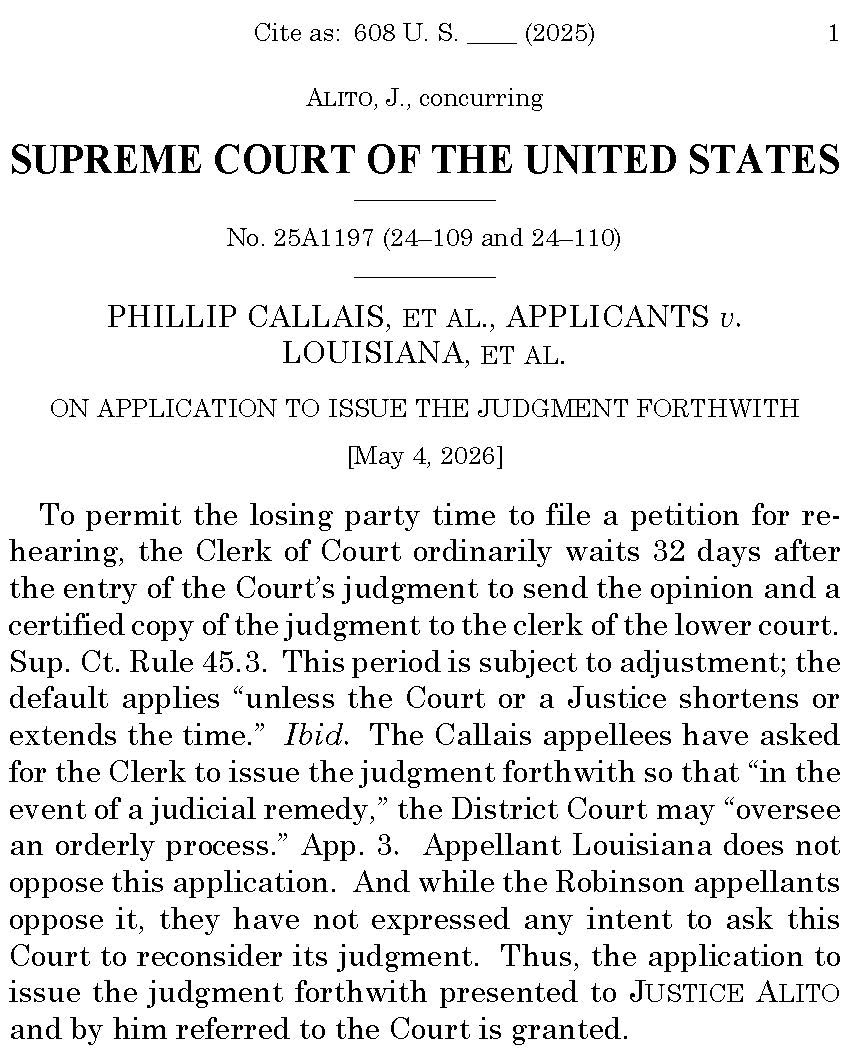
Justice Jackson wrote a highly unusual (but relatively temperate) dissent from the Court’s action—pointing out (1) that this is only the third time in recent history in which the Court has issued a judgment immediately over the losing party’s objection; and (2) the Court’s alacrity appears to be in service of efforts by Louisiana that smack of “a strong political undercurrent.”
Justice Jackson’s dissent provoked Justice Alito into writing an especially strident concurring opinion—in which, among other things, he describes Jackson’s arguments as “baseless and insulting” and claims that, unlike the Court’s action, it’s “the dissent’s rhetoric that lacks restraint.”
Some folks online have argued that the inconsistency here is how quickly the Court was willing to move in service to Louisiana Republicans—who want to be able to re-draw Louisiana’s congressional districts and have the new map apply to this cycle, even though a number of Louisianans have already voted in the primaries. Speed here, in contrast to the Court’s lack of expediency in, e.g., the Trump immunity case, for instance, seems revealing. (Likewise, some have suggested that the Court is again being inconsistent with regard to the so-called “Purcell principle,” by itself moving quickly in a way that will affect an ongoing election—something it regularly claims federal courts shouldn’t do).
But to me, the inconsistency here is far more specific—and far more galling. Alito defends the Court’s willingness to move quickly here on the ground that “[t]he dissent would require that the 2026 congressional elections in Louisiana be held under a map that has been held to be unconstitutional.” This is the same argument Alito made in his concurring opinion in the Malliotakis case in March—that the Court just can’t abide the specter of voters using a map that might be unlawful.
Here’s the problem: In 2022, after two different district courts held that Alabama’s post-2020 Census congressional district map was unlawful, the Supreme Court stayed those rulings—allowing Alabama to use that map in the midterms (Justice Alito was in the majority in that order). But when the Court reached the merits the following year, it agreed with the district courts. Thus, the Court intervened in 2022 in order to allow Alabama to use maps that district courts had blocked in rulings the justices later affirmed. Nor was the Alabama case a one-off; as I’ve noted before, one can draw a straight line from the Court’s unsigned, unexplained February 2022 intervention in Alabama to at least five congressional districts that should have been redrawn before the 2022 midterms but weren’t. Republicans won all five of those seats—giving Republicans their exact margin of control in the House in the 118th Congress.
Perhaps one of the Court’s defenders will come up with some explanation for why the Court correctly intervened to allow Alabama to use an unlawful map in 2022, and yet it’s been justified in intervening to prevent New York and Louisiana from using unlawful maps in 2026. Suffice it to say, Justice Alito didn’t provide one. And given that this inconsistency has the remarkably coincidental effect of benefitting Republicans in all three contexts, it strikes me as a heck of a lot more than “foolish”
If you’re not already a subscriber to “One First,” I hope you’ll consider becoming one—and upgrading to a paid subscription if you’re able and willing to support this kind of coverage of the Supreme Court:
We’ll be back (no later than) Thursday with our weekly “bonus” coverage of the Supreme Court. Until then, stay safe out there—especially from hobgoblins.
These same folks have apparently memory-holed the fact that, when the Court first intervened in April 2023 to preserve nationwide access to mifepristone, Justice Alito dissented.
This is just plain sad to read. In 1883 the spiritual forefathers of the Roberts majority struck down the Civil Rights Act of 1875, leading Frederick Douglass to lament "O for a Supreme Court of the United States which shall be as true to the claims of humanity, as the Supreme Court formerly was to the demand of slavery." Alito's petty partisanship is an embarrassment about which he seems not to be the slightest bit embarrassed.
Odd that the SCOTUS conservatives are so touchy! So quick to bristle over criticisms that they are too partisan, too opaque, too inconsistent … and consistently so.