

Welcome back to “One First,” a newsletter that aims to make the U.S. Supreme Court more accessible to lawyers and non-lawyers alike. I’m grateful to all of you for your continued support, and I hope that you’ll consider sharing some of what we’re doing with your networks.
Every Monday morning, I’ll be offering an update on goings-on at the Court (“On the Docket”); a longer introduction to some feature of the Court’s history, current issues, or key players (“The One First ‘Long Read’”); and some Court-related trivia. If you’re not already a subscriber, I hope you’ll consider becoming one—and upgrading to a paid subscription if your circumstances permit:
Back in February, I wrote about the tenth anniversary of the Supreme Court’s unsigned, unexplained February 2016 rulings blocking President Obama’s “Clean Power Plan,” and how they ushered in what might be called “the modern emergency docket.” In my earlier post, I raised a series of questions about what had led the Court to do something that, in 2016, was completely unprecedented (blocking an executive branch program then under review in the lower courts), and whether the justices had any idea of the Pandora’s Box they were opening. As I wrote, “because the Court didn’t write then, and hasn’t explained itself since, we’ll never know (at least, until our grandkids can read the justices’ internal papers from that time period).”
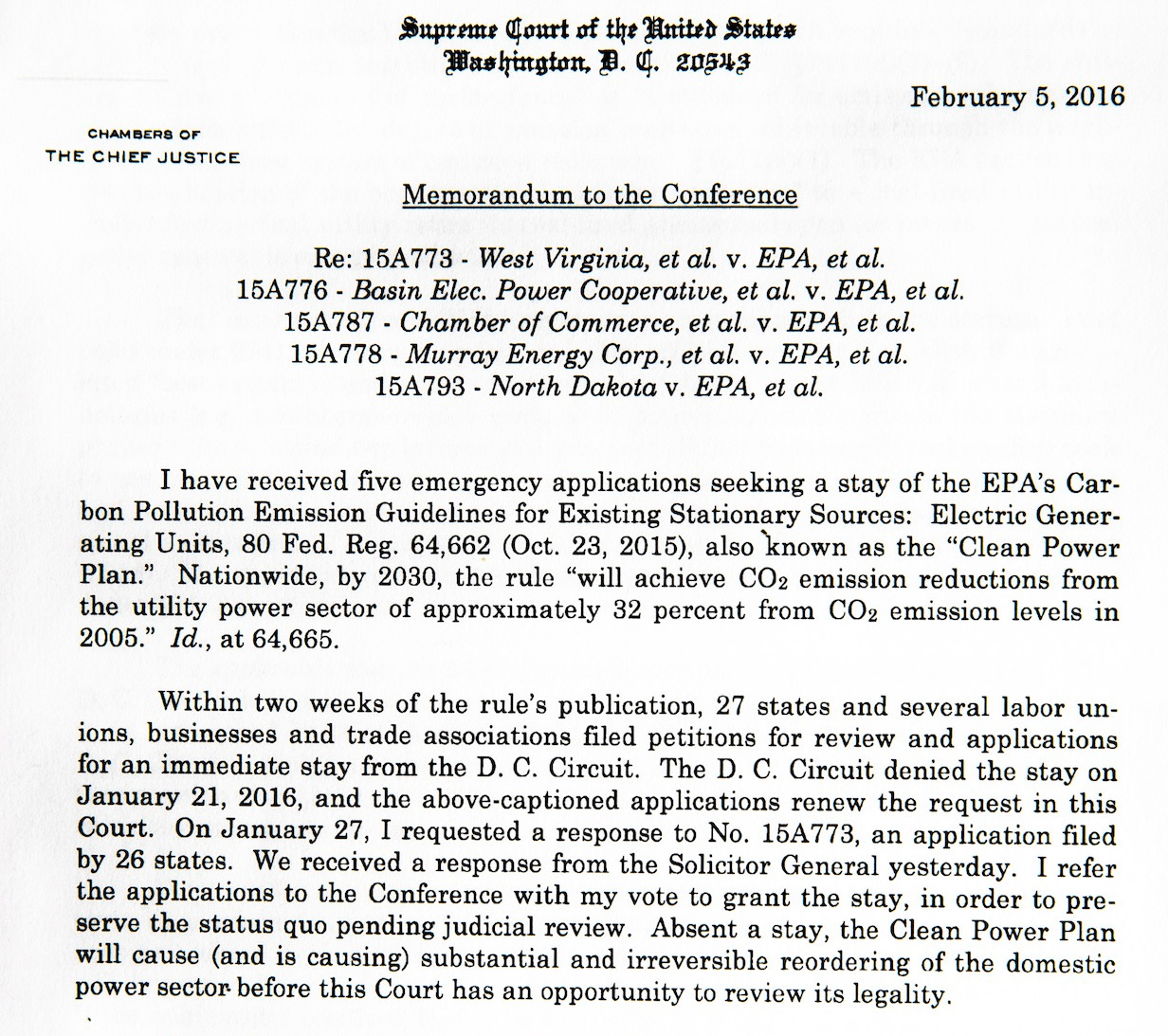
It turns out, thanks to some truly remarkable reporting from Jodi Kantor and Adam Liptak for the New York Times, that we didn’t have to wait quite that long. On Saturday, Kantor and Liptak published 16 pages of (leaked) internal memoranda from six of the justices providing a window into how and why the Court did what it did on February 9, 2016. And the memos are, at least to me, a remarkable combination of eye-opening and sadly unsurprising. As I explain below, I think there are at least five significant takeaways from these materials—none of which paint the Court in an especially flattering light. And at the heart of most of them is Chief Justice Roberts.
Behind the scenes, Roberts led the charge for the Court to blaze a new trail—relying on statements outside the record; invoking the wrong standard for the kind of relief the applicants sought; failing to even acknowledge the irreparable harm the government (and the environment) would suffer from the Court intervening; and pushing back aggressively when Justices Breyer and Kagan both urged a compromise that should have accounted for his ostensible concerns. I’ve suggested before that the real acceleration of the Court’s modern emergency docket behavior can be traced to 2018, right around when Justice Kavanaugh succeeded Justice Kennedy. But in the first major case in which the Court granted emergency relief as a means of shaping nationwide policy, it turns out that the justice who led the charge was the one who was doing quite a bit more than calling balls and strikes.
Much more on that below, but first, the (other) news.
On the Docket
Although the justices made plenty of news outside the Court (more on that in a moment), it was a pretty quiet week for the Court’s formal output. The only set of orders from the full Court were housekeeping orders relating to the April argument session (which starts later this morning); and there was a single ruling on the merits docket—with Justice Thomas writing for an effectively unanimous Court in allowing Chevron to remove a particular climate change suit from state court to federal court. (If you’re curious about the details, see the footnote at the end of this parenthetical.)1
Off the bench was a different story. On Monday, Justice Jackson delivered the James A. Thomas Lecture at Yale Law School, titled “Equity and Exigency: A First-Principles Solution for the Supreme Court’s Emergency Docket.” As you might imagine, Justice Jackson was quite critical of the Court’s behavior on emergency applications, especially over the past 14 months. And although she did not call any of her colleagues out by name, she was unsparing in her criticisms of how the Court, almost entirely in rulings that have divided the Republican appointees from the Democratic appointees, has gotten away from the role that “equity” is supposed to play in all emergency relief—in a manner that has allowed the Court to minimize, if not entirely ignore, the real-world harms its rulings have imposed. More than just a critique, Jackson also made a specific proposal—that the Court should formalize a two-step process for resolving emergency applications, in which it balances the equities first, and evaluates the likelihood of success on the merits only after concluding that the equities would support intervention. There’s a lot to be said for such an approach, in my view (only the more so in light of Saturday’s developments).
And then on Wednesday, Justice Clarence Thomas delivered a speech of his own at the University of Texas. Unlike Jackson’s surgical critique of the Court’s behavior, Thomas’s speech was a Jeremiad against … progressivism in general. Ostensibly tied to the upcoming 250th anniversary of the Declaration of Independence, Thomas argued, repeatedly, that such a political view “requires of the people a subservience and weakness” that is “incompatible” with the Constitution. (The speech is worth watching; I’m not quite doing justice to his disdain for what people like me believe.)
I’m not at all surprised to hear that Justice Thomas believes all of these things. But it’s pretty striking that he used such a rare public platform not to articulate or defend some particular interpretive philosophy or methodological approach to the Constitution, but to launch a series of thinly veiled broadsides at, let’s just say it, the modern Democratic Party. That’s not a defense of a particular set of legal principles by someone who is lionized on the right for his principles; it’s demonizing the left. It’s his right to say all of these things, but … ugh.
Wednesday also featured a rare apology from Justice Sotomayor for her remarks the previous week at the University of Kansas, in which, while criticizing Justice Kavanaugh’s concurring opinion in Noem v. Vasquez Perdomo, she had veered into more of a personal attack against her colleague. Quoting Sotomayor, “At a recent appearance at the University of Kansas School of Law, I referred to a disagreement with one of my colleagues in a prior case, but I made remarks that were inappropriate. I regret my hurtful comments. I have apologized to my colleague.” I’m with Chris Geidner on this: I’m deeply sympathetic to Sotomayor’s substantive critique of Kavanaugh’s concurrence in Vasquez Perdomo, but I’m also glad she apologized for what she said.
Turning to this week, we expect a regular Order List at 9:30 ET, followed by the beginning of the April argument session—the last two weeks of (scheduled) oral arguments for the October 2025 Term. And the justices have also announced that, before this Wednesday’s arguments at 10 ET, they’ll hand down one or more additional rulings in argued cases. This is the time of year when the Court’s output begins to ramp up—from now through the end of June.
The One First “Long Read”:
Chief Justice Roberts Opens Pandora’s Box
As I wrote 10 weeks ago, on February 9, 2016, the Supreme Court handed down unsigned, unexplained orders granting five pending emergency applications and effectively blocking President Obama’s “Clean Power Plan.” The rulings, all of which divided the Court 5-4 (with the Republican appointees in the majority and the Democratic appointees in dissent) were, in many ways, the birth of the modern emergency docket. It was completely unprecedented, at the time, for the Court to step in and block an executive branch regulation while it was being challenged in the lower courts; and it was deeply unusual for the full Court to grant emergency relief in any context that produced nationwide effects (it’s not that there were no pre-2016 grants of emergency relief; it’s that most of them were in death penalty cases and election-related cases, with a handful of cases about state laws). And because the Court didn’t explain what it did or why, we could only guess as to what had led the justices to set the stage for … everything that has followed.
We don’t have to guess anymore. Saturday’s New York Times included a remarkable trove of material—and reporting about the trove. In particular, Jodi Kantor and Adam Liptak got their hands on seven internal memoranda from six justices written over the span of five days as the Court considered what to do about the five applications. As part of its reporting, the Times posted the 16 pages of memos themselves; pieces summarizing what’s in the memos and key takeaways; and the (main) news story putting all of this in context.
My post from February already addressed the broader significance of the February 2016 rulings. Here, I’d like to focus on my key takeaways from Saturday’s Times reporting—of which there are five:
Takeaway #1: The Mechanics of Emergency Applications
First, and perhaps least importantly, the memos themselves seem to confirm a bunch of the speculation I offered last year about how we think the Court processes emergency applications. Chief Justice Roberts, as Circuit Justice for the D.C. Circuit, circulated an initial memo to the Conference that (1) referred the matter to the Court; (2) voted in favor of a stay; and (3) offered at least a bit of analysis in support of such an outcome. The justices then responded. Justice Breyer filed a memo disagreeing with the Chief Justice and suggesting a compromise; the Chief Justice responded to Breyer; Justice Kagan responded to the Chief (and piggybacked on Breyer’s compromise proposal); Justice Sotomayor did the same; Justice Alito responded; and Justice Kennedy weighed in (which appears to have been the decisive vote to settle the matter).
We don’t have memos from Justices Thomas, Scalia, or Ginsburg, but it stands to reason that they had each voted cursorily in favor of (Thomas and Scalia) or against (Ginsburg) Roberts’s proposal—and that their memos are missing because they didn’t say anything substantive. It’s possible that there are other substantive memos that weren’t part of this tranche, but I’m skeptical; Kennedy’s memo is clearly his first intervention, and it has the same date as the Court’s actual ruling. This all went down very quickly, and very cursorily. (The absence of the Thomas, Scalia, and Ginsburg vote memos may also suggest that the leaker was someone who did not have the entire case file in their possession—since I can’t imagine why the Times wouldn’t have published those, too. But that’s sheer speculation on my part.)2
The key here is how utterly impoverished the discussion was. There was no real debate and no in-person meeting to hash out differences of opinion; just a brief exchange of remarkably short memos over five days (two of which were a weekend). I’ve suggested before that folks would be floored to see just how little analysis and deliberation go into rulings like this that produce massive real-world effects; here, for once, is pretty compelling direct evidence in support of that speculation—and a pretty powerful rejoinder to those who have insisted that the Court’s internal debates in these cases are rigorous and deeply substantive. Whatever else this was, it wasn’t that.
Takeaway #2: The Chief Justice Railroads the Court
Turning to the substance, Roberts’s central argument comes in a sentence on page 1 of his first memo: “Absent a stay the Clean Power Plan will cause (and is causing) substantial and irreversible reordering of the domestic power sector before this Court has an opportunity to review its legality.”
There are three points to make about this sentence—and the analysis that follows it.
First, and right off the bat, Roberts invokes the wrong standard for relief—citing cases about the traditional standard for a stay of a lower-court ruling pending appeal of that ruling. What the Court was asked to do in the Clean Power Plan cases was something much more aggressive—to stay administrative action pending all judicial review of that action, something it had never done before. (Here’s a great 2024 Harvard Law Review student note on the problem.) By invoking only the traditional equitable standard, Roberts made his task much easier than it should have been—and never acknowledged the extraordinary nature of the relief he was proposing to grant (even though the Solicitor General had made the novelty point in his brief in response to the application).
Second, even under the (incorrect) lesser test for a stay pending appeal, look at how Roberts changes the question from whether the applicants will suffer “irreparable harm” to his claim that they will face a “substantial and irreversible reordering of the domestic power sector.” Those … aren’t the same thing. Worse than that, he never so much as mentions the other side of the equities—the irreparable harm the executive branch (to say nothing of the environment) would suffer if the Court did intervene. As regular readers of this newsletter know, one of the central features of the Court’s repeated grants of emergency relief to the Trump administration over the past 15 months has been its rigid and thinly defended assumption that the federal executive branch is always irreparably harmed when any of its behavior is blocked—even when it’s defying a statute (when the “presumption of constitutionality” from which this argument derives shouldn’t even apply).
And what opinion is most often cited for this idea that the government is always harmed? A 2012 in-chambers opinion by … Chief Justice Roberts (2012, just to be clear, was before 2016). In other words, Roberts didn’t change his mind sometime between 2016 and 2025; he’s just being a hypocrite. It’s irreparable harm for Republican presidents; just not Democrats (Roberts also claims the stay he’s proposing is “to preserve the status quo pending judicial review,” never mind that the “status quo” was that the rule was in effect.)
Third, with no record on which to rely (the challenges had only just been filed in the D.C. Circuit), Roberts’s sources for his “facts” are a combination of the applications themselves and outside news reports. His initial memo, for instance, cited to a BBC interview of the EPA’s administrator and a blog post by an EPA acting assistant administrator—not exactly vetted sources. (Just two years later, he’d be the author of the majority opinion refusing to rely upon public statements by President Trump in the travel ban case on the ground that they weren’t authoritative statements of policy.) And his second memo responding to Justice Breyer cited a pair of studies (see footnote 1) the provenance of which even he questioned (“the sources of those analyses lead me to believe that their figures are likely at the high end of possible cost range”), along with the same BBC interview. As Justice Sotomayor pointed out, “the factual basis for the Applicants’ claim of irreparable harm seems hotly contested by the Government and in tension with at least my cursory review of the record.” But who needs accurate and verifiable facts when there’s a policy to block?
Takeaway #3: The Superficiality of the “Irreparable Harm” Response
Chief Justice Roberts’s refusal to take the equities on the government’s side seriously was problematic (and hypocritical) enough. But after Justice Breyer proposed a more modest order—one that would nudge the D.C. Circuit to hustle and make clear that the state applicants could come back to the Court if the Obama administration didn’t grant them extensions (which should’ve dissipiated any irreparable harm)—Roberts ratcheted up his rhetoric about the irreparable harm the applicants would still suffer: “[Breyer’s] proposed order forces each state to engage its regulatory apparatus and expend resources well before that date, and does nothing to limit the on-going, cumulative, and irreversible harms that private parties are incurring each day under the rule.”
Of course, forcing a state to “engage its regulatory apparatus and expend resources” is not, and has not in any other case been, irreparable harm. A state can always be given its resources back—which is why emergency relief is almost never available in cases seeking monetary relief. As for the private parties, Justice Kagan’s memo pointed out both that, if states received the promised extensions, any harm (let alone irreparable harm) would likely be paused as well—and that the parties’ claims to the contrary was “both entirely speculative and highly doubtful.” After all, the rule didn’t require private parties to do anything; it required states to set emissions targets and then come up with their own regulations to meet them.
Instead, what seems to have really been going on here is that Chief Justice Roberts was offended by the belief that the EPA had already thumbed its nose at the Court in a different case—about the Mercury and Air Toxics Standards, which a number of actors had complied with before the Supreme Court struck them down on the merits in June 2015. As Justice Alito put it in his memo, “A failure to stay this rule threatens to render our ability to provide meaningful judicial review—and by extension our institutional legitimacy—a nullity.”
Of course, why voluntary compliance with a rule while it’s being challenged threatens the Court’s institutional legitimacy is beyond me, let alone why that same argument didn’t augur in favor of relief in, say, the Texas abortion case (where Alito was in the majority in denying relief). Again, there are two layers to the problems: the putative principles don’t make sense; and even if they did, the justices’ application of them sure seems to depend upon the partisan valence of the dispute. (Roberts may also have been worried that, by the time the case returned to the Court on the merits, it might be a different Court—with the 2016 election obviously looming in the background. This might also explain why Breyer and Kagan were willing to embrace a compromise that would effectively move everything back two years.)
Takeaway #4: The Refusal to Acknowledge the Precedent They Were Setting
I mentioned already that neither of Roberts’s memos acknowledged the novel step the Court was taking. The closest he came was admitting that what he was proposing was “unusual.” Justice Kagan, in contrast, was clear-eyed about the novelty: “As far as I can tell,” she wrote, “it would be unprecedented for us to second guess the D. C. Circuit's decision that a stay is not warranted without the benefit of full briefing or prior judicial decision.”
She was right. Contra what some right-wing commentators have claimed, the Clean Power Plan cases were something new—emergency relief to directly block an executive branch program (none of their earlier examples are anything of the sort). And yet, neither Kagan’s memo nor any of the other memos reflected any appreciation on the Court’s part for the fact that, by granting such unprecedented relief, the justices were establishing a new precedent—and signaling that they would be more open to other (less-unprecedented) requests for emergency intervention in cases about statewide or nationwide policies going forward. There were examples of emergency relief before and after the Clean Power Plan cases, but something undeniably changed on February 9, 2016.
And yet, it didn’t seem to occur to anyone during those five days in February 2016—or, at least, in anything that was written down—that, once this particular seal was broken, it would be so difficult to get the toothpaste back in the tube. Indeed, there have been three subsequent cases in which the Court provided this exact type of emergency relief—blocking the CDC’s COVID-related eviction moratorium in August 2021; OSHA’s vaccination-or-testing mandate in January 2022; and the EPA’s “Good Neighbor” ozone pollution rule in June 2024. All three, of course, were Biden administration policies. And more generally, it’s not a coincidence that the massive uptick in the volume of emergency relief granted by the Court followed only after the ruling in West Virginia v. EPA.
Takeaway #5: The New York Times and the Shadow Docket
Finally, this is the third major story the Times has published with inside (and previously unreported) information about how major cases unfolded on the emergency docket; earlier stories covered the September 2021 Texas abortion case (as part of a broader story on the road to Dobbs); and the presidential immunity case during the October 2023 Term. Indeed, as it noted in February, the Times has made a substantial, public committment to providing more in-depth coverage of the Supreme Court, and these stories have all been, in my view, remarkable (and, I’d argue, laudable) feats of journalism to that end. The folks (mostly on the right) insisting that the memos aren’t especially newsworthy are, frankly, telling on themselves.
But there’s a larger point here that I can’t resist making: The term “shadow docket” has itself become something of a litmus test for how one feels about the Supreme Court. Those who are even mildly supportive of the Court won’t be caught dead using the term; and even critics have started moving away from it, perhaps largely to avoid wasting time over terminology. Fair enough.
But the reason why Will Baude coined the term in 2015, and why I’ve used it since, is very well captured in Saturday’s Times story: The Court is deciding massively important questions not just out of public sight, or through unsigned and unexplained rulings, but with remarkably cryptic behind-the-scenes deliberations, too. These decisions are being made in the “shadows” in any number of ways. To use the term “shadow docket” to capture the inaccessibility, inscrutability, and insufficiency of the Court’s output in these massively important cases is simply to describe a pattern of behavior that should trouble everyone, and not just those who also don’t like the results.
And though some degree of secrecy and confidentiality is inherent in the ability of a court to do its job, it seems to me that the lack of depth or detail behind the scenes, or public explanation in front of it, did not serve the Court well in the Clean Power Plan cases—and hasn’t served it well since. Instead, Saturday’s reporting seems to bear out almost every significant criticism of the contemporary Supreme Court with respect to how it processes, analyzes, and rules on applications for emergency relief.
Someone really ought to write a book about all of that.
SCOTUS Trivia: Chief Justice Stone’s Passing
Eighty years ago this Wednesday, on April 22, 1946, the Court was in the middle of handing down 12 opinions in argued cases when Chief Justice Harlan Fiske Stone had a medical episode on the bench—apparently while beginning to read his opinion for the Court in Heiser v. Woodruff.3 Justice Black called a brief recess while he and Justice Reed helped Stone off the bench. Stone was stabilized by physicians—enough that his wife drove him home. But he passed away that night from a cerebral hemorrhage.
Stone’s passing was not just entirely unexpected and immensely sad, but it touched off a significant amount of drama over who would succeed him—for a seat that, by many accounts, President Franklin D. Roosevelt had promised to Justice Robert Jackson (who was himself away at Nuremberg at the time), before FDR himself passed away in April 1945. I told a fair amount of this story in my January 2023 post on the “Black-Jackson Feud”—the remarkably ugly public row between Jackson and Justice Hugo Black; one line that has stuck with me since writing that post is how Jackson, some years later, began a draft review of Merlo Pusey’s biography of Charles Evans Hughes. He was surely harkening back to April 1946 when he wrote that "Washington adores a funeral—especially if it ushers in a vacancy.”
I hope that you’ve enjoyed this installment of “One First.” If you have feedback about today’s issue, or thoughts about future topics, please feel free to e-mail me. And if you liked it, please help spread the word!
If you’re not already a paid subscriber and are interested in receiving regular bonus content (or, at the very least, in supporting the work that goes into this newsletter), please consider becoming one:
This week’s bonus issue for paid subscribers will drop on Thursday. And we’ll be back with our regular content for everyone (no later than) next Monday. As ever, please stay safe out there—especially from unpersuasive memoranda.
In a nutshell, the federal officer removal statute allows suits filed in state court to be removed to federal court if they are against a federal officer or persons “acting under” them and are “for or relating to any act under color of such office.” The question in Chevron was whether a state-court environmental suit challenging Chevron’s crude-oil production during World War II is “for or relating to” Chevron’s wartime refining of crude oil into aviation gasoline for the U.S. military, and thus removable to federal court. The Supreme Court said yes.
Jonathan Adler speculates that the leak may have originated in Justice Sotomayor’s chambers because the photocopy of her memo wasn’t on letterhead. As I noted on Saturday, I find that pretty thin. Sotomayor’s memo was misdated as February 16. Assuming it was February 6, that was a Saturday, when Sotomayor, her clerks, or, at the very least, any secreterial support would have been out of the office. In that context, a memo that was e-mailed and printed on plain paper without an ink signature would hardly be surprising.
There is some suggestion that Stone’s difficulties began while summarizing his dissent in Girouard v. United States. But the Court’s Journal, while noting that Justice Black announced Stone’s opinion in Heiser (and in two subsequent decisions on April 22), says nothing of the kind about Stone’s dissent in Girouard.
Thank you for your analysis of these disclosures. They show to me, at least, that behind closed doors CJ Roberts is closer in temperament to JJ. Alito and Thomas and has a willingness to be an advocate, and a pointedly adversarial one at that, for big business in general and the fossil fuel industry in particular. I am (naively?) disappointed. No more presumption of impartiality for CJ Roberts.
"The Court is deciding massively important questions not just out of public sight, or through unsigned and unexplained rulings, but with remarkably cryptic behind-the-scenes deliberations, too. These decisions are being made in the “shadows” in any number of ways. To use the term “shadow docket” to capture the inaccessibility, inscrutability, and insufficiency of the Court’s output in these massively important cases is simply to describe a pattern of behavior that should trouble everyone, and not just those who also don’t like the results."
The fact that we keep getting these leaks, in spite of the Chief Justice's attempt to tamp them down, suggests, at least to me, that there are people inside the building who are also alarmed.
(It's possible that they are just trying to cause mischief, but the potential penalty seems too big to indulge in leaking just for the sake of annoying the conservative Justices.)
My guess is it wasn't a great weekend for Chief justice Roberts. It's hard to stop something you can't control.