

Welcome back to “One First,” a newsletter that aims to make the U.S. Supreme Court more accessible to lawyers and non-lawyers alike. I’m grateful to all of you for your continued support, and I hope that you’ll consider sharing some of what we’re doing with your networks.
Every Monday morning, I’ll be offering an update on goings-on at the Court (“On the Docket”); a longer introduction to some feature of the Court’s history, current issues, or key players (“The One First ‘Long Read’”); and some Court-related trivia. If you’re not already a subscriber, I hope you’ll consider becoming one—and upgrading to a paid subscription if your circumstances permit:
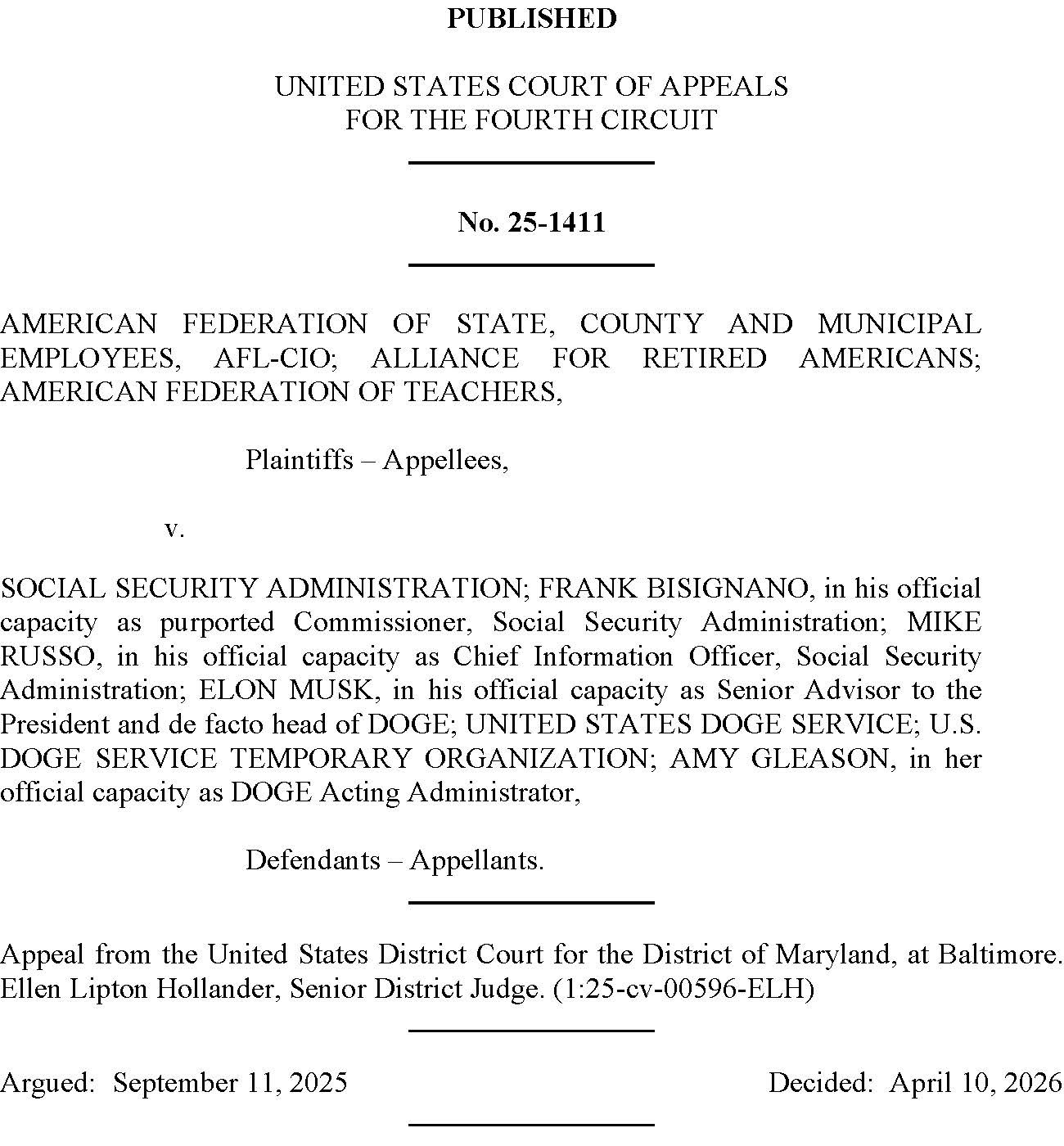
On Friday, the en banc Fourth Circuit handed down its much-anticipated ruling in the lawsuit challenging DOGE’s access to Social Security data—a case in which, as I noted in January, the Department of Justice had to “correct the record” to identify six different material misrepresentations that it had made to the district court in that case—five that stemmed from declarations from Social Security Administration personnel, and one that came directly from a DOJ brief. Although the court of appeals on Friday largely endorsed the plaintiffs’ challenge, it nevertheless vacated the district court’s injunction at least largely because the Supreme Court had already stayed it last June—never mind the subsequent … developments … in the district court.
What is especially striking about the court of appeals’ decision are the separate opinions respecting it: Six of the court’s Democratic appointees dissented almost entirely because of the weight the majority opinion gave to the Supreme Court’s thinly explained June 2025 intervention; and six of the court’s Republican appointees, in concurring opinions by Judge J. Harvie Wilkinson III and Julius Richardson, wrote separately to criticize the dissenters not only for failing to give the Supreme Court’s intervention sufficient weight, but for having the temerity to criticize the Supreme Court for not doing more to explain itself.
What this divide underscores is a phenomenon for which there is plenty of other evidence: how much views of the Supreme Court’s behavior on emergency applications (and not just the results the Court is reaching) are sorting folks ideologically. Besides simply documenting this phenomenon in today’s “Long Read,” I also aim to criticize it. There isn’t, or at least shouldn’t be, anything inherently ideological about believing that the Supreme Court should have to explain itself when it intervenes in cases in ways that upend the status quo—or, at the very least, in criticizing the Court when it both doesn’t explain itself and insists that lower courts must follow whatever tea leaves can be divined from its explanation-free interventions.
When the Court itself has told us, over and over again, that its legitimacy depends upon its ability to persuade readers through the principles it articulates in its decisions, defending the Court’s double-edged (if, ironically, unexplained) abandonment of that understanding isn’t “conservative” any more than criticizing it is “liberal.” Rather, it’s just covering for bad behavior that has nothing to do with ideology—and everything to do with power.
More on that below. But first, the (other) news.
On the Docket
The Merits Docket
Last week’s Order List brought with it a series of “GVRs”—orders in which the Court summarily granted certiorari, vacated lower-court rulings, and remanded for further proceedings. Two of particular note were in the Steve Bannon case, in which the Court sent the case back to the district court to consider the Department of Justice’s motion to dismiss Bannon’s conviction for contempt of Congress; and in FBI v. Fazaga, a long-running, ugly dispute over surveillance of Muslim Americans in Southern California allegedly motivated by anti-Muslim bias, which the Court sent back to the district court to sort out what to make of recent claims by a former FBI operative that he “made up” some of the allegations that have formed the basis for the plaintiffs’ claims.
The Court also added to the merits docket for next term a dispute over whether federal district courts have the authority to hear challenges to the constitutionality of federal laws affecting veterans’ benefits, or whether, as the Eleventh Circuit held, such challenges must be brought through the system Congress created for veterans’ benefits cases—through appeals to the Court of Appeals for Veterans Claims and thence to the Federal Circuit.
If you’re keeping score at home (more on this in the trivia, below), that brings to a grand total of just six the number of cases the Court has granted to date for the October 2026 Term.
The Emergency Docket
There was only a single new1 full-Court ruling on an emergency application last week—a denial, over no public dissents, of a strange application from an Ohio congressional candidate who state officials removed from the Republican primary ballot because he is not, in fact, a Republican.
I’m not aware of any pending applications that are likely to produce a full-Court ruling this week.
The Week Ahead
We don’t expect a regular Order List today. Instead, the only thing currently on the Court’s calendar is a public, “non-argument session” on Friday—which could end up including the handing down of one or more rulings in argued cases, but hasn’t yet been announced as such. Otherwise, it could end up being an especially quiet week at the Court.
Miscellaneous
On Wednesday, the Court formally transmitted to Congress proposed revisions to the Federal Rules of Appellate Procedure, the Federal Rules of Bankruptcy Procedure, and the Federal Rules of Evidence. I didn’t see anything in the proposed changes of interest to non-lawyers (only the bankruptcy changes are substantial). But for those curious about the Court’s rulemaking power and process, see this earlier post.
Finally, I’d be remiss in not noting the remarkable comments Justice Sotomayor made last week during a public (but not recorded) event at the University of Kansas School of Law—specifically about Justice Kavanaugh and his concurring opinion in the ICE profiling case, Noem v. Vasquez Perdomo. As reported by Jordan Fischer for Bloomberg Law, Sotomayor said “I had a colleague in that case who wrote, you know, these are only temporary stops.” She continued, “[t]his is from a man whose parents were professionals. And probably doesn’t really know any person who works by the hour.”
It seems worth making two different points about Sotomayor’s comments. First, they strike me as wildly out of character. Justice Sotomayor is not shy about expressing her own background and beliefs in public, behavior for which she receives far too much grief from motivated critics on the “right.” But this is different; it’s a personal attack on a colleague in a register that is not just uncommon, but, in my own view, unbecoming. One can be deeply critical of Justice Kavanaugh’s Vasquez Perdomo concurrence (as I was and remain) without making it personal.
Second, the unusually personal nature of Sotomayor’s comments leads me to wonder what prompted them. It’s been more than seven months since the Vasquez Perdomo ruling came down, so why is Sotomayor making hay about it now? The best explanation is that something else deeply ugly has happened and/or is happening inside the Court—and the best candidate for that is, in my view, Callais (the Louisiana redistricting cases). Perhaps the justices are just now finalizing their votes, or their separate opinions, and there was some kind of exchange that put Sotomayor and Kavanaugh at such loggerheads. We may never know, but I’ll just say that whatever else one thinks of Sotomayor’s comments, she’s far too sophisticated and used to these kinds of public appearances for them to have been accidental. Which raises the question we may never be able to answer: to what end?
The One First “Long Read”: The Ideological Divisiveness of Shadow Docket Critiques
Friday’s en banc Fourth Circuit ruling in the DOGE/Social Security case is a bit complicated, because it includes multiple different holdings that divided the full court of appeals’ 15 active judges into a series of different camps. But to make a long story short(er), the court reached three holdings with respect to the district court injunction (which had limited DOGE’s access to Social Security Administration data)—two in support of it, and one that led the majority to vacate the injunction and remand the case for further proceedings:
“[W]e disavow any suggestion [in an earlier decision by a Fourth Circuit panel] that district courts should assign numerical probabilities to a plaintiff’s chances of success on each issue and then multiply those probabilities together to determine whether the plaintiff’s ‘overall odds’ of success are high enough to warrant a preliminary injunction.” Likelihood of success, instead, should be assessed pursuant to the traditional, equitable criteria.
“Before entering a preliminary injunction, the district court concluded that plaintiffs had sufficiently established standing to pursue at least some of their claims. Reviewing that issue de novo, we agree”; and
Despite the new evidence in the record, “[t]he district court did not grant this preliminary injunction on the theory that plaintiffs’ members would be harmed by some downstream misuse or public disclosure of their personal data” (which is what the “corrections” seemed to confirm). Instead, “the irreparable harm on which the district court relied” has “two forms of corrective relief that may be available down the line: money damages and a reparative permanent injunction.” In other words, without regard to the merits, the Fourth Circuit vacated the injunction by concluding that the harms on which the district court had previously relied to justify preliminary relief lacked an adequate alternative remedy.
The third holding is the one that provoked sharp dissents from six of the court’s judges—Judges King, Gregory, Wynn, Thacker, Benjamin, and Berner. Much of the dispute is over whether, and to what extent, the court should have taken heed of the subsequent “corrections” of the record filed by the Department of Justice, or a related whistleblower report seeming to substantiate some of the plaintiffs’ allegations. After all, appellate courts can affirm district courts on any ground supported by the record—including corrections thereto.
But beyond that procedural point, I was struck by the sniping between the two separate dissenting opinions and the two concurring opinions over the precedential force of the Supreme Court’s June 2025 stay of the same injunction in the same case.
First, let’s start with what the Supreme Court actually said last June. Skipping over the first paragraph (which simply summarized the posture) and the last (which was the boilerplate language imposing the stay), here’s the sum total of the Court’s “analysis”:
When considering whether to grant a stay, this Court looks to four factors: “(1) whether the stay applicant has made a strong showing that he is likely to succeed on the merits; (2) whether the applicant will be irreparably injured absent a stay; (3) whether issuance of the stay will substantially injure the other parties interested in the proceeding; and (4) where the public interest lies.” Nken v. Holder, 556 U. S. 418, 434 (2009) (quoting Hilton v. Braunskill, 481 U. S. 770, 776 (1987)). After review, we determine that the application of these factors in this case warrants granting the requested stay. We conclude that, under the present circumstances, SSA may proceed to afford members of the SSA DOGE Team access to the agency records in question in order for those members to do their work.
As you may have noticed, there was no suggestion of why the Court “determine[d]” that a stay was warranted. Thus, although the order in SSA v. AFSCME doesn’t count as one of the Court’s entirely unexplained grants of emergency relief, it certainly is effectively unexplained. Nor can we assume the Court found a particular argument by the Department of Justice compelling; in its application for a stay, DOJ identified three very different grounds on which it was likely to succeed on the merits: a lack of Article III standing; a lack of “final agency action” for purposes of the Administrative Procedure Act; and that what DOGE was doing was perfectly lawful on the merits. Suffice it to say, those are three very different grounds for a stay.
Judge King’s dissent noted one problem with the Fourth Circuit relying upon the Supreme Court’s order in this context; Judge Wynn’s dissent noted another. Taking Judge King first:
[T]he proper outcome of this appeal cannot possibly be preordained, in that the Supreme Court had to rely on the erroneous original record in issuing its stay ruling, while we must assess the merits of the preliminary injunction on the basis of the corrected record. Simply put, the facts now known are materially different from the facts considered by the Supreme Court, foreclosing any notion that the Court’s Nken stay analysis controls our Winter preliminary injunction assessment.
And in his dissent, Judge Wynn also explained the myriad ways in which the question the Supreme Court was asked to decide last June is a meaningfully different one, even on the same record, as the one before the Fourth Circuit on this appeal. Moreover, Judge Wynn flagged the problems with relying upon an unexplained order in a context in which there were multiple potential grounds for granting a stay. As he put it, “an interim order has legal effect—it binds us as to its result. But to say that an interim order has effect is not to say that it has reasoning. And without reasoning, its reach extends no further than its result.”
At a more basic level, Wynn continued, the real problem with treating the Supreme Court’s stay as compelling a vacatur of the injunction is treating the stay as effectively deciding the appeal. Given that the Supreme Court itself has affirmed preliminary injunctions on the merits after staying them, it just doesn’t follow that, without any analysis, a stay does or should foreordain the merits in the same case. (Indeed, if the Supreme Court’s stay had been based on agreement with the government that the plaintiffs likely lacked Article III standing, then the Fourth Circuit’s ruling on Friday is directly inconsistent with that unexplained result—since Judge Heytens’ majority opinion specifically held that the plaintiffs do have standing.)
That brings me to the two concurring opinions. Judge Richardson’s opinion, joined by Judges Wilkinson, Niemeyer, Agee, Quattlebaum, and Rushing, takes an even more radical view of the precedential force of unexplained Supreme Court grants of emergency relief—arguing that “Supreme Court interim orders bind lower courts at the preliminary stage in like cases,” period.
With all due respect to Judge Richardson, that’s not what the Supreme Court majority said in the case from which he claims that proposition follows—Trump v. Boyle. There, the Court wrote only that, “[a]lthough our interim orders are not conclusive as to the merits, they inform how a court should exercise its equitable discretion in like cases.” That’s a far cry from saying they “bind” lower courts in like cases. And in any event, even the same case at Time 2 may be meaningfully different from what it was at Time 1, given shifts in the nature of the factual and legal record (as this case illustrates). Thus, whether two cases are “like” can’t be determined simply by an unexplained Supreme Court order at Time 1, even when the second case is the same case at Time 2. (Nor are Judge Richardson’s citations to Justice Gorsuch’s NIH concurrence persuasive; whatever one thinks of that two-justice opinion, it necessarily was not speaking for the Court.)
And then there’s Judge Wilkinson’s concurrence—which takes issue with the tone of Judge King’s and Judge Wynn’s dissents:
I regret my dear colleague Judge Wynn’s rhetorical assault upon the Supreme Court and my friend Judge King’s support of it. It is one thing to regret “emergency motions made under intense time pressure.” It is quite another to repeatedly lambast the Court for the “unexplained and summary nature” of its orders and to declare that “interim orders announced without reasons can just as easily be ignored without explanation,” which more than hints that this and future courts would be willing to do so. And while Judge Wynn states that “a stay may be a strong signal” as to the ultimate outcome on the merits, his opinion then proceeds to ignore that signal in this very case. My brothers King and Wynn have delivered a stern warning to the Supreme Court. This creeps too near the water’s edge of defiance for my comfort.
As someone who has long admired Judge Wilkinson (even when I’ve disagreed with him), this strikes me as a remarkably uncharitable reading of the two dissenting opinions in the guise of tone policing. Judge Wynn’s point about lower courts being ignored wasn’t a threat; it was an effort to underscore the problem with this entire misbegotten enterprise of giving precedential effect to decisions with no analysis—that lower courts might do it, too. And complaining that Judge Wynn “ignore[d]” the “strong signal” the Supreme Court sent last June misses the point that “strong signals” aren’t necessarily conclusive—and that Judge Wynn devoted significant explanation to why he didn’t think the signal here was.
After criticizing his colleagues, Judge Wilkinson turned toward rationalizing the Supreme Court’s behavior:
To be sure, in an ideal world, every ruling would be accompanied by full briefing, oral argument, lengthy and reasoned opinions, and the like. To truncate or dispense with that process on too frequent a basis would indeed reflect an arbitrariness that risks public faith in the judicial process. But there is another side to this. The Supreme Court is the one judicial body that can establish a degree of uniformity in the application of what is, after all, our national law. And if the Court senses something is very wrong, it cannot then be right to just let it go. Or if the rulings of lower courts are not only disparate but chaotic, is the Court just to shrug it away? Better by far to issue a stay with the expectation that its assessment will have at least some effect in those instances where cases are factually and legally similar. The stay holds matters in place, gives lower courts the chance to analyze and reflect, and achieves a measure of uniformity pending the ultimate decision on the merits. It is a useful device when used sparingly, and if the danger of overuse is arbitrariness, the risks of underuse are anarchic.
My colleagues jump too quickly onto the bandwagon of those who condemn each and every use of the Supreme Court’s emergency docket, no matter how justified. The unfortunate effect of Judge King and Wynn’s approach will be to aggrandize the role of the lower federal courts at the expense of the Supreme Court’s own place in a hierarchical judicial system.
Leaving aside that I’m unaware of anyone, present company included, who “condemn[s] each and every use of the Supreme Court’s emergency docket,” the first paragraph can’t be reconciled with what the Court has actually done over the past 14 months. This is not a device that has been “used sparingly”; there were as many grants of emergency relief during OT2024 as there were non-unanimous merits rulings. Nor is the Court using the emergency docket to “establish a degree of uniformity”; what was the uniform national rule that emerged from the Court’s unexplained June 2025 intervention in the Social Security case? (Or from CASA, where Justice Kavanaugh argued at length for the Court providing a “nationally uniform interim answer,” and then … didn’t in that very case.) And if there is some systemically problematic behavior by lower courts that’s leading to “chaotic” rulings each of which are demanding the Court’s intervention, well, the justices have yet to actually say what that behavior is, let alone why it’s wrong. Instead, Judge Wilkinson’s concurrence is propping the Supreme Court up entirely on the backs of straw men.
All of that leads to the question with which I started the post: Why is it that these kinds of defenses of the Court’s behavior are coming only from judges and commentators of one particular ideological bent, while the sharpest (albeit not the only) criticisms are coming from those on the “other” side? Why is it so hard to build consensus around the idea that the Supreme Court ought to explain itself if it wants to intervene in these cases—and, at the very least, that the absence of any explanation should all-but preclude giving the Court’s unexplained intervention any precedential force?
When the Court (and individual justices) in the past have explained the relationship between reasoned explanations and public confidence in the Court, those explanations have not come from the wings of the Court; they’ve come from its center. Here’s the joint opinion in Casey:
The Court’s power lies, rather, in its legitimacy, a product of substance and perception that shows itself in the people’s acceptance of the Judiciary as fit to determine what the Nation’s law means and to declare what it demands. The underlying substance of this legitimacy is of course the warrant for the Court’s decisions in the Constitution and the lesser sources of legal principle on which the Court draws. That substance is expressed in the Court’s opinions, and our contemporary understanding is such that a decision without principled justification would be no judicial act at all.
And here’s Justice Kennedy in March 2001, defending the Supreme Court’s decision in Bush v. Gore while testifying at a congressional hearing alongside Justice Thomas:
Justice Thomas and I and our colleagues will be judged not by what we say after the fact in order to embellish our opinions or detract from what some of our collegues say, we will be judged by what we put in our appellate reports. That’s the dynamic of the law. . . . My colleagues and I want to be the most trusted people in America. How do you instill that trust? Over time you build up a deposit, a reservoir, a storehouse of trust.
In other words, not that long ago, we took for granted that the Court’s power came from its ability to persuade us—not that the principles on which its rulings were based were necessarily correct, but at least that they were principles. These days, too many of us have become inured to the idea that the Court owes us no such persuasion. That’s remarkably disappointing—and an alarming sign of the thinness of the Court’s contemporary power.
At a basic level, I understand why the Court can’t always write. And I even understand why, even when it grants emergency relief, the Court doesn’t want to write. But whether or not one believes the Court should always be writing in these cases, it really shouldn’t be a “bandwagon” that divides us ideologically to suggest that lower courts shouldn’t have to give precedential effects to orders with precisely zero analysis. That’s not a “liberal” or “progressive” argument; it is an institutional one, one I find it increasingly hard to believe that anyone who takes judicial institutionalism seriously actually disputes.
SCOTUS Trivia: Halfway Home in OT2025
Last Monday (April 6) marked the formal halfway mark for OT2025—26 weeks in. To that end, I thought it would be useful to track where things stand (relative to last term) with regard to (1) decisions of the Court; (2) the emergency docket; and (3) what’s been granted for next term.
Starting with the merits docket, the Court as of last Monday had handed down 19 rulings in argued cases—exactly one-third of what we expect this term. At this point last term, the Court had handed down 21 rulings—but two were “DIGs” (dismissing certiorari as improvidently granted). So there were also 19 merits rulings at this point last year.
On the emergency docket, six months in to OT2024, the full Court had ruled on 59 emergency applications (on its way to a record of 140)—and had granted only four of them (it granted 27 in the second half of the term en route to a record of 31). Those totals for the first half of OT2025 are 56 full Court rulings and six grants. Of course, it’s possible we won’t see the same surge in applications (and grants) this summer that we saw last summer. But at least the (record-setting) denominator to this point is relatively similar.
Finally, as noted above, the Court has so far granted only six cases for OT2026. Through the first half of OT2024, the Court had granted eight cases for plenary review in OT2025. That different may seem modest, but given how much the Court’s docket has shrunk in recent terms, the paucity of grants for OT2026 to this point is potentially revealing.
Of course, we’ll see where the numbers end up come October. But at least at the halfway post, OT2025 looks a lot like OT2024—which, given how extraordinary OT2024 was, is a story unto itself.
I hope that you’ve enjoyed this installment of “One First.” If you have feedback about today’s issue, or thoughts about future topics, please feel free to e-mail me. And if you liked it, please help spread the word!
If you’re not already a paid subscriber and are interested in receiving regular bonus content (or, at the very least, in supporting the work that goes into this newsletter), please consider becoming one:
This week’s bonus issue for paid subscribers will drop on Thursday. And we’ll be back with our regular content for everyone (no later than) next Monday. As ever, please stay safe out there—especially from thinly explained Supreme Court decisions.
Monday’s Order List included a denial by the full Court of an application that had previously been denied by a circuit justice. As I’ve noted before, the Court’s internal process (about which Professor Taraleigh Davis has a fantastic new column for SCOTUSblog) appears to guarantee that, once an application is “re-filed” with a second justice, it is automatically referred to, and summarily denied by, the full Court. So I tend to give them less attention.
Might it have been reasonable, as well, to have denied the government's application on the basis that they came to the court with unclean hands, given the extraordinary confession of having provided substantial false information in the original round of proceedings? This ruling seems to reward the original falsehoods.
First, sounds like Sotomayor and Kavanaugh had some tussle about "If you don't like a decision, a state law, etc., you can move or attend state hearings during the work day, etc." I had these discussions with a former libertarian who grew up rich and would endorse radical changes to life as a means of dealing with local issues.
Second, I am not a judge for good reason because I would use even more inflammatory rhetoric to mock the Supreme Court's lack of reasoning, i.e. "The number of left-handed Presbyterians among parties and counsels compels the court to do X." Make it clear that the reason to explain the Court's actions is so that others can follow your reasoning in different cases, and let the Court know that blank decisions will be used as judges see fit.