

Welcome back to the weekly bonus content for “One First.” Although Monday’s regular newsletter and other unscheduled issues will remain free for as long as I’m able to do this, I put much of the weekly bonus issue behind a paywall as an added extra for those who are willing and able to support the work that goes into putting this newsletter together every week. I’m grateful to those of you who are already paid subscribers, and I hope that those of you who aren’t will consider a paid subscription if and when your circumstances permit:
Back on June 6, the Supreme Court granted the Trump administration’s emergency application in Social Security Administration v. American Federation of Government Employees—a case in which two labor unions and a grassroots advocacy organization had challenged whether the Department of Government Efficiency (DOGE) was violating the Privacy Act and other federal statutes by demanding access to Social Security data, including Personally Identifiable Information (PII), without the usual, required safeguards to protect the privacy of Americans’ Social Security numbers and other sensitive information. The district court had issued a temporary restraining order (TRO) and then a preliminary injunction largely blocking that access while it sorted out the relevant factual and legal questions, and the en banc Fourth Circuit had denied the government’s application for a stay.
But the Supreme Court granted a stay—clearing the way for DOGE to access Americans’ Social Security data without the usual safeguards—without really explaining why. All the majority wrote was that “After review, we determine that the application of these factors in this case warrants granting the requested stay. We conclude that, under the present circumstances, SSA may proceed to afford members of the SSA DOGE Team access to the agency records in question in order for those members to do their work.”
In dissent, Justice Jackson explained at length why and how the majority was trampling on the ordinary standards for emergency relief. But the real concern she raised was what would happen as a result. As she wrote, it is
not at all clear that it is in the public’s interest for the SSA to give DOGE staffers unfettered access to all Americans’ non-anonymized data before its entitlement to such access has been established, especially when the SSA’s own employees have long been subject to restrictions meant to protect the American people.
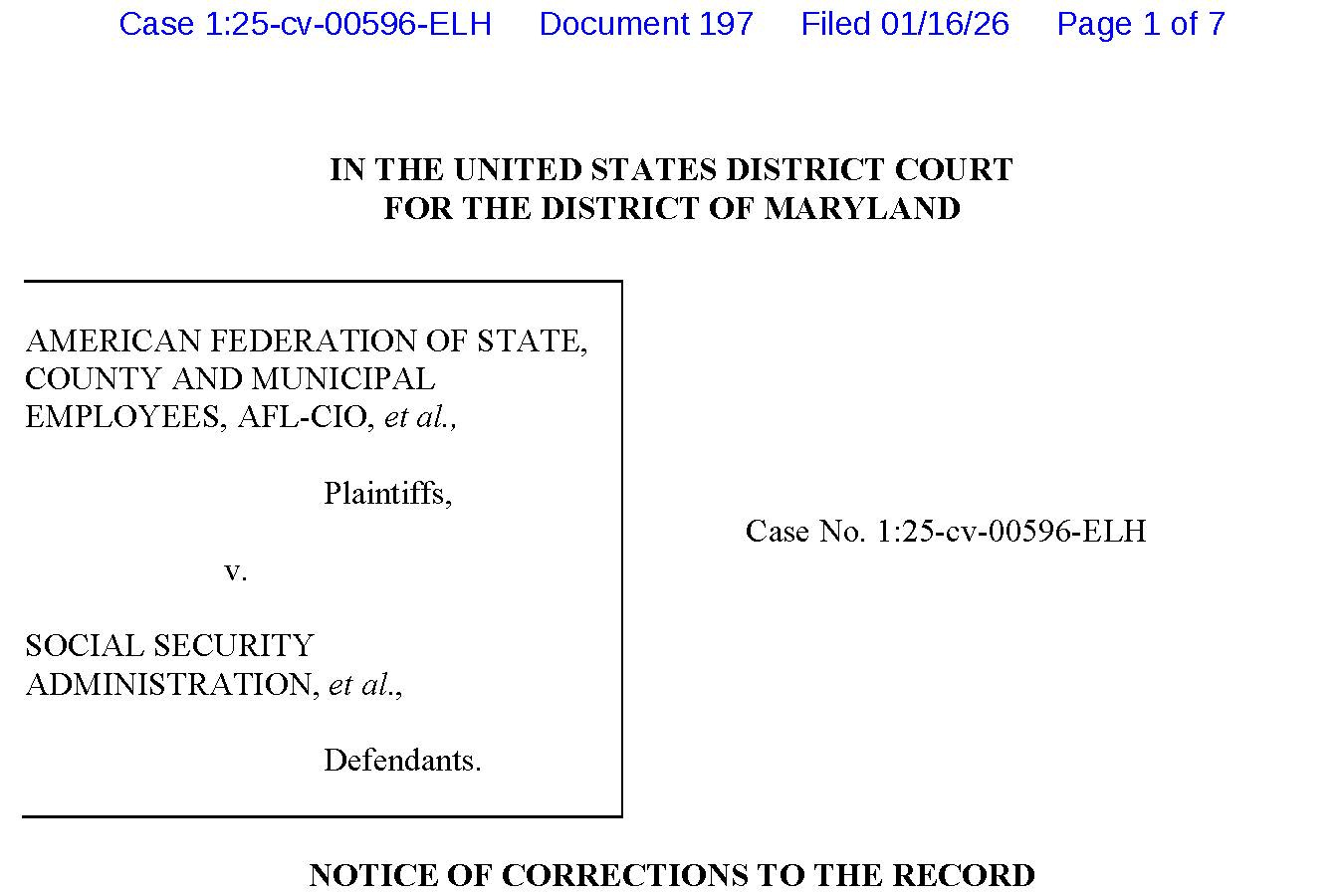
The reason why I’m bringing up a 7.5-month-old ruling is because of a filing the Justice Department made in the district court in that same case (which is still going) just last Friday. Titled “Notice of Corrections to the Record,” the filing identified six different material misrepresentations that the Department of Justice made to the district court in that case—five that stemmed from declarations from Social Security Administration personnel, and one that came directly from a DOJ brief. The biggest headline of the filing is that two DOGE personnel working at the Social Security Administration were secretly in touch with an advocacy group seeking to “overturn election results in certain States,” and one even signed an agreement that may have involved, or at least contemplated, unlawfully using Social Security data to match state voter rolls. (Those employees have apparently been referred to the Office of the Special Counsel for Hatch Act sanctions, but I’m not holding my breath.)
The even bigger takeaway from the filing, and what I kept coming back to as I listened to Wednesday’s oral argument on the Trump administration’s emergency application in the Lisa Cook case (I’m part of a roundtable in today’s New York Times reflecting on the argument), is that Justice Jackson’s SSA dissent was absolutely right—not just about the risks inherent in giving DOGE such unfettered access to Americans’ Social Security data, but about the dangers in the Supreme Court majority pausing the effects of lower-court rulings (which had blocked that access) without the benefit of a complete record, full briefing, or oral argument. I’ll unpack all of this below the fold, but to jump to the bottom line, DOJ’s “Notice of Corrections to the Record” ought to give the justices real pause not just about taking representations from the Trump administration at face value, but about substituting their judgment for that of district courts at least where preliminary relief has been based upon an impoverished (or nonexistent) record.
For those who are not paid subscribers, we’ll be back (no later than) next Monday with more regular coverage of the Supreme Court. For those who are, please read on.
