

Welcome back to “One First,” a newsletter that aims to make the U.S. Supreme Court more accessible to lawyers and non-lawyers alike. I’m grateful to all of you for your continued support, and I hope that you’ll consider sharing some of what we’re doing with your networks.
Every Monday morning, I’ll be offering an update on goings-on at the Court (“On the Docket”); a longer introduction to some feature of the Court’s history, current issues, or key players (“The One First ‘Long Read’”); and some Court-related trivia. If you’re not already a subscriber, I hope you’ll consider becoming one—and upgrading to a paid subscription if your circumstances permit:
The Scottish writer Andrew Lang is usually identified as the source of one of my favorite quotes. Specifically, Lang once complained about economists using statistics “as a drunken man use lampposts—for support, rather than illumination.”
That line has been on my mind as I’ve been watching, mostly from the sidelines, a pitched battle within the legal academy over the fairly transparent efforts of a small cohort of right-wing law professors to provide a fig leaf of historical support for the Trump administration’s legally and morally odious position in the birthright citizenship case. Starting with a tweet and a New York Times op-ed last February inisisting that there was already “an entire literature” supporting the government’s position, these folks have spent much of the last 14 months working hard to create the very literature they claimed already existed.
And when their efforts have been debunked by an ideologically diverse array of careful and serious scholars like Professors Evan Bernick, Paul Gowder, and Anthony Michael Kreis; Professor Michael Ramsay; and Professor Keith Whittington (among others), the revisionists have simply shifted the baselines of their claims rather than admitting that they were wrong and yielding the floor.1 (Kelsey Reichmann has a thorough article on the particulars via Courthouse News Service.)
I’ve written before about the obligations that law professors (especially those writing in public law) have when it comes to the scholarship they’re producing at this particular moment in American history—and I won’t rehash my thoughts here. Rather, it seems worth making two new points. First, at least based on how last Wednesday’s oral argument went, it certainly appears likely that those efforts will have been largely for naught.2 Solicitor General Sauer may have tried to allude to some of these newfangled arguments in his presentation; it didn’t sound to me like any of the justices were biting.
Second, as I elaborate upon below, it’s worth reflecting on the Court’s own responsibility for incentivizing this phenomenon—and how the move in the justices’ substantive constitutional jurisprudence toward “history and tradition” as dominant leitmotifs in constitutional interpretation necessarily invites the kind of “law-office history” that more responsible scholars have long decried and derided.
There’s a harder conversation (and, indeed, debate) to be had over the role that law schools play (and the responsibilities we bear) in supporting “scholarship” the purpose of which at least appears to be propping up a predetermined partisan political goal rather than meaningfully advancing academic understanding of a disputed historical or legal question. Academic freedom protects scholars’ right to challenge the orthodoxy; it doesn’t insulate them from charges of bad faith in doing so.3 But the problem here is one of both supply and demand. And for as much as recent discourse has been focused on the former, the Supreme Court bears at least some responsibility for the latter.
More on that below. But first, the news.
On the Docket
The Merits Docket
The Court handed down a single ruling in an argued case last week, but it was a biggie. In Chiles v. Salazar, Justice Gorsuch wrote for an 8-1 majority in holding that Colorado’s ban on “conversion therapy” regulates speech based upon its viewpoint—and must therefore be subjected to the most rigorous First Amendment scrutiny (i.e., it must be “narrowly tailored” to vindicate a “compelling governmental interest”).
Contra headlines in a number of media outlets, the Court did not itself “strike down” Colorado’s law. But given how difficult it is for laws to survive strict scrutiny (“strict in theory, fatal in fact,” as Professor Gerald Gunther famously put it in 1972), the writing is on the wall for what happens on remand. Justice Kagan wrote a short concurring opinion, which was joined by Justice Sotomayor. Kagan’s basic argument was that, although it’s possible for states to regulate conversion therapy through laws that are content-based but viewpoint-neutral, Colorado’s wasn’t—hence her vote with the majority. Justice Jackson dissented—and read her dissent from the bench (something the justices do only rarely, and in order to convey the gravity of their objections). At its core, Jackson’s argument was that “bedrock First Amendment principles have far less salience when the speakers are medical professionals and their treatment-related speech is being restricted incidentally to the State’s regulation of the provision of medical care.” My own view, which I hope to revisit in a future post, is that there’s a lot to both that argument and Justice Kagan’s concerns about its full implications.
The other two significant developments on the merits docket last week came in Monday’s regular Order List. First, the Court added another case to the merits docket for the October 2026 Term—taking up a nerdy Civil Procedure dispute with regard to when and how defendants can waive affirmative defenses by failing to raise them in their answer. Second, Justice Sotomayor, joined by Justice Jackson, filed a lengthy dissent from the denial of certiorari in a case in which the Court had previously (and summarily) vacated the petitioner’s co-defendant’s conviction because of the prosecution’s Brady violations. As Sotomayor argued, “Equal justice under law, the phrase engraved on the front of this Court’s building, requires that two codefendants, convicted of the same crime, who raised essentially the same constitutional claims, receive the same answer from the courts.” Alas.
The Emergency Docket
It was another quiet week on the emergency docket, with no full Court rulings of any kind on a single application for emergency relief. Nor am I aware of any pending emergency applications that are likely to produce full Court rulings this week.
The Week Ahead
Speaking of the week ahead, the justices are off the bench—and not expected back on it until next Friday, April 17. Besides a regular Order List at 9:30 ET this morning, we do not currently expect anything else out of the full Court this week, including any more decisions in argued cases. That can always change, but at least for now, the 17th is the next likely day for any additional rulings.
Miscellaneous
Finally, I wanted to flag a story my CNN colleague Joan Biskupic broke Friday morning—that Justice Alito was hospitalized in March after becoming ill at a Federalist Society dinner in Philadelphia (the story reports that he was “evaluated and administered fluids for dehydration”). The Supreme Court put out a statement only after Biskupic’s story was filed. There are obvious reasons why the justices (and the Court) have historically been mum about these kinds of episodes. That said, it seems worth at least asking if it does more harm to the Court for these kinds of stories to come out only thanks to journalistic scoops rather than through an effort on the Court’s part to provide even a modicum of transparency. As I’ve suggested before, the Court has bigger transparency problems, but those problems help to magnify the smaller ones.
The One First “Long Read”:
History, Tradition, and the Legal Academy
Of all of the long-form academic pieces I’ve published in my career, my favorite is still a 52-page book review I published in the Harvard Law Review in 2011. Titled “The New Habeas Revisionism,” the piece was ostensibly a review of a fantastic legal history monograph—UVa professor Paul Halliday’s Habeas Corpus: From England to Empire. But it also aimed to situate Halliday’s work within the Supreme Court’s (misbegotten) effort to define the scope of the writ of habeas corpus protected by the Constitution’s Suspension Clause by reference to the writ “as it existed in 1789.”
Unlike decades (if not centuries) of scholars, Halliday didn’t try to answer that question just by reading secondary sources; he went to the archives. And in looking at thousands of actual writs of habeas corpus issued by English courts across the sixteenth, seventeenth, eighteenth, and nineteenth centuries, Halliday made a number of discoveries that were inconsistent with various pieces of conventional wisdom about both the scope of and limits on pre-revolutionary English habeas practice. I won’t get into those discoveries here (the review does that). The more important point is that Halliday’s book both argued for and demonstrated the value of this kind of careful, methodologically driven historical (and historiographical) scholarship. In his words,
[I]f lawyers and judges want to act on claims about history, we must first make a fully contextualized reclamation of those past principles. Only then might history serve law: not as a grab bag of poor analogies, but as an otherwise unseen position from which to think anew about the questions that law must answer.
As someone who is not a professional historian, I have always tried to keep Halliday’s admonition in mind—not least because his book does such a remarkable job of demonstrating so many of the ways in which less-careful histories of habeas corpus have distorted our understanding of what was actually true on the ground. And, as my review argued, those distortions, in turn, have skewed the Supreme Court’s own jurisprudence (and numerous modern debates) regarding the “Great Writ”—and not at all for the better. Indeed, the review used a quote from a brief by Harvard law professor Paul Freund, which nicely dovetails with the broader thesis of Halliday’s work, as its epigraph: “We shall have to look to history for the essentials of the Great Writ, but not to one point in that history for its accidents.”
To be sure, this concern about lawyers doing bad history (and doing history badly) is not a new one—and wasn’t when I published that piece 15(!) years ago. More than three decades ago, Fordham law professor Martin Flaherty bemoaned what he called history “lite” in American constitutional scholarship. As Flaherty documented (and lamented), “constitutional discourse is replete with historical assertions that are at best deeply problematic and at worst, howlers.”
The problem has not just been bad history by law professors; it’s been bad history (and demands for bad history) by Supreme Court justices. Here’s DePaul law professor Stephen Siegel in 2010:
Historians coined the epithet "law-office history" over a half-century ago to describe the way Supreme Court Justices distort the historical record to provide support for positions they take on constitutional controversies. The epithet encompasses many abuses of the historian’s craft, such as cherry-picking evidence, ignoring the context in which evidence was embedded, and drawing clear conclusions from evidence that was conflicting or indeterminate.
As you might imagine, the rise of “law-office history” coincided with the turn in American constitutional law and scholarship toward originalism—and the idea that ambiguous constitutional text could and should be interpreted based upon how that language was understood by certain actors (the identities of which have … evolved) at that time. That is, in the main, a historical question—one that lawyers who aren’t professional historians might be singularly unqualified to answer, but have endeavored to answer nonetheless. Thus, whatever else might be said about when and why American constitutional law became obsessed with history, that turn is, by now, a longstanding one.
What’s new are two moves the Supreme Court first started making in detail just four years ago—during its October 2021 Term. The first move has been toward a more amorphous demand for evidence of “historical tradition” (or “history and tradition”), rather than the (somewhat) more analytically rigorous demands of “originalism.” As Emily Bazelon explained in an April 2024 feature in the New York Times Magazine that focused on those 2022 rulings enshrining the new approach,
[Originalism’s] main selling point was to fix the meaning of the Constitution to the moment in which it was written, to prevent judges from substituting their values for the wisdom of the nation’s founders. Though originalism in practice never lived up to this promise, because judges used it inconsistently or to reach the results they preferred, “history and tradition,” unlatched from any one moment, is even more pliable and indeterminate. It lets judges choose from a vast array of sources, which makes it easy to cherry-pick.
This approach was reflected on consecutive days in the Court’s landmark rulings in New York State Pistol & Rifle Ass’n v. Bruen and Dobbs v. Jackson Women’s Health Organization—in which the majority opinions by Justices Thomas and Alito seemed more interested in finding scattershot historical data points to support their conclusions than in being informed by the broader historical developments of what they asserted were the relevant eras. (Beyond the dissents in those cases, Justice Jackson’s dissent last year in Medina made this point powerfully in the context of the need for “a broader—and more inclusive—survey of historical sources” in unpacking the original understanding of 42 U.S.C. § 1983.)
All of that would be problematic enough by itself. But at the same time as a majority of the Court has been embracing an ever-more-amorphous conception of what kind of history matters, it has also started to treat law review articles much like Andrew Lang’s lampposts—as support, rather than illumination, for the historical propositions for which they were being cited.
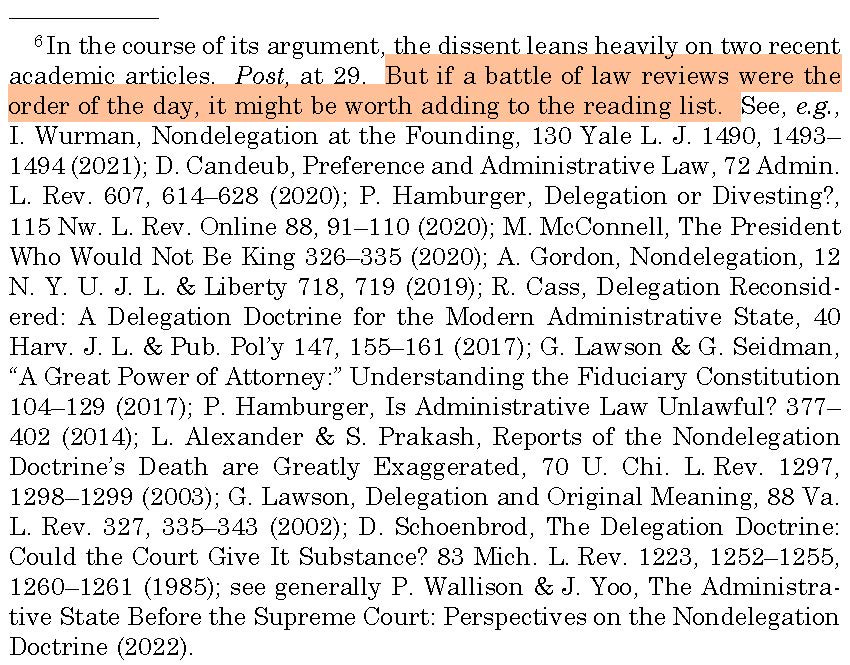
Consider Justice Gorsuch’s concurrence in West Virginia v. EPA (filed a week after Bruen and six days after Dobbs, and the source of the image above). Justice Kagan’s dissenting opinion in that case had responded to the Court’s claim that the Constitution is generally wary of statutory delegations of policymaking authority to the executive branch by flagging exceptional (and exceptionally careful) recent scholarship about how (and how often) Congress in fact delegated such power in the first years after the Founding. Indeed, before the recent contretemps over birthright citizenship, the scholarly debate over non-delegation was probably the most recent example of such widespread engagement over a specific historical-legal question.
In a footnote, Justice Gorsuch responded by suggesting that, “if a battle of law reviews were the order of the day, it might be worth adding to the reading list.” And then he cited 12 other scholarly works—none of which actually responded to the revisionist accounts invoked by Justice Kagan. Nor did Gorsuch explain how the authorities he cited actually supported his (and the majority’s) position notwithstanding Justice Kagan’s dissent and the sources on which she relied. Apparently, it was enough that there was scholarship on the other side; Gorsuch’s “battle of law reviews” was not about which scholars were actually correct (or even which were more persuasive about the same Founding-era historical evidence); it was about the citation scoreboard. A law review article on one side can be defeated merely by the existence of an article on the other.
The Gorsuch footnote is, alas, no outlier. One can find any number of other examples of justices citing recent scholarship as proof of (or at least support for) historical claims that, whatever their merits, just have not run the gauntlet of conventional historical scholarship. History can be, and usually is, complicated (the Dutch historian Pieter Geyl called history “an argument without end”). But if the Supreme Court is going to try to backfill its conclusions with whatever citations it can muster regardless of their integrity or persuasiveness, someone will provide those citations. Justice Sotomayor captured this exact point last month in paraphrasing Field of Dreams about how the Court’s behavior provokes responses: “if you build it, they will come.”
We should necessarily be critical of the transparent (and transparently cynical) attempt to generate “an entire literature” in the birthright citizenship case at the exact moment that President Trump attempted to reignite such a long-settled constitutional debate. But so long as this is the Supreme Court’s attitude toward legal scholarship, law professors will write articles that are designed and intended to be cited as much as they are designed and intended to be learned from. We should all be better about that—including the justices.
SCOTUS Trivia: My Two Citations
Further to the point of today’s “Long Read,” I thought I’d use the trivia to flag the two times my own work has been cited in Supreme Court opinions—both of which, I can safely say, were not part of any “battle of the law reviews.”
The first, perhaps unsurprisingly, was on the emergency docket—in Justice Sotomayor’s September 2019 dissent from the grant of a stay in Barr v. East Bay Sanctuary Covenant, in which the majority put back into effect one of the (first) Trump administration’s controversial asylum restrictions.
The second was, ironically enough, a citation to my Halliday review in Justice Jackson’s dissenting opinion in Jones v. Hendrix—as part of her refusal to accept that the Suspension Clause should be limited to protecting the scope of habeas corpus “as it existed in 1789.”
Something tells me it might be some time before there’s a third…
I hope that you’ve enjoyed this installment of “One First.” If you have feedback about today’s issue, or thoughts about future topics, please feel free to e-mail me. And if you liked it, please help spread the word!
If you’re not already a paid subscriber and are interested in receiving regular bonus content (or, at the very least, in supporting the work that goes into this newsletter), please consider becoming one:
This week’s bonus issue for paid subscribers will drop on Thursday. And we’ll be back with our regular content for everyone (no later than) next Monday. As ever, please stay safe out there—especially from misused lampposts.
To take one example of far too many, the initial New York Times op-ed by Professors Barnett and Wurman claimed that the key distinction in the Citizenship Clause is between "foreigners who came in 'amity—friendship'" and those "who did not come in amity.” But after a series of folks pointed out that this distinction was both non-sensical and contradicted by a ton of contemporaneous evidence, Wurman posted a reply strangely (mis-)portraying himself as Einstein in a debate over Newtonian physics, and then conceding that “[t]he decisive factor was not ‘amity,’” admitting that the original op-ed “should not have used the word ‘amity’ without further elaboration,” and magically ending up reaching the same conclusion based upon a different argument.
Law professors have a right to be wrong. And they have a right to correct their mistakes and be forgiven. But I’ll just say that, if I ever had a critical claim of mine so thoroughly disproven, I’d think long and hard—and then think long and hard again—before trying to persuade folks that the bottom line should still be the same. As regular readers of this newsletter know, I tend to think that everyone is entitled to a presumption of good faith. But in the end, it’s only a presumption—and presumptions can be overcome.
At least if the goal was to persuade the Supreme Court that President Trump’s executive order could be defended on constitutional grounds. If the goal was something less scholarly, well, see the last paragraph of the previous footnote.
Indeed, Professor Wurman’s response when asked by Reichmann about charges that his scholarly efforts have been politically motivated may have only helped to prove the point. After responding “spare me the outrage” (never mind the very real—and outrageous—effects that would result from his novel arguments being adopted), Wurman continued by engaging in lazy and superficial whataboutism:
Scholars on the left claiming someone on the right is politically motivated is kind of rich. I mean, can you name me one out of the thousands of public law professors who are on the left that have ever reached a single conclusion or idea that does not align with their political ideology? So it is kind of rich to accuse conservatives, whose method of originalism routinely requires them to update their understandings.
One might point out, first, that Wurman has also received plenty of sharp criticism from the right—which rather cuts against his not-so-subtle insinuation that he has been subject to a politically motivated assault on his work. And in any event, as someone who regularly writes in support of conclusions that are dramatically at odds with my political preferences (and who can name dozens of other highly visible “public law professors who are on the left” who do the same), all I can do is refer readers, once again, to the last paragraph of the first footnote to this post.
Another great column. I've been vexed by the willingness of conservative judges to grasp onto any 18th Century verbiage that ostensibly supports their views on the Constitution while rejecting any reliance on the clearly-documented legislative history of more recent enactments. Shocked (shocked!) to learn that their historical sources are thin and result-oriented.
"The Gorsuch footnote is, alas, no outlier. One can find any number of other examples of justices citing recent scholarship as proof of (or at least support for) historical claims that, whatever their merits, just have not run the gauntlet of conventional historical scholarship. History can be, and usually is, complicated (the Dutch historian Pieter Geyl called history “an argument without end”). But if the Supreme Court is going to try to backfill its conclusions with whatever citations it can muster regardless of their integrity or persuasiveness, someone will provide those citations. Justice Sotomayor captured this exact point last month in paraphrasing Field of Dreams about how the Court’s behavior provokes responses: “if you build it, they will come.”
Historians, most likely including these soi- distant originalist legal historians, are also very complicated. There is incredible hubris in thinking we can preserve a certain perspective in amber as though it was gospel. It's hard not to question their motives.
One thing I believe as the daughter of a historian is that we never really arrive... we keep pressing forward with the tools at our disposal at the time. We think we know...but I believe future generations will argue we know less than we thought we did.