

Welcome back to “One First,” a newsletter that aims to make the U.S. Supreme Court more accessible to lawyers and non-lawyers alike. I’m grateful to all of you for your continued support, and I hope that you’ll consider sharing some of what we’re doing with your networks.
Every Monday morning, I’ll be offering an update on goings-on at the Court (“On the Docket”); a longer introduction to some feature of the Court’s history, current issues, or key players (“The One First ‘Long Read’”); and some Court-related trivia. If you’re not already a subscriber, I hope you’ll consider becoming one—and upgrading to a paid subscription if your circumstances permit:
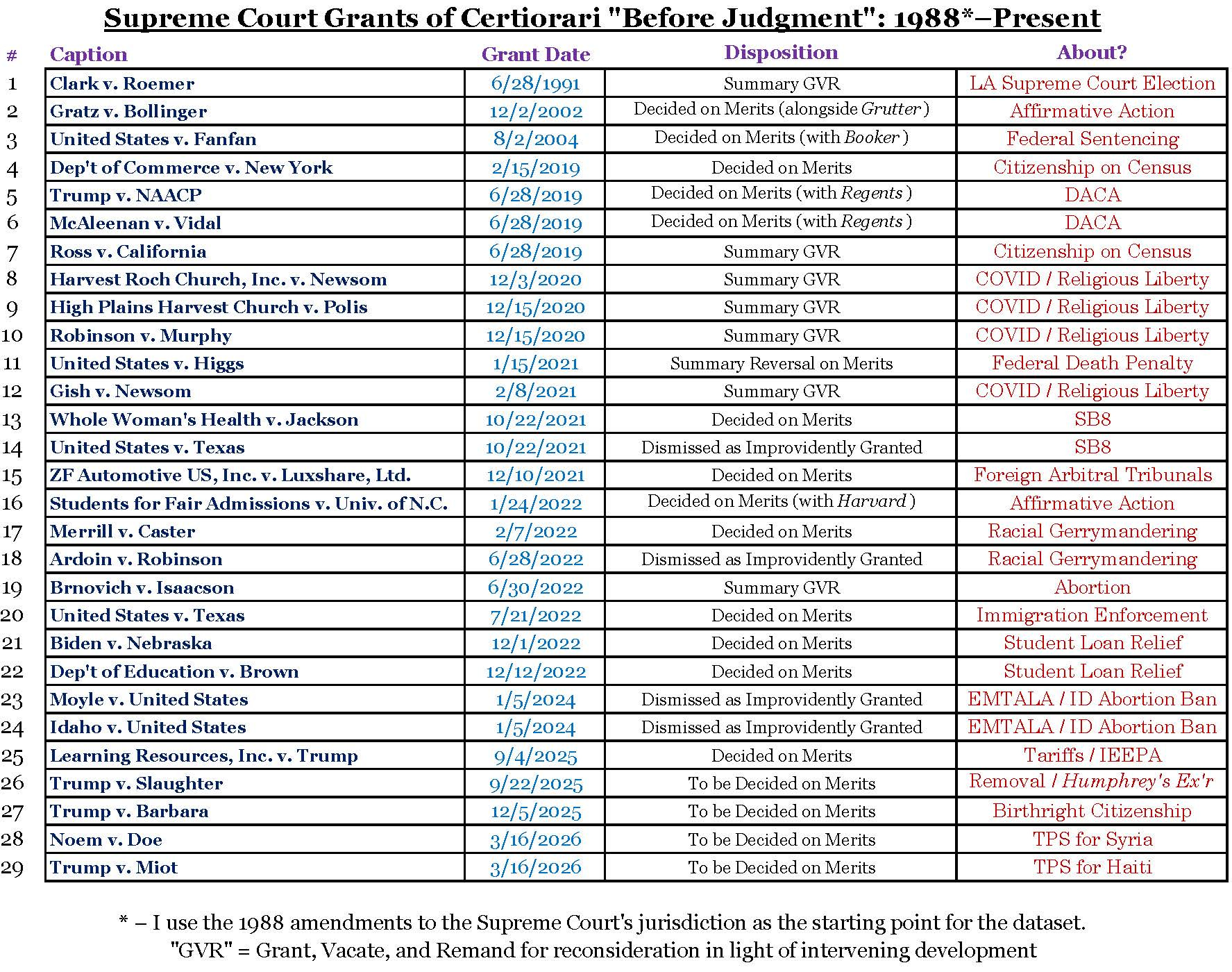
Today’s “Long Read” uses the Court’s grants of certiorari “before judgment” last Monday in the Haiti and Syria TPS cases (which were the focus of last week’s newsletter) as a foil for asking whether the Court is granting certiorari before judgment too often. Historically, the Court used this procedural device, which, unlike an “ordinary” cert. petition, allows the justices to leapfrog federal courts of appeals in cases of both exceptional importance and urgency, once in a blue moon; as the chart below reflects, between the last major reforms to the Court’s jurisdiction in June 1988 and February 2019, the Court granted cert. before judgment a total of three times—i.e., roughly once a decade. Last Monday’s grants, in contrast, were the 25th and 26th since February 2019—and the fourth and fifth of this term, alone. That’s a massive increase for an extraordinary power the exercise of which, as then-Justice Rehnquist put it in 1976, has historically been “an extremely rare occurrence.”
As last week’s post suggested, if the alternative to certiorari before judgment is a rushed, unexplained ruling on an emergency application after (at best) truncated briefing, it should be obvious why the plenary (if accelerated) merits review provided by certiorari before judgment is almost always going to be “better.” But there are also very real risks inherent in the Court coming to view cert. before judgment as a “compromise” to resolving high-profile disputes through the emergency docket—risks that have already manifested in real cases with real effects, and risks that it might behoove the justices to carefully consider sooner, rather than later.
More on that below. But first, the (other) news.
On the Docket
The Merits Docket
The only merits docket news last week was the single ruling the Court handed down on Friday—Justice Kagan’s opinion for a unanimous Court in Olivier v. City of Brandon. In a nutshell, the Court held that a plaintiff can bring a prospective challenge to a local or state law he or she believes is unconstitutional even if they have already been convicted of violating it. The Court thus distinguished the (much-maligned) “favorable termination” rule of Heck v. Humphrey,1 which the district court and a Fifth Circuit panel had concluded provided a bar to a Mississippi street preacher’s First Amendment suit (the Fifth Circuit denied rehearing en banc, 9-8).
The Emergency Docket
As noted above, on Monday, the Court took the Trump administration’s two applications for emergency relief in the TPS cases, treated them as petitions for certiorari before judgment, and granted them—setting an expedited briefing schedule that would allow the (now-consolidated) cases to be argued during the last week of April (and, presumably, decided by the end of June). Importantly, the Court did not also grant the Trump administration’s stay requests; it “deferred” them pending at least the April argument.2 Thus, the lower-court rulings in both cases (which had blocked Secretary Noem’s efforts to rescind TPS for Haiti and Syria, respectively) remain in place, at least for now. Although I had suggested in last week’s newsletter that this was the exact right outcome (granting cert. before judgment and not granting the stays), I’ll confess to being a bit surprised not only that the Court did the right thing, but that no one publicly dissented. More on that dynamic below.
The only other non-housekeeping order out of the full Court last week was Monday’s denial of a stay of execution (over no public dissents) to Florida death-row inmate Michael King. King was executed Tuesday evening.
The Week Ahead
We expect a regular Order List this morning at 9:30 ET, followed by the beginning of the “March” argument session at 10:00, with argument in a major dispute over whether federal law (simply by setting an “Election Day”) bars states from accepting mail-in ballots that are postmarked on or before Election Day, but received a short time thereafter. And the “March” session will be bookended next Wednesday (April 1), by the much-anticipated oral argument in the birthright citizenship case.
The Court has not yet identified the next day on which it will hand down rulings in argued cases. But with the justices already set to take the bench Monday through Wednesday both this week and next, it would be easy for the Court to add one of those as a hand-down day without too much effort. After next Wednesday, the next currently scheduled public session is Friday, April 17.
Beyond this action on the merits docket, I’m not aware of any pending emergency applications in which we expect full Court action this week.
Miscellaneous
On Thursday afternoon, the Court held its Bar Memorial for Justice Sandra Day O’Connor, who passed away in December 2023.3 As the Court’s website explains:
Since 1822, the Supreme Court has memorialized Justices who have died with a meeting of the Supreme Court’s Bar, followed by a Special Sitting of the Court. The Bar Meeting features a series of tributes to the late Justice and concludes with the adoption of resolutions in memory and appreciation of the Justice’s life, work, and service. The resolutions adopted by the Bar are then presented to the Court in a formal, ceremonial Courtroom presentation.
I didn’t get to watch the proceedings live (although one might note the remarkable revelation that the Court does have the capacity to provide live, streaming video!), but the archived audio reflects an understandable amount of nostalgia for a justice who not only had a remarkable career but who was also widely respected by colleagues to both sides of the ideological spectrum. When O’Connor announced her retirement from the Court in August 2005, Justice Scalia, with whom she had so often sparred, sent her a note in which he wrote that she had been “the forger of the social bond that has kept the Court together.” He wondered, “who will take that role when you are gone?” Two decades later, that remains an open question.
Finally, and speaking of video, I wanted to flag a rare video-recorded appearance by Chief Justice Roberts in Houston, where he was in dialogue with Judge Lee Rosenthal from the Southern District of Texas. What stood out to me (and, it seems, the entire Supreme Court press corps) about the conversation was Roberts’s response when asked about criticism of the justices. In his answer, Roberts noticeably went past limiting his answer to his colleagues on the Supreme Court to talk about the entire federal judiciary: “The problem sometimes is that the criticism can move from a focus on legal analysis to personalities. Judges around the country work very hard to get it right. And if they don’t, their opinions are subject to criticism. But personally directed hostility is dangerous and it’s got to stop.” You might think it’s no coincidence that those remarks came one day after President Trump (whom Roberts did not name) referred to D.C. district court Chief Judge Jeb Boasberg as “wacky, nasty, crooked and totally out of control”; I couldn’t possibly comment.
The One First “Long Read”:
The Cert. Before Judgment Express Lane
Let’s start with the easy part: It is objectively undeniable that the Supreme Court is granting certiorari before judgment at a far higher clip than it ever had before 2019, especially compared to what had become the norm on the far side of the 1988 revisions to the Court’s jurisdiction.4 As the chart above suggests, some of those grants have been so the Court can conduct plenary review on the merits docket; some have been to bring companion cases to the Court alongside cases that reached the Court through ordinary means (which is what happened, for instance, in the tariffs cases); and some have been to take various (previously unprecedented) procedural steps, especially during the COVID pandemic. (Don’t get me started about Higgs.)
Everyone will have their own suspicions about what caused this uptick. The obvious culprits, in my view, are the massive expansion of the emergency docket combined with (and perhaps partly caused by) the subtle-but-significant shift in the Court’s composition in 2018, when Justice Kavanaugh replaced Justice Kennedy. Indeed, Justice Kavanaugh has made no bones about his willingness to regularly take cases in relatively premature procedural postures if the issues are, from his perspective, important enough—including by granting certiorari before judgment (as he explained quite directly in his concurring opinions last year in both Trump v. Illinois and Trump v. Boyle). There’s plenty of reason to believe that Justice Kennedy would have been far less likely to support certiorari before judgment in comparable contexts, and certainly not at this scale. And although “regular” cert. petitions take only four votes to grant, as noted in today’s trivia, it’s now fairly clear that cert. “before judgment” takes five—so it would’ve been hard to imagine similar upticks prior to 2018 without Kennedy’s support.
As for the role of the emergency docket in pushing the Court toward more grants of certiorari before judgment, one of the things that’s striking about the list of cases above is how many of the recent ones reached the Court first as emergency applications—where granting certiorari before judgment was, quite likely, some kind of compromise. For instance, in December 2023, the Court granted certiorari before judgment in the student loan cases rather than rule up or down on the Biden administration’s applications for emergency relief; as in the TPS cases, it “deferred” those applications pending the plenary review the Court conducted in Biden v. Nebraska and Department of Education v. Brown. None of the justices who ultimately dissented in Nebraska (who would’ve upheld the program) publicly objected to the December 2023 orders—which is at least circumstantial evidence that the acceleration of merits review alongside deferral of the emergency applications reflected some kind of behind-the-scenes deal.
Ditto the Court’s January 2024 intervention in the EMTALA/Idaho abortion cases—in which, in the same order, it granted certiorari before judgment and stays of the district court’s injunction, and no one (at least at the time) publicly dissented.5 I don’t think I’m speaking out of school to suggest that granting cert. before judgment in these cases was thus less about the exceptional importance of the case relative to historical examples and more about a transactional move by the justices—to accelerate the Court’s ability to fully resolve a contentious case that arrived via an emergency application by granting cert. before judgment either alongside or instead of emergency relief. Indeed, both Justice Kagan’s and Justice Jackson’s subsequent opinions in the EMTALA cases provide at least some hints that they were not fully onboard with granting the stays in January 2024—but acquiesced because of the accelerated merits review.
Without reference to those specific examples, Justice Kavanaugh, at least, has all-but admitted that this is what’s happening—writing the following in Labrador v. Poe ex rel. Poe in 2024:
Given the extraordinary significance of the question whether a consequential new law can be enforced during the several years while merits litigation is ongoing, the Court should use as many tools as feasible and appropriate to make the most informed and best decision. Sometimes that might mean taking more time (if available), ordering supplemental briefing, or inviting amicus briefs. In certain circumstances, moreover, the Court might benefit from oral argument or may even grant certiorari before judgment.
Especially in recent years, the Court has employed many of those tools to help the Court better decide important emergency applications. [citing examples.] And I believe that the Court should continue to be flexible in employing appropriate procedures so as to best decide important emergency applications.
The harder question is whether, insofar as this is what’s happening in the TPS cases (and/or why there have been so many grants of certiorari before judgment), it is ultimately a good trade-off for the Court. Of course, if the alternative is only “grant emergency relief in an unsigned, unexplained order and wait for the case to come back sometime later,” then it’s easy to see why cert. before judgment is better in almost every respect—especially if the Court is going to continue to resort to such impoverished procedures for (and provide such little explanation in) resolving emergency applications.
But it strikes me that there are also at least three costs to this fairly significant shift in the Court’s docket—costs that ought to at least be accounted for, even if one might conclude that they are ultimately outweighed by the benefits either in individual cases or across the entire field.
First, and most obviously, certiorari before judgment cuts off the very percolation of disputes in the lower courts that the justices have so often defended, and the lack of which was one of the concerns the conservative justices (and right-wing commentators) often leveled against “universal” injunctions. I’ve written before about all of the ways in which the Court’s frequent claim that it is “a Court of review, not first view” has been utterly belied by its behavior in recent years, but the flood of grants of certiorari before judgment is, by volume, the most significant dataset.
Leapfrogging the federal courts of appeals necessarily deprives the justices of a meaningful additional layer of review; an additional round of briefing and argument; and the opinion(s) of other appellate judges on questions that are, in so many of these cases, ones of first impression. To take just one especially visible example, in Biden v. Nebraska, at the point at which the Supreme Court took up the legal validity of President Biden’s student loan debt forgiveness program, the district court and the Eighth Circuit, between them, had said exactly one word about the merits (that word was “substantial,” which was the sum total of how the Eighth Circuit described the plaintiffs’ claims in granting a nationwide injunction pending appeal). Maybe more percolation and the creation of a record in the lower courts might’ve made clear just how little the states’ theory of Missouri’s standing was actually supported by the facts.
Second, and related to the lack of percolation, is the far-heightened risk of error from taking cases too quickly and on completely undeveloped records. Again, an example may help to illustrate the concern. Consider the Court’s handling of Moyle v. United States—the consolidated cases from 2024 about the conflict between Idaho’s abortion ban and the federal Emergency Medical Treatment and Labor Act (EMTALA). The district court had enjoined Idaho’s abortion ban insofar as it barred doctors from performing medically necessary abortions to stabilize emergent (but not immediately life-threatening) conditions, and the Court stayed that injunction in the same order in which it granted certiorari before judgment.
As I wrote back when the Court ultimately dismissed certiorari as improvidently granted (what’s known as a “DIG”) and vacated the stays, the separate opinion by Justice Barrett, which was joined by the Chief Justice and Justice Kavanaugh, suggested that the key justices had been under a material misimpression about the record, the factual representations made by the parties, and various other features of the cases, all of which would likely have been clearer had ordinary appellate review run its course. Nor was the Court’s belated DIG harmless; as Justice Kagan pointed out in her separate opinion, in the six months during which the Court’s stays had been in effect, countless doctors had been forced to arrange medical airlifts out of Idaho for pregnant woman for whom abortions were the safest way to stabilize an emergent medical condition—and for whom abortions would have been available under EMTALA (and the district court’s injunction) but for the Supreme Court’s intervention.
Third, the indirect and direct costs of a lack of percolation aside, there’s also the inevitability that holding certiorari before judgment out as an alternative to granting or denying a stay will alter the internal calculus respecting votes on emergency applications in a way that sharply reduces the costs (to the justices, anyway) of either move. Justices Kavanaugh and Barrett are both fond of arguing that the Court has no choice when it receives emergency applications; it must “grant or deny.” But that argument doesn’t actually explain why the Court’s impulse, in so many more cases these days than ever before, is to grant, not deny.
Put another way, in a world in which the Court was faithfully applying the standards for emergency relief (standards that, in my view, should produce far more denials of emergency applications), there wouldn’t be the same pressure to grant certiorari before judgment—because it wouldn’t in so many cases be an alternative to a grant of a stay. But holding cert. before judgment out as an “alternative” to an unsigned, unexplained intervention moves the baseline in ways that take the Court off the hook for its own misadventures with emergency applications (and for the very different standards that are supposed to apply to these different procedural moves). The Court’s bad behavior on stays shouldn’t create leverage for mainstreaming a practice that used to be “extremely rare.”
Again, I don’t think these costs necessarily outweigh the benefits in individual cases. That may be especially true in the TPS cases, where part of the justification for cert. before judgment wasn’t as an alternative to staying the district court’s rulings, but because of the significant uncertainty in the lower courts across a large number of cases other than the Haiti and Syria disputes. And yet, it’s worth closing by underscoring the source of that uncertainty, i.e., the Court’s own unsigned, unexplained grants of stays last May and October in the Venezuela TPS case—and confusion about whether the Court was expressing a view on the jurisdictional question, the substantive merits with respect to the Secretary’s legal authority, or the Venezuela-specific facts (to say nothing of confusion over the precedential force in other TPS cases of the Court’s unexplained interventions in the Venezuela dispute).
If the ultimate case for certiorari before judgment is that it makes it easier for the Court to more expeditiously clean up its own messes, maybe the real conversation should be about why the Court shouldn’t be creating those messes in the first place—and not why this is the best way to fix them.
SCOTUS Trivia:
How Many Votes for Cert. Before Judgment?
Even relatively casual Supreme Court-watchers likely know the “rule of four,” i.e., that it takes four justices to agree to grant certiorari and take up a discretionary appeal in an ordinary case (It isn’t actually a “rule,” but I digress.) But for quite some time (at least outside the Court), there was genuine confusion about the vote threshold for certiorari before judgment.
It turns out, at least based on an internal September 1985 memorandum by then-Justice Rehnquist in the Court’s consideration of Darden v. Wainwright, that the answer is “five votes,” and that the Court only conclusively settled on that answer in 1983—in the process of granting cert. before judgment in Barefoot v. Estelle, one of the most legally significant capital cases of the decade. As Rehnquist wrote:
In hashing all of this out at the time of the discussion about the stay application in Barefoot, I think it was agreed by all of us that past practice required five votes to grant certiorari before judgment. I haven’t the slightest doubt that it should take a majority to grant certiorari before judgment, where our Rules provide that it will be granted “only upon a showing that the case is of such imperative public importance as to justify the deviation from normal appellate processes and to require immediate settlement in this Court.”
Of course, this “rule of five” isn’t written down publicly, either.
I hope that you’ve enjoyed this installment of “One First.” If you have feedback about today’s issue, or thoughts about future topics, please feel free to e-mail me. And if you liked it, please help spread the word!
If you’re not already a paid subscriber and are interested in receiving regular bonus content (or, at the very least, in supporting the work that goes into this newsletter), please consider becoming one:
This week’s bonus issue for paid subscribers will drop on Thursday. And we’ll be back with our regular content for everyone no later than next Monday (but it’s 2026, so you never know). As ever, please stay safe out there.
The “favorable termination” rule is a Court-created bar on civil suits under 42 U.S.C. § 1983 if success in the civil suit would necessarily undermine the legitimacy of a prior conviction (in such cases, the plaintiff has to attack the conviction directly, usually through a—much harder—habeas petition).
In case you’re keeping score, this means there are now four emergency applications from the Trump administration that have been deferred—with rulings also still outstanding on the Justice Department’s stay requests in Trump v. Cook and Blanche v. Perlmutter, both of which are probably waiting for the Court’s forthcoming (cert.-before-judgment) merits docket ruling in Trump v. Slaughter.
Especially on the far side of COVID, the Bar Memorial has usually occured 2-3 years after a justice has passed. Justice Stevens’s memorial was in May 2022; and Justice Ginsburg’s was in March 2023.
If you’re curious, there were a total of 27 grants of certiorari before judgment from when Congress first gave the Court that power in 1925 through the 1988 jurisdictional reforms.
One counterexample is the Court’s denial of a stay in 2022 in United States v. Texas—in which, although the Court also granted certiorari before judgment, Justices Sotomayor, Kagan, Barrett, and Jackson still dissented from the denial of the stay.
"Again, I don’t think these costs necessarily outweigh the benefits in individual cases. That may be especially true in the TPS cases, where part of the justification for cert. before judgment wasn’t as an alternative to staying the district court’s rulings, but because of the significant uncertainty in the lower courts across a large number of cases other than the Haiti and Syria disputes. And yet, it’s worth closing by underscoring the source of that uncertainty, i.e., the Court’s own unsigned, unexplained grants of stays last May and October in the Venezuela TPS case—and confusion about whether the Court was expressing a view on the jurisdictional question, the substantive merits with respect to the Secretary’s legal authority, or the Venezuela-specific facts (to say nothing of confusion over the precedential force in other TPS cases of the Court’s unexplained interventions in the Venezuela dispute)."
With regard to the TPS cases, the SCOTUS process (if it can be dignified with that description) sounds opaque at best, sloppy and callous at worst...
Real people will have to grapple with real consequences. Sometimes I wonder if the justices are so blinded by self-regard that they forget that simple truth.
Grants of certiorari before judgment presumably provide insights into what Justices perceive as issues that deserve their attention as matters of higher than “normal” urgency - whatever “normal means these days – and hence the biases that like all human beings affect their decisions no matter how much they or we may protest and argue that we are only influenced by verifiable facts and iron clad arguments. This Court is however also noteworthy by its failure (in my opinion) to act swiftly to deal with situations in which people are suffering or will suffer harm unless, for example, the federal Government is told to stop what the DHS is doing.
I note also Professor’s Vladeck’s news that maybe, just maybe, Chief Justice Roberts is finally waking up to the dangers of personally directed hostility towards individual Judges at any level in the judiciary. The most influential and persistent offender is of course President Trump. The Chief Justice has now been a target himself (as one of the Justices rejecting the President’s tariff polices) of “unfriendly” comments emanating from the White House. Will this personal experience finally make him recognize that the President and his sycophantic appointees are no more to be trusted and believed than Vladimir Putin should be if he appeared as an advocate for a plaintiff or defendant in a case before the Court?
My overall impression of this Supreme Court, especially its usual majority, is that it is in as much of a shambles in terms of consistency, clarity and cognitive consonance with respect to principles and goals as the foreign policies of the US. I refer to the increasingly self-contradictory statements about the purpose of the Iran War, especially those of the hapless Secretary of State whose sorry mien is evident in his many appearances alongside or just behind the President.
P.S. I appreciate Professor Vladeck’s partial quote from the British TV series House of Cards, the inspiration of the US series with the same name. The complete quote is, "You might very well think that; I couldn’t possibly comment,” which is meant to confirm information while maintaining plausible deniability. A tactic that is indispensable for anyone working for the President or his sycophants who wishes to retain any vestiges of integrity