

Welcome back to “One First,” a newsletter that aims to make the U.S. Supreme Court more accessible to lawyers and non-lawyers alike. I’m grateful to all of you for your continued support, and I hope that you’ll consider sharing some of what we’re doing with your networks.
Every Monday morning, I’ll be offering an update on goings-on at the Court (“On the Docket”); a longer introduction to some feature of the Court’s history, current issues, or key players (“The One First ‘Long Read’”); and some Court-related trivia. If you’re not already a subscriber, I hope you’ll consider becoming one—and upgrading to a paid subscription if your circumstances permit:
Obviously, the big news from the Supreme Court last week was Friday’s 6-3 ruling in the tariffs cases, about which I wrote in some detail on Friday night. One of the points I made on Friday was that the dissenters (Justices Thomas, Alito, and Kavanaugh) certainly appear to be voting inconsistently given their reliance upon the so-called “major questions doctrine” (MQD) to invalidate President Biden’s student loan debt forgiveness program in Biden v. Nebraska—in which the executive branch’s position was based on just as much of a “national security” statute as it was in the tariffs case (which was their putative basis for not relying upon the MQD here).
Not surprisingly, there are plenty of folks on the right who have argued that the only (or, at least, primary) justices who were inconsistent here were the Democratic appointees, since they voted to uphold the delegations in Nebraska and a handful of other high-profile cases from the Biden administration. Whether they acknowledge it or not, these commentators seem to all be taking their cues from Justice Gorsuch, who devoted a healthy chunk of his 46(!)-page concurrence to attacking Justices Sotomayor, Kagan, and Jackson.1
As I explain below, there are two different problems with this argument. The first is that it completely fails to account for the implications of the Democratic appointees’ refusal to embrace the major questions doctrine. To justices for whom any ambiguity in a statute is fatal to an executive branch claim of broad delegated power (i.e., those who have embraced the MQD), a vote to nevertheless uphold some ambiguous delegations (and/or to selectively apply the MQD to foreign relations/national security cases) is necessarily inconsistent—which was a central part of my critique of Justice Kavanaugh’s tariffs dissent in Friday’s post. But for justices who don’t think the MQD is a thing, different ambiguous statutes will often (if not usually) raise different questions depending upon the specific terms that are ambiguous and the broader (and necessarily different) contexts in which they were enacted. Simply pointing to the different outcomes in those cases and the relevant occupant of the Oval Office and then charging inconsistency is … lazy.
Second, as Justice Kagan’s seven-page concurrence makes clear, there are some relatively straightforward reasons why, in a world without the MQD, the HEROES Act question in Nebraska and the IEEPA question in Learning Resources really should come out differently—especially when one takes into account the specific verbs and objects at issue in each statute, and the broader contexts in which both statutes were enacted. Even if one isn’t persuaded by that argument (and, I’ll confess, I am), it seems that one would have to explain why it isn’t even reasonable before accusing Justices Kagan and Sotomayor and Jackson of hypocrisy. One of the things about more nuanced approaches to statutory interpretation is that they tend to produce … nuances.
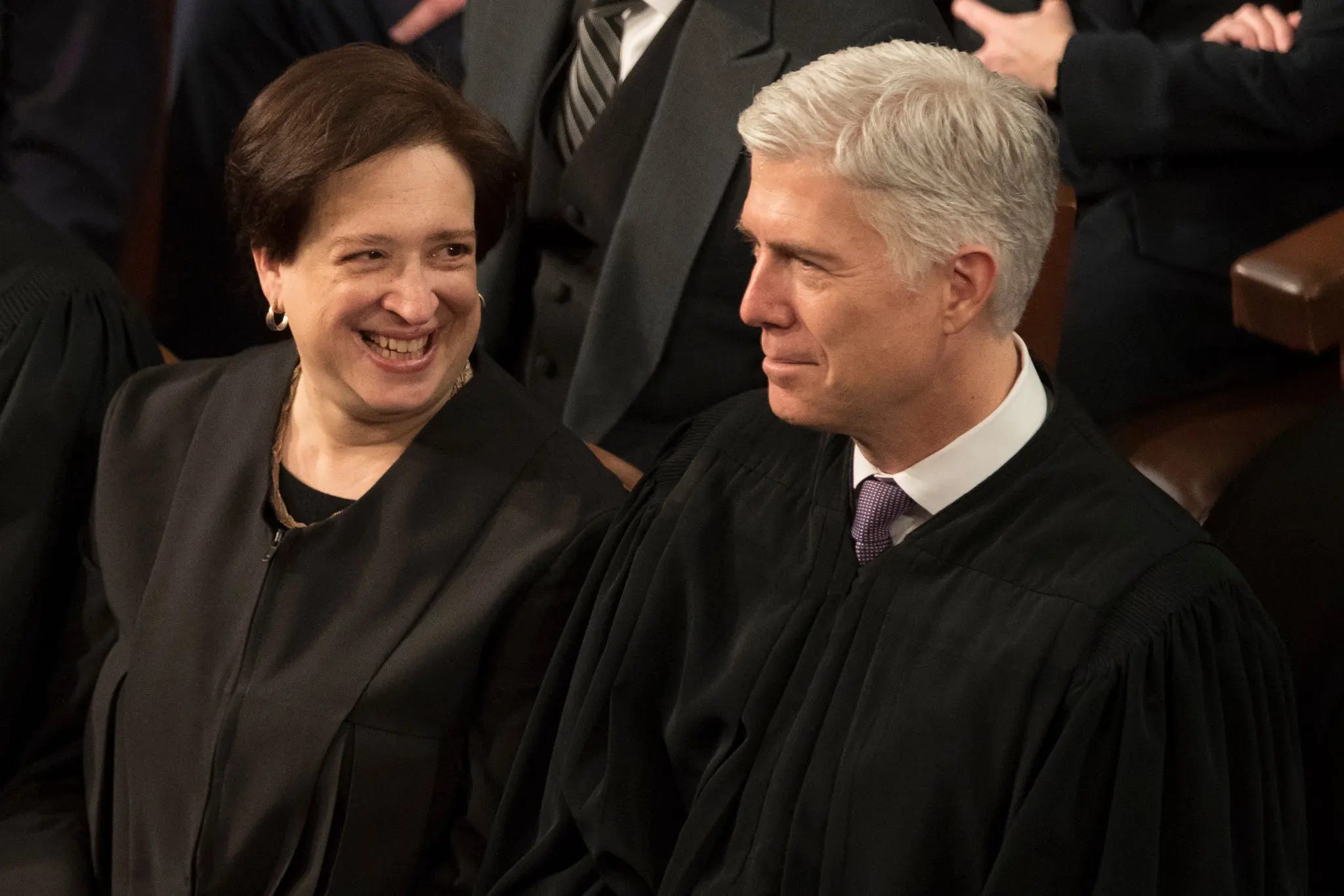
More on this below. But first, the (other) news.
On the Docket
Besides Friday’s ruling in the tariffs case, the only action on the merits docket last week was a housekeeping order allowing the Solicitor General to participate as a friend of the Court in an upcoming oral argument. There were no full Court rulings on emergency applications. And the only other public action by the full Court was the adoption of two sets of changes to its own rules. The first, which got a fair amount of media coverage, requires litigants, as part of their Corporate Disclosure Statement and other procedural filings, to identify any publicly traded corporation with an interest as a party (or an interest in one of the parties) not just by name, but by its stock ticker symbol(s)—almost certainly to make it easier for the Court’s software to catch conflicts for the Chief Justice and Justice Alito, i.e., the only two justices who (for some reason) still own individual stocks.
The second, which got no media coverage, clarifies that, even when a party electronically files a cert. petition through the Court’s e-filing system on or before the day that it is due, it must still complete physical service of the petition within three days. (The sequencing of electronic filing and physical service had been unclear under the previous iteration of the rule; my own risk-averse approach had been to ensure that they happened on the same day.)
Turning to this week, it’s shaping up to be a busy one. We expect a lengthy regular Order List at 9:30 ET this morning (lengthy because there hasn’t been one since January 26), followed by the beginning of the “February” argument session at 10:00. We also expect the Court to hand down one or more opinions in argued cases both tomorrow at 10 ET and Wednesday at 10 ET. And the Court now has a decent backlog of potentially high-profile emergency applications to dispose of, including the two applications relating to Republican Congresswoman Nicole Malliotakis’s effort to reinstate her New York congressional district (after a state court had ordered it to be redrawn), which I wrote about last week, and which Rep. Malliotakis had asked the Court to rule on by … today.
The One First “Long Read”:
Gorsuch vs. Kagan in Learning Resources
A common (and maddeningly superficial) critique of the Democratic-appointed justices is that they vote in lockstep in every major case, and always for the “Democratic” position and against the “Republican” position. It’s hard to tell whether this claim reflects selective amnesia on the part of those making it or just a lack of any effort to even try to identify counterexamples.
But for anyone who actually cares about facts (and/or who wanted to look), contrary evidence abounds—whether it’s Justice Breyer providing the decisive fifth votes for the majority in both Hamdi and Armstrong; Justices Breyer and Kagan voting to strike down the Medicaid expansion in the first Affordable Care Act case and also joining the majority over “liberal” dissents in Masterpiece Cakeshop, Our Lady of Guadalupe, Trinity Lutheran, Little Sisters of the Poor, and any number of other religion cases; Justice Jackson voting to throw out the January 6 conviction in Fischer; Justices Ginsburg and Breyer concurring in the judgment in Thuraissigiam (personal ugh!); Justice Kagan joining the majority last term in Diamond Alternative Energy; Justice Kagan concurring in the judgment in Collins v. Yellen; Justice Kagan writing the majority opinion in Lucia v. SEC; and, well, I suspect you get the point.
What’s more, that’s just on the merits docket. There were so many examples last year of rulings on emergency applications from which only Justices Sotomayor and Jackson, or Jackson alone, publicly dissented, that the New York Times wrote a whole story just last fall on (alleged) behind-the-scenes tensions among the Democratic appointees.
Alas, the effort to accuse the Democratic appointees of inconsistency hasn’t been limited to the right-wing commentariat; Justice Gorsuch took a similar (if slightly more specific) set of shots in his lengthy concurrence in the tariffs case—an opinion remarkable, among other things, in its not-so-subtle effort to persuade readers that Gorsuch is the only justice with real legal principles (never mind numerous examples to the contrary), and that the MQD is (in his view) one of them.2
The heart of Gorsuch’s critique of the Democratic appointees comes in Part I of his concurrence. After falsely claiming that the Democratic appointees “do not object to [the MQD’s] application in this case” (which, in point of fact, they do), Gorsuch turns to his charge that “their approach today is difficult to square with how they have interpreted other statutes.” He offers four examples—two of which are, amusingly enough, from rulings on emergency applications (it’s all precedent now, apparently); the third is the student loans case; and the fourth is West Virginia v. EPA. Here were the statutory delegations at issue in those cases:
Whether OSHA had the authority to require large employers to mandate COVID vaccinations or regular testing for their employees from a statute that empowered it to issue “mandatory occupational safety and health standards applicable to businesses affecting interstate commerce,” and that required OSHA to issue “an emergency temporary standard to take immediate effect upon publication in the Federal Register if [the agency] determines (A) that employees are exposed to grave danger from exposure to substances or agents determined to be toxic or physically harmful or from new hazards, and (B) that such emergency standard is necessary to protect employees from such danger.” The majority held (in an unsigned, nine-page opinion) that this authority did not extend to harms that didn’t originate in the workplace (like a highly communicable virus), but as the joint dissent explains, you have to go well past the text to find support for any argument that the statute is limited to workplace-originating harms.
Whether the CDC had the power to impose a temporary moratorium on evictions in the middle of the COVID pandemic based upon a statute that authorized the agency “to make and enforce such regulations as in [its] judgment are necessary to prevent the introduction, transmission, or spread of communicable diseases [interstate],” and that specified that “the Surgeon General may provide for such inspection, fumigation, disinfection, sanitation, pest extermination, destruction of animals or articles found to be so infected or contaminated as to be sources of dangerous infection to human beings, and other measures, as in his judgment may be necessary.” The majority held (in an unsigned, seven-page opinion) that the CDC was limited by the text of the statute to measures that “directly relate to preventing the interstate spread of disease by identifying, isolating, and destroying the disease itself.” Again, as the dissenters pointed out, that’s not in the text. And as in the OSHA case, Congress didn’t just use broad and ambiguous language; it specifically gave the agency the power to act based upon what the agency deemed was “necessary” to respond to a crisis. These are delegations not just of power, but of judgment.
Whether the Secretary of Education had the power to forgive student loan debts based upon a statute that authorized him to “waive or modify any statutory or regulatory provision applicable to the student financial assistance programs . . . as the Secretary deems necessary in connection with a war or other military operation or national emergency.” Note, again, the delegation of power to the executive branch to decide if particular measures are “necessary.” The majority in Biden v. Nebraska thought that the student loan program couldn’t be pegged to the Secretary’s power to “waive or modify” things like repayment requirements. But as Justice Kagan’s dissent points out, the whole purpose of the statute was to leave it to the Secretary’s judgment to decide if such drastic actions were necessary in response to a major emergency. One can think Congress shouldn’t be delegating such power to the executive branch and still conclude that it did.
Whether the EPA could impose limits on greenhouse gas emissions from fossil-fuel-fired power plants under a statute that required it to adopt the “best system of emission reduction . . . that has been adequately demonstrated” (to the agency) for the kind of existing source at issue. The majority held that this power did not extend to “generation shifting” (that is, to effectively requiring—through emissions limits—energy production to shift from “dirtier” to “cleaner” power plants). Again, as Justice Kagan’s dissent pointed out, one has to find that constraint somewhere other than the text—which, as in the OSHA, CDC, and student loan cases, deliberately vested the executive branch not just with broad authority, but with broad discretion over the means by which the specified ends could be achieved.
Against that backdrop, IEEPA is different. It may be a “broad” statute, but it is most definitely not one that leaves to the executive branch the ability to fill in all of the different ways in which its broad ends can be achieved by delegating the authority to decide what is “necessary,” or what is “in [the agency’s] judgment.” As Justice Kagan’s tariffs concurrence points out, the relevant authorizations in IEEPA contain nine verbs and 11 objects—producing 99 specific permutations of actions that the statute sanctions, the other 98 of which don’t come anywhere close to tariff-imposition authority. (It’s to Justice Kagan’s credit that there’s no reference to “99 Problems”—“but tariffs ain’t one”—in her opinion.)
As I suggested above, then, the charge of inconsistency leveled by Justice Gorsuch runs into two different, if overlapping, roadblocks. First, and consistent with the rest of Gorsuch’s 46-page opus, it rests on a refusal to acknowledge the consequences of not following the major questions doctrine—the biggest of which is that not all ambiguities in statutory delegations are created equal. As Justice Kagan put it in her dissent in West Virginia v. EPA (still my favorite argument against the major questions doctrine), “[t]he current Court is textualist only when being so suits it. When that method would frustrate broader goals, special canons like the ‘major questions doctrine’ magically appear as get-out-of-text-free cards.” Real textualism, on the other hand, is hard—and requires analysis that goes past “which President won.” Yes, the dissenters in the OSHA, CDC, student loan, and EPA cases may have also described the statutory delegations in general terms as “broad,” but there was a lot more substance to their analysis of the breadth of those delegations than just ipse dixit.
Second, and turning to the nuances that ought to govern statutory interpretation, despite writing 46 pages, Justice Gorsuch has remarkably little to say about Justice Kagan’s actual explanation for how “ordinary” principles of statutory interpretation lead to the same result here—but different results in previous cases in which the majority relied upon, or purported to rely upon, the MQD. Indeed, his concurrence spends more time quoting from the dissents in those cases than from the statutes that were at issue. And he never explains, or attempts to explain, why Congress’s choice to delegate the decision of whether particular actions were “necessary” and/or “in [the agency’s] judgment” in those statutes cannot be distinguished from the more specific delegations in IEEPA. He may think they’re indistinguishable, but before accusing his colleagues of inconsistency, he ought to enlighten them (and us) as to why.
In a way, these omissions all make sense; when you’re wielding the MQD as a hammer, any ambiguity is a nail. But I suspect that Justice Gorsuch’s real objection with all of these statutes isn’t their ambiguity; it’s with the delegations themselves. Having apparently lost the war over revitalizing the non-delegation doctrine (which would’ve limited Congress’s power to delegate these kinds of authorities regardless of how specifically it did so), Gorsuch has turned to belatedly trying to reclaim territory through the back door of the MQD. That’s his prerogative, of course. But it’s not a sign of inconsistency or hypocrisy for others to refuse to play along.
To be sure (and, it should be said, unlike the three dissenters from Friday’s decision), Justice Gorsuch is at least committed to the bit. For instance, he devotes pages of his concurrence to criticizing Justice Barrett’s attempt to reconcile the MQD with “common sense”—by pointing to cases in which the MQD produced results that were … not fairly described as “common-sense” readings of the relevant statutory text. For Gorsuch, those examples are offered as proof that Barrett’s attempt to reconceptualize the doctrine can’t be retrofitted onto those cases. For anyone else, they ought to be proof that the major questions doctrine, at least as Gorsuch understands it, regularly leads courts away from the most natural (and, one would think, correct) readings of statutes. But here we are.
Ultimately, I think Justice Kagan had the right response to this entire (distracting) endeavor, which was to respond to Justice Gorsuch briefly, snarkily, and in a footnote, to boot:
Given how strong his apparent desire for converts, I almost regret to inform him that I am not one. But that is the fact of the matter. I proceed in this case just as I did in West Virginia and Nebraska: I consider a delegation provision’s language, broaden the scope to take in the statutory setting, and apply some common sense about how Congress normally delegates. Contrary to Justice Gorsuch’s suggestion, that conventional method of interpretation will not always favor (or always disfavor) executive officials, given the variety of delegation schemes Congress adopts. I’ll let Justice Gorsuch relitigate on his own our old debates about other statutes, unrelated to the one before us. What matters here is only that IEEPA’s delegation refutes the Executive’s assertion of authority to levy tariffs, without any help from the major-questions doctrine.
I hope you’ll forgive me for taking a few more (and less well-written) words to get to the same conclusion.
SCOTUS Trivia: The Longest Concurrences
It’s not every day that a justice publishes a 46-page concurrence—especially when (1) it’s a solo opinion; and (2) the majority opinion is less than half as long. That led me to wonder about the last time we saw a longer concurrence.
Well, as luck would have it, my old long-time friend and University of Tennessee law professor Benjamin Barton has a brand-new article in the University of North Carolina Law Review titled “The 107 Longest Supreme Court Cases,” which offers empirical answers to that question—and a bunch of others. The article is so new, alas, that it’s not yet available publicly. But it should be available very soon via the law review’s website, and if you have access to a commercial database, it’s already published at 104 N.C. L. Rev. 433 (2026).
It turns out that Gorsuch’s Learning Resources concurrence should crack the list of longest concurring opinions in the Court’s history somewhere around 15th.3 Among current justices, only Justices Thomas and Alito (with one each) have ever written longer ones—Thomas’s concurrence in the judgment in McDonald v. City of Chicago and Alito’s 77(!)-page 2021 concurrence in the judgment in Fulton v. City of Philadelphia, which comes in at #4 all time (and, to answer my question, was the most recent concurrence that was longer than Gorsuch’s). The longest concurrence ever was Justice Frankfurter’s 102-page concurrence in McGowan v. Maryland (an opinion with 143 footnotes), where he wrote in support of a Maryland statute involving state-mandated Sunday closures of businesses on “the Lord's Day.” (Sigh.)
Of course, these are all put to shame by the longest dissents in the Court’s history. But I’ll save those for some future trivia—other than to say that Alito and Thomas both show up in the top five there, as well.
I hope that you’ve enjoyed this installment of “One First.” If you have feedback about today’s issue, or thoughts about future topics, please feel free to e-mail me. And if you liked it, please help spread the word!
If you’re not already a paid subscriber and are interested in receiving regular bonus content (or, at the very least, in supporting the work that goes into this newsletter), please consider becoming one:
This week’s bonus issue for paid subscribers will drop on Thursday. And we’ll be back with our regular content for everyone no later than next Monday (but it’s 2026, so you never know). As ever, please stay safe out there.
I’m not inclined to link to some of the more unhinged versions of this claim that I’ve encountered since Friday. But here’s a piece by Washington Post columnist Jason Willick that, if nothing else, provides a saner (albeit no-more-convincing) version of this argument.
For the two of you wondering why Justice Gorsuch’s concurrence appears before Justice Kagan’s in the Court’s ruling, even though Kagan has seniority, it’s because the Court always puts “concurring” opinions ahead of opinions “concurring in part” and/or “concurring in the judgment” (Kagan’s was both), regardless of who wrote them.
Because the initial “slip opinions” the Court puts out are formatted slightly differently from the final paginated versions of the U.S. Reports, it’s possible Gorsuch’s concurrence will take up marginally fewer pages when it’s officially published.
Gorsuch seems like such a pompous ass. I’ll never get over the Dems allowing McConnell to effectively steal that seat from President Obama 😑
On May 28, 2025 the U.S. Court of International Trade (CIT) granted summary judgment unanimously and concluded,
"The court holds for the foregoing reasons that IEEPA does not authorize any of the
Worldwide, Retaliatory, or Trafficking Tariff Orders. The Worldwide and Retaliatory Tariff
Orders exceed any authority granted to the President by IEEPA to regulate importation by means
of tariffs. The Trafficking Tariffs fail because they do not deal with the threats set forth in those
orders. This conclusion entitles Plaintiffs to judgment as a matter of law; as the court further finds
no genuine dispute as to any material fact, summary judgment will enter against the United States."
Higher courts generally accept the lower court's findings of fact unless they have a strong possibility of overruling the case. Furthermore, the CIT is the expert among the federal courts in matters of trade, so the higher courts should not have issued stays or agreed to hear this particular case. Even worse, higher courts are supposed to weigh the potential harms of a stay versus allowing the ruling to stand. In this case, allowing clearly illegal tariffs to continue has brought us to a place where up to $175 billion has been collected, and now the federal courts will be burdened by having to figure out how to rectify that situation with possible refunds to importers and customers who were affected by the tariffs. There is also the harm in allowing a clearly illegal usurpation by Trump of the power to levy tariffs granted in the Constitution to Congress. If one accepts the dissenters argument that the IEEPA gave the President the power to regulate international trade, wouldn't that be an unconstitutional delegation of Congress's enumerated powers to lay duties and regulate commerce?
I wish Professor Vladeck or someone would try to flush out the possible legitimate rationale why both the U.S. Court of Appeals and the Supreme Court didn't decline the appeals? And in that same vein, why the Supreme Court didn't deny the appeal of the birthright citizenship case?