

Welcome back to “One First,” a newsletter that aims to make the U.S. Supreme Court more accessible to lawyers and non-lawyers alike. I’m grateful to all of you for your continued support, and I hope that you’ll consider sharing some of what we’re doing with your networks.
Every Monday morning, I’ll be offering an update on goings-on at the Court (“On the Docket”); a longer introduction to some feature of the Court’s history, current issues, or key players (“The One First ‘Long Read’”); and some Court-related trivia. If you’re not already a subscriber, I hope you’ll consider becoming one—and upgrading to a paid subscription if your circumstances permit:
There is, as ever, too much court- (and Court-)adjacent news to cover, including this morning’s New York Times double-feature on the Chief Justice’s move to have Court employees sign non-disclosure agreements and on the Times’s own expanding coverage of the Court. But I wanted to use today’s “Long Read” to come back to a post I wrote last July—shortly after the Department of Justice submitted (and then Attorney General Bondi tweeted about) an unprecedented judicial misconduct complaint against the chief judge of the D.C. federal district court, James E. Boasberg. As I wrote at the time, DOJ’s complaint was “almost laughably preposterous.” The gravamen of its charge was that Boasberg had violated the Code of Conduct for United States Judges by relaying (at a private breakfast with the Chief Justice and a group of other district judges before a meeting of the Judicial Conference of the United States) that several of his colleagues were worried about the Trump administration potentially defying their rulings.
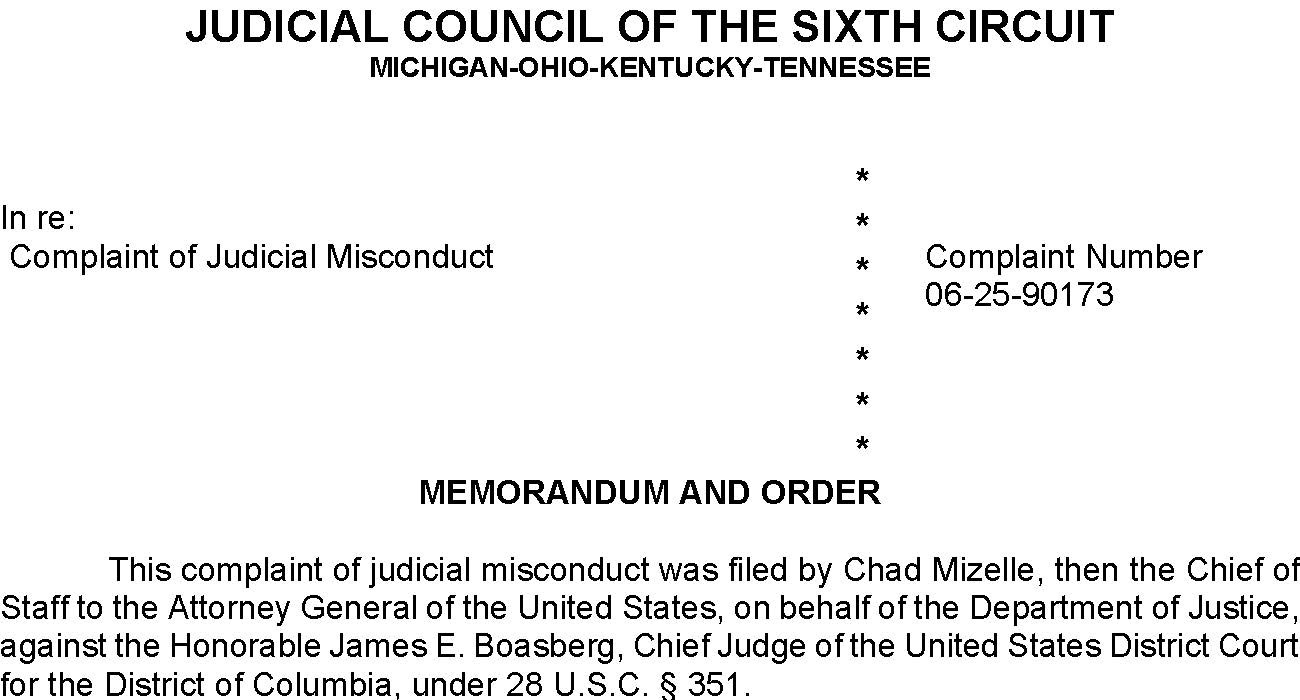
That complaint is back in the news because late last week, we finally learned about its outcome. After a bit of procedural shuffling that I’ll explain below, it was dismissed, quite cursorily, by Sixth Circuit Chief Judge Jeffrey Sutton in a … brusque … seven-page memorandum and order. Not only did Sutton pour cold water on DOJ’s theor(ies) of Boasberg’s misconduct, but he also expressed understandable frustration with the fact that DOJ never produced the document that it claimed memorialized Boasberg’s alleged misconduct—even after it was specifically told that it needed to do so to substantiate its claims.
In other words, after filing an unprecedented complaint against a sitting federal judge, making a big public stink about it (which, by the way, was itself a violation of the law), and having its complaint invoked as one of the grounds for the proposed impeachment charges against Chief Judge Boasberg, DOJ … never followed through. It turns out, it was never about adjudicating Boasberg’s behavior; it was about making splashy headlines and fueling right-wing attacks on the judiciary without regard to whether DOJ’s specious charges would withstand meaningful scrutiny.
The obvious takeaway is that the Department of Justice has once again beclowned itself. I’d say it has shredded even more of its credibility, but when you’re publicly soliciting for new lawyers to apply via Twitter (with the primary qualification being that they “support President Trump”), there may not be any credibility left to shred. Instead, the more significant takeaway is that this really ought to be the final nail in the coffin of congressional Republicans’ breathless efforts to gin up impeachment charges against a judge whose only actual sin, as it turns out, was to decline to roll over when the government defied one of his orders, and then lied about it.
But first, the (other) news.
On the Docket
The Merits Docket
The Court handed down its fourth “summary” reversal of the term last Monday—reversing, without merits briefing or argument, a Fourth Circuit ruling that had ordered a new trial for a Maryland state prisoner in a federal post-conviction habeas case. (I put “summary” in quotation marks because, even though that’s the general term used to describe these certiorari-stage dispositions, this one produced a 12-page majority opinion.) I had speculated, earlier this term, that after a quiet period for these kinds of summary dispositions (there were none during the entire October 2023 Term), we may be seeing a meaningful uptick. That speculation certainly seems to be holding.
Monday’s Order List also included a single grant of certiorari—on “[w]hether the phrase ‘goods or services from a video tape service provider,’ as used in the Video Privacy Protection Act’s definition of “consumer,” refers to all of a video tape service provider’s goods or services or only to its audiovisual goods or services.” The real significance of this grant (in Salazar v. Paramount Global) was the absence of any expedited briefing schedule—which likely means that (1) Salazar is the first grant for next term (OT2026); and (2) barring any late-breaking additions, the Court is done filling out the merits docket for its current term.
The only other merits docket-related news last week was the Court’s public release of the oral argument calendar for the “March” argument session—the highlight of which is, without question, the birthright citizenship argument, which the Court scheduled for Wednesday, April 1. The date is certainly a coincidence, but I still chuckled.
The Emergency Docket
There was exactly one full Court ruling on an emergency application last week—a denial, over no public dissents, of Texas death-row prisoner Charles Thompson’s application to stay his execution. Thompson was executed on Wednesday evening.
The Week Ahead
The Court has absolutely nothing scheduled for this week. No regular Order List is expected today, and the justices are not set to take the bench or even meet in person (until Friday, February 20). That said, we may well get a ruling on the (rather cynical) emergency application seeking to block California’s congressional redistricting—in which the briefing wrapped up late last week.1 Besides that and possible rulings on other, less significant emergency applications, it should be a quiet week at One First Street.
Miscellaneous
Finally, on a more frivolous subject, I thought I’d flag a fun upcoming event: On Tuesday, February 17, at 7:30 p.m. (ET), D.C.’s Shakespeare Theatre Company is hosting its 37th Annual “Mock Trial” (narrator: it’s really a moot court), in which real advocates argue both sides of a Shakespeare-derived legal dispute to a panel of real judges. I’m one of the advocates this year (I’m representing Emilia’s estate in a dispute derived from Othello), and I’ll be arguing against Karen Dunn from Dunn Isaacson Rhee LLP (who represents Desdemona’s estate). Lots of details, including the factual/legal prompt and access to tickets—whether in-person or streaming, can be found here. And if you want to see the briefs (filed last Friday), here’s mine, and here’s Karen’s.
The One First “Long Read”:
The Denouement of the Boasberg Misconduct Mess
My post from last July walked through the background and details of the Justice Department’s judicial misconduct complaint against Chief Judge Boasberg (and why it suffered from four independently fatal defects). I’d encourage folks to refer back to that post if you could use more context.
In a nutshell, DOJ’s chief accusation was that Boasberg had violated the Code of Conduct for United States Judges by publicly suggesting that he had “pre-judged” the merits of specific cases involving the Trump administration (even though, in fact, Boasberg had only privately relayed concerns that his colleagues had raised about how the Trump administration might behave in unnamed future cases). Indeed, at the time Boasberg made the relevant comments, the lawsuit in which his interactions with the Trump administration have been most visible—the J.G.G. Alien Enemies Act case—hadn’t even been filed yet. Nonetheless, DOJ decided to make hay out of Boasberg’s alleged misbehavior, and six Republican senators have since piled on by urging D.C. Circuit Chief Judge Sri Srinivasan (who, by law, was the recipient of DOJ’s misconduct complaint) to suspend Boasberg while the complaint (and a potential impeachment investigation) was pending.2
The process created by the Judicial Conduct and Disability Act of 1980 is supposed to be almost entirely confidential (which is why Attorney General Bondi’s tweet announcing the complaint was itself likely a violation of the act). But we often learn about the dispositions, at least, once the complaint has been fully resolved. That’s why we learned last week about the result of DOJ’s complaint; not only had Chief Judge Sutton dismissed it, but the 30-day period within which DOJ could have sought further review of Sutton’s decision (by filing a “petition for review” with the full Sixth Circuit Judicial Council) had expired.3
As for how DOJ’s complaint made its way to Sutton, Sutton’s memorandum explains the procedural history:
On November 26, in view of several appellate challenges to the judge’s rulings in the underlying case [J.G.G.] and of concerns that the judges on the D.C. Circuit might have to recuse themselves from any proceedings before the Judicial Council, Chief Judge Srinivasan asked Chief Justice Roberts to transfer the judicial misconduct proceeding to another circuit. On December 5, the Chief Justice transferred the matter to the Judicial Council of the United States Court of Appeals for the Sixth Circuit for resolution.
Sutton, who I have to think the Chief Justice did not pick at random (Roberts could have referred the complaint to any of the chief judges of the other circuits), made quick work of DOJ’s complaint—dismissing it just two weeks after he received it. His seven-page ruling is worth reading—not just for its thoroughness, but because, if you’re not used to reading these kinds of rulings, it is all-but-dripping with contempt for the Department of Justice’s behavior.
In short, Sutton found four different problems with DOJ’s complaint:
First, he found that DOJ lacked “sufficent evidence” to support its allegations—because it never actually produced the document (“Attachment A”) that its complaint claimed memorialized Boasberg’s (allegedly inappropriate) statements. DOJ’s failure to produce Attachment A is, frankly, mind-boggling—all the more so because, as Sutton explains, “The D.C. Circuit contacted the Department about the missing attachment and explained that, if it failed to submit the attachment, the circuit would consider the complaint as submitted. The Department did not supply the attachment.” In other words, the putative evidence that DOJ made a big deal out of in its complaint, and which was referred to in a … one-sided … piece in The Federalist (which was somehow made aware of this episode before DOJ even filed), was never actually provided to substantiate DOJ’s charges. It’s hard to imagine why DOJ wouldn’t provide the attachment, although, in the footnote at the end of this sentence, I offer two possibilities.4
Second, in the name of due diligence, Sutton explained why, even if “Attachment A” said what DOJ says it does, it still wouldn’t provide grounds to substantiate a misconduct complaint. In his words,
A key point of the Judicial Conference and the related meetings is to facilitate candid conversations about judicial administration among leaders of the federal judiciary about matters of common concern. In these settings, a judge’s expression of anxiety about executive-branch compliance with judicial orders, whether rightly feared or not, is not so far afield from customary topics at these meetings—judicial independence, judicial security, and inter-branch relations—as to violate the Codes of Judicial Conduct.
Third, Sutton pooh-poohed DOJ’s suggestion that Boasberg had publicly commented on a pending case—making the (rather obvious) points that (1) the comments were private; and (2) the only “pending” case to which DOJ referred … wasn’t pending at the time of Boasberg’s comments. (That DOJ ever suggested otherwise is a really damning indictment of what it will argue in formal filings.)
Finally, to DOJ’s charge that Boasberg’s subsequent handling of the J.G.G. case is itself a basis for at least a full investigation, Sutton, again, was unpersuaded, noting how DOJ’s complaint
does not explain how a Supreme Court ruling about a prior action by the judge necessarily shows “willful indifference” when the judge addresses a distinct set of circumstances in a later ruling. Because these allegations in the end merely challenge the merits of the judge’s actions, they are not the proper subject of a misconduct complaint and do not warrant the Department’s request for a referral of the complaint to a special investigative committee.
And just for good measure, Sutton concluded by explaining another point that DOJ should already have known—that a judicial misconduct complaint, even if successful, would not empower the Judicial Council to reassign pending cases to other judges.
***
Chief Judge Sutton’s ruling is not just a tour de force in how a judicial ruling can persuasively give the back of its hand to a claim; it is, or at least ought to be, a humiliating smackdown for the Department of Justice—which bungled every single aspect of its misconduct complaint, from publicly announcing it to making spurious arguments about what the alleged misconduct actually was (the distinction between “public” and “private” really shouldn’t be hard, nor should the fact that March 11 is prior to March 15) to refusing to provide the very evidence on which the complaint purported to rest.
There’s just no serious argument, at this point, that any court should take DOJ’s representations in cases with even a whiff of political involvement at face value—or give it any benefit of the doubt when it comes to its litigation behavior. District courts across the country have clearly learned that lesson (see, for instance, Chief Judge Schiltz’s rather shocking discussion of government misbehavior in an immigration detention case last week), but it’s long-past time for all of their colleagues on the courts of appeals, and, yes, on the Supreme Court, to follow suit.
In the interim, Sutton’s ruling should also be the end of the line for those (looking at you, congressional Republicans) who are continuing to push baseless claims against Boasberg (and Maryland district judge Deborah Boardman), with an eye toward what would be an unprecedented, dangerous, and ultimately unsuccessful (given the composition of the Senate) effort to remove them from office. The outcome here should be seen for what it is: how a sober-minded jurist actually views these charges, versus how they’re manipulated and broadcast by the Department of Justice and right-wing mouthpieces to serve partisan political ends.
Between Chief Judge Sutton’s ruling and the AO letters I wrote about last month, the courts have done a laudable job of carefully but conclusively deflating this nonsense. Anyone who continues to claim at this point that Chief Judge Boasberg has done anything worthy of further investigation and/or impeachment is telling on themselves.
SCOTUS Trivia: February 2, 1790
236 years ago today, on Tuesday, February 2, 1790, the Supreme Court officially convened for the first time in its history, on the second floor of the Royal Exchange in New York City—then the seat of the federal government.
Section 1 of the Judiciary Act of 1789 had set “the First Monday of February” as the date for the beginning of one of the Court’s two annual “Terms.” But only three of the Court’s six justices had made it to New York in time for the Court to convene on Monday, February 1, so the Court had no quorum with which to conduct any business (the Judiciary Act required four justices for a quorum). The arrival of Justice John Blair from Virginia later on Monday provided the Court with its needed fourth participant—and so it gaveled itself into existence the following morning.
As I wrote in The Shadow Docket, although the February 2 session brought with it a bit of fanfare, “there were no cases on the docket for the justices to hear. After appointing the Court’s officers, admitting twenty-six lawyers to its bar, and dispensing with a few other housekeeping matters, the Court adjourned its first ‘term’ eight days later, not to meet again until August, when it conducted a grand total of two days of business. It was an inauspicious debut for the fledgling Court.”
Perhaps there’s a reason why the Court doesn’t mark February 2 as a meaningful anniversary in its history…
I hope that you’ve enjoyed this installment of “One First.” If you have feedback about today’s issue, or thoughts about future topics, please feel free to e-mail me. And if you liked it, please help spread the word!
If you’re not already a paid subscriber and are interested in receiving regular bonus content (or, at the very least, in supporting the work that goes into this newsletter), please consider becoming one:
This week’s bonus issue for paid subscribers will drop on Thursday. And we’ll be back with our regular content for everyone no later than next Monday (and, if I were a betting man, sooner). As ever, please stay safe out there.
As I suggested last week, the cynicsm here is asking the Court to do literally the opposite of what it did with respect to the Texas redistricting case in December—this time, to block a new map (that favors Democrats) after it unblocked a map that favored Republicans.
The letter—like the January 7 Senate Judiciary subcommittee hearing I wrote about last month—also makes claims based upon misconduct in Chief Judge Boasberg’s handling of subpoenas and non-disclosure orders in the Arctic Frost investigation. As I suggested in my testimony at that hearing, these charges have been categorically deflated by the Administrative Office of the U.S. Courts’ explanation that they’re based upon a fundamental misunderstanding of how those kinds of applications are (and, at the time, were) processed by district courts.
Chief Judge Sutton also dismissed two other complaints against Chief Judge Boasberg on December 19. Here’s the second dismissal order. The third complaint is from a group calling itself Citizens to Advance Security in America. They’ve been good enough to post their complaint (which is more about Arctic Frost than the Judicial Conference comments); Sutton’s dismissal thereof; and their petition for review by the full Sixth Circuit Judicial Council.
Although some have speculated that “Attachment A” doesn’t exist, the Department of Justice has confirmed, in separate litigation seeking Attachment A under the Freedom of Information Act, that it does exist. (Paragraphs 19 and 21 of DOJ’s declaration in the FOIA case are … quite something, as is its motion to dismiss, which, among other things, states that “The Department and the Judiciary are unaware of how Attachment A was transmitted to the Department.”) Among other things, this certainly seems to suggest that DOJ didn’t get it from The Federalist (although the reverse may well be true). Indeed, I’ve always suspected that Attachment A was a contemporaneous memorialization of the entire Judicial Conference by one of its attendees (my best guess, another district judge who was at the same breakfast with Chief Justice Roberts)—prepared solely to inform their district court colleagues of the goings-on—that one of the recipients, for whatever reason, chose to leak to DOJ.
And given that the judicial misconduct process is designed to keep these kinds of documents confidential, there was no risk of disclosure (outing either the judge who wrote it or the judge who leaked it) if DOJ did provide it to the D.C. Circuit or to Chief Judge Sutton. Thus, the only two remaining explanations that I can come up with for why DOJ didn’t provide Attachment A even after it was specifically asked to do so are that (1) Attachment A doesn’t actually say what DOJ’s complaint claims it does; or (2) DOJ came into possession of Attachment A through means that it’s unwilling to have to identify—even confidentially as part of the judicial misconduct process. Both of those possibilities are, of course, disturbing in their own right.
Observers who are big on pointing out which president appointed which Art. III judge, presumably believing that a judge's politics invariably dictate the judge's decisions, might want to note that Judge Sutton is a Republican appointee.
Thank you for continuing to shine light on the...what other word can we use but tragic?...destruction from the top down of the once rightfully proud DOJ.