

A few weeks ago, I wrote a post about an emerging trope among the Court’s less nuanced defenders, which has (sadly) been picked up by Justice Barrett—that one of the reasons why it’s inaccurate to view the Court as being defined by its 6-3 ideological division is because the media tends to label rulings as “big” only after they’ve split the justices along those exact lines. This argument was silly then, and it got even sillier on Tuesday, when the justices handed down five rulings—four of which produced that exact divide, and none of which were treated by the media as “big” ones worthy of significant attention.
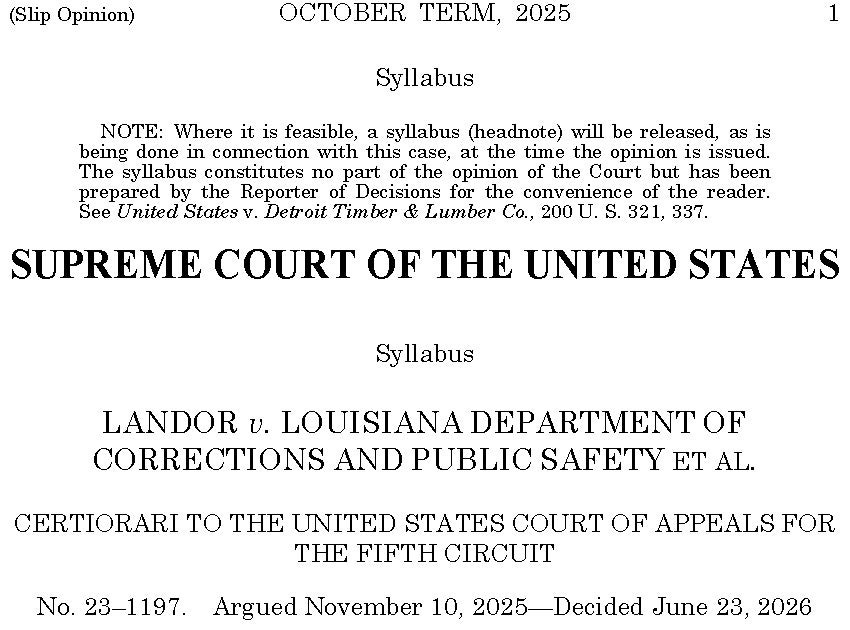
To be sure, I understand why decisions like Cisco Systems, Inc. v. Doe, Landor v. Louisiana Department of Corrections and Public Safety, and Blanche v. Lau don’t get the same coverage as the soon-to-drop (perhaps as early as this morning) rulings in Slaughter, the birthright citizenship case, and so on. But I want to use today’s bonus post to argue that Landor is actually a massively important holding with constitutional dimensions—one that reflects the culmination of a long-term conservative legal project to weaken one of Congress’s most important regulatory powers; one that comes at the direct expense of private individuals for whom Congress has expressly created an array of federal statutory rights; and one that, as Justice Jackson’s dissent details, is remarkably difficult to justify on almost any analytical terms. The idea that the Court is disempowering Congress is hardly a new one. But the shamelessness of Justice Gorsuch’s majority opinion in Landor is exasperating, to say the least.
The dispute in Landor began when a Louisiana state prisoner, Damon Landor, brought with him a copy of a Fifth Circuit decision holding that, under the Religious Land Use and Institutionalized Persons Act of 2000 (RLUIPA), Rastafarian inmates had a right to keep their dreadlocks. One prison guard took the ruling and threw it in the trash; two others seized Landor and shaved his head. One would think the Supreme Court would be a little more wary about letting state officials literally throw lower-court rulings in the trash (before metaphorically trashing them). One would be mistaken.
For those who aren’t paid subscribers, we’ll be back no later than Monday (and likely before) with our continuing, free coverage of the Court. For those who are, please read on.
