

Welcome back to the weekly bonus content for “One First.” sAlthough Monday’s regular newsletter and other unscheduled issues will remain free for as long as I’m able to do this, I put much of the weekly bonus issue behind a paywall as an added extra for those who are willing and able to support the work that goes into putting this newsletter together every week. I’m grateful to those of you who are already paid subscribers, and I hope that those of you who aren’t will consider a paid subscription if and when your circumstances permit:
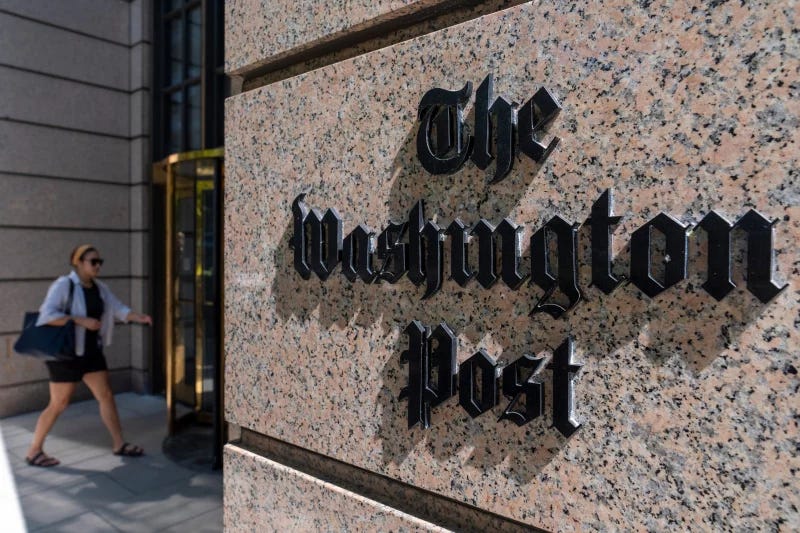
Even with three merits rulings from the Supreme Court on Wednesday (albeit not the tariffs decision—as I’d suggested on Monday), and even with President Trump’s threat on Thursday to invoke the Insurrection Act (my background post is here), I wanted to use today’s newsletter to focus on Wednesday’s eye-opening news that the FBI had executed a search warrant at the home of Hannah Natanson—a Washington Post reporter whose work has included pieces derived from anonymous sources inside the Trump administration. According to the Reporters Committee for Freedom of the Press, it’s the first time ever that the federal government has executed a search warrant at a reporter’s home for evidence in a leak investigation.
Attorney General Bondi tweeted that officials executed “a search warrant at the home of a Washington Post journalist who was obtaining and reporting classified and illegally leaked information from a Pentagon contractor.” But the warrant itself, as reported by the Post (and as summarized by Matt Murray, the Post’s executive editor, in a message to staff), sounds like it is wholly inconsistent with Bondi’s claim. (Sigh.) Rather, Natanson herself does not appear to be a target of the relevant investigation, which is focused on Aurelio Perez-Lugones—a system administrator in Maryland who has a top-secret security clearance and who has been charged with accessing and taking home classified intelligence reports. The theory behind the search seems to be that Natanson might have been in possession of at least some material relayed to her by Perez-Lugones—not that she was in any way conspiring with Perez-Lugones.
There’s a lot we still don’t know. But below the fold, I want to flag three different sets of concerns. The first is that the government may be using the (superficially legitimate) investigation of Perez-Lugones as a pretextual basis for trying to obtain the identities of Natanson’s sources inside the executive branch unrelated to Perez-Lugones’s alleged offenses. The second is that this is exactly why it has been so important, over the years, for the Department of Justice to have a policy limiting the circumstances in which prosecutors can seek to use compulsory legal process to obtain information from reporters—a policy Bondi rescinded in May 2025. (There’s also the Privacy Protection Act of 1980, about which more below.) And the third is to reflect a bit more broadly on why these kinds of searches—and, in extreme cases, prosecutions—of journalists raise such grave First Amendment questions.
In a thought-provoking 1974 speech, Justice Potter Stewart famously suggested that
The press is free to do battle against secrecy and deception in government. But the press cannot expect from the Constitution any guarantee that it will succeed. There is no constitutional right to have access to particular government information, or to require openness from the bureaucracy. The public’s interest in knowing about its government is protected by the guarantee of a Free Press, but the protection is indirect. The Constitution itself is neither a Freedom of Information Act nor an Official Secrets Act.
The problem with Wednesday’s events is the suggestion that we are sliding toward the latter.
For those who are not paid subscribers, we’ll be back (no later than) next Monday with more regular coverage of the Supreme Court. For those who are, please read on.
