

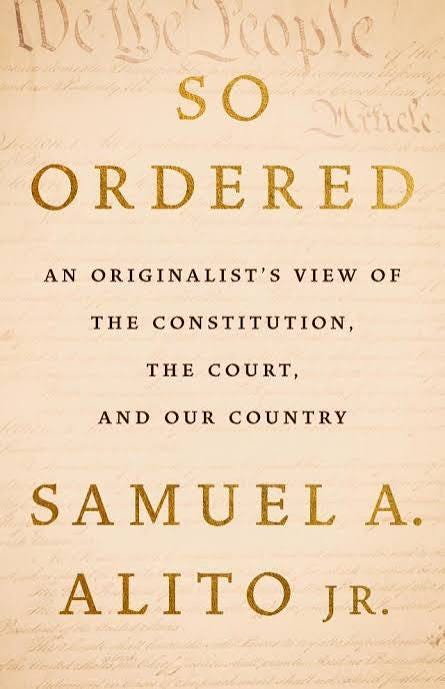
In the pre-publication galleys to his new book, So Ordered: An Originalist’s View of the Constitution, the Court, and Our Country, Justice Alito spelled my last name inconsistently.1 This is, I suspect, the pettiest possible point on which to open in discussing a Supreme Court justice’s new memoir, and I would never have mentioned it except for the fact that inconsistency turns out to be the organizing feature of the chapter in which I (“the most prolific academic critic of the emergency docket”) repeatedly appear.
The central inconsistency of Chapter 8, which is devoted to the emergency docket, is structural: Rather than tackle the subject holistically (as one might expect in a book), Alito mashed together the speech he gave five years ago at Notre Dame Law School with a “postscript.” The former was deeply flawed even at the time (among lots of other things, Alito repeatedly insisted that there was “nothing new” about the Court’s behavior on emergency applications during the first Trump administration and COVID); and the latter tries to move the goalposts away from the specific phenomena to which critics like me have actually objected.
The result is to leave readers with a disjointed, inaccurate, and misleading sense of what the debate is even about—to say nothing of how the Court’s own behavior since September 2021 (including Alito’s) has only further undermined the already-flawed claims Alito made back then. Somewhere between the galleys of Alito’s book and the final product (which hits bookstores today), someone apparently figured out that my last name should be spelled the same way (and correctly!) throughout. The other, more significant inconsistencies were, apparently, harder to fix.
Alito’s September 2021 Notre Dame Speech
It may help to start by doing something Justice Alito doesn’t—to put his September 2021 speech into the context in which Alito made it. September 2021 was the first time the term “shadow docket” had broken through into the mainstream media ecosystem. Specifically, public attention was turbocharged by the Court’s 5-4 order late in the evening on September 1 (almost certainly written by Alito) that had allowed Texas’s six-week abortion ban (“SB8”) to go into effect nine months before Dobbs. The dramatic uptick in rulings on emergency applications during the first Trump administration and then during COVID had certainly gotten some media coverage. But the first usage of the “shadow docket” term in a Supreme Court opinion had come in Justice Kagan’s SB8 dissent,2 where she argued (my emphasis added) that
Today’s ruling illustrates just how far the Court’s “shadow-docket” decisions may depart from the usual principles of appellate process. That ruling, as everyone must agree, is of great consequence. Yet the majority has acted without any guidance from the Court of Appeals—which is right now considering the same issues. It has reviewed only the most cursory party submissions, and then only hastily. And it barely bothers to explain its conclusion—that a challenge to an obviously unconstitutional abortion regulation backed by a wholly unprecedented enforcement scheme is unlikely to prevail. In all these ways, the majority’s decision is emblematic of too much of this Court’s shadow-docket decisionmaking—which every day becomes more unreasoned, inconsistent, and impossible to defend.
A couple of weeks later, the Senate Judiciary Committee picked up on these critiques, devoting a full Committee hearing (at which I was one of the majority witnesses) to “Texas’s Unconstitutional Abortion Ban and the Role of the Shadow Docket.” Alito, rather transparently, decided to use a (kinda-sorta-)public address at Notre Dame to push back.3
Alito’s speech, as reconstructed in the book, purported to defend the Court’s behavior by identifying what he described as the “ten criticisms” of the emergency docket, and then explaining why each criticism was unpersuasive. As I explained in detail at the time, the common theme of Alito’s arguments was that the Court was merely reacting to events beyond its control; that it wasn’t doing anything unusual (“nothing new”) in how it was reacting; and that its tendencies both to not explain its rulings and to hand them down at all hours of the night could be attributed to the fact that all of these cases unfolded against external deadlines (which wasn’t true even then in the vast majority of them; even in the SB8 case, where there was a deadline from when the law went into effect, the Court missed it by 23 hours). Meanwhile, Alito insisted, the Court was consistently following the standards governing emergency relief. Moreover, the fact that none of these rulings had any precedential value mitigated any concern over their broader, downstream effects.
Even in September 2021, Alito’s arguments were inconsistent with the facts—as I laid out during a presentation for the American Constitution Society chapter at Notre Dame one week after Alito’s speech, in a live-streamed video that’s still online. There were, already, countless examples during the first Trump administration and in COVID-related cases of the justices (Alito included) doing exactly what Alito disclaimed at Notre Dame; here’s the Court in February 2021 treating an order without a majority opinion as a precedent; here’s an April 2021 ruling granting an injunction (which requires a “clear and indisputable right to relief”) based upon a novel interpretation of the Free Exercise Clause. And there were lots of examples from the Trump I era of the Court already accepting that the “government” suffers irreparable harm anytime it is subject to an injunction.
By caricaturing what the criticisms actually were, and by asserting things that weren’t true, Alito was able to duck the single most important criticism then being made of the Court’s emergency docket behavior—that, in deciding so many high-profile cases on the emergency docket with such truncated process and so little explanation, the Court was also behaving inconsistently, so that it appeared that its rulings were motivated more by the political preferences of a majority of the justices than by the faithful application of neutral legal principles. Again, to quote Justice Kagan’s SB8 dissent, these rulings were increasingly becoming “more unreasoned, inconsistent, and impossible to defend.”
Consider, in this respect, the May 2022 Texas social media case, where Alito dissented from the Court’s refusal to disturb a lower-court injunction, warning that enjoining a state law was “a significant intrusion on state sovereignty” and that Texas “should not be required to seek preclearance from the federal courts before its laws go into effect.” It is a principled-sounding objection, except that Alito was (or, at least, appeared to be) in the majority in each of the COVID cases in which the Court blocked New York’s and California’s laws before, or just after, they took effect. If there is a neutral principle that distinguishes blue states’ laws from red states’ laws, he hasn’t articulated it (either then or since).
Alito’s “Postscript”
In the five years since Justice Alito’s Notre Dame speech, a couple of things have happened—especially on the emergency docket. The “postscript” to Chapter 8 at least concedes that, “[s]ince then, both the size and the importance of that docket have grown enormously.” And Alito identifies three causes for this shift—all of which are external to the Court: (1) presidents increasingly making policy without legislation; (2) “[e]qually bold” litigation countermeasures by opposing state AGs and interest groups, with deliberate forum selection; and (3) overreach by district judges.
I don’t actually disagree that all three of these developments have contributed to the phenomenon, even if Alito and I might disagree about which district judges have been engaged in overreaching. But Alito’s postscript never even considers the possibility that the Court bears any responsibility for the uptick—including by behaving in ways that have made it more attractive for certain litigants (especially the Trump administration) to keep coming back to the justices for emergency relief they wouldn’t previously have sought. On Alito’s telling, the only actual problem critics have identified that’s worth addressing is the increased volume—which is, in his view, everyone’s fault except the Court’s.
This deeply dubious framing allows Alito to make two moves. First, the postscript never returns to the criticisms he purported to address in the Notre Dame speech, and so he never even attempts to explain how the Court’s behavior over the last five years hasn’t completely undermined his defense of its behavior as of September 2021.
To take just one example, consider the question of whether orders respecting emergency relief have precedential force. Alito was adamant, in his Notre Dame speech, that rulings on emergency applications don’t have precedential value. That was, if anything, part of why he thought critics’ concerns were overstated. But now we have the July 2025 ruling in Trump v. Boyle, where the Court (in language Alito almost certainly joined), not only held that the result in a different case was “squarely controlled by” an earlier emergency docket ruling; it went on to stress that, “Although our interim orders are not conclusive as to the merits, they inform how a court should exercise its equitable discretion in like cases.” 2021 Alito asserted that this just wasn’t true; 2026 Alito doesn’t bother to reconcile the contradiction because he doesn’t even acknowledge that it exists.
Likewise, at Notre Dame, Alito had insisted that the Court was faithfully applying the existing standards for emergency relief, a central part of which is the balancing of the equities. Just over three months later, he joined a majority opinion asserting that, on an emergency application “[i]t is not our role to weigh such tradeoffs,” and he’s since been part of dozens of rulings in which the Court has skewed equities-balancing in ways that have asymmetrically benefitted the Trump administration (as compared to the Biden administration or private parties). Conservative law professors have kept asking whether the Court has sub silentio changed the standards for relief in these cases; Alito insisted in 2021 that it hadn’t, and has nothing to say about the topic today, even in the face of overwhelming evidence that the Court is not consistently applying the standards that it still insists are applicable.
My favorite charge of Alito’s, though, is that the Court’s emergency docket critics are just unhappy with the results—and so they’re dressing up substantive disagreements with outcomes in procedural terms. Leaving aside the not-so-subtle implication of bad faith on the part of the Court’s critics, Alito himself has also relied upon these same procedural objections when they have led to outcomes with which he is dissatisfied. In a June 2022 dissent, he complained that the majority “unnecessarily resolves difficult . . . questions on which . . . we have received only hurried briefing and no argument.” And as I noted at the time, his April 2023 dissent from the Court’s grant of stays in the mifepristone case is impressive in just how completely tone-deaf its hypocrisy is.
It’s also the case, as I’ve pointed out before, that not all of the shadow docket’s critics are disappointed progressives. Will Baude, who coined the term, is a conservative former clerk to Chief Justice Roberts; Donald Ayer was the number-two official at the Justice Department under George H.W. Bush; and the Chief Justice himself joined the Democratic appointees in dissent in a number of the higher-profile 2021 and 2022 emergency docket rulings (including the SB8 case). Ditto the 11 Republican-appointed judges surveyed by the New York Times last fall who “disagreed” that the Court had made appropriate use of the emergency docket during the second Trump administration.
And it wasn’t even two weeks ago that Eighth Circuit Judge David Stras urged the justices to provide more thoroughgoing explanations respecting their rulings on emergency applications in remarks at an event at William & Mary Law School. As ever, if the complaint were really just about outcomes, it would be very strange for the critics to spend so much energy begging the Court to write more—to give longer, more candid, more binding explanations for results they are said to oppose.
Second, by framing “what’s new” entirely as a function of volume, Alito can analyze reform proposals (including mine) solely through the lens of whether that proposal would help reduce the volume of emergency applications the Court receives. And so when, magically, proposals that aren’t actually about the volume problem won’t actually solve the volume problem, Alito throws up his hands. As the chapter closes, “No modest changes” could “stem the tsunami,” which he attributes to polarization, congressional deadlock, presidential frustration, a litigious culture, and “no small measure of hubris on the part of some district court judges.” (He’s going to love the Foreword.)
It’s hard to reply to such a non-responsive response. So let me close by making two points, neither of which should be new to regular readers of this newsletter. First, the emergency docket is a problem not because it exists, but because of how, too often, the Court behaves on it. The critique is, as succinctly as possible, that in too many high-profile cases, the justices are handing down significant rulings on scant briefing with little internal deliberation and little public explanation, in ways that at least appear to be inconsistent with the relevant standards of review, where the inconsistencies have a remarkable tendency of benefiting Republicans, and all while insisting that what little the Court says after such a truncated process should have precedential effects below.
And second, for a Court whose authority depends on diffuse public acceptance that its rulings are principled (if not of the principles themselves), the proliferation of thinly explained precedential rulings in high-profile cases has made it that much harder for that support to be earned. Yes, there are cases to which the critique does not easily apply. And yes, the Court is writing more—as evidenced by the recent run of grants of emergency relief that were accompanied by majority opinions. But numerators are meaningless without denominators. And especially since September 2021, the denominator of emergency docket rulings remains full of cases illustrating some or all of this charge, even as recently as last week. It’s the forest that matters far more than the trees.
So framed, there is virtually nothing in Chapter 8 of So Ordered that actually responds to the underlying critique at least largely because Alito never acknowledges anything other than the size of the forest—including his, and the Court’s, deeply inconsistent behavior therein. Like so much of the Court’s problematic behavior in recent years, Alito’s real defenses are, ultimately, unexplained.
“Vladeck” vs. “Vladek.” (The latter is the single most common misspelling of my last name.)
Technically, the term had also appeared in a 2019 dissent by Justice Sotomayor, but only in the title of an article she cited (my then-forthcoming Harvard Law Review essay, “The Solicitor General and the Shadow Docket”).
Alito’s talk was initially open only to those who could attend in person. After some public criticism (including from the Court’s press corps), the talk was live-streamed over the internet, but no official video- or audio-recording of the event (or transcript) has been publicly available since.
Alito's insistence that the Court is apolitical and not doing anything untoward reminds me of Senator Larry Craig's insistence that he wasn't soliciting sex from men in bathrooms.
Both men are just too upstanding for such accusations.
Highly recommend following the link to the Youtube video for an explanation of the way the Shadow Docket is now being used/abused. Thank you.