

This will be a very brief post, but I thought it might be useful to explain what the Eighth Circuit did this evening in the Missouri redistricting case; why it’s both indefensible and not likely to be long for this world; and, perhaps most significantly, how it’s yet another powerful illustration of the mischief the Supreme Court creates when it intervenes on the emergency docket (as it already has in the Missouri litigation) without telling anyone why.
As with my other stream-of-consciousness posts, my apologies for any errors resulting from the speed (or, frankly, anything else).
1. What Did the Eighth Circuit … Do?
I’m going to assume folks have some familiarity with the background to the Missouri redistricting mess. If you could use it, here’s my full explainer from before the Supreme Court ruled on Thursday, September 10; and here’s my breakdown from last Monday of what it all meant. There’s a lot more detail (and links to all of the relevant developments) in those posts.
To make a very long story short(er), the Missouri Supreme Court had held that Missouri cannot use “HB 1”—a congressional map adopted by the state legislature last summer—because it must go through a popular referendum (slated for this November’s election) before it can become law. Instead, Missouri had to use its not-quite-as-gerrymandered map from 2022. Missouri had asked the Supreme Court to put HB 1 back into effect by pausing that ruling, but Justice Brett Kavanaugh, acting by himself, said no. That was the first trip to the Supreme Court—where it was Missouri asking to put HB 1 back into effect.
Then, in the case now at issue, a Republican congressman sued in federal court to force Missouri to use HB 1—claiming that it would violate the federal Constitution to have a general election conducted pursuant to a different map than the primary (my earlier post explained in detail why this argument is flatly inconsistent with the Supreme Court’s precedents—and why it would also defy common sense). A district court nevertheless sided with Missouri, and issued a temporary restraining order requiring Missouri to use HB 1 (and barring it from using the 2022 map), which, among other things, led to all kinds of fun contempt proceedings before the Missouri Supreme Court.
The folks who initially succeeded in forcing a referendum on HB 1, who were the “intervenor-defendants” in the federal suit, then appealed that ruling to the Eighth Circuit, and sought a stay of the TRO pending appeal. The Eighth Circuit denied the stay, suggesting (ironically given tonight’s ruling) that it didn’t have jurisdiction. The Supreme Court then very quickly did what the Eighth Circuit didn’t—it issued its own stay of the district court’s TRO, a stay that will remain in place, and keep the TRO frozen, until and unless the Supreme Court itself does something further. That was the second trip to the Supreme Court—this time, with the intervenor-defendants asking the justices to put HB 1 back on hold (which they did).
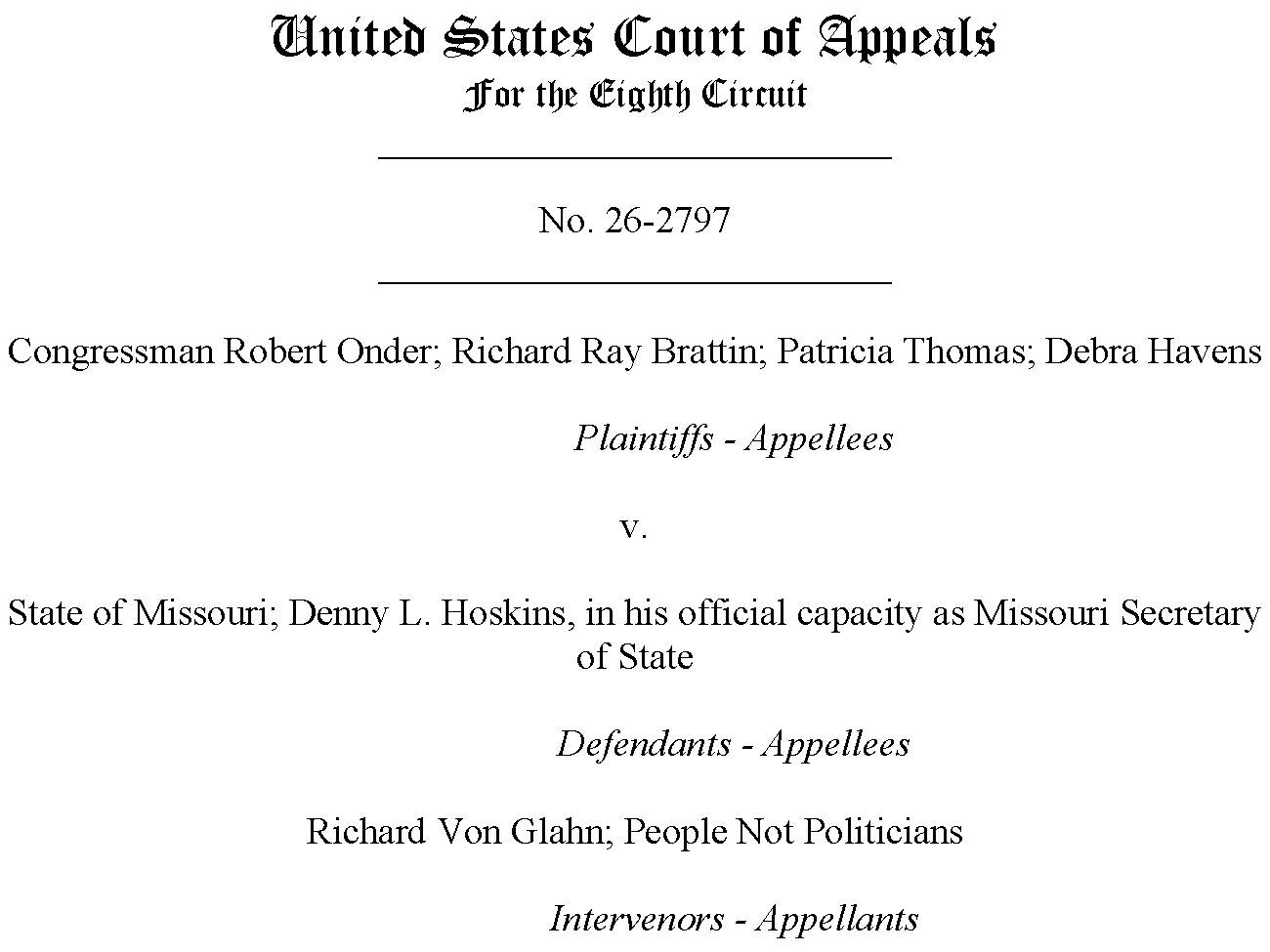
That brings us to tonight’s ruling. Ostensibly resolving the TRO appeal over which it earlier claimed it lacked jurisdiction, the Eighth Circuit purported to “affirm” the district court’s TRO (the one the Supreme Court stayed on September 10). By itself, that would be a nothing-burger; we’ve seen lots of prior cases where courts of appeals have affirmed injunctions after they were stayed (indeed, the First Circuit just did something kind of like this last week in the third-country removals case—affirming vacatur of a rule even after the Supreme Court stayed a preliminary injunction against it). Affirming a stayed injunction isn’t per se problematic, all the more so because it has no effect on the status quo. The wild part here is what the Eighth Circuit ordered as a remedy: instead of just affirming the TRO and letting the appeals process play it, the court of appeals remanded the case with instructions to the district court to enter a permanent injunction requiring the use of HB 1.
Time is too short to get into all the ways in which this move is procedurally bananas, but let’s just say that I’m unfamiliar with any prior case in which a court of appeals, on a TRO appeal, ordered the district court to enter permanent injunctive relief. (One might say the Eighth Circuit is “Fifth Circuit-ing,” but I can’t remember even the Fifth Circuit pulling this move.)
The relevant point for present purposes is that such an injunction from the district court would be different relief from the TRO that the Supreme Court already stayed on September 10. In other words, and quite deliberately, the Eighth Circuit is instructing the district court to issue relief that won’t be subject to the Supreme Court’s earlier stay—never mind that it certainly appears to be flatly inconsistent with the reasons why that stay must have been issued. The upshot is that, if this is the last word, it would mean that, by early next week, the district court will enter a permanent injunction requiring Missouri to use HB 1 for its 2026 congressional elections (even though folks have already started voting using the 2022 map).
2. What Happens Next?
Perhaps recognizing the absurdity of what it was ordering, the Eighth Circuit built in a bit of a pause button. Even as its order directs the district court to issue a permanent injunction, it also directs that same court to “administratively stay” such an injunction until 5 p.m. CT next Monday (September 28), ostensibly “[t]o allow for appellate review.” Thus, the intervenor-defendants in the federal case (the ballot referendum sponsors) have a full week to not just seek emergency relief from the Supreme Court, but to obtain it (of course, Justice Kavanaugh, as Circuit Justice for the Eighth Circuit, could issue an administrative stay of his own to give the Court more time to rule).
In the interim, nothing can or should change on the ground. Voters who have not yet returned their ballots may now pause out of an abundance of caution, but there is, as yet, no judicial order in effect that would allow Missouri to try to implement HB 1. The 2022 map is, for the moment, still the map in effect.
I have no doubt that the intervenor-defendants will quickly appeal the Eighth Circuit’s ruling to the Supreme Court and seek emergency relief (probably in the form of a vacatur). And I have very little doubt that the Supreme Court—yes, even this Supreme Court—will grant it. If there had been any appetite in the Supreme Court for these kinds of shenanigans, we would’ve seen it in the Court’s ruling on September 10, when the justices were first asked to stay the district court’s TRO, and when anyone who wanted to see Missouri use HB 1 this cycle could have conjured some reason to sit on their hands. It’s also telling that, when the issue first came to the Court on Missouri’s application to stay the Missouri Supreme Court’s ruling, Justice Kavanaugh was so confident that none of his colleagues wanted to do so that he denied the stay by himself.
And when the Court agreed to step in and block the district court’s TRO on September 10 (something that’s a lot proactive more than a passive denial, as in the first iteration), there were no public dissents from the grant. As I wrote at the time, that suggests that no justice was publicly willing to upend Missouri’s congressional districts at this late hour—or to let a lower federal court override the Missouri Supreme Court’s construction of its own state law. It is exceedingly difficult to see how anything the Eighth Circuit said in its ruling tonight will alter that calculus in the new map’s favor; if anything, the passage of time (and the distribution of ballots) only further augurs in favor of a stay—and of preserving the Missouri Supreme Court’s directive to use the 2022 map this November.
Of course, you can never be 100% certain about this Supreme Court. But every single tea leaf in the Missouri litigation so far has pointed in this direction—and rather emphatically, at that.
3. What’s the Broader Lesson?
I hope my relative confidence about how this ends doesn’t obscure how ridiculous the Eighth Circuit’s ruling is. It’s procedurally bonkers; it’s substantively dangerous; and it’s a far more serious instance of a lower court acting in direct tension with the Supreme Court’s directive than any of Justice Gorsuch’s three examples of “defiance” in his NIH concurrence last August.
Technically, the entering of a permanent injunction is not barred by the stay the Supreme Court issued on September 10—and so it’s not outright defiance of the justices’ ruling (again, because the stay operated only on the TRO, and not any subsequent relief). But as the justices wrote last summer, “Although our interim orders are not conclusive as to the merits, they inform how a court should exercise its equitable discretion in like cases.” Clearly, the issuance of a stay of the TRO in this same case just 11 days ago should have “inform[ed]” how the Eighth Circuit acted here. And it’s willful blindness on the court of appeals’ part to suggest otherwise.
That said, this is also yet another example of the dangers of Supreme Court rulings on the emergency docket that come with no analysis. Had the justices provided even a sentence or two about why they were staying the district court’s TRO (as they did in explaining the denial of a stay in the mail-in ballots case last Monday), it would have been harder for the Eighth Circuit to manufacture any wiggle room and justify its remand here. I still think the Supreme Court’s unexplained September 10 order was sufficiently clear about the message it was sending, but as the dispute over Missouri’s map returns to the Court for the third time this month, it’s worth not losing sight of the justices’ own responsibility for not previously nipping this in the bud.
As for how to do that in its next ruling, I’m reminded of an especially notorious California death penalty case from the 1990s—that of Robert Alton Harris.
Harris was scheduled for execution by cyanide gas on Tuesday, April 21. On April 17, on behalf of Harris and every other death-row inmate in California, the ACLU had brought a class-action suit challenging the use of such gas as cruel and unusual punishment under the Eighth Amendment. One day later, a San Francisco–based district judge granted a temporary restraining order—giving Harris a ten-day reprieve. On Monday afternoon, after a brief pause for Easter and the second night of Passover, a divided three-judge panel of the Ninth Circuit reversed the lower court’s restraining order, only to have the full court of appeals restore that ruling and impose multiple separate stays of Harris’s execution just before midnight.
Three hours later, close to 6:00 a.m. Tuesday morning in Washington, the Supreme Court vacated both stays, over dissents from Justices Blackmun and Stevens. Harris was brought to the execution chamber within the hour, and was strapped to one of the chairs, when the proceeding was stayed again, this time by Ninth Circuit Judge Harry Pregerson. Unamused, the Supreme Court responded by not only vacating Pregerson’s stay, but also stating that “[n]o further stays of Robert Alton Harris’ execution shall be entered by the federal courts except upon order of this Court.” As I wrote in The Shadow Docket, “California could have dropped Harris from a helicopter at that point; the Supreme Court wasn’t going to let anyone else intervene.”
Whatever one thinks of the Harris episode, the Court would do well, when (not if) it intervenes in this latest Missouri midterm mishegas, to provide at least a bit of explanation for why it’s doing so. And given the Eighth Circuit’s behavior, it may want to adopt similar language to what it had written in 1992—so that there isn’t a fourth trip from Missouri to the Court before November.
Sigh.
Ir reads as a willful defiance of the Supreme Court by the 8th Cicuit.
Thank you for getting this out so quickly and assuaging my mind that SCOTUS likely won't go along for this. Absolutely INSANE.