

Welcome back to “One First,” a newsletter that aims to make the U.S. Supreme Court more accessible to lawyers and non-lawyers alike. I’m grateful to all of you for your continued support, and I hope that you’ll consider sharing some of what we’re doing with your networks.
If you’re not already a subscriber, please consider becoming one—and upgrading to a paid subscription if and when your circumstances permit:
The Trump administration’s sustained campaign against the press over the last twenty months reached a new low on Friday, when President Trump banned CNN, MS NOW, and Politico from the White House for overtly viewpoint-based reasons. It’s not the first time the administration has brazenly interfered with the freedom of the press: The Associated Press lost its access to the Oval Office and Air Force One because it refused to drop the term “Gulf of Mexico,” but the White House called that a matter of managing a crowded press pool; the Pentagon conditioned credentials on rules a district judge has since held to be unconstitutionally vague, but the stated concern behind them was to prevent the solicitation of classified information; the FCC opened investigations and license reviews in seeming retaliation against (and to chill) editorial decisions the President dislikes, but the actual paperwork invoked news distortion, equal time, and even anti-discrimination law; public and international broadcasters lost their funding, but under the guise of reallocating priorities through the appropriations process; the Justice Department rescinded the policy shielding reporters from subpoenas, but framed it as an ordinary revision of internal guidelines; and the list goes on (and on … and on).
Even though many of the justifications for these actions have appeared to be transparently pretextual, they’ve forced those challenging the government’s actions to prove what the government was actually doing rather than to simply describe it. Some of those challenges have succeeded; others remain pending; but the rulings that have come down have been about process and pretext, not principle; and many are still pending appellate review.
Then came Friday. In a Truth Social post, Trump announced that he was barring CNN, MS NOW, and Politico from the White House altogether because of their “constant ‘reporting’ FAKE NEWS,” and he warned that other outlets could be next. By Saturday morning, the ban had been given teeth: reporters from all three outlets showed up for work; they were turned away at the gate; and they had their credentials taken from them, in one case by a Secret Service agent at the entrance. And early this morning, reports surfaced that the outlets will be suing to challenge their bans—perhaps as early as today.
The Supreme Court has not always drawn the clearest lines when it comes to the First Amendment and press freedom. But this is just not a close case. Whatever other leeway the executive branch may have to restrict press access on national security grounds, hand-picking three outlets to exclude from what the Court’s jurisprudence calls a “nonpublic forum” because of the President’s disagreement with the putative viewpoint of their reporting is about as close to a textbook violation of the existing precedents as it comes. And the finer points of the Court’s First Amendment doctrine aside, a free press wouldn’t mean very much in a world in which only those whose reporting the government likes are in a position to meaningfully cover it.
More on that below. But first, the (other) news.
On the Docket
The Merits Docket
We’re one week out from the “Long Conference”—the justices’ first formal gathering since rising for their summer recess at the end of June, where they’ll dispose of the hundreds of cert. petitions that have stacked up over the summer (and probably grant a handful). One piece of merits docket news before then (which I just plain forgot to cover last week) is that the Court has dismissed one of the cases that had been set for argument in October—Genalo v. Black, an important case about the Fifth Amendment limits on immigration detention pending removal. New York Governor Kathy Hochul recently pardoned the one remaining respondent for the New York state offense that rendered him removable in the first place, which mooted that question at least as applied to him (if he can’t be removed, he can’t be detained pending removal). Among other things, that means the Court is down to only six arguments during its October sitting—across five days. One of these days, we might actually have a serious discussion about how much the Court’s docket has shrunk—and why it matters.
The Emergency Docket
Last week was, of course, another busy week on the emergency docket. Monday night brought with it the mail-in ballots ruling, which I wrote about on Tuesday. The Court also denied two stays of execution over no public dissents—one on Wednesday in the case of Texas death-row inmate LeJames Norman; and one on Thursday in the case of Alabama death-row inmate Jeffery Lee (whose execution the Court had refused to un-block earlier this summer). The denials were the 123rd and 124th full Court rulings on emergency applications during the October 2025 Term—moving it past the October 2023 Term into second place all time in my database (there were 140 full Court rulings during OT2024).
The Week Ahead
We’re likely to see even more action on the emergency docket this week. The Trump administration’s application in the SAVE case has been fully briefed since Wednesday—and could produce a ruling at any time. The respondents in the messy interstate surrogacy application I discussed last week filed their opposition on Friday—which clears the way for a ruling sometime this week. There’s a new application from Americans For Prosperity challenging Delaware’s election-related donor disclosure rules that is likely to get the full Court’s attention; Justice Alito has called for a response by 4 p.m. ET on Wednesday. And former Solicitor General Paul Clement has filed an application on behalf of Arizona seeking to immediately get out from under a district court ruling placing the state’s prison healthcare system under the authority of a court-appointed receiver; Justice Kagan has called for a response by 4 p.m. ET on Friday.
That three of these don’t involve the Trump administration should be all the evidence anyone needs that the unprecedented volume on the emergency docket hasn’t been, and won’t be, a Trump-specific phenomenon.
The One First “Long Read”:
Newsgathering and the First Amendment
The constitutional law regarding newsgathering may not be fully settled, but it has a number of waypoints. For starters, the press has no constitutional entitlement, as the Supreme Court put it in Pell v. Procunier, to “special access to information not available to the public generally.” Houchins v. KQED held effectively the same thing with respect to physical access to a government facility. So far as I know, there is no case holding that a reporter can demand entry to the building where officials work solely because they are on the job.
But there are plenty of cases outlining what the government can’t do to the press. As relevant to the latest White House contretemps, the relevant framework is “forum” doctrine, which sorts government property into categories and applies varying degrees of scrutiny based upon what kind of forum is at issue. Traditional public fora (think public streets and parks) can be subject to reasonable restrictions on the time, place, and manner of speech (e.g., no loud noise after 10 p.m.); whereas content- and viewpoint-based discrimination are subjected to (and usually fail to satisfy) strict scrutiny (where the restriction on speech must be narrowly tailored to achieve a compelling governmental interest).
A “designated” public forum is created when the government intentionally opens otherwise nonpublic property for general, indiscriminate communicative activity—such as a school auditorium used for a public meeting; a municipal theater; state fairgrounds; or public university facilities. A “nonpublic” forum, in contrast, is one that is not a traditional or designated public forum, and that’s typically opened only selectively or for a limited purpose. This distinction matters for content-based restrictions—which are generally subjected to strict scrutiny in a designated public forum, but need only be reasonable in a “nonpublic” forum. And, of course, some government spaces aren’t fora at all—because the government hasn’t opened them up for any speech whatsoever.
This last category matters because, when President Trump excluded the Associated Press from the Oval Office, Air Force One, Mar-a-Lago, and other restricted spaces, it’s the ground on which a divided D.C. Circuit panel stayed the district court’s injunction against that exclusion pending appeal. Here’s the key excerpt from Judge Rao’s opinion (which Judge Katsas joined, and with citations omitted):
When the White House opens its facilities to the press generally, as it does in the Brady Briefing Room, it cannot exclude journalists based on viewpoint. In Sherrill, we held that the “White House press facilities having been made publicly available as a source of information for newsmen, the protection afforded newsgathering under the [F]irst [A]mendment guarantee of freedom of the press” attached, requiring that “access not be denied arbitrarily or for less than compelling reasons.” We recently explained that “[a]lthough Sherrill predated modern forum analysis, its description of the Press Area fits the definition of a nonpublic First Amendment forum.” Thus, “access to the White House Press Area can be restricted as long as the restrictions are viewpoint neutral and reasonable.” Sherrill and Ateba stand for the proposition that White House spaces generally open to the press are nonpublic fora, and therefore access cannot be restricted based on viewpoint.
On the other hand, we have never suggested that there are any First Amendment restrictions on “the discretion of the President to grant interviews or briefings with selected journalists.” In deciding which journalists to speak with, the President may of course take into account their viewpoint. If President Trump sits down for an interview with Laura Ingraham, he is not required to do the same with Rachel Maddow. The First Amendment does not control the President’s discretion in choosing with whom to speak or to whom to provide personal access. It is a time honored and entirely mundane aspect of our competitive and free press that public officials “regularly subject all reporters to some form of differential treatment based on whether they approve of the reporters’ expression.”
The panel then applied that distinction to hold that the AP was unlikely to succeed on its newsgathering-based challenge to the exclusion. And the panel also suggested it was unlikely to succeed on its retaliation claim because “Picking and choosing journalists on the basis of viewpoint might be actionable in some contexts, such as when the White House opens its facilities ‘to all bona fide Washington-based journalists,’ but this is not one of those circumstances.”
Judge Pillard wrote a lengthy dissent from the grant of a stay—with which, I should confess, I largely agree. But the relevant point for present purposes is that, as the quotes from above underscore, categorically excluding CNN, MS NOW, and Politico from the White House is exactly what Judges Rao and Katsas distinguished in the AP case. In other words, even from the perspective of judges who have, frankly, gone out of their way to rationalize this administration’s actions against media outlets that won’t sing its tune, there’s still a material difference between excluding an outlet from private sessions with the President and from spaces in the White House that aren’t generally used for communicative activity, versus excluding them from the Brady Press Briefing Room—a space that exists for the express purpose of providing credentialed journalists with access to the President and the White House.
Whatever one thinks of Judge Rao’s forum analysis in the AP case, it seems axiomatic, as she all but held, that the Press Briefing Room itself is, and the spaces the White House provides to the credentialed media on “Pebble Beach” (where cameras are set up on White House grounds but outside the building itself) are, “nonpublic fora” under the Supreme Court’s First Amendment jurisprudence. And whether or not viewpoint discrimination in such spaces is per se unconstitutional (as Judge Pillard argued in her dissent), or “merely” subject to strict scrutiny, the result would be the same; categorically excluding these outlets (1) does not advance any compelling governmental interest; and (2) is certainly not “narrowly tailored” to achieving one.
Beyond the substantive First Amendment violation resulting from the obvious viewpoint-based discrimination, President Trump’s exclusion of CNN, MS NOW, and Politico also raises serious due process concerns, at least under the D.C. Circuit’s jurisprudence. As the D.C. Circuit has recognized for a half-century, when the government moves to deny First Amendment protections to reporters, that implicates the Fifth Amendment, as well—and “notice, opportunity to rebut, and a written decision are required because the denial of a pass potentially infringes upon first amendment guarantees.” Indeed, when Jim Acosta’s press pass was revoked during the first Trump administration, the ground on which a district court ordered it restored was a failure to provide due process—rather than a First Amendment violation. So quite apart from the straightforward First Amendment question raised by categorically excluding CNN, MS NOW, and Politico, there’s also the way President Trump did it, i.e., without any due process whatsoever.
To be sure, prior efforts to challenge the Trump administration’s interference with the press have not all succeeded, in at least some cases because litigants have been unable to demonstrate that the government’s profferred justifications were in fact pretextual. Here, though, President Trump has done that work for them, not just in what he said, but in the reporting that his Truth Social post “blindsided the press office,” which will certainly be deployed to disprove any argument that this was actually a considered policy choice on the White House’s part. That also means, among other things, that a standalone retaliation claim should also be on firmer footing than it was in the AP case.
And President Trump saying the quiet part out loud extends past the viewpoint-based nature of his actions, for he also threatened every other credentialed media organization by suggesting “Other Fake News Media Outlets to Follow.” In so “truthing,” Trump not only drove home the underlying constitutional flaw in his actions, but he underscored their stakes, too. Whatever folks think about the three outlets Trump singled out here (and remember that I’m a CNN analyst), a world in which the President can categorically exclude any outlet from the White House solely because he dislikes their reporting is one in which any president can construct a press room full of sycophants and other sympathetic mouthpieces for the government’s policies. This isn’t about individual reporters or reports being punished; it’s about chilling critical journalism about the executive branch of the United States.
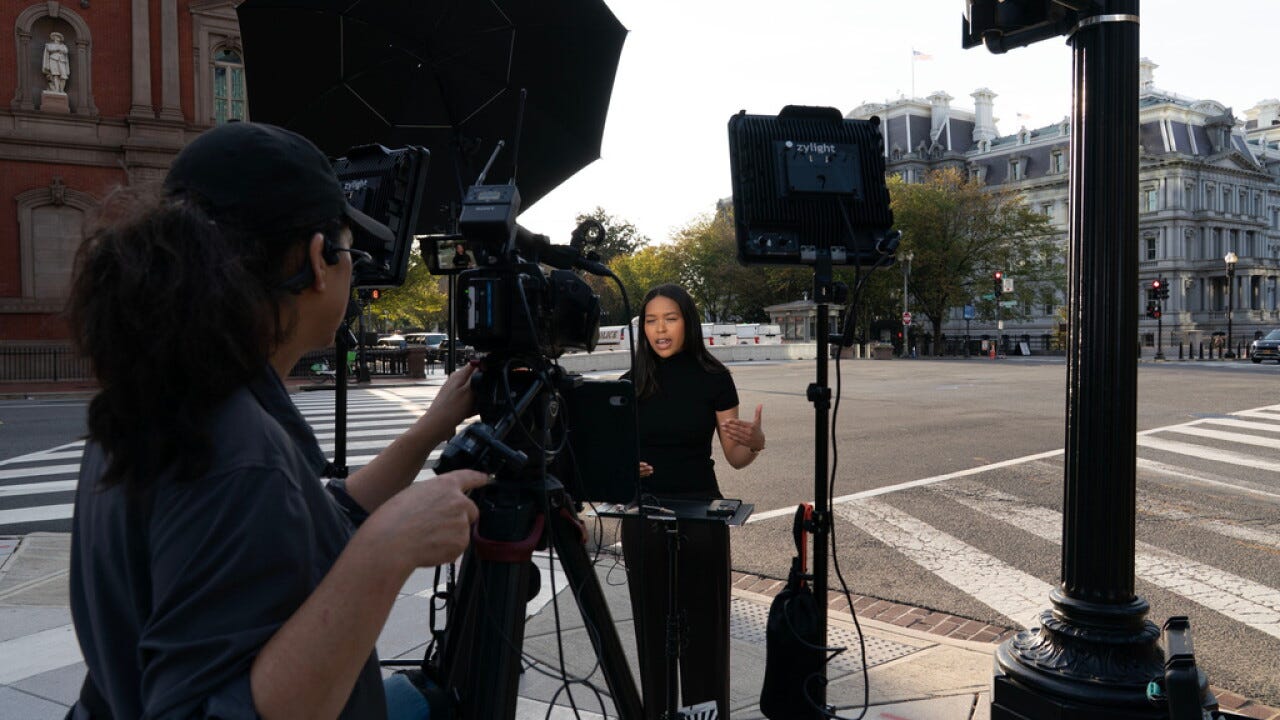
The news this morning is that CNN, MS NOW, and Politico are suing to challenge the ban, perhaps as early as later today. That’s good, and they should (and almost certainly will) win. But they shouldn’t have to litigate this at all. Once again, we’re seeing what happens when an executive branch can operate free from any traditional political constraints—where two of the nation’s largest cable news outlets have been forced to set up cameras literally across the street from the White House grounds while their press colleagues cover the government from within, and for no reason other than writing stories the President doesn’t like. Whatever freedom of the press means, that ain’t it.
SCOTUS Trivia:
Potter Stewart’s “Or of the Press”
On November 2, 1974, as part of Yale Law School’s sesquicentennial convocation, Justice Potter Stewart delivered an address titled “‘Or of the Press.’” In the wake of a flurry of high-profile legal and political developments respecting the press (not the least of which was the Supreme Court’s decision in the Pentagon Papers case), Stewart set out to demonstrate that “the established American press in the past ten years, and particularly in the past two years, has performed precisely the function it was intended to perform by those who wrote the First Amendment of our Constitution,” and that “this thesis is supported by the relevant decisions of the Supreme Court.”
The speech was published by the Hastings Law Journal in 1975, and is worth a read today. One passage, in particular, has always stayed with me:
So far as the Constitution goes, the autonomous press may publish what it knows, and may seek to learn what it can.
But this autonomy cuts both ways. The press is free to do battle against secrecy and deception in government. But the press cannot expect from the Constitution any guarantee that it will succeed. There is no constitutional right to have access to particular government information, or to require openness from the bureaucracy. The public’s interest in knowing about its government is protected by the guarantee of a Free Press, but the protection is indirect. The Constitution itself is neither a Freedom of Information Act nor an Official Secrets Act.
The Constitution, in other words, establishes the contest, not its resolution. Congress may provide a resolution, at least in some instances, through carefully drawn legislation. For the rest, we must rely, as so often in our system we must, on the tug and pull of the political forces in American society. Newspapers, television networks, and magazines have sometimes been outrageously abusive, untruthful, arrogant, and hypocritical. But it hardly follows that elimination of a strong and independent press is the way to eliminate abusiveness, untruth, arrogance, or hypocrisy from government itself.
Those words seem even more important today. And although this isn’t really “trivia,” some things are more important.
I hope that you’ve enjoyed this installment of “One First.” If you have feedback about today’s issue, or thoughts about future topics, please feel free to email me. And if you liked it, please help spread the word!
If you’re not already a paid subscriber and are interested in receiving regular bonus content (or, at the very least, in supporting the work that goes into this newsletter), please consider becoming one:
This week’s bonus issue will drop on Thursday. As ever, I hope you are all staying safe out there, especially from frontal assaults on press freedom.
The three (as of now) banned outlets will prevail; that's inevitable. It's only a question of how long it takes -- and it shouldn't take very long. My question is why are any other news media continuing to cover Trump while colleagues are barred for viewpoint reasons. Do the others not realize that by barring CNN for its negative viewpoint, Trump is essentially blessing CBS for its supportive slant?? Or at least that's the strong implication. If all media stood with "the 3", Americans would be spared the sight and sound of our president's "weaves" and bloviation, at least for a few days. A little respite would do us all good.
The problem that MS Now, Politico, and CNN run into is the "violence" problem when dealing with authoritarians like Trump. Unless there is some form of punishment in retaliation, a win that simply maintains the status quo is insufficient; there must be "violence" against Trump in some fashion. In criminal law, that's locking someone up. In civil law, like here, that would be a fine paid by Trump. A civil fine of legal fees paid for by the Treasury does not touch Trump personally. Trump being forced to sit, like Clinton, for a long and humiliating deposition is partial "violence" against his time and his dignity.