

Welcome back to “One First,” a newsletter that aims to make the U.S. Supreme Court more accessible to lawyers and non-lawyers alike. I’m grateful to all of you for your continued support, and I hope that you’ll consider sharing some of what we’re doing with your networks.
If you’re not already a subscriber, please consider becoming one—and upgrading to a paid subscription if and when your circumstances permit:
As early as the middle of this week, the Supreme Court may once again be asked to put back into effect President Trump’s effort to interfere with the use of mail-in ballots during the upcoming midterm election cycle. As I suggested after last Monday’s ruling in Trump v. California, Judge Talwani (D. Mass.) moved quickly to issue a temporary restraining order against the U.S. Postal Service’s Final Rule purporting to implement President Trump’s executive order, and the government has already appealed that ruling to the First Circuit (and will surely seek a stay pending that appeal). Once the First Circuit rules, it seems inevitable that the case will go right back to the justices.
One of the questions I raised last week was whether the government would argue (with more than a little chutzpah) that Judge Talwani’s latest intervention should be stayed because it’s “too close” to the election, an invocation of the so-called “Purcell principle”—the idea that that federal courts should stay their hand as election day draws nigh lest they issue rulings that increase the risk of voter confusion.
But the Supreme Court has never previously been asked to apply Purcell where the election-related rule blocked by a lower federal court came from the federal government. Going back to Purcell itself, every single application of Purcell by the Supreme Court over the last 20 years has involved a lower-court injunction against a state (or local) directive. That’s as it should be. Even taking Purcell seriously (which is admittedly challenging) and assuming, for the sake of argument, that it’s a consistent, neutral principle defining the equitable authority of federal courts, there are two independent reasons why Purcell ought never to apply when the federal government is the defendant—and a third reason, for those unpersuaded by the first two, why it ought not to apply in the mail-in ballots cases specifically.
More on that below. But first, the (other) news.
On the Docket
The only formal ruling out of the Court last week was Monday’s per curiam opinion (and dissents) in the first mail-in ballots case, Trump v. California. Although my initial post reacting to that ruling was written in a hurry, I think it still suffices to summarize what the Court did (and, as importantly, what it didn’t do).
I also want to flag one of the more ridiculous recent efforts by states to invoke the Supreme Court’s original jurisdiction—a new motion for leave to file a bill of complaint filed by Iowa and Montana against twelve different states, seeking to have the Supreme Court stop those states from suing (as they currently are) to block Paramount’s merger with Warner Bros. Discovery. In other words, Iowa and Montana are trying to use the Court’s original jurisdiction to speed up a merger of private companies. (Beyond seeking a grant of leave to file, Iowa and Montana have also asked the justices to expedite their consideration of the motion for leave to file.) Whatever one thinks about the Thomas/Alito view of the Court’s original jurisdiction (i.e., that it is mandatory when states are on both sides of the “v.”), the reality is that the Court has repeatedly rejected that view—and has made abundantly clear in recent years that it will not let its original docket be hijacked for political disputes. The only grants of original jurisdiction over the last two decades have all involved cases in which the states are the real parties in interest on both sides—basically disputes over land and water rights. Whatever one thinks of the Paramount/WBD merger, this ain’t that. Instead, this latest suit is just a waste of a lot of time, effort, and taxpayer money.
Speaking of efforts to manipulate the legal system for political purposes, the New York Times published a very well-reported story over the weekend about how the Trump administration has gamed the civil litigation rules to bring various disputes not just in the Northern District of Texas, but before Judge Reed O’Connor, specifically—one of the federal judiciary’s most visible public defenders of the very “judge shopping” in which DOJ is engaging (here’s my response to O’Connor’s speech on the subject). I’ve pointed out before the irony (one might even say hubris) of folks complaining about where suits against the Trump administration have been filed given this kind of behavior; it’s nice to see a discussion of it outside this newsletter.
Turning to this week, we expect the third and final housekeeping summer Orders List this Friday (September 4) at 9:30 ET. It also stands to reason that, at some point, we’ll get the full Court ruling on President Trump’s application to allow him to continue building his new ballroom for the duration of the litigation challenging it; Chief Justice Roberts’s administrative stay (allowing the construction to continue for now) has been in place for 10 days. Obviously, that could also come this week. Or not.
The One First “Long Read”: Purcell and Uncle Sam
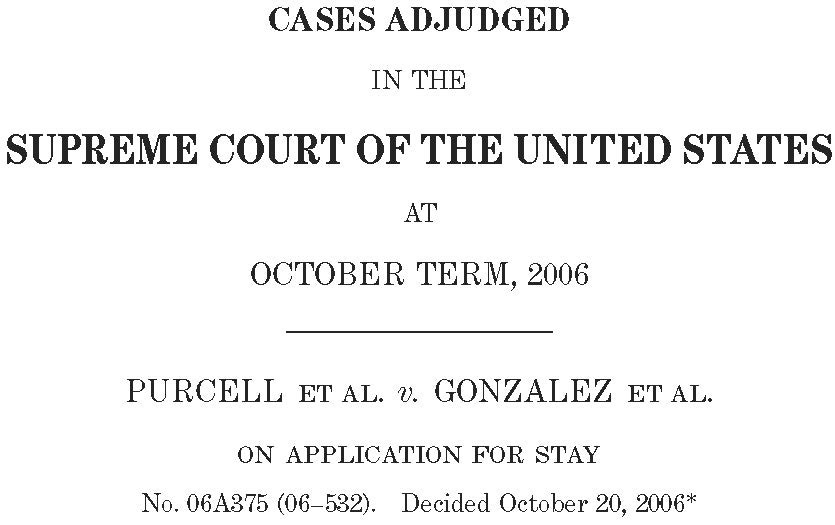
The “Purcell principle,” as UCLA professor Rick Hasen has dubbed it, is the idea that, as election day draws nigh, federal courts should refrain from using their equitable authority to rule in ways that might increase voter confusion. It’s named after a remarkably (if typically) cryptic unsigned opinion respecting a grant of an emergency application that the Supreme Court handed down in October 2006. And it has become deeply controversial over the last five years as the justices have wielded it in ways that at least appear to be inconsistent along any axis other than whether the intervention favors Democrats or Republicans. (I make—and defend—this argument in detail in Chapter 6 of The Shadow Docket.) If anything, the Court’s inconsistency has been on even sharper display this term—given its enthusiastic invocations of Purcell to block district court rulings (in the Texas and Alabama redistricting cases) while refusing to apply Purcell to itself (including in the Alabama case, where the district court’s intervention was only necessary because of the Supreme Court’s post-Callais decision to vacate and remand the earlier injunction in that case).
Indeed, the only thread that unites every single application (or not) of Purcell to date is that the relevant change in election rules came from a local or state government—not the United States. Largely because the federal government tends not to try to interfere even in federal elections, there’s just no history of emergency litigation challenging late-breaking changes to federal rules respecting elections.
Beyond a descriptive claim about the twenty-year history of Purcell, that’s also a normative one. Even taking Purcell at face value, there are two independent reasons why it should not apply when the federal government is the defendant, and a third reason, even for those who embrace Purcell in full, why the Trump administration shouldn’t be able invoke it in the mail-in ballots cases specifically.
I. Purcell as a Federalism Doctrine
In a fascinating 2024 student note in the Virginia Law Review, Casey Schmidt argued (persuasively, in my view) that Purcell doesn’t make sense on its own terms (i.e., the “avoiding voter confusion” argument), and that the more principled way to rationalize at least many of the Court’s interventions in this space is to tie the “principle” to federalism—“the idea that decisions about election procedures are primarily the province of the states.”
Schmidt offered that thesis as a better rationalization of at least many of the Court’s previous Purcell-driven interventions, but I think it was also doing work in those cases themselves. Justice Kavanaugh, for instance, has repeatedly described Purcell as establishing the principle that “federal district courts ordinarily should not enjoin state election laws in the period close to an election”—which suggests that it’s about more than just limits on the equitable authority of federal courts. If it were just about the federal equity power (regardless of whose rules the equity power was being invoked to block), there’d be no reason to emphasize that it applies to state rules, specifically. And in the Texas case in December, the majority cast the district court’s injunction against Texas’s new congressional map (which it stayed under Purcell) as “upsetting the delicate federal-state balance in elections.” That balance is not just a creature of Supreme Court jurisprudence; it is reflected in the Constitution itself, Article I, Section 4 of which makes states the first movers when it comes to the rules for even federal elections. Congress can override state rules, of course, but the key is that there’s at least a loose structural hook for Purcell as reflecting that same federalism-driven default rule.
On that reading, the point of Purcell is not to insulate late-breaking changes to election rules from all judicial review; it’s to suggest that any equitable relief against those changes ought to come from state courts—not federal courts. And the Supreme Court’s behavior during the 2020 election cycle largely backs that up. Although the Court intervened repeatedly to stay federal court injunctions that would’ve altered the status quo with regard to election procedures, it declined to intervene in cases from North Carolina and Pennsylvania where the underlying ruling came from a state court. The issue wasn’t a lack of jurisdiction; those cases involved federal claims as well as state ones.
As Chief Justice Roberts put it in a (rare) concurrence in an October 2020 case from Wisconsin (where the Court refused to vacate the Seventh Circuit’s Purcell stay of a federal district court injunction), “Different bodies of law and different precedents govern these two situations and require, in these particular circumstances, that we allow the modifcation of election rules in Pennsylvania but not Wisconsin.” New York’s highest court sounded a similar theme in 2022: “The Purcell doctrine cautions federal courts against interfering with state election laws when an election is imminent, and does not limit state judicial authority where, as here, a state court must intervene to remedy violations of the State Constitution.” States can choose to follow Purcell; the relevant point is that it’s their choice.
The upshot is that federal law just has nothing to say, one way or the other, about whether state courts may issue eleventh-hour injunctive relief in election cases—because that question is one that’s committed to the states as a matter of federalism. By that logic, it ought to be obvious that Purcell would (and should) not likewise constrain federal courts reviewing election procedures grounded in federal statutes and rules—because there is no federalism concern pressuring the federal courts to stay their hand.
II. Purcell and the Vanishing Forum
A related but distinct point is the availability of alternative remedies. As the North Carolina and Pennsylvania cases from 2020 illustrate, in those states that don’t adopt their own version of Purcell, late-breaking changes to local or state election rules remain subject to injunctive relief in state court—so that application of Purcell to lower federal courts does not foreclose all potential channels for judicial review.
In contrast, state courts generally lack the power to issue coercive relief against federal defendants—practically because any such suit would inevitably be removed to federal court, and likely formally, as well (although Richard Arnold famously argued otherwise). That means that, when it comes to efforts to challenge late changes to election procedures imposed by the federal government, federal courts are the only forum in which those challenges can be brought.
That’s more than just a procedural detail, to me. Applying Purcell to state or local governments simply closes the doors of one courthouse. Applying Purcell to the federal government would close the doors of every courthouse, leaving voters without any remedy for even the most nefarious, malicious, or otherwise blatantly unlawful last-minute federal interventions in elections. A federal rule that is concededly unlawful would nonetheless govern a national election, immune from review anywhere, simply because the government waited long enough to issue it. This asymmetry, of course, is a one-way ratchet. The federal government can always cure a timing problem by acting earlier (as the USPS was supposed to have done, here), whereas voters cannot manufacture a forum that does not exist.
III. Heads They Win; Tails We Lose
Even for those who are not (yet) persuaded, there’s one final argument about Purcell in the specific context of the mail-in ballots cases that is worth articulating—which is the government’s unclean hands in even invoking it. After all, this is the same government that argued, as recently as a week ago, that it was too early for litigants to challenge the Trump administration’s efforts to interfere with mail-in balloting, an argument that succeeded in the Supreme Court. But equity can’t—or at least shouldn’t—abide a party arguing one day that it’s too early for a claim to be brought, only to argue the next day that it’s now too late. Whether one frames that in terms of unclean hands or judicial estoppel, the upshot ought to be the same: insofar as Purcell is, at its core, a doctrine about the equity power, equity should not be used to allow a party to manufacture absurd results. (There’s a cryptic 2022 order in a Georgia election case in which the Court said a version of this—vacating an Eleventh Circuit Purcell stay because of the party’s own representations in the lower court.) A “principle” that turns on who is asking, and when it suits them, is no principle at all.
SCOTUS Trivia: The Court’s Longest Vacancy
For … reasons, I was looking at Supreme Court nominations from the Antebellum Era, and came across a tidbit I’d seen before, but haven’t ever used as trivia: The longest vacancy in the Supreme Court’s history. The answer involves the vacancy created upon the April 1844 death of Justice Henry Baldwin, while President John Tyler was still in office. “His Accidency,” the first person to become president other than by election (he succeeded William Henry Harrison upon Harrison’s death), had alienated his fellow Whigs (who expelled him from the party)—and had virtually no support in Congress. He unsuccessfully tried to fill Baldwin’s seat three different times—twice with Edward King, and once with John Meredith Read. (Tyler also struggled to fill the vacant seat of Justice Smith Thompson, although the Senate eventually confirmed his sixth(!) choice—Samuel Nelson—on February 14, 1845.)
After James K. Polk came to office in March 1845, he offered Baldwin’s seat to James Buchanan—who considered the offer before turning it down in favor of becoming Secretary of State. Polk eventually settled on a relatively obscure Western Pennsylvania judge, Robert Cooper Grier, who was confirmed on August 4, 1846, and sworn in on August 10—841 days after the vacancy was created. To put that number in context, it is almost exactly twice as long as the 422-day vacancy between Justice Scalia’s February 2016 death and Justice Gorsuch’s April 2017 swearing-in, which was itself only the second vacancy to exceed a calendar year since the Civil War (the 391-day vacancy created by Justice Fortas’s resignation and filled by Justice Blackmun was the first).
I hope that you’ve enjoyed this installment of “One First.” If you have feedback about today’s issue, or thoughts about future topics, please feel free to email me. And if you liked it, please help spread the word!
If you’re not already a paid subscriber and are interested in receiving regular bonus content (or, at the very least, in supporting the work that goes into this newsletter), please consider becoming one:
This week’s bonus issue will drop on Thursday. As ever, I hope you are all staying safe out there, especially from the Purcell principle.
My heavens. What a thought. What a plaintive voice in the wind. The DOJ is using that argument. Has all along. And this heads I win, tails you lose Supreme Court used the flip side of it, in its decision to overrule the Court of Appeals to let the cases get good and rotten on the vine.
Here is what we have going on. Roberts does not want to be on the losing side if these cases, nor dies he want to author a 5/4 decision. He has lost the resoect of the minority for good now. He does not want to lose that if any of his partisan colleagues. Nor their votes if they can be had. There are those that will vote to put a stop to this mockery of law and order, on a par with Trump's birthright citizenship order. But there are some who will not abd he wants to keep them in the fold as long as possible. The prior decision represents an agreement reached with them concerning the cases. For the most part, it is just a six person Supreme Court. All that matters to its Reoublican appointed members is what they can agree upon amongst themselves. Like for instance absolving the President of crimes committed while in office.
what if SCOTUS rules as it should and does not intervene . Could it be that certain (red) states will recognize Trump's EO and the USPS rule implementing same? Is it possible that some states will recognize the EO while others will not, thereby throwing the election into the desired chaos??