

Welcome back to “One First,” a newsletter that aims to make the U.S. Supreme Court more accessible to lawyers and non-lawyers alike. I’m grateful to all of you for your continued support, and I hope that you’ll consider sharing some of what we’re doing with your networks.
If you’re not already a subscriber, please consider becoming one—and upgrading to a paid subscription if and when your circumstances permit:
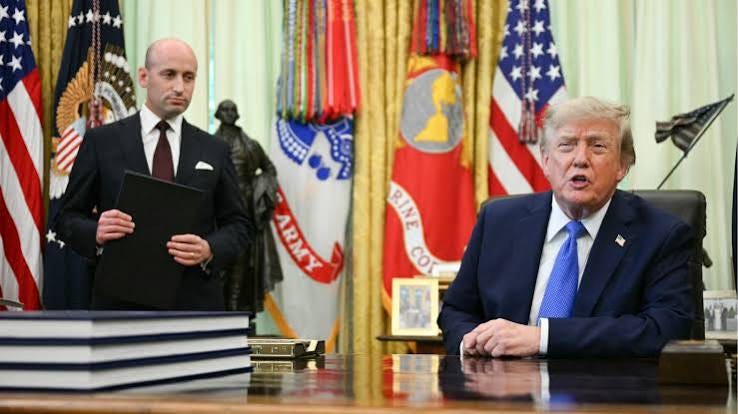
Five weeks after losing at the Supreme Court, President Trump on Thursday signed two new executive orders once again purporting to limit birthright citizenship. Trump has made no bones about his displeasure with the decision in Trump v. Barbara (which he loudly promised to ask the Court to rehear, only to … not follow through). But his and the White House’s efforts to describe these new orders as mere “adjustments” are, perhaps not surprisingly, deeply misleading. The new executive orders reflect a series of efforts to attempt to extend, solely by presidential fiat, the scope of the narrow exceptions to birthright citizenship that the Court reaffirmed on June 30.
As I explain below, although some parts of these new executive orders are likely to survive judicial review either because (1) they’re conditional; or (2) they merely restate what existing law already provides, the important parts are in direct conflict not just with the Fourteenth Amendment itself, but with Barbara’s reaffirmation of the breadth of the Citizenship Clause.
More on all of that in a minute. But first, the news.
On the Docket
The Court, at least as such, made virtually no news last week. There were no decisions by the full Court, and no new major emergency applications were filed. We are, of course, still waiting for the Court to rule on the emergency applications filed by the Trump administration and a group of red states in the mail-in ballots litigation—which I covered in more detail here, and which have been fully briefed since Tuesday. It’s entirely possible that we get that ruling sometime (anytime) this week, although it’s just as possible that we … don’t.
Speaking of emergency applications, we may also get one from the Trump administration this week in the ballroom case, given the 2-1 ruling by the D.C. Circuit on Friday reaffirming “(i) Congress’s full constitutional control over federal property and the funding of its maintenance and development, (ii) the absence of any express or implied authorization for the ballroom construction, and (iii) express statutory limitations that the ballroom construction violates.” In the same ruling, the panel denied as moot the Trump administration’s request for a stay pending appeal, but it also paused its ruling for 14 days to give the government time to ask the Supreme Court for the same relief. After a relatively quiet period with regard to emergency applications from the Justice Department, we may be entering a new, busy one.
Finally, although it’s not really news, Justice Alito gave another “interview” in the Wall Street Journal with James Taranto. This one doesn’t have quite the same stunners as the one from 2023 (in which Alito argued, with a straight face, that “no provision in the Constitution gives [Congress] the power to regulate the Supreme Court”). But it’s still an interesting read, even if it’s also a good reminder of how infrequently the justices are confronted with questions they don’t want to answer. (Now there’s an idea for a future post…)
The One First “Long Read”: Déjà Vu, All Over Again
On June 30, in Trump v. Barbara, a 6-3 majority of the Supreme Court affirmed that children born in the United States to parents who are unlawfully or temporarily present are “subject to the jurisdiction” of the United States and are citizens at birth. Justice Kavanaugh concurred in the judgment and dissented in part; Justices Thomas, Gorsuch, and Alito each dissented.
More important than the vote count is the reasoning. Chief Justice Roberts grounded the Citizenship Clause in the common-law rule the Reconstruction Congress meant to constitutionalize: “the status of citizenship” is “fixed by the place of nativity, irrespective of parentage,” subject to a limited exception for “the children of foreign ministers, and of other persons who may be within our territory with rights of extraterritoriality.” Those exceptions were limited (to three) and narrow: children born in lands the sovereign did not control, children born in areas temporarily outside the sovereign’s control, and children of foreign ministers—the last “by a fiction of extraterritoriality.” The Court also said, specifically, that aliens who come here for “business or pleasure” get no exemption from U.S. jurisdiction, and that their children born here are citizens.
What ties those exceptions together is sovereignty—not on the part of the non-citizen, but on the part of the U.S. government. Each asks whether the United States actually had legal authority over the place and the person at the moment of birth. That was the whole point of the Reconstruction rule. It replaced tests based on parentage or on somebody’s judgment about worthiness with a territorial rule officials would have little room to manipulate. Being “subject to the jurisdiction” of the United States meant being born inside a legal order that could protect you, regulate you, and punish you, no matter who your parents are.
On August 6, the President signed two orders. The first, “Continuing to Protect the Meaning and Value of American Citizenship,” directs federal agencies not to issue or accept documents recognizing citizenship for certain U.S.-born children where neither parent is a citizen. The second, “Ending Birth Tourism,” directs State and DHS to deny visas to suspected birth tourists. Agencies have 30 days to issue implementing guidance.
Everything in the first order hangs on six words from Barbara: “for whom no extraterritorial fiction applie[s].” The White House fact sheet says the new categories are exceptions “the Supreme Court recognized.” Here is the sentence they come from: “Any child who was born ‘under the protection of’ the United States—that is, any child for whom no extraterritorial fiction applied—was made a citizen.” Roberts wrote that to explain why the rule is broad. The order wrongly reads it as authority to make the rule narrower.
Before getting to the unconstitutional parts, let’s start with the parts of the orders that don’t change anything. This is an important baseline, because it allows the administration to say that “some” of the order is “merely” reaffirming settled law:
The accredited-diplomat core. Barbara affirmatively reaffirmed an exception for “the children of foreign ministers,” and existing regulations already implement it: under 8 CFR 101.3, a child born here to “a foreign diplomatic officer accredited to the United States” is not subject to U.S. jurisdiction and is not a citizen. The reason is not complicated. Accredited diplomatic agents are immune from U.S. criminal jurisdiction and largely from civil and administrative jurisdiction, so American law does not reach them in the ordinary way. On this much the order restates settled law, and nobody will sue over it. The problem is how it purports to build out from the foreign ministers themselves. More on that below.
Territories. The order also reaches births in U.S. territories and territorial waters where citizenship isn’t conferred by statute. As of today, that’s exactly one territory: American Samoa. And as I’ve written about before, both the Tenth and D.C. Circuits have held (wrongly, in my view) that the Citizenship Clause doesn’t apply to American Samoa, either (see also this 2017 Harvard Law Review Note)—which means the new executive order merely reflects existing law. The other territories are all covered—Puerto Rico under 8 U.S.C. § 1402, the U.S. Virgin Islands under § 1406, Guam under § 1407, and the Commonwealth of the Northern Mariana Islands under the 1976 Covenant. Congress could repeal those statutes, of course. But the executive order doesn’t (and can’t) do it for them.
Thus, with respect to the territories, the order does … nothing.
Just about everything else is attempting to enlarge, by executive order, one of the existing historical exceptions. The foreign-employee provision widens the diplomat exception. The alien-enemy provision widens the enemy-occupation exception. The surrogacy provision tries to manufacture an extraterritorial fiction out of a private contract. The fraud provision tries to turn misconduct (which could provide the basis for denaturalization) into an absence of jurisdiction. Under Barbara, each should turn solely on where the birth happened and whether American sovereign authority applied at that time. It should not turn on whether officials can pin a disqualifying label on a parent.
“Foreign government employees” beyond accredited diplomats. This provision is easiest to mistake for existing law. It is not. The order does not stop at those diplomats who are outside the jurisdiction of the United States because they enjoy diplomatic immunity. Rather, it purports to create a broader “foreign government employee” category, including an embassy employee who is a national of the country he works for. It also reaches employees of international organizations with international-organization immunity—never mind that international-organization immunity is meaningfully distinct from diplomatic immunity.
This all sweeps well past the current rule. Under settled practice, a child born to a consular officer, a locally hired embassy staffer, or an administrative employee without full diplomatic immunity is a U.S. citizen at birth. So the substitution matters. The existing exception rests on actual immunity from American law; the order rests on foreign employment. But the extraterritorial fiction exists only because the parent is formally beyond the reach of American courts and police. A consular officer who can be prosecuted, sued, and regulated here is subject to U.S. jurisdiction in precisely the sense that Chief Justice Roberts meant in Barbara. As applied to everyone other than the foreign ministers with diplomatic immunity, the order would violate the Fourteenth Amendment.
Surrogacy. The order also purports to deny citizenship to children born in the United States whose parents “engage in a commercial transaction with a surrogate present in the United States, or a territory of the United States, to give birth.” This may be the weakest provision in the package. The problem is not only that surrogacy appears nowhere in the historical exceptions. The trouble runs deeper: it has nothing to do with why those exceptions exist in the first place. A surrogate physically present in the United States is subject to American law in every respect (unless, I guess, the surrogate is a foreign ambassador with diplomatic immunity). Again, the order reasons by analogy: diplomats are treated by fiction as outside territorial jurisdiction, so perhaps a private contract can do similar work. But the constitutional question is not whether an arrangement is commercial or even evasive. It is whether the birth happened under American sovereign authority. To sustain this, the government would have to convince a court that a surrogacy contract does the same jurisdictional work as diplomatic immunity. That was a non-starter even before Barbara.
“Commercial transactions” and fraud. The order also covers parents who “engaged in a commercial transaction to purchase or access birthright citizenship.” That includes paying to get the mother here to give birth. The theory seems to be that fraud somehow generates an extraterritorial fiction. But again, we come back to the same problematic move: A rule about people formally outside American sovereign authority becomes a rule about people who allegedly lied their way in. But Barbara held that visitors here for business or pleasure remain subject to U.S. jurisdiction. A child born in Houston is no less within American authority because of what her mother paid a middleman (like, you know, a travel agent).
A mother’s intent. The order also reaches babies of mothers who lie about their reasons for visiting while pregnant. Consider what that means in practice. A child’s citizenship would depend on a federal official’s after-the-fact judgment about what her mother was thinking at a port of entry sometime before the child was born. Folks have already pointed out that it’s not clear how any of this could be enforced. This isn’t a drafting glitch; it’s what happens when constitutional status rests on an unprovable fact about somebody else. To be sure, there are existing authorities to pursue denaturalization of naturalized citizens who obtained their citizenship through fraud. But even in the most supportive hypothetical, a child born on U.S. soil isn’t obtaining their citizenship from their parents’ fraud; they’re obtaining their citizenship from being born on U.S. soil. They’re not naturalized citizens; they’re birthright citizens.
“Alien enemies.” Finally, this last category deserves more care than it has received, because the exception does have a genuine historical pedigree. Barbara acknowledged an enemy-related exception. It discussed the old rule that if enemies “possess” a “castle or fort,” children born there were not born under the sovereign’s allegiance. So a child born to British parents in an area under British control during the War of 1812, say, would not have been a birthright citizen (even if the Citizenship Clause existed then).
But the order tries to dramatically expand this category to include any parent who belongs to a designated Foreign Terrorist Organization under 8 U.S.C. § 1189, or who is a Specially Designated Global Terrorist under IEEPA and Executive Order 13224. There is a massive gap between the foreign-occupation exception to birthright citizenship and membership in a designated FTO or designation as an SDGT. Indeed, it is entirely possible for groups/individuals to end up on those lists without doing anything in the United States. Even knowingly funding an organization the individual has reason to believe may be engaged in acts of international terrorism is still not within a country mile (or, really, ocean) of being an occupying power on U.S. soil.
Just to put the matter directly, part of why the British child during the War of 1812 couldn’t be a citizen is because he couldn’t be arrested, prosecuted, sanctioned, and deported; he was outside U.S. jurisdiction both formally and practically. Given how regularly the government uses the FTO and SDGT designation processes to impose consequences on U.S. soil, it should be obvious how these processes involve an entirely different category of behavior than what the historical exception was meant to encompass. This goes well past nibbling at the margins; it’s taking the historical exceptions and twisting them into pretzels.
***
It’s pretty obvious that these expansions can’t be reconciled with Chief Justice Roberts’s opinion in Barbara. It’s worth noting, though, that they also can’t be reconciled with Justice Kavanaugh’s opinion concurring in the judgment and dissenting in part. Kavanaugh may believe that Congress can expand the exceptions by statute, but his opinion was unambiguous that the President can’t do it by himself—which is why he agreed that the January 20, 2025 executive order is unlawful (because it’s inconsistent with the current statutes respecting birthright citizenship). The same would be true here.
If the relevant parts of the executive order are almost certainly to be struck down by the Supreme Court, then why go through the motions? Indeed, Stephen Miller called this one of the most important immigration reforms of the presidency.
I have two theories. The first is procedural: Unlike with regard to the January 20, 2025 birthright citizenship order, it’s not as immediately clear who can sue to challenge at least some of these provisions—e.g., the efforts to expand the alien enemy exception. And even with plaintiffs with standing, Trump v. CASA sharply curtailed universal injunctions, so a plaintiff who wins may protect only herself unless she can proceed as a class (which, again, may be only one provision at a time), or find another route to systemwide relief. Barbara itself was a class action, but a challenge to this order may take five or six class actions on behalf of different groups (or an attempt at universal relief by states, who would be stuck trying to figure out how to implement this mess if it ever goes into effect). I still think this will get sorted, but it’s more complicated—and the administration may be planning to battle adverse lower-court rulings on procedural grounds, as much as on substance.
My second theory is that at least part of the goal isn’t to win here, but to continue moving the Overton Window on citizenship—and to more generally try to muddy the waters when it comes to describing categories of non-citizens. Diplomats become indistinguishable from foreign employees. Enemy occupation gets blurred with statutory sanctions listings. Diplomatic extraterritoriality somehow morphs into a template for surrogacy contracts. And sovereign jurisdiction is converted into a subjective after-the-fact judgment about fraud or a mother’s motives. Each move uses a specific historical exception as a justification for executive branch line-drawing. If that works, citizenship stops being a fact fixed at birth and becomes an administrative conclusion reached afterward based upon shifting executive branch priorities. The question would no longer be whether a child was born under American sovereignty. It would be whether officials can pin a disqualifying label on her parent. It’s ugly; it’s wrong; and it’s already succeeding more than I would’ve expected 18 months ago.
That brings me to one last point: President Trump defended all of this by saying the Fourteenth Amendment “was for the babies of slaves” and that people are now building businesses around it, and by claiming the United States is “just about the only country, period,” that does birthright citizenship. The second claim is utterly false; there are at least 32 other countries that recognize a similar rule, and 50–60 more that recognize birthright citizenship in at least some form.
The first claim attempts to be a history lesson, which is what makes it so dangerously misleading. The Citizenship Clause was indeed written to repudiate Dred Scott, the 1857 Supreme Court decision holding that Black people could never be citizens. But the Reconstruction Congress did not swap one caste rule for a narrower one; it extended the promise to “every free-born person in this land.” The idea wasn’t just to retroactively protect “the babies of slaves”; it was to prospectively forestall all future efforts to deny citizenship based on whatever other non-sovereignty-based criteria might be politically popular in any given moment. That is the principle the Supreme Court just reaffirmed in Barbara—a principle that is fundamental to what it means, constitutionally, to be an American, no matter what President Trump, Stephen Miller, or even certain Supreme Court justices might prefer.
SCOTUS Trivia:
The First SCOTUS Recess Appointment
I’ve written before about the phenomenon of “recess” appointments to the Supreme Court—when presidents have temporarily installed justices during formal recesses of the Senate. The first of those happened 231 years ago this Wednesday, when President Washington appointed John Rutledge to be the nation’s second Chief Justice (so that Rutledge could preside over the Court’s August term). In the process, Rutledge became the first justice to ever serve two non-consecutive terms on the Court (Charles Evans Hughes is the only other person to do it).
Unbeknownst to Washington, in late July, Rutledge had delivered a blistering attack on the Jay Treaty with Great Britain at a public gathering in Charleston, South Carolina. In the speech, he said, among other things, that he would rather see the President die than sign it. The Senate had ratified that treaty three weeks earlier, by the barest two-thirds margin. The Federalists who supplied those votes were in no mood to hear it trashed by the man now sitting in Jay’s old chair. Soon, treaty supporters spread word that the speech was proof Rutledge was losing his mind, and pressed Washington to withhold the commission. Washington kept his promise anyway, and Rutledge took his seat.
Once the Senate returned in December, however, it voted 14–10 against him—the first time it ever refused a Supreme Court nominee. After 138 days, Rutledge resigned on December 28 (even though he probably could have served until the end of the Senate session the following year—when his recess appointment expired), and he remains both the shortest-serving Chief Justice and the only recess appointee to the Court whom the Senate declined to confirm.
I hope that you’ve enjoyed this installment of “One First.” If you have feedback about today’s issue, or thoughts about future topics, please feel free to email me. And if you liked it, please help spread the word!
If you’re not already a paid subscriber and are interested in receiving regular bonus content (or, at the very least, in supporting the work that goes into this newsletter), please consider becoming one:
This week’s bonus issue will drop on Thursday. As ever, I hope you are all staying safe out there, especially from unconstitutional executive orders.
It also moves the Overton Window in that the original EO purported to reach children with no parent who was a citizen *or* a Legal Permanent Resident. This one dispenses with the latter exception. It is another move in the direction of trying to make citizenship a matter of blood and descent (jus sanguinis) instead of where you are born.
I have a third theory why Trump is trying this. One reason the Supreme Court ruled as it did in Barbara is it had no real choice if it was to maintain a facade of impartially ruling on the law and the Constitution - the text of the Constitution is just too clear. By making up some scenarios that may not be as obviously wrong to the casual observer, Trump is hoping the Supreme Court will feel more entitled to rule in his favor.