

Welcome back to “One First,” a newsletter that aims to make the U.S. Supreme Court more accessible to lawyers and non-lawyers alike. I’m grateful to all of you for your continued support (this post is our 400th overall!), and I hope that you’ll consider sharing some of what we’re doing with your networks.
Every Monday morning, I’ll be offering an update on goings-on at the Court (“On the Docket”); a longer introduction to some feature of the Court’s history, current issues, or key players (“The One First ‘Long Read’”); and some Court-related trivia. If you’re not already a subscriber, I hope you’ll consider becoming one—and upgrading to a paid subscription if your circumstances permit:
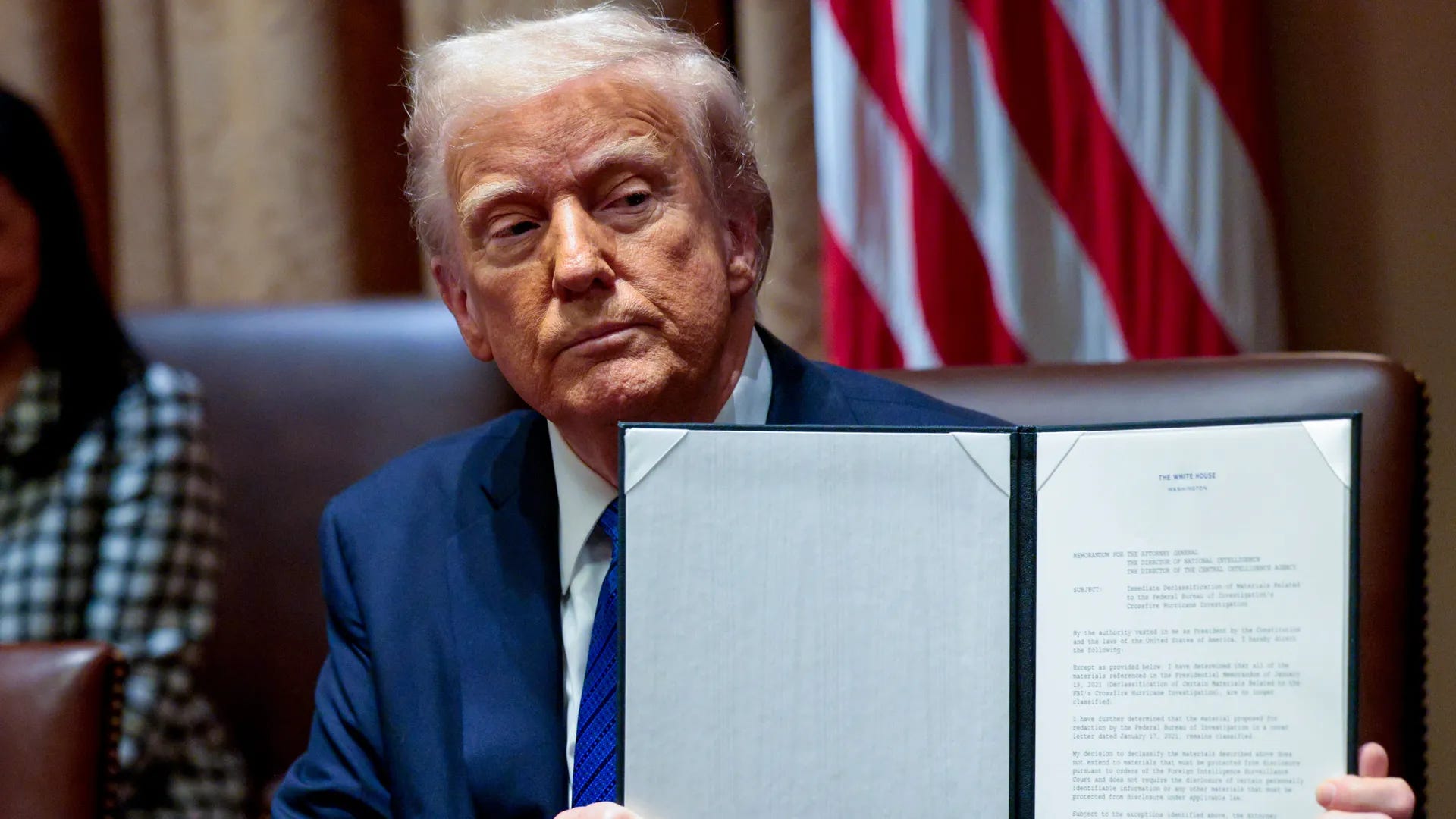
In an effort to cajole the Senate into passing the deeply controversial “SAVE” Act, President Trump has continued to publicly make claims about his putative authority to ban certain voting practices (like mail-in ballots) through unilateral executive action. Leaving aside the wildly overstated voter fraud claims purportedly animating these efforts, and the not-so-subtle attempt to make it harder for Americans without ready access to government-issued identification to vote, I wanted to use today’s “Long Read” to explain why the President’s threats are both legally and practically empty.
The legal argument is straightforward enough: the President has neither unilateral constitutional authority nor delegated statutory authority to set nationwide election rules. (This is why the SAVE Act is even on the table.) But for those who wave their hands and say “that hasn’t stopped this administration before” (even though, in point of fact, it has), there are also some pretty significant practical reasons why the President’s threats can’t amount to anything in practice, most of which sound in long-settled principles of constitutional federalism.
That doesn’t mean we won’t see other efforts from this administration and its supporters to interfere with—and otherwise attempt to undermine—the electoral process come this fall. But the President changing the rules all by himself is, both legally and practically, a complete non-starter.
More on that below. But first, the (Court-related) news.
On the Docket
The Merits Docket
The Court made virtually no news on the merits docket last week. It released the oral argument calendar for the April argument session; and, although the actual move happened back on February 5, the release of the calendar confirms that the Court agreed to take one of the cases granted back in January—Anderson v. Intel—and kick it to next term. That means that, barring a late-breaking development, we’re looking at no more than 56 “merits” decisions in argued cases this term, which will be tied for the second-lowest total since … 1864.
The Emergency Docket
The only rulings from the full Court last week were a pair of denials of stays of execution in capital cases—Tuesday’s order refusing to block Florida’s execution of Ronald Heath; and Wednesday’s order refusing to block Oklahoma’s execution of Kendrick Simpson. Both came over no public dissents.
The Court also received a pair of high-profile applications by (and in support of) Republican Congresswoman Nicole Malliotakis, who’s asking the justices to restore the map of her specific New York congressional district, which was blocked by a New York state court on the ground that the map unlawfully diluted the voting power of Black and Latino residents. The Trump administration has joined the party—filing (yet another) uninvited amicus brief in support of emergency relief.1 But for all of the mischief the Court has wrought through emergency interventions under the so-called “Purcell principle,” that principle has been focused on limiting the ability of federal courts to change the rules of an election as Election Day nears. Intervening to block a state court ruling would be a dramatic expansion of Purcell even for this Court.
The only other pending emergency application of note is the long-pending application in a lawsuit challenging a California state law that bars teachers from notifying parents that their students have identified as transgender. A district court had preliminary enjoined the law, only to have that injunction partially stayed by the Ninth Circuit. Back on January 8 (i.e., nearly six weeks ago), the plaintiffs asked the Court to vacate the Ninth Circuit’s stay. It’s possible that the justices are waiting to see what happens next in the lower courts, or that someone is writing one heck of a dissent from a denial. But either way, that one is more than ripe for a ruling from the full Court, too.
The Week Ahead
Turning to this week, the justices are back on the bench on Friday, when they are also expected to hand down more rulings in cases argued earlier this term. It’s certainly possible that the tariffs ruling will be among them (I’d always predicted “late February”), but the Court has also announced that it is likely to hand down rulings in argued cases next Tuesday and Wednesday, as well. All of that’s to say, the odds are certainly pretty good that the tariffs ruling will be in there somewhere, but (1) that’s by no means a certainty; and (2) in any event, there’s no indication as to the specific date on which it might drop. Otherwise, nothing else is expected from the Court until next Monday—when the Court will issue a regular Order List out of this Friday’s Conference at 9:30 ET, before kicking off the February argument calendar at 10:00.
Miscellaneous
Finally, on a personal note, I wanted to plug the launch of a new podcast, titled “Uncles-in-Law,” featuring Matt Mira (Karen’s sister Doree’s husband); Michael Shafrir (Karen’s brother/my brother-in-law); and me. The double entendre notwithstanding, it’s not (at least to this point) especially law-heavy. Rather, it’s the three of us, who see each other in person far too seldom, mostly chatting about current events; a fair amount of sports; and the different (if very first-world) parenting challenges we each get to encounter on a daily basis. We’re recording it both for audio and video, so you can find it on Apple Podcasts (or wherever you find your podcasts) and/or YouTube.
The One First “Long Read”:
President Trump’s Empty Elections Rhetoric
President Trump’s latest election-related focus has been about voter ID requirements—and his (apparent) goal to impose them as a uniform requirement before voting in federal elections. In the words of his TruthSocial account, “There will be Voter I.D. for the Midterm Elections, whether approved by Congress or not!”
The “or not” part is the problem. The relevant constitutional provision is the Elections Clause—Article I, Section 4: “The Times, Places and Manner of holding Elections for Senators and Representatives, shall be prescribed in each State by the Legislature thereof; but the Congress may at any time by Law make or alter such Regulations.” As the text suggests and as the Supreme Court has long explained,
The Clause is a default provision; it invests the States with responsibility for the mechanics of congressional elections, but only so far as Congress declines to pre-empt state legislative choices. Thus it is well settled that the Elections Clause grants Congress “the power to override state regulations” by establishing uniform rules for federal elections, binding on the States.
For a host of reasons, Congress has only established a handful of such uniform rules—such as an 1842 statute requiring single-member House districts; subsequent statutes requiring House districts to be contiguous, compact, and with substantial equality of population; and the 1872 statute creating, as amended, a nationwide Election Day. Congress has also used other powers (such as its powers to enforce the Fourteenth and Fifteenth Amendments) to pass other legislation relating to voting. But with a handful of exceedingly modest exceptions, Congress has otherwise left the rules for the times, places, and manner of elections to state governments—even for elections to the House, the Senate, and the presidency.
This reality matters to President Trump’s ongoing efforts to purport to interfere with state election rules in two different respects: First, any legal authority to so interfere must come from a statute—not from the Constitution itself. And there’s no existing federal statute that gives the federal government as a whole, let alone the executive branch by itself, the unilateral authority to set identification requirements for everyone voting in federal elections.
Second, the distribution of responsibility for elections is also the biggest practical obstacle to President Trump attempting to impose new federal rules through executive order: no one who’s actually in charge of those elections would be bound to comply with such an order. So unlike the President’s ability to order, say, executive branch agencies (or, say, immigration judges) to obey an unlawful executive order, here, he’d have no coercive power whatsoever. Some jurisdictions may choose to comply with an unlawful election-related executive order from the Trump administration, but the key for present purposes is that it would be those state/local officials’ choice, not a federal mandate, that does the work.
Indeed, we’ve already seen this movie. As folks may recall, President Trump attempted last March to impose by executive order new identification requirements before individuals could register to vote—trying to rely on the federal government’s control of the Election Assistance Commission (and, through it, the National Mail Voter Registration Form) to implement his wishes. (That executive order prompted a bonus post from me on “What Executive Orders Can (and Can’t) Do.”)
Well, the D.C. federal district court has since preliminarily, and now permanently, enjoined the executive branch from implementing the key provision of that order—entirely on the ground that it violated the separation of powers by purporting to exercise power belonging only to Congress. And that was where Congress already has created at least some federal presence in the field (by creating the EAC and the federal voter registration form). There, at least, Congress had done … something, and the entity the President was seeking to strongarm was a federal one. Trying to impose a national voter ID requirement through executive order would thus be even more vulnerable to legal challenge—and even harder for the President to try to cajole the relevant actors into undertaking anyway.
It is, or at least ought to be, deeply alarming that we’re even having to talk about a President trying to unilaterally change the rules for federal elections—especially given this particular President’s … history … concerning respect for the integrity of our electoral processes. One might also point out that the number of eligible voters who would likely be disenfranchised by the SAVE Act this fall is many degrees of magnitude higher than the total number of documented cases of voting by non-citizens over decades’ worth of elections. But without getting too deep into the policy debate here (which ought to militate against both disenfranching eligible voters and empowering this specific President), it’s worth underscoring that there’s just no viable legal argument, and no plausible practical basis, on which a President could unilaterally tell states that don’t want to listen how they must run their elections—including what, if any, identification registered voters need to produce in order to cast their ballots.
If the SAVE Act doesn’t make it through the Senate, that should be the end of the matter, at least on this topic, and at least for now.
SCOTUS Trivia: Justices as Presidential Candidates
Given Justice Alito’s book announcement (and the near-simultaneous announcemment of a biography hagiography from a sympathetic right-wing commentator), there’s been a fair amount of speculation that Alito is going to retire before this term is up. (FWIW, I agree; the October publication date is a pretty big tell since one can’t exactly go on a book tour during the first argument session of the term.)
Although I don’t imagine that Justice Alito is envisioning much of a political career after leaving the bench, that gossip—and today’s topic—got me thinking a bit about justices who were serious contenders for the presidency. As Penn State professor Rachel Shelden documents in her (wonderful) forthcoming book, The Political Supreme Court, it was actually quite common, especially in the nineteenth century, for justices to be actively involved in national politics—including in conversations about running for the presidency.
The most famous modern example, of course, is Charles Evans Hughes—who resigned from the Court in 1916 to accept the Republican nomination for President. (Folks unfamiliar with the Election of 1916 may not appreciate just how close Hughes came to winning; he would’ve won with just another 3773 votes in California alone.) To this day, Hughes is the only justice to subsequently receive a major party’s presidential nomination.2 And, of course, he returned to the Court as its 11th Chief Justice in 1930.
But we may have come even closer to a former-justice-turned-president in 1945. Of course, just about everybody knows that Franklin Delano Roosevelt tapped Missouri Senator Harry S Truman to be his running mate in 1944 in lieu of Vice President Henry Wallace, so that it was Truman who succeeded to the presidency upon FDR’s April 12, 1945 death. But heading into the Democratic National Convention in Chicago, the other name that was bandied about the loudest to replace Wallace on the ticket was that of Justice William O. Douglas—who FDR had appointed to the Court five years earlier. As I noted in a December 2023 issue of the newsletter, FDR
apparently told his advisors that he’d be happy with either Douglas or Missouri Senator Harry S Truman. But the incoming party chairman, Robert Hannegan, who strongly supported his fellow Missourian, managed to have the names reversed in the version of the note from Roosevelt that was shared with convention delegates—so that it appeared as if Roosevelt preferred Truman over Douglas: “You have written me about Harry Truman and Bill Douglas,” the circulated version of FDR’s note read. “I should, of course, be glad to run with either of them and believe that either of them would bring real strength to the ticket.”
Truman might have won the vice-presidential nomination anyway. But it’s fascinating to wonder how history might have been different if the note had listed Douglas and Truman in order—and if that had led to Douglas’s election as Vice President in 1944 and his succession to the presidency in 1945.
I hope that you’ve enjoyed this installment of “One First.” If you have feedback about today’s issue, or thoughts about future topics, please feel free to e-mail me. And if you liked it, please help spread the word!
If you’re not already a paid subscriber and are interested in receiving regular bonus content (or, at the very least, in supporting the work that goes into this newsletter), please consider becoming one:
This week’s bonus issue for paid subscribers will drop on Thursday. And we’ll be back with our regular content for everyone no later than next Monday (and, if I were a betting man, sooner). As ever, please stay safe out there.
As Arnold & Porter partner (and savvy SCOTUS veteran) John Elwood noted in a post for SCOTUSblog last week, the Solicitor General has filed an unprecedented number of “uninvited” amicus briefs at the cert. stage and respecting emergency applications—weighing in to support review in cases in which the federal government is not a party, something the “SG” used to do only once in a blue moon. As I told my CNN colleague John Fritze for his story on this striking pattern, “[i]t’s using the solicitor general’s unique position as a way to push not just the policy and political agenda of the current president, but the broader ideological agenda of the Republican Party.” And the Malliotakis case is, alas, yet another example.
According to the memoirs of Wilson’s Secretary of State, Robert Lansing, Wilson was prepared, in the event of a loss, to immediately appoint Hughes as Secretary of State and then resign, along with his Vice President—so Hughes could immediately assume the office of the presidency (and confront the increasingly likely specter of U.S. entry into World War I).
Might I suggest referring to the SAVE act as the SAVE TRUMP act? Or is it too honest?
I’m most worried about voter intimidation thru the use of ICE at polls.
Lawyers like yourself&Marc Ellias&some judges will probably curtail Trump’s more ridiculous ideas about the law.