

Welcome back to “One First,” a (more-than) weekly newsletter that aims to make the U.S. Supreme Court and related legal topics more accessible to lawyers and non-lawyers alike. I’m grateful to all of you for your continued support—and I hope that you’ll consider sharing some of what we’re doing with your networks:
Every Monday morning, I’ll be offering an update on goings-on at the Court (“On the Docket”); a longer introduction to some feature of the Court’s history, current issues, or key players (“The One First ‘Long Read’”); and some Court-related trivia. If you’re not already a subscriber, please consider becoming one. And with the arrival of the holiday season, you might also consider whether a gift subscription would be a welcome present (or, at least, an amusing gag) for a friend or family member:
With the Court making relatively little news last week, I wanted to use this week’s “Long Read” to respond to a post by my friend and Wash U. law professor Dan Epps on Friday—ostensibly in defense of (the now-Dispatch-owned) SCOTUSblog’s choice to call its new blog about the Court’s emergency docket the “Interim Docket Blog.”
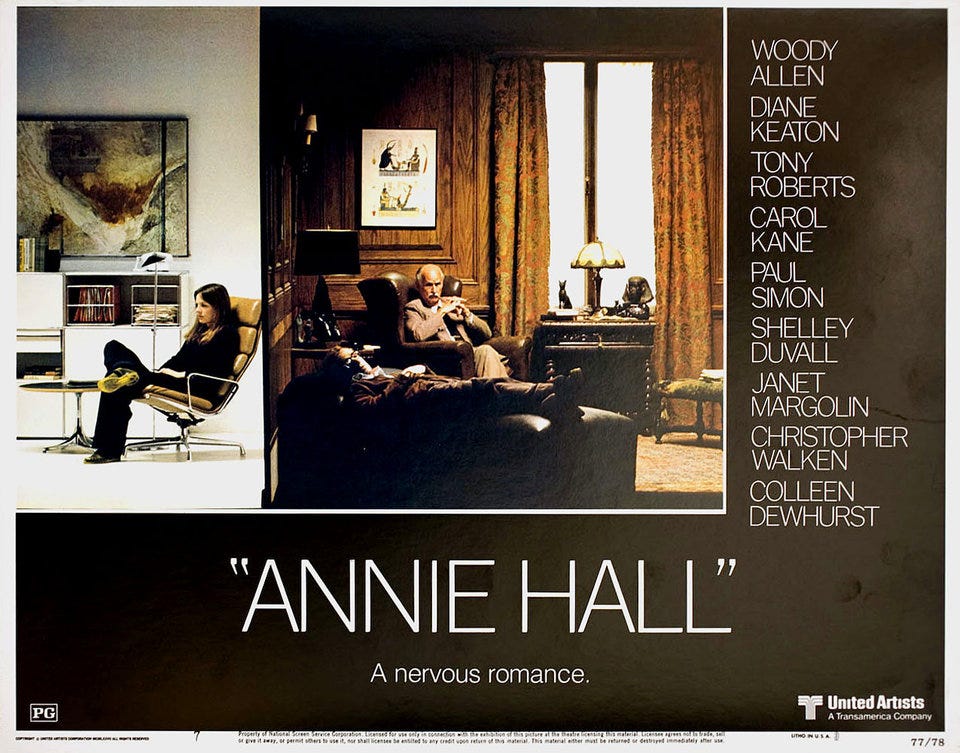
As readers know, I’ve been quite critical of Justice Kavanaugh’s efforts to thus rebrand the Court’s behavior on emergency applications—both because the branding conversation is a frustrating distraction from what the Court is actually doing and because, on the merits, it’s deeply misleading to try to downplay the significant (and often irreparable) real-world consequences and the precedential effects of the Court’s decisions by calling them “interim” rulings. In response to me making this point on Bluesky (and linking to my original post), Dan wrote a post for the new blog that accuses unnamed critics of “a certain schizophrenia” in their objections to the Supreme Court, comparing them (us?) to the two old woman in Woody Allen’s joke at the beginning of Annie Hall—one of whom complains that the food at a Catskills resort is terrible, and the other says “yeah, I know; and such small portions.” The charge, so far as I understand it, is directed at folks who often criticize the Court on both procedural and substantive grounds—and suggests, if not a lack of good faith on their part, then at least a view that they’ll never be satisfied by anything that this Court does.
Insofar as I’m fairly summarizing Dan’s charge, I think it’s balderdash, for at least two independent reasons. First, the whole point of the joke in Annie Hall is that, if the food is so terrible, small portions shouldn’t bother us—and so complaining about both says more about the person complaining than about the subject of their complaint.1 That’s just not true of critiques of the Supreme Court’s behavior here, where problematic procedural moves don’t necessarily affect the substantive legal analysis, and vice-versa. As I’ve said before, there are rulings on emergency applications with which I disagreed, but where I thought the Court was mostly by the book, and vice-versa.
Second, and in any event, I don’t doubt that there are some folks who care only about the results in these cases, and so will gravitate toward any critique that undercutes a ruling they don’t like. But insofar as at least some critics are being consistent, and are offering neutral procedural and/or substantive criticisms of the Court’s work that ought to apply regardless of the result, it seems to me that responses to those critiques should be explaining why the neutral criticisms are wrong—rather than accusing those offering them of “schizophrenia.” Indeed, the point of my Bluesky post was to challenge the folks writing for this new blog to respond to the substance of the lengthy critique of the “interim docket” label that I offered back in September. Alas.
More on all of this below, but first, the (real) news.
On the Docket
The Merits Docket
The Court did not add any new cases to its plenary docket in last Monday’s regular Order List. But it took two actions that might augur significance going forward. First, it issued a “GVR” (granting certiorari, vacating the decision below, and remanding for further consideration) in a challenge to a 2019 New York law that bars religious exemptions to school vaccine requirements. Specifically, the GVR was in light of the Court’s ruling earlier this year in Mahmoud v. Taylor—a not-so-subtle message to the lower courts to reconsider whether the New York law violates the Free Exercise Clause. Second, and speaking of New York and vaccine mandates, the Court called for the views of the Solicitor General (i.e., the Trump administration) in a challenge by healthcare workers to New York’s COVID vaccination mandate for the healthcare industry. The petitioners argue that they were entitled under federal statutes (specifically, Title VII) to a religious exemption from that mandate. We likely won’t hear from the SG for awhile, but it’s very possible that this Justice Department will encourage the Court to take up this issue—perhaps as soon as next term.
The Court also handed down what has to be a contender for the shortest per curiam opinion in its history—a two-paragraph summary reversal in Doe v. Dynamic Physical Therapy, in which the justices brusquely reminded the Louisiana state courts that “a State has no power to confer immunity from federal causes of action.” The full opinion runs 212 words—providing yet further evidence for the proposition that the length of the Court’s disposition isn’t what’s driving when the Court chooses to hand down a ruling on an application as an “order” versus when it hands it down as/with an “opinion of the Court.” And Justice Sotomayor appended a three-page statement to the denial of certiorari in Davenport v. United States—reminding lower federal courts that “Federal courts are not prohibited from defining reasonable doubt for the jury.”
Otherwise, the real news on the merits docket last week came from the oral arguments—including Monday’s argument in Trump v. Slaughter, which I wrote about in last week’s bonus issue.
The Emergency Docket
It was a surprisingly quiet week on the emergency docket. Besides summary full Court denials of three applications that had already been denied in chambers, the full Court only took a single action on a pending application—denying a stay of execution to Tennessee prisoner Harold Nichols, who was executed later on Thursday. There were no public dissents.
We’re still waiting for the Court to act on the two pending emergency applications from the Trump administration—the very-long-pending application in the Illinois National Guard case; and the now-fully briefed application in the immigration judges case (where the real dispute is over which challenges to Trump administration actions by current or former federal employees can be brought in district court and which must be brought to the … not very independent … Merit Systems Protection Board). It seems a decent bet that we could get both of those rulings this week—and certainly at least one of them.
The Week Ahead
Speaking of the week ahead, we expect a regular Order List from the Court at 9:30 this morning—and nothing else. The justices are not set to meet formally in person again until January 9—which is also the next time we expect the Court to take the bench. Whether it will hand down opinions in argued cases then remains to be seen. But any rulings between now and then will be on emergency applications—and so can (and will) come at any time.
The One First “Long Read”:
Procedure vs. Substance in Supreme Court Critiques
It has become an all-too-common feature of contemporary discourse for participants, rather than responding to someone’s substantive arguments, to attack the person making them. This feature, unfortunately, makes regular appearances with respect to criticisms of the current Supreme Court—with the critics being accused of partisan hackery; bad faith; or some combination of both.
My own view has long been that these attacks, by not actually engaging with the substance of the criticisms to which they are purportedly responding, are mostly just telling on themselves. But in this case, I think it’s worth unpacking the two very different ways in which the Annie Hall quip seems like an especially poor fit for those whose criticisms of the current Supreme Court include both procedural and substantive arguments.
Let’s start with what should be the more obvious point: The correlation that makes the Annie Hall joke work just doesn’t exist here. Take, for instance, one of my biggest critiques of the Court’s behavior on emergency applications—its refusal to write majority opinions or otherwise provide explanations, especially in cases in which it is granting emergency relief and thus upsetting the status quo. Well, the criticism goes, if the Court writes an opinion, someone like me is just going to criticize that, too—which just proves that my procedural objection isn’t really serious.
It is certainly possible that I’ll disagree with what the Court would write in these cases, but it’s by no means a given. If the Court were, among other things, to correctly identify the standard of review for granting emergency relief, and then apply that standard faithfully, I really wouldn’t have much to criticize even if I personally disliked the result. This is how I’ve generally felt, to take just one example, about the August 2021 ruling blocking the CDC’s COVID-based eviction moratorium. Likewise, there are examples of grants of emergency relief that I very much agreed with, but wish the Court would’ve explained—as in, to take just one example, the mifepristone cases. One can think the Court should be explaining itself whether or not one either (1) likes the results or, (2) if the Court does write, agrees with what it says.
If anything, the Annie Hall bit seems especially inapt here—where there’s at least a chance that, if the Court was impelled to write whenever it granted emergency relief, that might actually lead the justices to a different outcome because the one for which they’ve voted “just won’t write.” One of the biggest problems with not writing when granting emergency relief, in my view, is that it absolves the justices of the responsibility to articulate the very neutral principles that are demanded of their critics.
More generally, it just doesn’t follow that one must be either a procedural critic of the Supreme Court or a substantive critic. The charge that the Court needs to provide more explanation when it grants emergency relief would, quite obviously, be obviated if the Court writes, but the fact that the Court provides a written explanation for a particular ruling hardly immunizes what the Court writes in that opinion from its own criticisms.
And that brings me to the second point: The critique that certain Supreme Court critics are “schizophrenic” would have a lot more traction if it included explanations for why those critics’ objections are actually unpersuasive. I already flagged my post setting forth what I see as the serious arguments against using the term “interim docket” as a descriptively neutral (or accurate) means of referring to the Court’s rulings on emergency applications; one might respond to that post by … responding to that post.
More generally, back in October, I wrote a post titled “The Missing Defenses of the Court’s Behavior,” in which I highlighted the remarkable paucity of serious, sustained efforts by any academics or other commentators to holistically defend the Supreme Court’s behavior on emergency applications over the past 10 months, as opposed to picking out individual interventions and defending them in a vacuum. As I wrote back then:
[M]aybe one can defend the Court granting emergency relief more often than ever before and in cases with far greater real-world (and structural) impacts. And maybe one can defend the Court altering (if not completely scrapping) the traditional balance of the equities in these cases. But does that defense extend to the Court doing so especially in cases in which President Trump is a party—and no others? And does it extend to the Court doing all of this without usually providing written explanations of what it is doing—or why? And even if the answer is somehow “yes,” does it also extend to the Court doing all of this, not usually explaining what it’s doing or why, and nevertheless accusing lower courts who fail to read the justices’ minds of “defying” the Court?
I have a very hard time believing that anyone can genuinely make it through even three of those sentences with a coherent defense of what the Supreme Court has done over the past seven months—let alone all five of them. I’d love to see such an argument, if it exists, but I haven’t been—and won’t be—holding my breath.
Maybe, if those writing for the “Interim Docket Blog” think the Court’s behavior is worth defending, they’ll defend it on its own terms—and not Woody Allen’s.
SCOTUS Trivia:
When Did Chief Justice Rutledge’s Tenure End?
According to the Supreme Court’s website, today (December 15, 2025) is a remarkably coincidental anniversary: It’s the 230th anniversary of the end of the tenure of the second Chief Justice, John Rutledge; and it’s the 225th anniversary of the end of the tenure of his successor, the third Chief Justice, Oliver Ellsworth. Five years apart, two chief justices’ tenures ended, according to the Court’s website, on the very same day.
Alas, I don’t think that the Court’s website is correct, at least with respect to Rutledge. As I’ve briefly written about before, Rutledge was initially appointed Chief Justice via a recess appointment by President Washington while Congress was out of session in the summer of 1795 (Rutledge was one of 14 different justices initially appointed in that manner). While his recess appointment was pending, Rutledge made the … interesting … decision to give a widely publicized speech railing against the Jay Treaty, noting that he would rather the President die than sign it. That was especially awkward given that, by the time of the speech, not only had President Washington publicly endorsed the treaty, but the Senate (whose support Rutledge would soon need) had ratified it. Between that and concerns about his declining mental capacity and apparent depression, the Senate rejected Rutledge’s nomination, 14-10, on December 15, 1795—still the only recess-appointed justice whose nomination was rejected.
But per the text of Article II, recess appointments don’t expire with a negative Senate vote; rather, they “expire at the End of [the Senate’s] next Session.” So the adverse result in the Senate did not automatically terminate Rutledge’s tenure as Chief Justice; he could theoretically have continued to serve until June 1, 1796—when the Fourth Congress’s first session formally ended. Rutledge instead chose to resign, formally stepping down on December 28—two days after a failed suicide attempt, and a date reflected, among other places, in his Federal Judicial Center biography.
December 15 is still a momentous day in the history of Chief Justices (indeed, Salmon Chase took office as the sixth Chief Justice on—you guessed it—December 15, 1864). But it wasn’t quite that momentous.
I hope that you’ve enjoyed this installment of “One First.” If you have feedback about today’s issue, or thoughts about future topics, please feel free to e-mail me. And if you liked it, please help spread the word!
If you’re not already a subscriber, I hope you’ll consider becoming one. If you are, I hope, circumstances permitting, that you’ll consider upgrading—and/or getting a gift subscription for the Yankees fans in your family:
Either way, this week’s bonus issue for paid subscribers will drop on Thursday. And we’ll be back with our regular content no later than next Monday (and something tells me sooner). Have a great week, all!
Woody Allen’s character (Alvy Singer) makes this abundantly clear in his next sentence: “Well, that’s essentially how I feel about life. Full of loneliness and misery and suffering and unhappiness, and it’s all over much too quickly.”
Just tell your critics (as I once suggested to you we tell the Court itself), what every Fourth Grade teacher tells his or her students: “SYW - SHOW YOUR WORK.” The job is not done if you do not show your work. Especially when they expect others to not only divine their reasoning but, moreover, to follow it. Speaking of schizophrenic! What SCOTUS has done is sort of like saying: “We won’t tell you how we arrived at this conclusion because you would not believe it or accept it. You are stuck with our conclusion one way or the other, so why don’t we just give you that and skip the argument and reasoning.” A wonderful now old lawyer and boss once told me that writing your reasoning is the surest way to make certain it holds water. SCOTUS fails us when they don’t! They do us a disservice; and it is dishonorable like a middle finger to “we the people,” acting in the same way as their newly crowned and immune Executive Majesty.
Do the work, and show your work - critics and SCOTUS, both!
Tomato, Tomato. I have felt you have bent over backwards in not calling out what is obvious at times. The Court calls balls and strikes before the pitch. Timing errors are errors with substantive import. Perhaps they can't read the room, so don't feel they have a need to explain.