

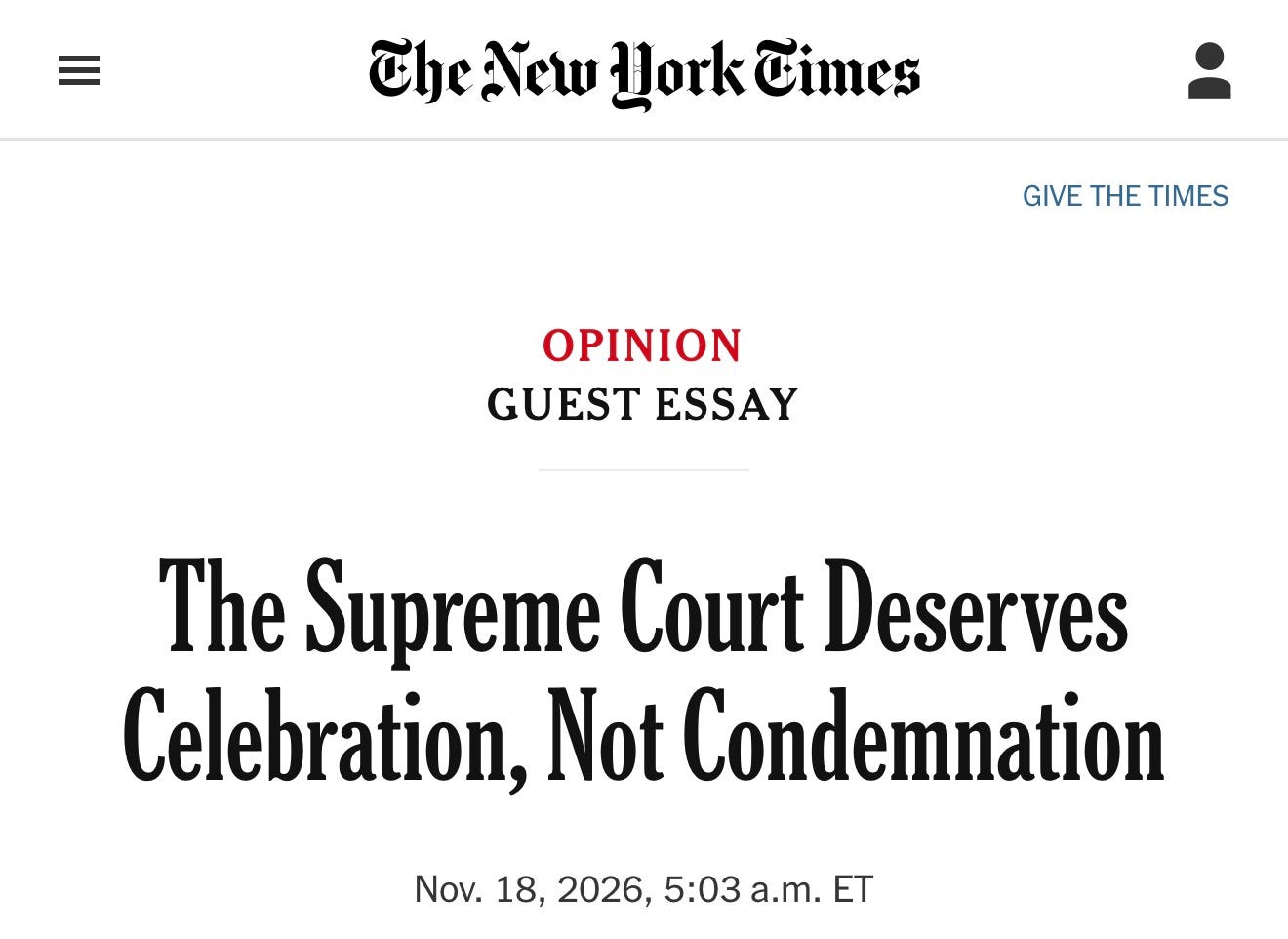
My friend, recurring sparring partner, and University of Chicago law professor Will Baude had an op-ed in yesterday’s New York Times that was originally titled “The Supreme Court Deserves Celebration, Not Condemnation” (the title has since been changed). In a nutshell, Will’s argument is that, judged by the pressure it faced in President Trump’s second term, the Supreme Court has held up remarkably well. It ruled against the president on tariffs, birthright citizenship, the National Guard, and the Federal Reserve, so it deserves praise rather than an overhaul. What’s more, Will argues, reforms driven by anger at particular rulings would just turn the Court into a political weapon for whichever party holds power; any of the Court’s true flaws are better fixed by the justices doing better (they should “try harder,” in Will’s words). At most, modest reforms might be worth it not to fix any particular problem, but to restore public confidence.
As regular readers of this newsletter know well, I actually agree with what I take to be Will’s biggest point—that the wrong kinds of Supreme Court reforms risk permanently damaging the Court (and the courts) as an institution, in ways that will leave our constitutional system worse off than we are today. But I disagree with almost everything Will argues along the way (at least, in this piece) to that conclusion. Indeed, Will’s piece is a useful example of just how unable the Court’s defenders are to admit that anything specific is wrong with the current institution—and also of how many of the defenses of the Court don’t actually engage with criticisms of anything other than the results the justices are reaching.
Will writes that “the Court’s most serious institutional problem” is “its image.” But as I explain below the fold, that confuses the disease for one of its many symptoms. The Court’s most serious institutional problem is its hubris—its increasingly strong belief that it isn’t, and ought not to be, accountable to any other government institution (or, through them, the people), a belief that enables the justices (especially the six Republican appointees) to do whatever they want, whenever they want. Urging the justices to “try harder” as your principal Court reform proposal fails to accept the mounting evidence that too many of the justices see no reason to “try” in the first place.
For those who aren’t paid subscribers, we’ll be back Monday with our regular coverage of the Court (and tomorrow with a special audio bonus). For those who are, please read on.
