

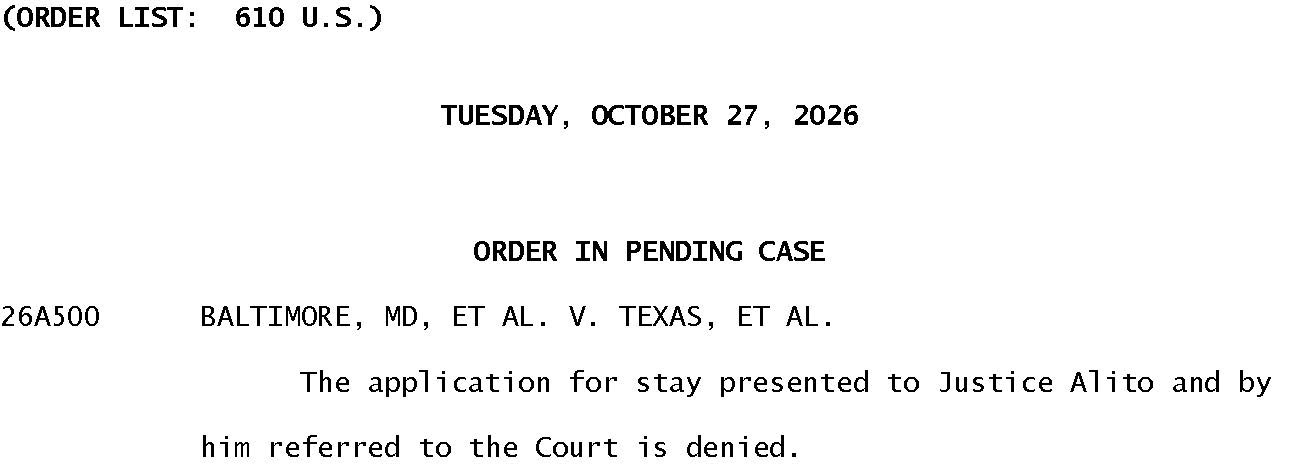
On Tuesday morning, the Supreme Court handed down a one-sentence order denying an emergency application, with no noted dissents, in a case with a strange caption, City of Baltimore v. Texas. The ruling didn’t get a lot of attention, perhaps because the case comes wrapped in some fairly dense immigration court (and appellate) procedure, and perhaps because, for some reason, it took the Court almost a full day to post the order to its website.
But I think the entire dispute deserves a lot more attention than it has thus far received. On June 22 of this year, Texas sued the U.S. Department of Justice in the Wichita Falls Division of the Northern District of Texas (where there was a 100% chance that the suit would be assigned to Chief Judge Reed O’Connor), challenging a 2024 Biden-era rule that allows immigration judges to “administratively close” (that is, temporarily shelve) certain removal cases. Within hours, the two nominal adversaries filed a joint motion asking Judge O’Connor to rule for Texas. He did so that same day, vacating the entire rule nationwide and permanently enjoining the Justice Department from adopting anything like it in the future (yes, this last part is especially wild).
Both sides waived their right to appeal. When three cities and an immigration legal services provider (Centro Legal) tried to step in and defend the rule that no one else would, Judge O’Connor held that they lacked standing. The Fifth Circuit, without a written opinion, declined to disturb any of this. And now the Supreme Court has done the same.
Reasonable people can (and do) disagree about the validity of the Biden-era administrative closure rule. But the way it was eliminated ought to bother just about everyone. The way to get rid of a rule is to rescind it, not to enter into a collusive settlement with a state that challenged it. Federal courts aren’t supposed to be notaries for agreements between parties who want the same thing, and the Supreme Court has said as much for more than 130 years. Four of the current justices have even complained about a milder version of this very maneuver—albeit back in 2022, when the ideological shoe was on the other foot.
And if the whole thing sounds even more familiar, it should: This is the second time in barely a year that the Justice Department, the Texas Attorney General’s Office, and Judge O’Connor have combined to make an arguably valid rule disappear in a single day.
Today’s bonus post explains how we got here, it summarizes why this is both a sequel to last year’s in-state tuition case and something quite different from the “sue and settle” practices Republicans spent the Obama and Biden presidencies decrying, it describes how the lower courts let it happen (and why each step was a problem on its own), and it takes up what, to me, is the hardest question: Why didn’t any of the Democratic appointees publicly dissent from, or at least write with respect to, the Supreme Court’s denial of a stay?
For those who aren’t paid subscribers, we’ll be back (no later than) Monday with our regular coverage of the Supreme Court. For those who are, please read on.
