

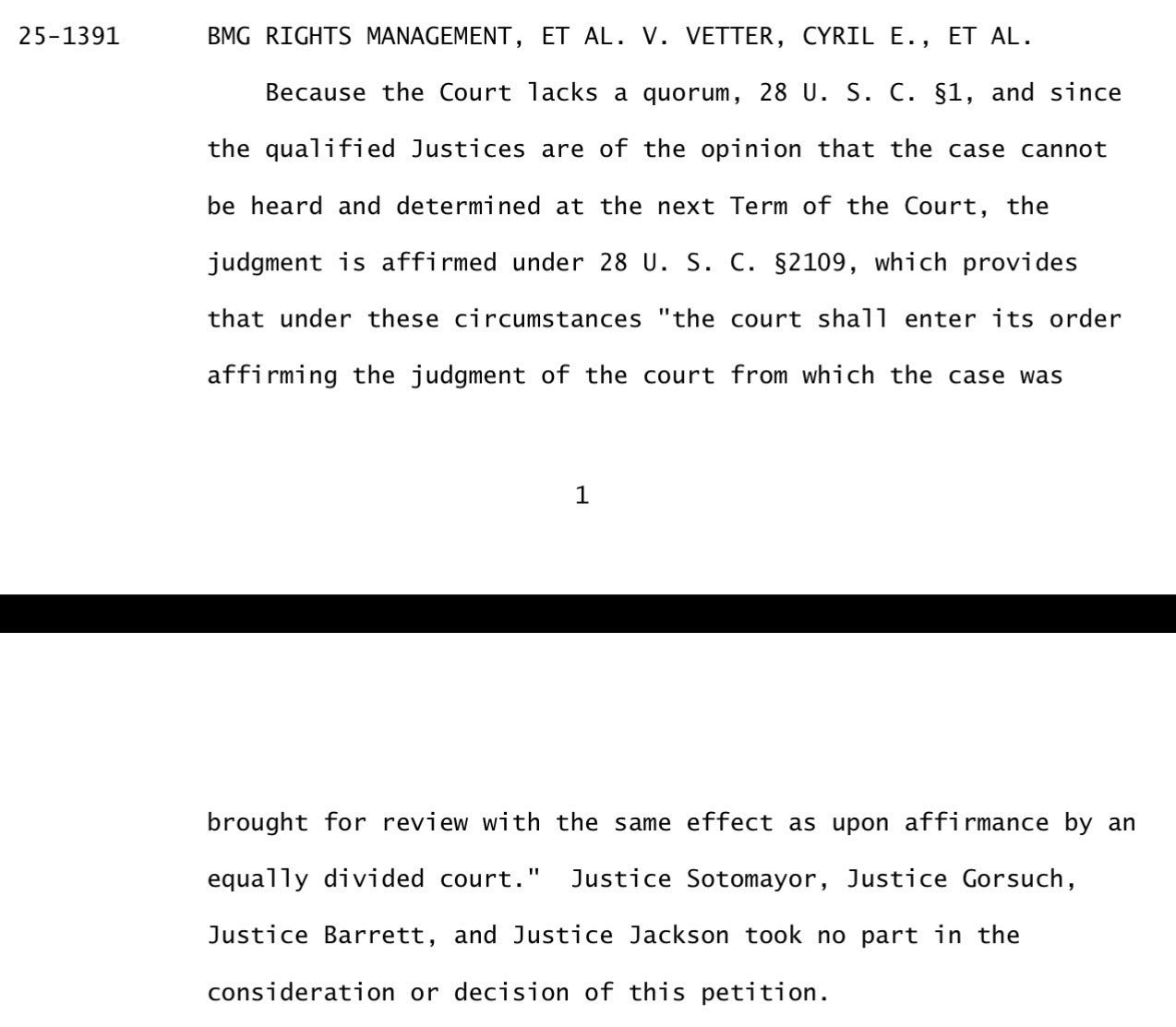
Monday’s regular Order List included an unusual (but not unheard-of) disposition respecting the cert. petition in BMG Rights Management v. Vetter, No. 25-1391. The Court explained that, “Because the Court lacks a quorum, 28 U.S.C. § 1, and since the qualified Justices are of the opinion that the case cannot be heard and determined at the next Term of the Court, the judgment is affirmed under 28 U.S.C. § 2109.” The order also noted that Justices Sotomayor, Gorsuch, Barrett, and Jackson “took no part in the consideration or decision of this petition,” although it didn’t say why.
It turns out that there’s quite a bit to the story of the Vetter case—very little of which has to do with the actual, underlying dispute, which concerns the extraterritorial effects of a copyright holder’s recapture of their rights under the 1976 Copyright Act. Rather, Monday’s “affirmance without opinion,” which has the same practical effect as a denial of certiorari, provides a useful foil for two distinct—but overlapping—topics: First, it’s a good illustration of the problems with the Court’s approach to cases in which the body is structurally inquorate, i.e., when fewer than six justices are available to participate and that’s not likely to change solely with the passage of time. Second, it’s an even better illustration of the problems caused by the number of justices with book deals—especially because four of them (you guessed it—Sotomayor, Gorsuch, Barrett, and Jackson) have published with presses owned by the same European conglomerate.
What Monday’s order drives home is that one specific company has an effective exemption from Supreme Court review of a wide variety of cases in which it’s a party. That reality ought to reinvigorate two different sets of reform conversations—one about ways to provide for more effective (and conclusive) resolution of cases in which more than three justices are recused; and one about ways to insulate against the ethical effects of the justices’ extrajudicial commercial activities. Below the fold, I sketch out what those reforms could—and, in my view, should—look like.
For those who aren’t paid subscribers, we’ll be back (no later than) Monday with our continuing coverage of the Supreme Court. For those who are, please read on.
