

When we talk about the “Bill of Rights” today, we invariably mean the ten amendments that were officially adopted on December 15, 1791—when Virginia became the eleventh state to ratify “articles” that Congress had submitted to the states on September 25, 1789.1 But the First Congress had actually proposed twelve amendments to the Constitution, not ten.
One of the two amendments that wasn’t immediately ratified would have banned Congress from raising its own pay—a proposal that was eventually adopted by three-fourths of the states as the Twenty-Seventh Amendment in 1992. The other un-ratified proposal was the very first “Article” that Congress submitted to the people. And although its language was messy (and would’ve led to an apportionment paradox in the 1820s), its underlying purpose was clear: Congress wanted the size of the House of Representatives to expand in at least loose proportion to the size of the country. The Constitution itself had ensured a minimum size for the House of Representatives (“no more than one Representative for every 30,000 persons”). But it had said nothing beyond that, and a number of the Founders wanted to ensure that the House expanded as the country did.
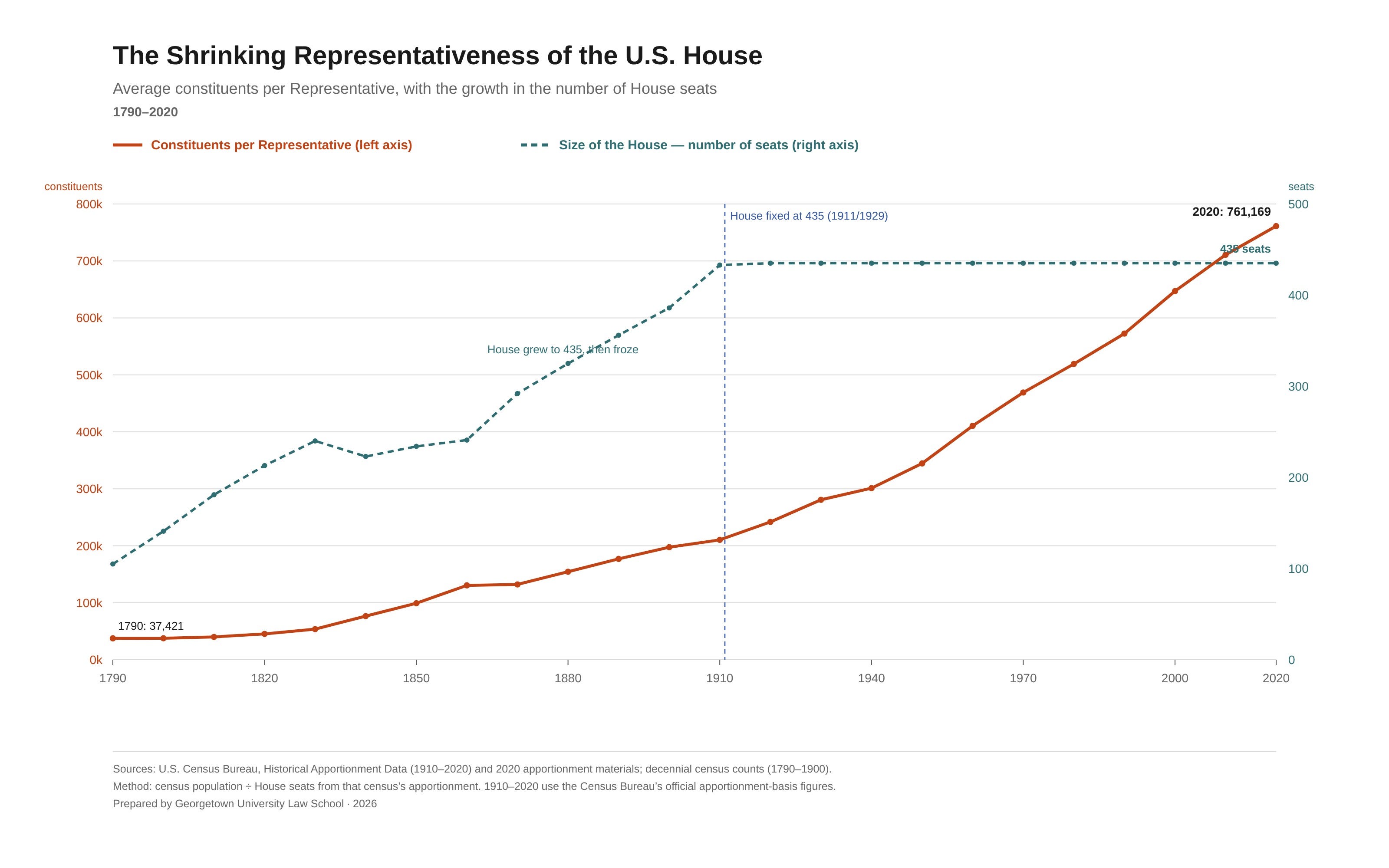
Today, the size of the House of Representatives—435 members—has been fixed since 1911, when the population of the country was 93.8 million people. In other words, we’ve gone from one representative for every 37,000 inhabitants after the 1790 Census to one for every 215,000 inhabitants in 1911 to one for every 788,000 inhabitants today. The average member of the House today thus represents twenty-one times more constituents than their predecessors did when the Bill of Rights was adopted. And those are just averages; two of the 435 districts in the current Congress (Delaware’s at-large district and Idaho’s First District) have more than one million people living in them.
Reasonable minds will disagree about how much bigger the House of Representatives should be. But it shouldn’t be controversial that the House has become wildly un-representative, or that uncapping the House is something we ought to all be able to get behind (even—if not especially—if it’s not obvious whether it benefits Democrats or Republicans more in the short- or long-term). As I explain below the fold, uncapping the House (which could be done through an ordinary statute) would have at least three major virtues: (1) it would increase representativeness—and, thus, local accountability for representatives—even if the ways it does so might not be immediately visible; (2) it would dilute the weight of Senate seats in the Electoral College—which would thus reduce the Electoral College’s problematic bias toward small states; and (3) it would reduce the wild disparities in the size of the House’s current districts, where some districts are nearly twice as populous as others.
There are other positives, too, but these strike me as the most indisputable ones. Had it been adopted, the original First Amendment may not have actually succeeded in producing this result. But it’s long-past time to talk about at least passing a statute to replicate the principle for which it stood.
For those who aren’t paid subscribers, we’ll be back with our regular coverage of the Supreme Court (no later than) Monday. For those who are, please read on.
