

I have spent a good chunk of my professional career criticizing federal judges in print—including, more than once, Judge Reed O’Connor and Judge Matthew Kacsmaryk, to take two recent and prominent examples. A lot of my early career writing was about how the D.C. Circuit of the late aughts and early 2010s, led by three specific judges (one of whom has since been promoted), mucked up the Guantánamo habeas litigation to a fare-thee-well. To drill down on the O’Connor/Kacsmaryk point, I’ve written that plaintiffs (especially Texas and the Trump administration) have chosen their courthouses in order to choose their judges; that some of the resulting rulings were utterly indefensible on the merits; and that the whole enterprise has done real damage to public confidence in the federal courts. And I continue to stand by it.
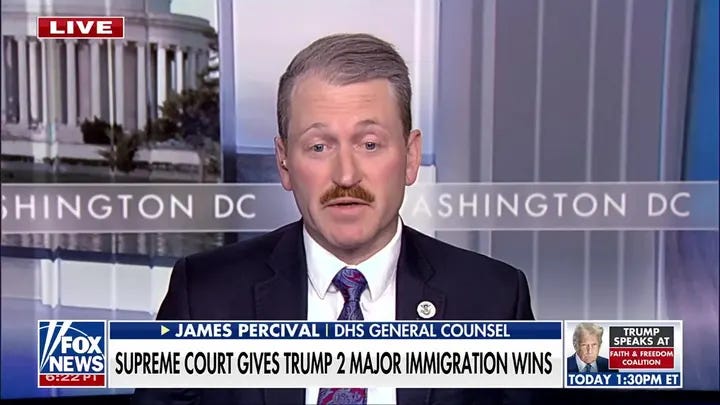
My own work is why I want to take seriously the argument that has been made, with increasing volume over the past week, on behalf of Department of Homeland Security General Counsel James Percival: that what he’s been doing is not meaningfully different from what folks like me have been doing, and that the only difference is whose ox is being gored. Florida Attorney General James Uthmeier put a version of it in a letter to the Florida Bar on Monday: “Criticizing any government official, including the Attorney General of Florida, is not professional misconduct. Judges are no exception.” He’s right about that, but utterly wrong that that’s all that Percival has done. My goal in today’s bonus post is to explain, as carefully as I can, exactly why Percival’s conduct is different in kind, and not just degree, from many of the other criticisms of judges floating out there.
The two key factors, in my view, are what the criticism actually says, and who is saying it. The problem isn’t naming judges; judges sign their opinions (except for Supreme Court rulings on emergency applications, anyway), and naming the author of a ruling you think is wrong is how legal commentary has worked in this country since there were rulings to complain about.
Rather, the problem is two-fold: Percival is a government lawyer, and he’s insinuating bad faith and corruption on the part of the judges he’s naming without any proof. And lest you think the latter is my own subjective criterion, it’s the one Rule 4-8.2(a) of the Florida Rules of Professional Conduct already draws. The rule tolerates harsh criticism; what it forbids is a statement about a judge’s “qualifications or integrity” that the lawyer knows to be false or makes with reckless disregard for its truth. You can call a ruling wrong or even lawless. Telling the world that the judge who issued it was acting in bad faith is a different move, and one any lawyer, but especially a government lawyer, had better have some factual basis for making. And it’s because Percival doesn’t have any proof, and because he holds the job he currently holds, that his comments are so profoundly unprofessional—and warrant our repudiation and colloquial sanction, whether or not they also warrant (and will result in) professional discipline.
For those who aren’t paid subscribers, we’ll be back (no later than) Monday with our continuing coverage of the Supreme Court. For those who are, please read on.
