

On May 26, in an unsigned, five-page per curiam opinion, the Supreme Court summarily reversed the Fourth Circuit in Margolin v. National Association of Immigration Judges, holding that the court of appeals had violated the principle of party presentation when it remanded a federal-employee speech case for fact-finding on a theory that no party had raised.
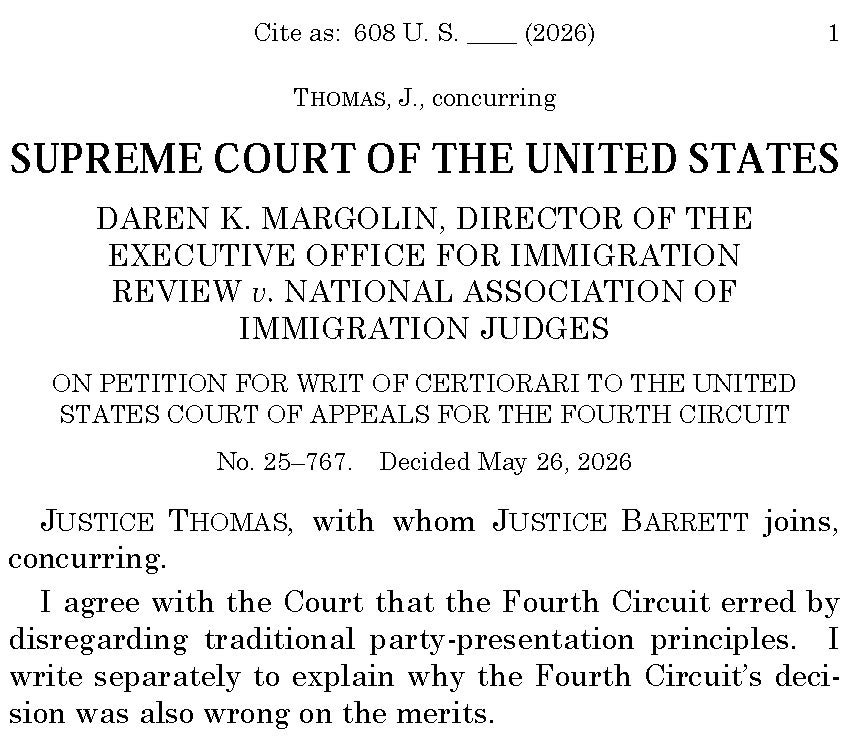
On its face, the Margolin ruling is a narrow, almost technical disposition—the kind of housekeeping reversal that ordinarily gives rise to a decidedly modest news cycle and then disappears. But buried beneath the per curiam decision is something far more consequential: a concurrence by Justice Thomas, joined by Justice Barrett, that would have decided the case on the merits and slammed the courthouse door on the immigration judges’ claims for good. This post is about that concurrence—and, more specifically, about Justice Barrett’s (quite intentional) decision to publicly add her name to it.
Specifically, the post does three things below the fold: First, it explains the discrete question lurking in Margolin: whether a politically controlled and (for much of 2025) inquorate Merit Systems Protection Board (MSPB) remains the exclusive forum for federal employees’ workplace claims, or whether the dysfunction of that forum does and should reopen the doors of the district courts. Second, it situates that question within a much larger family of “channeling” disputes now metastasizing across the litigation against the Trump administration—including, most recently, the Third Circuit’s deeply consequential (and, in my view, flawed) ruling in Khalil v. Trump, and its subsequent denial of rehearing en banc. Third, and finally, it explains why I think Justice Barrett’s willingness to put her name on Justice Thomas’s Margolin concurrence is an important—and, in my view, genuinely ominous—signal for how that whole family of cases is likely to come out. That may not surprise anyone who read her split-the-difference concurrence in the NIH case last August. But precisely because Barrett’s vote is so often the decisive one in these cases, her visible choice to join Thomas here could end up being a very big deal.
For those who aren’t paid subscribers, we’ll be back (no later than) Monday with our continuing coverage of the Supreme Court. For those who are, please read on.
