

Welcome back to the weekly bonus content for “One First.” Although Monday’s regular newsletter will remain free for as long as I’m able to do this, I put much of the weekly “bonus” issue behind a paywall as an added incentive for those who are willing and able to support the work that goes into putting this newsletter together every week. I’m grateful to those of you who are already paid subscribers, and I hope that those of you who aren’t will consider a paid subscription—both to have full access to the bonus content and to more broadly support these efforts—if and when your circumstances permit:
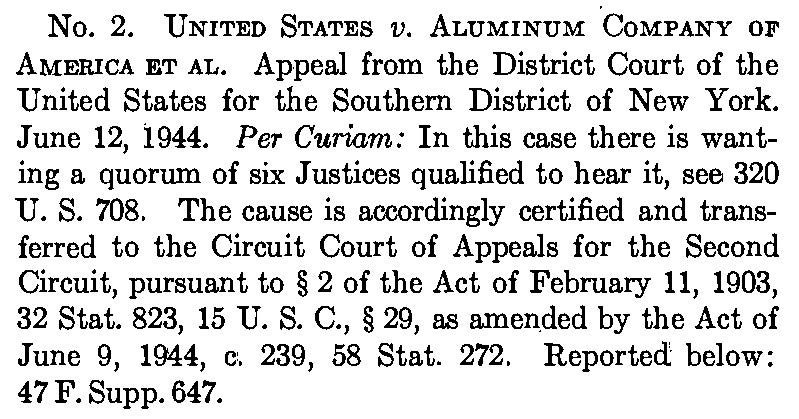
Today’s bonus post was inspired by a colleague at an Inn of Court event last night, who reminded me of one of my favorite obscure (and arcane) nerdy procedural stories about the Supreme Court—the 1940s-era case in which Congress decided to give a specific Second Circuit panel the final say in a landmark antitrust case, at least once it became clear that the Supreme Court lacked a quorum to decide it.
The Second Circuit’s subsequent decision in that case—United States v. Aluminum Co. of America (Alcoa)—remains an important precedent in that field. But the historical precedent for Congress exercising such direct power over a specific case has largely receded from memory—even though the Court today retains the power to follow a similar procedure in cases in which it lacks a quorum, at least if it wants to do so. For structural reasons, that authority almost never comes up.
On one hand, it’s difficult to read too much of a precedent into Congress making some other court “supreme” in the Alcoa case—because that was a case in which the Court had itself already determined that it lacked the power to resolve the federal government’s appeal. On the other hand, it’s a reminder of two broader points I’ve touched on before—that Congress used to be a lot more directly involved in tweaking the Court’s docket where necessary; and that Congress also used to mandate that the Court take particular actions, versus its more modern pattern of giving the justices a ton of power, but almost complete discretion over when and how to exercise it.
It’s not the most important thing you’ll read this week—or even today. But it’s a telling and colorful moment from the Court’s history with at least some contemporary ramifications. (And I can’t make every post about current events!)
For those who aren’t paid subscribers, we’ll be back (no later than) Monday with our regular coverage of the Court (including the Court’s deeply exasperating dispositions of two different qualified immunity appeals earlier this week). For those who are, please read on.
