

Justice Owen Roberts’s decisive vote in West Coast Hotel v. Parrish, which was handed down on March 29, 1937, is known to law professors and generations of law students as “the switch in time that saved nine.” That shorthand, originally expressed by the satirist Cal Tinney (a play on “a stitch in time saves nine”), captured the monumental shifts in the Court’s jurisprudence that Roberts’s surprising about-face in West Coast Hotel heralded. Among lots of other things, those shifts played a major role in sapping the energy behind President Franklin Delano Roosevelt’s Court-packing plan, which he had unveiled seven weeks earlier. As the logic goes, Roberts’s positional “switch,” which would manifest repeatedly in the weeks, months, and years after West Coast Hotel as the Court turned decisively toward the New Deal-era “left,” “saved” a nine-justice Court, if not the Court itself.
We now know that Roberts’s “switch” took place at the justices’ Conference on December 19, 1936, six and a half weeks after Election Day—and before FDR announced his Court-packing plan. But even if FDR’s specific proposal to expand the Court wasn’t the catalyst for Roberts’s change of heart, the Election of 1936 sure seems to have played a significant role. By 1936, FDR was a tremendously popular president. Even though the Supreme Court had reined in a number of his New Deal policies in 1935 and 1936, including several major 5-4 rulings in which Roberts joined the four conservative justices (“the Four Horsemen”) in the majority, those programs remained massive sources of public support, so much so that FDR’s Republican opponent in 1936, Kansas Governor Alf Landon, largely agreed with the central features of the President’s program. In reality, by running on policies the Court had repeatedly struck down, FDR ended up running as much against the Supreme Court in 1936 as he did against Landon. After the Court struck down New York’s minimum wage law for women on June 1, Roosevelt described the ruling as creating a “‘no-man’s-land’ where no Government—State or Federal—can function.”
FDR’s 1936 campaign was a massive success. He won 46 of 48 states (resulting in a rather lopsided 523-8 margin in the Electoral College); received the highest share of the national popular vote since James Monroe’s effectively uncontested re-election in 1820; and swept a number of liberal Democrats into the House and Senate on his coattails. Thus, by November 1936, it was obvious that FDR had a sizeable electoral mandate (reflected in large supermajorities in both chambers of Congress), a significant part of which rested on opposition to the Supreme Court. Confronted with that popular mandate, Roberts—and the Court—blinked.
Fast forward to this morning, and to a question I have yet to see anyone ask after last night’s overwhelming election results: How is this Roberts feeling today?
There’s going to be lots more to say about what the 2026 election results mean for all of our institutions in the weeks and months to come. But today and tomorrow, I want to kick off those discussions with two posts about the midterms and the federal courts, specifically. Today’s post focuses on the Supreme Court; tomorrow’s will pivot to the lower courts. As I see it, the election results raise three questions about the Supreme Court, the answers to which could do quite a bit to shape its future.
Question 1: How Does the Court Reassess Its Relationship With President Trump?
For most of the last two years, the most charitable account of the Court’s bewildering behavior on Trump-related emergency applications has been what I’ve called the “appeasement thesis.” On this view, the Roberts/Kavanaugh/Barrett trio has been picking its battles, granting (mostly unexplained) relief in case after case in order to lower the interbranch temperature and save the Court’s capital for the fights it can’t avoid—so that it could hand President Trump losses on, e.g., tariffs, National Guard deployments, Lisa Cook’s firing, and birthright citizenship.
I never found that defense persuasive, even taken on its own terms. These weren’t one-off disputes; they were a flood of cases. Twenty-five consecutive grants of emergency relief to the Justice Department in 2025 greenlit an unprecedented amount of executive lawlessness and caused enormous real-world harm that subsequent rulings would never have been (and have not been) able to undo.
And appeasement only works when the party being appeased is willing to take the win and stand down. As I argued in The Supreme Court Review, the better account of what the justices were doing was protecting their own supremacy. They pushed back mainly when their mandates were on the line, as in the Alien Enemies Act cases. That approach was always going to be self-defeating, because it emboldened the executive and drained the very credibility the Court thought it was saving. Indeed, just two days ago, the New York Times documented evidence of that dynamic: an administration making routine use of the once-rare emergency docket while skirting court commands, and distrust between the branches spiraling.
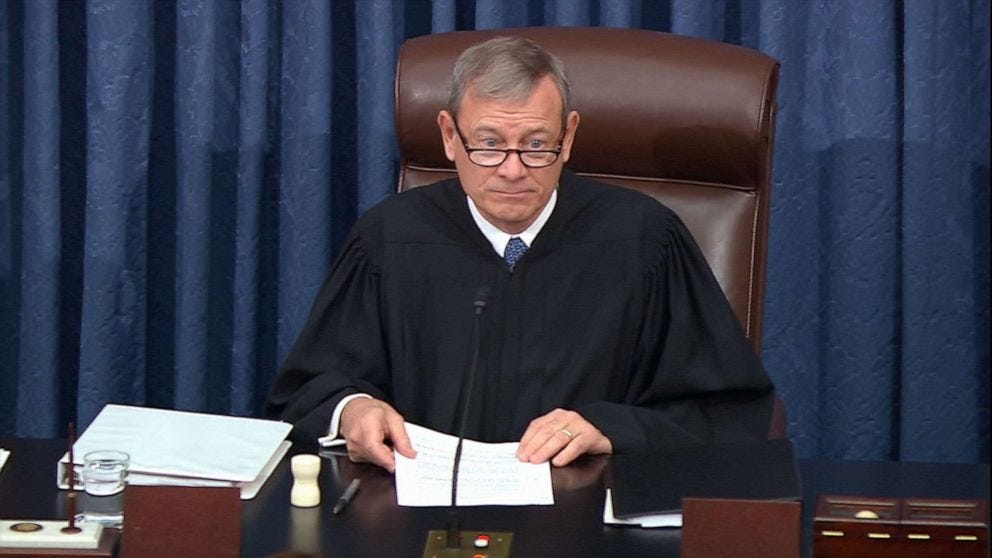
Against that backdrop, last night should flip the entire premise of the appeasement thesis on its head. Democrats resoundingly won control of both the House and the Senate, flipping seven Senate seats (so far) and winning the national House vote by roughly 13 points (according to the New York Times), which would be the largest margin for either party in at least half a century. That result is (correctly, in my view) being read as a decisive rebuke of the President, and (for now) he has said he will accept it. The appeasement thesis always rested, at least implicitly, on the idea that the Court was the only institution standing between the President and his maximal ambitions, so it couldn’t afford to lose (I’ll have some more to say tomorrow about the lower courts’ role in that story). As of January, that won’t be true. A Congress that can investigate, legislate, and use the power of the purse (and impeachment!) will stand between them too. The voters, in other words, just told the justices that the capital they’ve been hoarding is no longer at risk from confronting this President. If anything, it has been at risk from not confronting him—and that risk will only increase between now and January 2029, whether or not Chief Justice Roberts finds himself presiding over another presidential impeachment trial along the way.
Ultimately, whatever the “median” justices told themselves about why they were letting the President win the “small” fights, that rationale didn’t survive yesterday’s results. So will the Court's approach to Trump-related emergency applications shift? And if not, what will that tell us about why it was behaving this way all along?
Question 2: How Much Is the Court Worried About a Democratic Trifecta in 2029?
Beyond the Court’s relationship with Trump is the even bigger question of the Court’s relationship with the new Congress, and the increasingly serious specter of Court reform. Of course, the short-term conversation is still one in which major reform by statute is unlikely; even if a bill could get through a filibuster in the Senate, it’s hard to imagine a veto-proof supermajority in either chamber. More oversight is certainly incoming in the 120th Congress. Beyond that, it’s anyone’s guess.
But last night’s results make a Democratic trifecta in January 2029 significantly more likely. And the justices surely know that Court reform is no longer a niche cause for the Democratic Party’s progressive flank. To the contrary, Leader Schumer has said it will be a priority if Democrats hold both chambers. Leader Jeffries has spoken of “dramatic reform.” Former Vice President Harris and Representative Clyburn have openly endorsed expansion. And Senate Democrats have reintroduced an 18-year term-limits bill.
Whatever one thinks of any of these specific proposals, last night’s margins, including the Democratic Senate wins in Texas, Kansas, and South Carolina; a national House margin of roughly 13 points; and the state-level results as well, all make that agenda look far less hypothetical than it did even a month ago. Even Governor DeSantis is now predicting that Republicans will struggle to win Congress back in 2028. It seems objectively clear that the odds of significant Court-reform legislation passing before this decade is out have increased substantially over the last 16 hours.
So if you’re John Roberts, or Brett Kavanaugh, or Amy Coney Barrett, how worried are you about what a Democratic trifecta might do to the Court in 2029—and how, if at all, does that shape your behavior between now and then? This is why I started today’s post with the “switch in time.” The real lesson of 1937 isn’t that Court-packing failed; it’s that a Court that saw where the country was heading made Court-packing unnecessary—changing its jurisprudence and aligning itself with the democratic (and Democratic) majorities as an exercise in institutional self-preservation.
For justices who are worried about this reality, one response is not just to put your faith in a Trump veto or a Senate filibuster; it’s to refill the “reservoir” of public trust (to borrow Justice Kennedy’s words from a March 2001 budget hearing) that the Court has spent so much of the last decade draining. If, instead, the rest of this Term and the October 2027 Term include more of the same (an ongoing run of 6-3 rulings further shifting our jurisprudential center of gravity to the right), they’ll have no one but themselves to blame for what a unified Democratic government might decide to do about it.
Question 3: Will Thomas or Alito Try to Retire During the Lame Duck Session?
Partly for these reasons, and partly for others, I think the odds that either Justice Thomas or Justice Alito quickly announces his intent to retire so a successor can be rushed through the lame-duck Senate are close to nil, for reasons that are both practical and institutional.
Starting with the practical: On paper, the move is certainly available. The outgoing Republican majority stays in control until the new Senate is seated—although it will lose one seat as soon as Senator-elect Brown is certified as the victor in Ohio (since that was a special election). There are roughly four and a half work weeks on the Senate’s calendar between Election Day and January 3. And Majority Leader Thune said back in July that a lame-duck confirmation “can be done.”
But there are real reasons to doubt it will happen. For starters, the (smaller) lame-duck majority is a different animal than the one we had two days ago. Some of these senators have been turned out of office, or were turned out earlier this year, and have seen their seats get handed to the other party (e.g., Senators Collins, Cornyn, and Tillis). Others may not be too inclined to help President Trump do much of … anything (e.g., Senator Murkowski). What’s more, Justice Alito told Bloomberg just last month that he plans to stay through the current Term even if Democrats won the Senate, adding that “I made that decision many months ago.” And Justice Thomas has long ruled out retiring (and is only about 18 months from breaking Justice Douglas’s record for longest tenure).
And even if it’s politically (and practically) possible, it would be institutionally catastrophic. A justice who has spent years decrying the politicization of the Court would hand his seat to a President the voters just repudiated, via a Senate the voters just repudiated, in a rush that would make the October 2020 Barrett confirmation look leisurely. And all of this from a party that, just 10 years ago, held a seat open for more than a year on the theory that the people should decide. There couldn’t be a more visible confirmation of every critic’s claim that the Court is just partisan politics by other means. Nor is there anything that would do more to more quickly drain whatever is left of the Court’s “reservoir” of public trust.
Beyond triggering one of the most explosive confirmation fights in American history, such a move would also necessarily galvanize even those with unformed or tentative views on Court reform to endorse far more aggressive measures than they might otherwise have ever considered. The question would no longer be whether the Court deserves to be restructured, but whether the other side has left Democrats any choice. Reforms that today seem far-fetched, from expansion to jurisdiction-stripping to much more, would suddenly look like retaliation the Court unambiguously brought upon itself. Folks may have little faith in the Republicans to fear the political consequences of such brazenness, but what about the institutional consequences?
In other words, a lame-duck retirement might secure one more seat for a generation. But it could easily cost the Court far more than that, and the justices who most want to preserve the Court’s supremacy should understand that better than anyone. That, to me, is why I wanted to start and end with Owen Roberts’s switch in time—a history lesson that has relevance far beyond the terms on which the current justices leave the Court. Thanks to last night’s results, it’s a lesson that the justices may need to heed a lot sooner than anyone had expected.
I hope you have enjoyed this extra issue of “One First,” and that, if you’re not already a subscriber, you’ll consider becoming one:
Happy Wednesday, all.
I think both Thomas and Alito have too much ego to retire right now.
As a first shot across the Supreme Court's bow, I'd like to see a mandatory ethics standard imposed though even that might still be out of reach