

Welcome back to “One First,” a newsletter that aims to make the U.S. Supreme Court more accessible to lawyers and non-lawyers alike. I’m grateful to all of you for your continued support, and I hope that you’ll consider sharing some of what we’re doing with your networks.
If you’re not already a subscriber, please consider becoming one—and upgrading to a paid subscription if and when your circumstances permit:
The Supreme Court made plenty of news last week, and we’ll get to that in a moment. But the far bigger headline of the day, it seems to me, is the increasingly transparent, brazen, and disturbing efforts of the Department of Justice to use its authority to preemptively interfere in next Tuesday’s elections. In particular, the last 10 days have seen the filing of two separate lawsuits—one in California and one in Alaska—in which the federal government is taking it upon itself to seek to cast doubt on the results of the elections before people have even finished voting.
Below, I walk through the two lawsuits, what the government’s arguments are, why they are almost certainly destined to fail (the Alaska suit is, in my view, objectively frivolous), and where things stand as of this morning. But the larger point is that the impending judicial rejections and dismissals may not be sufficient. The Department of Justice is putting its formidable thumb on next week’s elections in a way that seems clearly intended to call into question the legitimacy of any result that is especially unfavorable to Republicans—before those results have even come in. These efforts are incredibly dangerous to our democracy—especially to the extent that they are legally baseless. And they ought to be loudly and publicly condemned by anyone who cares seriously about democratic legitimacy.
More on that below. But first, the (SCOTUS) news.
On the Docket
The Merits Docket
Last week’s Order List included two new grants of certiorari (both of which are in fairly significant cases about which I hope to write more later), along with the weird 28 U.S.C. § 2109 affirmance that I wrote about in Thursday’s bonus issue. We also had another Sotomayor/Gorsuch “statement” respecting the denial of certiorari—this time to flag a circuit split over whether and when a state’s exercise of its police power is immune from Takings Clause challenges. It’s a good bet that this issue will make it onto the merits docket in the near future.
Meanwhile, the stakes of the Barbosa da Cunha immigration detention case, which the Court agreed to take up earlier this month (and which I’ve described as the most important case currently on the docket), got even higher on Friday, when the en banc Fifth Circuit, by a 10-7 vote, held that noncitizens have no due process right to a bond hearing pending their removal proceedings, even if they’ve been physically present in the United States for decades. If the justices side with the overwhelming majority of lower courts in Barbosa da Cunha and hold that the relevant statutes require bond hearings in most of these cases, then that will largely moot the significance of the Fifth Circuit’s ruling. But if the Court goes the other way on the statutory question, this (massively important) constitutional question will now be right behind it. (There’s also quite a bit to say about both Judge Ho’s continued auditioning and Judge Oldham’s continued assault on habeas corpus … when there’s time.)
The Emergency Docket
The full Court handed down three rulings on emergency applications, including two that produced public dissents.
On Tuesday, the Court denied a stay of execution, with no public dissents, to Florida death-row prisoner William Reaves;
On Wednesday, the Court denied the Trump administration’s request to allow it to resume denying gender-affirming medical care to transgender federal prisoners. Justices Thomas and Alito noted, but did not explain, their dissents. I’m not as surprised by the outcome here as by the timing—the Court took more than three weeks for a denial with no writing. I wonder if the majority (or the dissenters) had drafted some kind of statement, only to have second thoughts…;
And on Thursday, the Court granted a stay in the New Hampshire student ID case I wrote about last week—with a brief explanation (albeit not an “opinion of the Court”), and over a slightly longer dissent from Justice Jackson. Justice Jackson is, in my view, exactly right that it makes no sense to apply the “Purcell principle” (as the majority did) in a case in which the risk of voter confusion runs entirely in the other direction. Alas, that ship has sailed (which may be why neither Justice Sotomayor nor Justice Kagan publicly joined her).
Meanwhile, we’re still waiting for the Court to rule on the emergency application in the K.M.K. Washington state transgender athlete case. And there’s yet another emergency application from the Trump administration (#43, if you’re scoring at home)—this one seeking the Court’s permission to resume construction of a small section of the “Border Wall” in West Texas. For once, I’m sympathetic to the government on the merits here (TL;DR: I don’t think a lack of statutory authority is the same thing as a constitutional claim)—although I am once again hard-pressed to see how it’s “irreparable” harm for the government to have to wait to continue a non-emergency construction project.
The Week Ahead
No orders are expected today, and the justices are off the bench until next Monday, so nothing formal is anticipated from the Court. That said, it’s hard to imagine we’ll get to next weekend without significant rulings on either pending or new emergency applications.
Miscellaneous
Finally, and further to my renewed efforts to share details on my upcoming appearances, I’ll be participating in five public events this week:
I’ll be in Ann Arbor, Michigan, today for a lunchtime conversation with Professor Leah Litman at the University of Michigan Law School on all things SCOTUS—sponsored by the American Constitution Society;
Tonight at 7 p.m., I’ll be in conversation with Penn State Professor Rachel Shelden about her fantastic new book, The Political Supreme Court: A Forgotten History (due out tomorrow!), at the Connecticut Avenue location of the Politics & Prose bookstore in northwest D.C.;
Wednesday night, I’ll be at the Union League Club of Chicago for what promises to be a fascinating conversation on the current and future state of our constitutional system, part of the Bruno and Sallie Pasquinelli Constitutional Conversations Lecture Series sponsored by the University of Illinois Chicago;
Thursday, I’ll be at Seattle University School of Law at lunchtime for the latest installment of its “Dean’s Luminaries in Law Series” (in my defense, I didn’t name it). The title aside, I’ll be in dialogue with Professor Andy Siegel about my recent work on the Court—including the soon-to-be-published Harvard Law Review Foreword and the slightly less impending book; and
Late Thursday afternoon in Seattle, I’ll be joining Judge Robert Lasnik at the Rainier Club for a conversation about the Supreme Court and the rule of law, sponsored by the Washington Chapter of the American Board of Trial Advocates.
And then, sleep (well, actually, trick-or-treating, then sleep).
The One First “Long Read”: The Offensiveness of DOJ’s California and Alaska Lawsuits
Last Thursday afternoon, the Justice Department filed in federal court in Anchorage one of the dumbest lawsuits by the federal government I’ve ever seen, asking a judge to keep Alaska from certifying its U.S. Senate race, but only if incumbent Republican Senator Dan Sullivan loses. That was a week to the day after the same Department sued California to keep it from counting the mail ballots of roughly 20,000 voters the federal government claims are both (1) “likely” noncitizens and (2) on California’s voter rolls.
On the merits, neither suit is close, for reasons I’ll elaborate upon below. But I don’t think the merits are the point. Most of the hand-wringing this cycle about federal “election interference” has focused on what might happen after the votes are counted. What the Justice Department has done over the past ten days is different. It is asking federal courts, before a single result exists, to bless the reasons it might later give for refusing to accept particular outcomes. For lack of a better term, I’ve been calling it preemptive election interference. And it’s as troubling as it is unprecedented.
California
The California case began with an ultimatum. Earlier this month, Acting Deputy Attorney General Trent McCotter sent letters to California counties, Los Angeles among them, directing them to review a list of names of suspected noncitizens who had supposedly been sent mail ballots. The list came on a thumb drive, with the password on a sticky note, and officials were given 48 hours to vet the names and told not to count those voters’ ballots in the meantime. California refused, and DOJ sued on October 15 in the Central District of California. The complaint describes what DOJ wants as “commonplace election relief when a ballot is called into question.”
It is, of course, nothing of the sort. NPR (correctly) called it unprecedented. And the complaint itself concedes that it “is not practicable or feasible” for the United States to investigate, before the election ends, the thousands of people its own investigators flagged. In other words, DOJ wants the remedy now and promises to come up with the proof later. That’s … not how any of this works.
What’s more, there’s good reason to doubt the proof exists. DOJ has variously described the voters as “likely,” “suspected,” “confirmed,” and “verified” noncitizens, and McCotter has conceded, “We’re not perfect.” In a county review of 200 names, more than half of the targeted individuals weren’t registered to vote at all, and many others were U.S.-born. And as Rick Hasen notes, a DHS list of 16,000 supposedly ineligible Nevada voters fell to zero once the state investigated. The California number has also shrunk: DHS had earlier alleged there were as many as 190,000 noncitizens on the voter rolls.
None of this has slowed the Department down. On Friday, federal prosecutors sent similar letters to at least 18 more California counties, again with a 48-hour deadline, and L.A.’s not-quite-U.S. Attorney Bill Essayli warned that any official who “knowingly processes the ballot of a noncitizen is opening themselves to legal jeopardy.”
Perhaps unsurprisingly, the law is not on DOJ’s side. In their motions to dismiss, California and Los Angeles County argue that 18 U.S.C. § 611, a criminal ban on noncitizen voting, gives the Attorney General no civil authority to tell states how to count ballots, especially when Congress expressly provided such authority in other election statutes. That strikes me as plainly right. And it gets worse for the government, because the National Voter Registration Act (NVRA) bars states from systematically purging voters in the 90 days before a federal election. So DOJ is asking a federal court to order California to do something that Congress has expressly forbidden California to do on its own.
It’s not even clear the order could be carried out; Los Angeles County told Judge David O. Carter that segregating the ballots would require changing multiple software systems during its election freeze, “risking a catastrophic impact” on the infrastructure that runs the whole election. As the county put it, the order DOJ wants “is not merely burdensome; it is logistically impossible.” Once a ballot’s signature is verified, it’s separated from its envelope and mixed with the others, so the relief would reach few ballots anyway.
And yet, when Judge Carter didn’t rule on DOJ’s emergency motion by the October 22 deadline it had requested (instead scheduling a hearing for tomorrow), the Department filed a notice of appeal to the Ninth Circuit, arguing that his silence amounted to a “constructive denial.” Hasen aptly called it “a Hail Mary procedural play in a Hail Mary substantive case.” The problem, of course, is that there’s no order to appeal. As Los Angeles County argued in its motion to dismiss the appeal, what DOJ is really after is a writ of mandamus it hasn’t bothered to ask for by name, ordering a district judge to rule on a motion he has already set for a hearing a few days out. (I certainly agree that a district court refusing to act can amount to a “constructive denial.” But scheduling a hearing within five days of the request for preliminary relief when there’s no overnight emergency hardly seems to qualify as such.)
To be sure, the Ninth Circuit did something I didn’t expect. Rather than dismissing the appeal for want of an appealable order, it ordered responses by noon Saturday, and then heard oral argument yesterday afternoon. But media reports suggest that the argument did not go well for the government before the three-judge panel composed of Judges Mark Bennett and Patrick Bumatay (both Trump appointees) and Gabriel Sanchez (a Biden appointee). In its Saturday brief, California said DOJ’s request “makes no sense, factually or legally,” would “turn the Constitution on its head,” and glosses over the government’s “slipshod, unreliable process” for compiling the list. Although Judge Bumatay may dissent (or at least write separately), I’d expect the Ninth Circuit to dismiss this misbegotten appeal as early as today.
Meanwhile, Judge Carter has (rightly) kept going as if the appeal didn’t exist. He ordered DOJ to file an omnibus reply by 3 p.m. Pacific yesterday, and he has said he will rule on DOJ’s TRO request at the end of Tuesday’s hearing. One way or the other, it’s not hard to imagine this case getting before the Supreme Court by the end of the week.
Alaska
And then there is the absolute bollocks that is the Justice Department’s lawsuit in Alaska. For starters, the “voter confusion” issue has already been litigated in Alaska’s state courts. In June, the state disqualified Daniel J. Sullivan, a retired Petersburg teacher, on the ground that he filed to run for the Senate “with a purpose to confuse or mislead.” But a superior court judge reinstated him, holding that the state’s decision rested on a “previously unstated, ‘good faith’ criteria” found nowhere in Alaska law, and that the state had other tools to address confusion. On June 29, three hours after oral argument, the Alaska Supreme Court affirmed. The ballot now lists the challenger Sullivan with no party, and lists Senator Sullivan as “Registered Republican” and “incumbent”; as Derek Muller put it, officials “went out of their way” to reduce confusion:
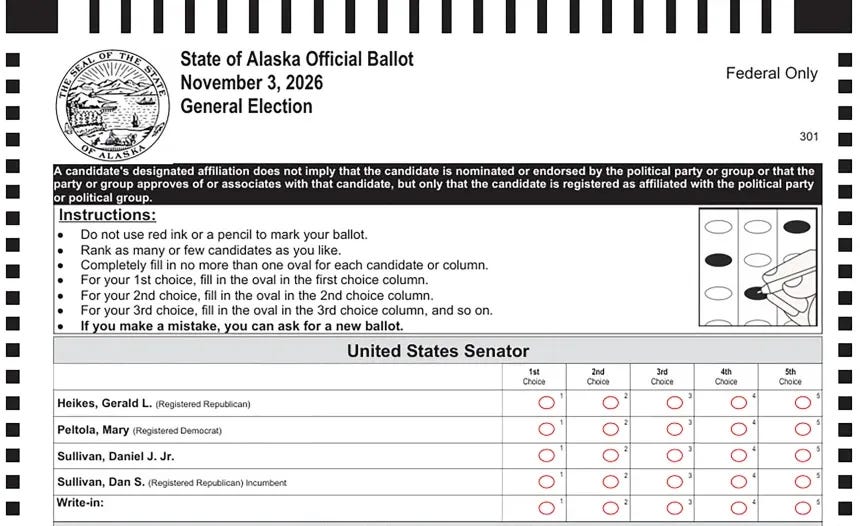
One might also point out that, beyond the ballot design, there are two other ways to ameliorate the risk of confusion. First, there has been so much press coverage of this issue that Alaska’s electorate is well informed about the presence of two Dan Sullivans on the ballot. Second, as the above image underscores, Alaska has ranked-choice voting—meaning someone who is confused can rank the two Sullivans first and second, which, barring some incredibly unlikely scenario, means a vote for the imposter Sullivan will effectively end up as a vote for the incumbent Sullivan. And, not for nothing, but when this same issue arose in the primary, not only did the imposter receive far fewer votes than the margin separating Sullivan from former Rep. Mary Peltola, but it at least appears that many of the votes the other Sullivan did receive came from heavily Democratic precincts.
That’s not to say it’s especially good that the imposter Sullivan is in the race, but holy moly is it not the result-altering fraud being alleged by President Trump—who wrote on Truth Social on Wednesday that it was “ridiculous that the Court didn’t stop this SCAM,” and said his administration was “looking at powerful legal options.” The next day, DOJ sued. And lest there be any doubt about the sequence, the President told reporters on Friday, “Well, I’m the one that said ‘do it.’” According to the New York Times, he pushed for the suit even as some Department officials raised concerns (Attorney General Todd Blanche has since tried to disclaim any external interference).
In a nutshell, the complaint argues that certifying a result “tainted” by Daniel J. Sullivan’s candidacy would mean Alaska had failed in its obligation to protect the integrity of the election. Its putative hook is the NVRA, and specifically that statute’s stated purpose of “protect[ing] the integrity of the electoral process.” It asks the court to bar certification of “any result that may be impacted by voter confusion,” pending an investigation into whether votes for one Sullivan were meant for the other (apparently, the Department of Justice has no recollection of Palm Beach County’s infamous butterfly ballots from 2000).
In other words, per the Department of Justice, a result counts as “impacted” only if the senator loses and would have won had Daniel J.’s votes gone to him (never mind that the complaint doesn’t explain how the government would go about finding out who people meant to vote for). The upshot is that, if the senator wins, nothing happens. If he loses, the result is presumptively suspect. If you wanted a single example of what I mean by preemptive interference, this would be it. On Saturday, Blanche insisted that DOJ isn’t trying to stop certification at all, only to make sure ballots are “preserved” so that Alaska officials can decide whether voters were “confused or mislead [sic].”1 That claim will come as news to whoever drafted the complaint, which asks the court to keep the state from certifying any result “that may be impacted by voter confusion.” Blanche either hasn’t read the complaint—or he has. I’m not sure which is worse.
Regardless, the merits here are just not close. Muller described it as “one of the worst” legal arguments he has ever seen; Michael Morley called it “completely meritless,” since DOJ doesn’t even allege an NVRA violation; a purpose clause is not a cause of action. And the prayer for relief is missing its verb; it never says what DOJ actually wants the court to do. The Cato Institute’s Walter Olson dubbed the suit “abusive” and “nearly frivolous.” I’ll go further: this suit is frivolous, and it ought to be sanctionable. Even if the “risk of voter confusion” were a basis on which the federal government could bring lawsuits (AND IT ISN’T), Alaska’s ballot is … not confusing.
Don’t just take that from me, though; Alaska’s senior senator, Republican Lisa Murkowski, has said the same thing—and also suggested that the suit “should never have been filed.” No kidding. One might say that all of the lawyers involved in the government’s filing should be ashamed, but at this point, shame is a fading spot in the rearview mirror. This lawsuit is heading for dismissal; the question is how much damage it will do before (and after) that inevitability.
Preemptive Election Interference
In one of his posts on these cases, Hasen described them as “press releases masquerading as lawsuits,” noted that DOJ is 0-for-26 in its voter-list suits, and suggested that its “blazing incompetence” puts him “a little bit more at ease.” I agree with every word of that on the merits. Where I’m less sanguine is how much comfort we should take from it, in part because Hasen himself says what worries him most is DOJ interfering with tabulation and certification, “especially in a place like Alaska,” where counts are slow. A lawsuit doesn’t have to be any good to do damage in that setting. It just has to be pending when the count is slow and the margin is close. And three features of these suits make me worry about exactly that possibility.
First, the cause-of-action problems matter well beyond these two cases. The Constitution gives the executive almost no role in running elections, and these suits try to create one. If a criminal statute or a statutory preamble is enough to support an order about how a state counts or certifies its votes, the Justice Department has given itself a roving license to intervene in any election whenever it invokes “integrity.” That’s the precedent these suits are fishing for, and every day that they survive makes the next one easier to file.
Second, there’s the timing. As I noted above, the Supreme Court on Thursday froze a ruling against New Hampshire’s student ID limits on the Purcell theory that federal courts shouldn’t change election rules on the eve of an election. Hasen argues that timing alone, through laches and Purcell, should doom the California request, since DOJ has never explained why it waited until voting was underway to produce its list. The Court’s own words cut the same way. Just last Term, in Bost, it quoted Justice Scalia’s warning from when the Court stayed the recount in Bush v. Gore that “[c]ount first, and rule upon legality afterwards, is not a recipe for producing election results that have the public acceptance democratic stability requires.” DOJ is asking for the inverse: rule first, before anyone has counted. That is, in every respect, worse—precisely because it is assuming there will be mischief rather than responding to actual evidence thereof.
Third, and most importantly, there’s ripeness, which is also why I don’t think losing will cost DOJ very much. Neither suit alleges that anything has gone wrong yet. In most cases, that would be the end of the matter. But a dismissal on ripeness, standing, or cause-of-action grounds is a ruling about the court’s power, not about whether ballots were lawful, and that distinction is easy to blur. After 2020, dozens of threshold rulings against the Trump campaign became part of the fraud narrative (“no court would hear the evidence”) instead of the decisive evidence against it. We’ve already seen a preview this cycle: the President’s response to the Alaska ballot ruling was that it was “ridiculous that the Court didn’t stop this SCAM.” If Chief Judge Sharon Gleason (to whom the case was assigned) dismisses the suit and former Rep. Peltola wins narrowly, it isn’t hard to guess how that will be described: an Obama-appointed federal judge allowed a “rigged” result to be certified over the Justice Department’s objection. Win or lose, DOJ gets its talking point.
The Attorney General says DOJ would seek to block certification only in a “doomsday scenario.” He has also threatened similar suits in “a number of states.” None of those suits, of course, will be on any firmer footing. And so I continue to have confidence in the courts—yes, even this Supreme Court—to not endorse any of this nonsense.
But I keep coming back to the same broader concern—not that DOJ will win these cases, but that a federal government lawsuit against a state’s vote count will stop seeming extraordinary, because by the time it really matters, we’ll already have seen several. Preemptive election interference is a prelude. Its whole point is to have the theories and the filings in place—and the specter of mischief in the air—before the counting starts so that the results can be attacked if, but only if, they don’t come out the “right” way.
That is a deeply sobering depth for the Department of Justice to have sunk to, and it’s one that ought to be loudly condemned not just by those who already think this administration has a casual relationship with the rule of law, but by anyone who still honestly believes that the law does and should matter.
SCOTUS Trivia: A Century of Myers v. United States
Yesterday was the 100th anniversary of Myers v. United States, a massive separation-of-powers ruling handed down by the Supreme Court on October 25, 1926.
Under an 1876 statute, the President needed the Senate’s advice and consent to appoint first-, second-, and third-class postmasters, and also to remove them. President Wilson put Frank Myers in charge of the Portland, Oregon, post office in 1917 for a four-year term. In 1920, Wilson fired him without the Senate’s consent. Myers sued for his back pay. He died while the case was pending, so the suit went forward in his estate’s name. Although the case was initially argued in December 1923, it was reargued in April 1925, and not decided until October 1926.
By a 6-3 vote, the Court ruled against Myers’s estate. Chief Justice Taft—who, not so coincidentally, was the only former President to ever serve on the Court—wrote the opinion. He held that Article II gives the President “general administrative control of those executing the laws,” including the power to remove executive officers. He relied heavily on the “Decision of 1789,” the First Congress’s debate over removal, and on the later political fight over Andrew Johnson and the Tenure of Office Act. The dissents were memorable. Justice Holmes called the majority’s arguments “spider’s webs inadequate to control the dominant facts.” Justice Brandeis wrote that the separation of powers was adopted “not to promote efficiency but to preclude the exercise of arbitrary power.”
For most of the century after Myers was decided, the Court took steps to mitigate its harshest effects—identifying contexts in which Taft’s ambitious and unprecedented reading of Article II could be constrained by Congress, and taking a more functionalist approach to the separation of powers between the legislative and executive branches. But among lots of other things, June’s 6-3 ruling in Trump v. Slaughter reflected the apotheosis of Myers—at the expense of a lot of what had happened since.
So happy birthday, I guess?
I hope that you’ve found this installment of “One First” useful. If you have feedback about today’s issue, or thoughts about future topics, please feel free to e-mail me. And if you liked it, please help spread the word!
If you’re not already a paid subscriber and are interested in receiving regular bonus content (or, at the very least, in supporting the work that goes into this newsletter), please consider becoming one:
This week’s bonus issue for paid subscribers will drop on Thursday. And we’ll be back with our regular content for everyone (no later than) next Monday.
Stay safe out there…
This really is the dumbest timeline.
The DOJ isn't some mythical, non-human creature. Lawyers are bringing these cases trying to overthrow democracy, and it's up to the field of law, law schools, state bar organizations, to stop it, not normal people. We didn't have anything to do with this.
A) The Alaska suit implicitly insults the intelligence of Alaskans, as it assumes the voters there cannot discern what "incumbent" means.
B) The larger question is whether, after all of these frivolous, waste-of-time lawsuits, the DOJ can ever regain the presumptions its lawyers enjoyed before Trump-Bondi-Blanche. After cases like this -- along with the many instances of DOJ lawyers playing "cute" with judicial orders -- it would be understandable for the federal judiciary to start with an initial presumption of bad faith when the DOJ attorneys come into their courtrooms.